Nemotron 3 Ultra. Open, free, a million tokens of context. Below isn't about benchmarks, it's about what this model does easier, simpler, and cheaper than the others, and how to earn from it.

Okay, straight up. I spent a few days running Nemotron 3 Ultra and went in skeptical. Then it clicked: the interesting part isn't the IQ scores, it's that it does things others make expensive and clunky, and it costs pennies doing them. That's what the money play below is built on. Not "another AI report," but something you can't just replicate on ChatGPT.
What actually makes this model better than the others
Before the money, four differences that everything rests on. This is the answer to "why this one."
- A million tokens in one shot. Paste hundreds of pages, a whole folder of documents, or 20 competitor sites in one block. It reads all of it at once and keeps the thread. Cheap models can't do that, the context gets cut off, so you have to build RAG or chop the material into pieces and glue it back by hand.
- Near-zero cost. The free tier on OpenRouter (zero in, zero out, rate-limited) and a pennies paid tier, $0.50 and $2.50 per million tokens. You can run it at volume, even around the clock. An expensive closed model at the same volume would eat all the profit.
- Open weights, runs on your hardware. Download it, stand it up on your boxes, fine-tune it for a niche, and it's yours. Nothing leaves your network. Closed GPT, Gemini, and Claude can't be handed over like that, you can only rent them.
- Fewer hallucinations. On the tests it has the best non-hallucination score in the set, 78.7. For paid reports that's critical, one invented fact costs you a client.
Hold onto those four. Each tier of the play below leans on a specific one.
The money play, built on that edge
The idea: you charge for analyzing big piles of information that competitors on cheap ChatGPT can't swallow in one pass. Your trump card is point 1, the million-token context.
What exactly to sell
Not "a brief on three competitors," anyone can do that. Things that need volume:
- A market map across 15-30 competitors at once, not three.
- A whole document pack: an investor data room, a set of contracts, tender paperwork.
- An audit of an entire review corpus, thousands of them, in one pass.
- A whole codebase or a year of chat and call archives.
The trick is the client dumps everything on you in one block, and you hand back a finished analysis. No RAG, no chunking, no pain.
The working prompt, copy it
1You are a senior market analyst. I will paste raw material on several competitors below (sites, pricing, reviews, report excerpts).23If no material is pasted, ask me for it instead of guessing.4Use ONLY the material I provide. If a fact is missing, mark it "not in source," do not invent it.56Produce:7- a market map (price vs positioning) as a table8- shared customer pain points across all reviews, with how many competitors show each9- white space nobody covers well10- three niches my client could move into, each with a wedge and differentiators11Format: tables and short bullets, no fluff.
Try feeding that to free ChatGPT, it'll truncate or ask you to cut it into parts. Here you paste it all at once, and that's the whole difference.
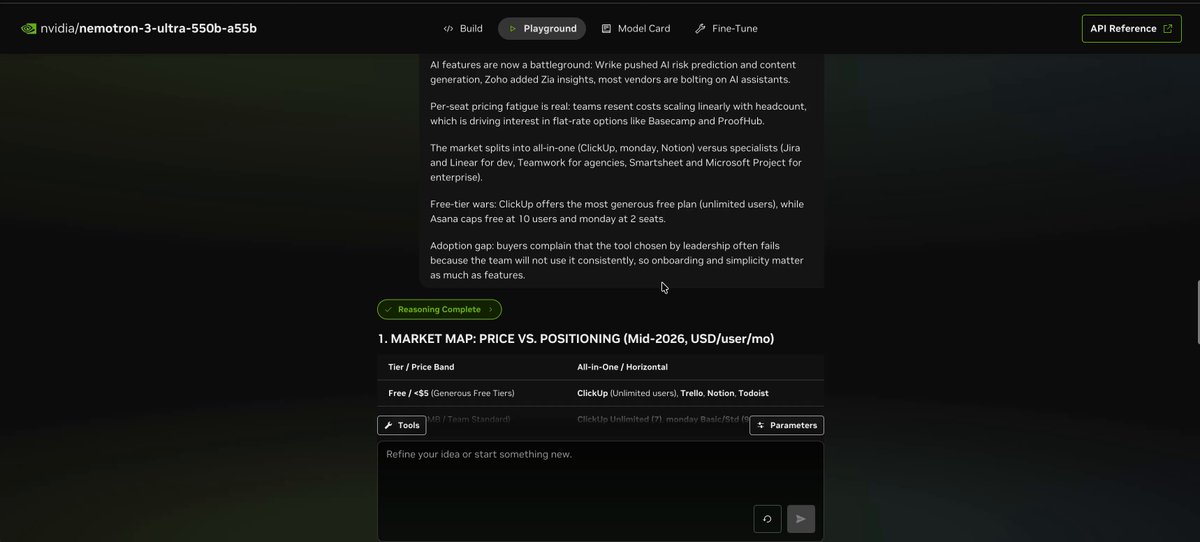
What it costs you
A big analysis like that is roughly 300-800 thousand input tokens and a few tens of thousands out. On the paid tier that's under a dollar, on the free tier zero. Your model cost trends to nothing, that's your edge in numbers.
What people pay for it
Market figures, 2026. Market research on Upwork runs about $25-70 an hour, and a big analysis isn't three hours, it's a full piece of work, so the fee is above a plain brief. Audits and data-room reviews cost more than a simple report. A single retainer client, a monthly subscription, is often $2,000-3,000 a month.

An offer ladder, so it's a business and not a one-off gig
- Tier 1, fast cash. One-off analyses of big piles. Cost is pennies, fee from a hundred to several hundred dollars each. Leans on point 1, context.
- Tier 2, recurring. A subscription to an always-on agent: every night it monitors competitors or the market and emails the client a digest. This only works because tokens are near-free, point 2. A closed model on constant runs would bankrupt it.
- Tier 3, big ticket. Deploying a private, fine-tuned assistant right at the client, for lawyers, clinics, finance, government, anyone who can't send data to the cloud. Only an open model can do this, point 3. This is consulting, the fee is far higher, but so is the bar, you need the skills.
How to start in a day
- Get access: NVIDIA browser playground, https://build.nvidia.com/nvidia/nemotron-3-ultra-550b-a55b, or a key on OpenRouter. A couple of minutes.
- Build one big sample before clients. Take a real niche, feed it a pile of material, package it nicely.
- Go find clients. Upwork: search "competitor analysis," "market research," "due diligence," filter to the last 7 days, 10-15 short proposals a day, sample up front. X: founders constantly ask about competitors, reply with value. Product Hunt: launches from the last month, email founders directly.
- Deliver fast. Speed is your edge, a same-day analysis reads as more valuable.
- Move them up to Tier 2 and 3. After delivery, ask for a review and a contact who needs this too.
The catch, for real
This isn't an income promise, it's market arithmetic plus near-zero cost. What you personally make depends on whether you land clients. The AI freelance market is crowded, reply rates in the AI category on Upwork sit around 5-7%, so sell the result, "a finished analysis by tomorrow morning," not "I use AI." Check quality by hand, the model can get facts wrong. Tier 3 needs real technical skills, it's not for everyone.
So what is this model
Quick version. Most models answer in one shot, an agent plans, reaches for tools, checks itself, and grinds in steps. The longer the chain, the pricier it gets. Nemotron is tuned for the long loop. Under the hood: Mixture-of-Experts (of 550 billion parameters only 55 billion work per token, like a hospital of 512 doctors where only the 22 you need walk in) and Mamba layers in place of most of the Transformer (the cost of each step stays roughly flat, which is where the million tokens without lag come from).

Nemotron 3 Ultra vs Opus 4.8 and the giants

Against the open rivals (Kimi K2.6 at 1T, GLM-5.1 at 754B, Qwen-3.5 at 397B), fair and square: not top of every benchmark, but it wins on speed and reliability. Up to 5.9x faster than GLM-5.1 on long generation, 94.7 recall at a million tokens, best in the set on non-hallucination, 78.7.
Where it falls short
No rose-tinted glasses. On the hardest reasoning and one-shot problems, closed GPT, Gemini, and Opus 4.8 are ahead. On short prompts with heavy input it loses to Qwen-3.5. And it's 550 billion parameters, you won't run it on a laptop, for Tiers 1 and 2 use an API where it's pennies, and Tier 3 is about serious GPUs. For the hardest tasks keep a top closed model nearby.
Where to get it
- Playground: https://build.nvidia.com/nvidia/nemotron-3-ultra-550b-a55b
- API: OpenRouter https://openrouter.ai/nvidia/nemotron-3-ultra-550b-a55b (paid $0.50 and $2.50 per 1M tokens or free with rate limits), Together AI, Nebius, AWS SageMaker JumpStart
- Weights to fine-tune, needs GPUs: https://huggingface.co/nvidia/NVIDIA-Nemotron-3-Ultra-550B-A55B-BF16
- Inside a product: Perplexity on the Pro plan
Where this is all heading
The closed giants still win the demos, but the real work drifts to where it's cheaper and where the data stays under control.
NVIDIA has already pulled together the Nemotron Coalition and is building Nemotron 4.
A powerful tool just arrived at near-zero cost, and the window is open for whoever turns it into a service first.
The smartest AI gets the applause. The cheapest one that works gets paid.


