A signal-native edge computer for droids, mycelium, ecosystems, machines, and AI agents

Computers were built for humans.
They were built to process text, numbers, images, spreadsheets, code, commands, and language. They were built around keyboards, screens, files, operating systems, and networks designed by people for other people. Even the current wave of artificial intelligence is still largely trained on artifacts of human expression: books, websites, papers, conversations, code repositories, images, captions, and videos.
But the Earth does not speak in paragraphs.
Soil does not describe drought in English. Fungi do not announce stress through a chatbot. Trees do not publish telemetry to an API. Ant colonies do not explain their routing logic in JSON. Ocean environments do not label acoustic anomalies for us. Living systems signal through gradients, voltages, gases, pressure, vibration, moisture, heat, chemical change, electrical oscillation, growth, decay, motion, and response.
That is why we built MycoBrain.
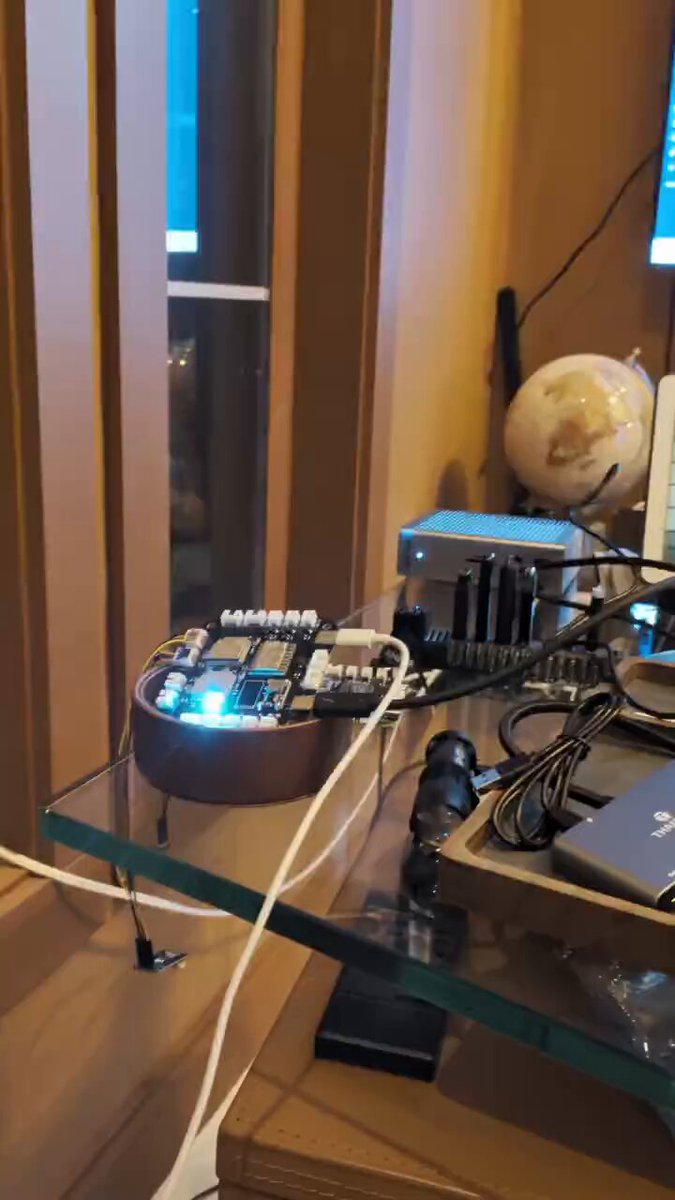
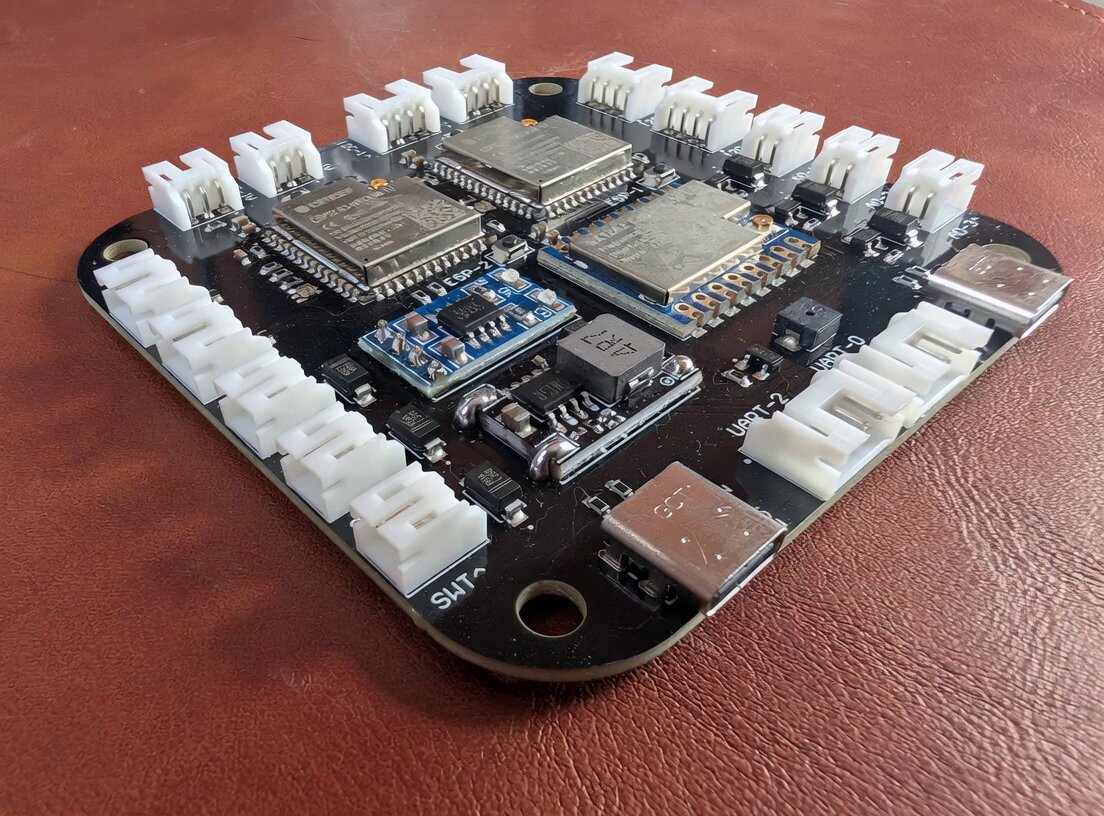
MycoBrain is the core computer inside @Mycosoft environmental droids — the robots, probes, buoys, stations, and biological interfaces we build to live outside, survive outside, learn outside, and operate outside without requiring a human to tell them what to do every moment. It is our shared hardware nervous system: a modular dual-ESP32-S3 sensor and communications motherboard that connects the living world to edge AI, mesh networking, and the Nature Learning Model.
MycoBrain is not just a development board. It is not simply an IoT controller. It is the first computer we are deliberately building for non-human communication: not communication through words, but communication through signal.
The hardware portfolio defines MycoBrain as the shared dual-ESP32-S3 controller platform at the heart of every Mycosoft device, with Side-A handling sensor I/O and Side-B handling LoRa mesh networking. The V1 board is documented as an 85 mm × 55 mm, 45 g PCB using dual ESP32-S3-WROOM modules, four analog inputs, I²C, MOSFET outputs, UART, SX1262 LoRa, and 5–12 V power input.
The reason MycoBrain exists
The current AI industry is building larger and larger models that read the internet. That is useful, but it is not enough.
Language models are trained on representations of reality that have already passed through human perception. A forest becomes a paragraph. A soil condition becomes a note. A fungal stress response becomes a lab observation. A coastal acoustic environment becomes a labeled dataset. By the time the model sees it, reality has already been compressed, filtered, interpreted, and translated.
Mycosoft is building something different.
Our thesis is that the next generation of intelligence must learn from physical reality before it becomes language. The Nature Learning Model, or NLM, is designed around that idea. It is a grounded sensory world model that learns from wavelengths, waveforms, voltages, gas concentrations, temperature gradients, pressure fields, and live biospheric signals rather than only text and images. Its architecture uses an SSM/Mamba backbone, Graph/Hypergraph layers, and Sparse Attention for continuous sensor streams and multi-modal environmental relationships.
That requires a new kind of computer at the edge.
A computer that can sit in soil, air, water, forests, farms, labs, buildings, and oceans. A computer that can read gas resistance, humidity, temperature, pressure, conductivity, pH, bioelectric spikes, hydrophone waveforms, radar returns, LiDAR geometry, camera frames, battery state, and mesh status. A computer that can route those signals to local AI inference on NVIDIA Jetson or M5Stack LLM modules, then synchronize with NatureOS, MINDEX, MYCA, AVANI, FUSARIUM, and the broader Mycosoft stack.
That computer is MycoBrain.
The central design: one brain, many bodies
Every Mycosoft droid has a different body.
Mushroom 1 is built for soil, mycelium, and field sensing. SporeBase is built for bioaerosols, spores, and air sampling. Hyphae 1 is built as a modular industrial sensor and edge compute node. MycoNode is built as a buried subsurface fungal interface. ALARM is built for biological and environmental alerting. Psathyrella is built for maritime acoustic intelligence. Agaric is built as an aerial droid and deployment platform.
Different bodies. Different environments. Different missions.
But they all need the same fundamental nervous system.
They need to collect sensor data, manage power, communicate over mesh networks, buffer data when links fail, synchronize telemetry, expose expansion ports, support firmware updates, and connect to an inference layer. If every device had a completely different motherboard, firmware stack, connector map, and protocol, Mycosoft would become unscalable immediately.
So we built MycoBrain as the reusable internal architecture.
One board family. One firmware lineage. One telemetry vocabulary. One signal pipeline. One scalable manufacturing path.
MycoBrain as the communication and sensor acquisition heart of every Mycosoft device, and identifies its design IP as a dual-MCU architecture with dedicated sensor and router subsystems on a single PCB, plus a UART bridge topology that enables independent firmware updates.
That matters for manufacturing, but it matters even more for intelligence. The whole fleet learns through the same nervous system.
MycoBrain V2: the board we are building around now

MycoBrain V2 takes the V1 concept and expands it into a larger, more capable edge-control board.
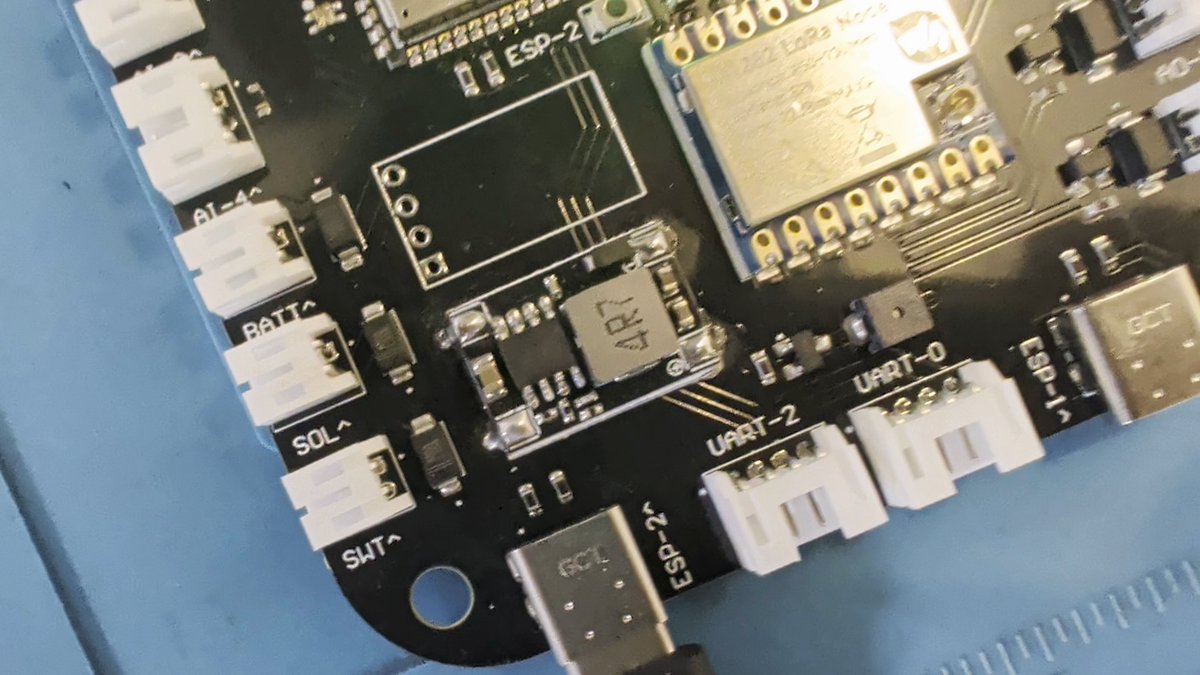
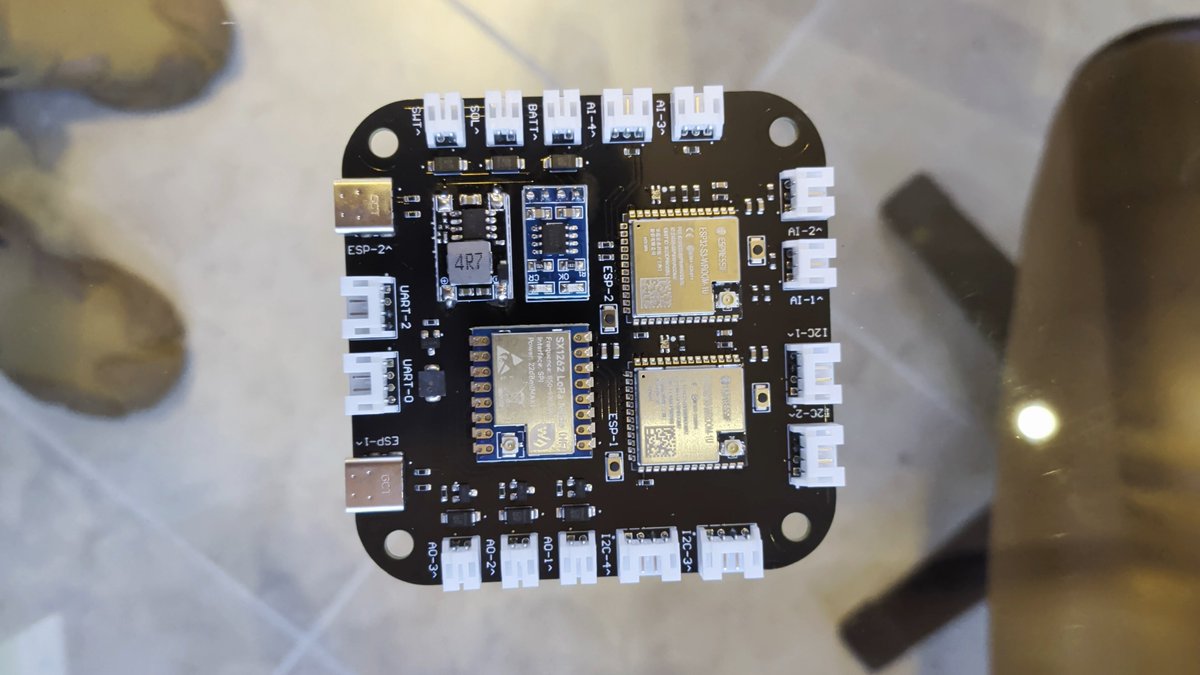
Tarchitecture: two ESP32-S3-WROOM-1U-N16R8 modules, a CORE1262-868M LoRa transceiver, a SIM7600G 26-pin modem header, two USB-C connectors, four analog inputs, four I²C headers, UART0 and UART2 headers, three 5 V outputs, NeoPixel outputs, two buzzers, a 12 V input, and 5 V and 3.3 V rails.
That combination gives us a practical field computer with three jobs.
The first job is sensing. MycoBrain must collect the raw physical state of the environment. That means analog input, I²C sensors, gas sensors, bioelectric probes, external sensor cards, camera/radar/LiDAR expansion through companion compute, battery monitoring, and future modular payloads.
The second job is routing. MycoBrain must move data through a world where WiFi is not guaranteed, cellular is intermittent, and field devices may need to relay through each other. That is why LoRa is built into the core architecture and why Side-B exists as the communication cortex.
The third job is coordination. MycoBrain sits between the biological world and the AI world. It is the board that lets a fungal probe, soil sensor, hydrophone, weather package, LTE module, Jetson, and cloud platform participate in one coherent system.
The board is not trying to be the biggest computer. It is trying to be the most important computer in the body.
Side-A and Side-B: why MycoBrain has two brains
A single microcontroller can run a sensor node. It cannot become the long-term nervous system for a fleet of autonomous environmental droids.
The dual-ESP32 structure exists because sensing and communication are different jobs with different timing, power, and reliability requirements.
Side-A is the deterministic body controller. It is responsible for sensor polling, analog readings, I²C expansion, local actuator control, power monitoring, threshold detection, and safety bounds. Side-A is the part of the system that should remain calm, predictable, and efficient. It reads the physical world with discipline.
Side-B is the communications and routing controller. It manages LoRa, BLE, WiFi, LTE expansion, future modem paths, heartbeat traffic, gateway behavior, and mesh participation. Side-B can spend more energy when communication is needed and sleep or duty-cycle when it is not.
This split makes the architecture robust. If a radio stack locks up, the sensor side can keep collecting. If an experiment requires high-rate sensor sampling, communications can be scheduled around it. If the device is buried, floating, walking, or flying, the same division still makes sense.
A simple mental model looks like t
1 ┌──────────────────────────────┐2 │ Jetson / AI Cortex │3 │ NLM inference, MYCA agents │4 │ local memory, model weights │5 └──────────────┬───────────────┘6 │7 MDP / UART / Bridge8 │9┌────────────────────────────┴────────────────────────────┐10│ MycoBrain │11│ │12│ ┌──────────────────────┐ ┌──────────────────────┐ │13│ │ Side-A ESP32-S3 │ │ Side-B ESP32-S3 │ │14│ │ deterministic sensing │◄────►│ comms + mesh routing │ │15│ │ analog / I²C / power │ │ LoRa / BLE / WiFi/LTE │ │16│ └──────────────────────┘ └──────────────────────┘ │17│ │18└──────────────────────────────────────────────────────────┘
Tcomplexity for its own sake. It is biological thinking applied to embedded systems: specialize the organs, then let the organism coordinate.
The signal-native data model
Traditional AI pipelines look like this:
1Text → Tokenizer → Transformer → Text
MycoBrain exists because nature’s pipeline looks nothing like that.
A fungal stress response may arrive as a voltage fluctuation. A spore event may arrive as particulate count, gas profile, and optical anomaly. A maritime threat may arrive as a pressure waveform in a hydrophone stream. A tree’s stress may emerge as moisture, VOCs, temperature, and mycorrhizal bioelectric response.
So the MycoBrain pipeline starts with physical state:
xt=[Vt,It,Tt,RHt,Pt,VOCt,CO2t,pHt,ECt,At,Mt,Lt,Rt]xt=[Vt,It,Tt,RHt,Pt,VOCt,CO2t,pHt,ECt,At,Mt,Lt,Rt]
Where:
- Vt s voltage or bioelectric potential
- It is current or impedance-derived signal
- Tt is temperature
- RHt is relative humidity
- Pt is pressure
- VOCt is volatile organic compound response
- CO2t is carbon dioxide equivalent or related gas estimation
- pHt is acidity/basicity
- ECt is electrical conductivity
- At is acoustic waveform state
- M is mechanical or motion state
- Lt is light, spectral, or LiDAR-derived geometry
- Ris radio/network state
The Nature Learning Model then learns a latent environmental state:
zt=fθ(xt−k:t,mt,gt)zt=fθ(xt−k:t,mt,gt)
Where xt−k:t is a history window of signals, mt is metadata such as device role and calibration state, and gt is graph context: nearby devices, organisms, geography, weather, topology, or known ecological relationships.
From there, MYCA can propose actions, but AVANI governs whether those actions are safe:

1â_t = action proposed by MYCA2a_t = action actually allowed to execute3π_MYCA = MYCA’s action policy4z_t = current latent environmental state5G_AVANI = AVANI governance gate6∅ = no autonomous action
This is the core of the system: signals become state, state becomes inference, inference becomes proposed action, action passes governance, and the physical world feeds back into the model.
Code view: what a MycoBrain signal frame looks like
A developer should be able to understand MycoBrain as a board, but also as a protocol participant. The device is not merely “sending sensor readings.” It is publishing structured physical evidence.
A simplified signal frame might look like this:
1{2 "frame_type": "MYCOBRAIN_SIGNAL_FRAME",3 "device_id": "mycobrain-v2-0001",4 "device_role": "mushroom1",5 "timestamp": "2026-05-28T00:00:00Z",6 "location": {7 "lat": 32.6401,8 "lon": -117.0842,9 "alt_m": 24.210 },11 "signals": {12 "thermal": {13 "temperature_c": 23.41,14 "relative_humidity": 67.2,15 "pressure_hpa": 1012.816 },17 "chemical": {18 "voc_resistance_ohms": 323410,19 "co2_equivalent_ppm": 612,20 "gas_index": 8421 },22 "bioelectric": {23 "channels": 16,24 "sample_rate_hz": 100,25 "range": "uV-mV",26 "window_ms": 5000,27 "features": {28 "spike_count": 18,29 "dominant_frequency_hz": 3.7,30 "mean_amplitude_uv": 42.631 }32 },33 "mechanical": {34 "vibration_rms": 0.013,35 "orientation": [0.01, -0.04, 0.99]36 },37 "network": {38 "link": "LoRa",39 "rssi_dbm": -103,40 "snr_db": 7.2,41 "mesh_hops": 242 }43 },44 "provenance": {45 "source": "side-a",46 "transport": "MDP",47 "crc16": "0xA81F",48 "hash": "sha256:..."49 }50}
That frame can be routed to a Jetson for local inference, stored locally during network loss, transmitted through LoRa, forwarded through LTE, published into NatureOS, hashed into MINDEX, assessed by NLM, and governed by AVANI.
This is why MycoBrain is not “just hardware.” It is a physical-to-digital grammar.
MDP: the device protocol layer
For MycoBrain to operate across devices, it needs a low-level protocol that is simple enough for embedded microcontrollers but structured enough for a fleet. Internally, that role is handled by MDP, the MycoBrain Device Protocol.
The FUSARIUM architecture describes MDP v2 as a binary transport protocol using COBS encoding and CRC-16 integrity checking, designed for UART and BLE physical transport, with structured message types for observations, alerts, commands, config updates, and heartbeats.
At a conceptual level:
1[ magic ][ version ][ type ][ seq ][ payload_len ][ payload ][ crc16 ]
A firmware loop can stay clean:
1while True:2 # Side-A: deterministic sensing3 raw_signals = side_a.sample_all(4 analog=True,5 i2c=True,6 power=True,7 bioelectric=True8 )910 # Encode into a reliable frame11 frame = mdp.encode(12 message_type="OBSERVATION",13 payload=raw_signals,14 crc16=True,15 cobs=True16 )1718 # Side-B: communications routing19 side_b.route(20 frame,21 preferred_links=["LoRa", "BLE", "WiFi", "LTE"],22 store_and_forward=True23 )2425 # Jetson: optional local inference26 if jetson.available():27 latent_state = nlm.encode(raw_signals)28 decision = myca.propose(latent_state)2930 if avani.gate(decision) == "PASS":31 side_a.execute(decision.action)
This is the embedded version of the Mycosoft philosophy: measure first, infer second, act only after governance.
- a fungal network producing bioelectric oscillations
- a soil microbiome changing conductivity and gas exchange
- a forest responding to drought
- an ant colony altering movement patterns
- a tree exchanging resources through mycorrhizal relationships
- a hydrophone detecting ocean acoustic pressure
- a robot body managing its own power and sensor schedule
- an AI agent requesting evidence from the field
- another MycoBrain relaying telemetry through a meshWhy MycoBrain is built for non-humans
The phrase “the first computer built for non-humans” is not a slogan we use lightly.
We mean something specific.
Most computers assume the primary user is a person. The human types, clicks, speaks, gestures, or taps. Even AI assistants ultimately map the world into human language.
MycoBrain inverts that.
The primary user may be:
- a fungal network producing bioelectric oscillations
- a soil microbiome changing conductivity and gas exchange
- a forest responding to drought
- an ant colony altering movement patterns
- a tree exchanging resources through mycorrhizal relationships
- a hydrophone detecting ocean acoustic pressure
- a robot body managing its own power and sensor schedule
- an AI agent requesting evidence from the field
- another MycoBrain relaying telemetry through a mesh
In that world, language is not the first interface. Signal is.
The FCI white paper defines the Fungal Computer Interface as a two-way communication channel between fungal mycelium and digital computing systems, converting fungal bioelectric and biochemical signals into digital data streams for environmental sensing, data processing, and biological computation.
This is the foundation of MycoBrain’s non-human orientation. The board does not wait for the living world to become text. It meets the living world at the level where life already communicates.
Mycelium as a living signal network
Fungi are not passive material. Mycelium senses and responds.
The FCI materials describe mycelium as a living sensor array that responds to environmental cues such as temperature, moisture, pH, nutrients, toxins, and other stimuli through electrical and chemical signaling. They also describe fungal bioelectric activity, adaptability, and environmental responsiveness as properties that make mycelium useful for sensing and unconventional computation.
A MycoBrain connected to an FCI probe can begin to treat that living tissue as a signal source. Not as magic. Not as mysticism. As instrumentation.
Electrodes read faint bioelectric changes. Analog front ends amplify the signal. Filtering extracts features. ADCs digitize the waveform. Side-A packages the reading. Side-B routes it. Jetson or another accelerator performs inference. NatureOS displays it. MINDEX stores provenance. NLM learns patterns. AVANI governs action.
The system becomes a loop:
1Living substrate → electrode → amplifier → ADC → MycoBrain → NLM → MYCA → AVANI → stimulus → living substrate
That loop is the beginning of biological I/O.
Signal tokenization: beyond words
Language models tokenize text. MycoBrain enables NLM to tokenize signals.
A crude language token might be:
1"wet"
A signal token is different. It may encode a short window of physical dynamics:
τi=Q(ϕi(xt:t+Δt))τi=Q(ϕi(xt:t+Δt))
Where ϕi extracts features from a time window — spike count, frequency, amplitude, slope, phase relationship, gas-resistance delta, temperature gradient, pressure waveform, or cross-sensor correlation — and Q quantizes or embeds those features into a model-usable representation.
A fungal bioelectric token might represent:
1{2 "modality": "bioelectric",3 "window_ms": 5000,4 "dominant_frequency_hz": 2.8,5 "spike_density": 0.31,6 "amplitude_band": "uV",7 "context": {8 "soil_moisture_delta": -0.07,9 "temperature_delta_c": 0.4,10 "voc_shift": 0.1211 }12}
That is not a word.
It is a small piece of reality compressed into machine-learning form.
When enough of those tokens accumulate across devices, environments, organisms, and time, Mycosoft can build models that do not merely describe nature. They learn from nature’s own signals.
The six senses of NLM
MycoBrain is the device-side input layer for a larger model architecture: the Nature Learning Model.
NLM is organized around six physical senses:
NLM sense
Physical domain
Example MycoBrain-connected inputs
Spectral
Light, wavelength, imaging
cameras, multispectral sensors, LiDAR
Acoustic
Pressure waveforms
microphones, hydrophones, vibration
Bioelectric
Biological voltages
FCI probes, mycelial electrodes
Thermal
Heat and gradients
BME688/BME690, IR sensors
Chemical
Gas and molecular signatures
VOC, CO₂, pH, EC, particulate sensors
Mechanical
Pressure, vibration, touch
IMU, strain, seismic, radar-adjacent motion
The capability documents define NLM as a model that learns from raw physical reality and identify these six senses as the signal domains: spectral, acoustic, bioelectric, thermal, chemical, and mechanical. fileciteturn8file12
This is where MycoBrain becomes strategically important. A model that learns from physical reality is only as good as the physical instruments feeding it. MycoBrain is the standardized mouth, nose, skin, ear, electroreceptor, and nervous system connector for that model.
Jetson, Orin, Blackwell, and the edge AI path
MycoBrain is intentionally not trying to be a giant GPU.
It is the low-power acquisition and coordination layer. Heavy inference belongs on edge AI modules. Today that means NVIDIA Jetson Nano, Jetson Orin Nano, Jetson Orin, and related modules depending on device class. In the hardware portfolio, larger devices such as Mushroom 1 and Hyphae 1 use Jetson Orin Nano or Jetson Nano for full edge AI inference, while smaller devices can use the M5Stack LLM Module 8850 for compact GPU/NPU-accelerated inference.
This gives Mycosoft a practical split:
MycoBrain handles low-level sensing, local control, power-aware operation, and mesh communication. Jetson handles AI inference, computer vision, larger models, acoustic classification, local NLM processing, and higher-level autonomy. In maritime deployments, MycoBrain can connect to a Jetson Orin Nano in the same buoy housing to enable real-time NLM acoustic classification at the edge without depending on backhaul.
The roadmap extends this further.
Version 3 adds a cellular expansion path: a 4G/5G-capable SIM module such as a SIM7000/SIM7600-class board positioned as a hat over the LoRa region. That gives MycoBrain cellular backhaul without abandoning LoRa mesh.
Version 4 moves toward direct high-performance expansion: PCIe, underside SSD, local model storage, and direct integration of Blackwell-class or future AI accelerator modules. The goal is to step beyond development boards and place AI accelerators, storage, and sensor orchestration onto Mycosoft-controlled hardware.
That transition matters. Dev kits are how you prototype. Custom AI carrier boards are how you own the platform.
Local storage: memory for the field
A field computer cannot assume constant connectivity.
Forests lose signal. Buoys drift out of range. Droids enter dead zones. Soil probes may be buried in locations where radio is intermittent. Defense deployments may operate in denied environments.
That is why the Mycosoft hardware strategy includes local storage at multiple tiers: NVMe SSDs for large Jetson-equipped devices, microSD for medium devices, ESP32 flash for smaller devices, and local buffers for buried probes.
For MycoBrain V4, SSD support becomes even more important. Local storage means the device can store:
- raw sensor windows
- processed features
- calibration history
- model weights
- NLM embeddings
- event logs
- mesh delivery queues
- cryptographic provenance
- experiment state
A future MycoBrain should not merely stream data. It should remember.
Why the board has so many connectors

A normal consumer device can decide what it is before it ships.
MycoBrain cannot.
One MycoBrain may become a soil station. Another may become a buoy. Another may become an industrial sensor gateway. Another may become a biological interface. Another may become a drone payload. Another may become a handheld environmental AI device. Another may become part of a lab biological computer.
That is why the connector philosophy is aggressive: analog, I²C, UART, USB-C, LoRa, LTE header, 5 V outputs, NeoPixel, buzzers, external sensors, and power rails. The V2 schematic confirms the presence of those connector families, including dual USB-C, analog inputs, I²C headers, UART headers, 5 V outputs, SIM7600G modem interface, 12 V input, and 5 V / 3.3 V rails.
In practice, that lets developers attach almost anything:
- BME688 / BME690 environmental sensors
- VOC and gas sensors
- particulate sensors
- pH and conductivity probes
- soil moisture probes
- hydrophones
- IMUs
- magnetometers
- cameras through companion compute
- radar and LiDAR through companion compute
- FCI electrodes
- actuators
- pumps
- valves
- LEDs
- buzzers
- external modems
- battery monitors
A board like this is not built around a single use case. It is built around the assumption that the environment will keep surprising us.
The droid operating model

Mycosoft calls its outdoor robots droids because they are not just sensors in boxes. They are autonomous machines designed to survive and operate in the world.
A Mycosoft droid has to know its body. It has to know its battery. It has to know whether its sensors are healthy. It has to know whether it should sample faster, sleep longer, relay a neighbor’s packet, wake its Jetson, or call home. It has to operate under solar constraints, radio constraints, thermal constraints, environmental constraints, and ecological constraints.
MycoBrain provides the low-level body intelligence that makes this possible.
Mushroom 1 can use it to monitor underground fungal networks and soil conditions. SporeBase can use it to coordinate bioaerosol collection. Hyphae 1 can use it as a modular industrial I/O controller. MycoNode can use a smaller form to support subsurface bioelectric sensing. Psathyrella can use the architecture for underwater acoustic monitoring. The capability materials describe MycoBrain as the ESP32-S3 edge compute platform for Mycosoft hardware deployments and identify Mushroom 1, SporeBase, Hyphae 1, MycoNode, ALARM, and FCI as part of the hardware lineup.
The point is not that every robot is the same.
The point is that every robot shares a brainstem.
Mesh networking: the digital mycorrhiza
MycoBrain’s network philosophy is inspired by mycelium.
A fungal network does not depend on a single central router. It branches, reconnects, reroutes, explores, and survives damage. Mycosoft’s device networks should behave the same way.
That is the role of the Mycorrhizae Protocol: a pub/sub messaging protocol for routing biological sensor data across distributed field networks. he Mycorrhizae Protocol is optimized for biological data, time-series telemetry, bioelectric waveforms, environmental measurements, self-healing mesh topology, and edge-native operation light enough for ESP32-S3 while still supporting Jetson inference nodes.
A MycoBrain mesh is not only about sending data back to a dashboard. It is about local cooperation.
One droid may detect a signal. Another may have stronger backhaul. A third may have a better sensor angle. A fourth may have local AI compute available. A fifth may be asleep but wake on a neighbor’s event.
This creates a field intelligence network:
1MycoBrain → MycoBrain → Gateway → NatureOS2 ↘ ↕ ↗3 Sensor Relay Jetson4 ↘ ↕ ↗5 NLM / MINDEX / MYCA
When deployed at scale, Myains become more than devices. They become a distributed environmental nervous system.
Developer interface: build on the brain
MycoBrain should be approachable to makers and serious enough for engineers.
A developer working with it should be able to think in roles:
1device:2 id: mycobrain-v2-alpha3 role: mushroom14 side_a:5 mode: deterministic_sensor_controller6 sample_rate_hz:7 environmental: 18 bioelectric: 1009 power: 0.210 side_b:11 mode: mesh_router12 links:13 - lora14 - ble15 - wifi16 - lte_hat17 cortex:18 module: jetson_orin_nano19 tasks:20 - nlm_inference21 - anomaly_detection22 - local_buffering23 - model_update
A sensor can expose itself through a manifest:
1{2 "sensor_id": "fci_probe_01",3 "modality": "bioelectric",4 "channels": 16,5 "units": "microvolts",6 "sample_rates_hz": [10, 50, 100, 500],7 "calibration": {8 "gain": 1000,9 "noise_floor_uv": 0.8,10 "last_calibrated": "2026-05-01"11 },12 "safety": {13 "stimulation_enabled": true,14 "max_stimulus_mv": 300,15 "requires_avani_gate": true16 }17}
This is what makes the board community-worthy. It is a physical platform, but also a programmable ecosystem. A maker can plug in a sensor. A researcher can run a fungal signal experiment. A robotics developer can add a payload. A defense integrator can route encrypted telemetry. An environmental scientist can push data into NatureOS. An AI engineer can train a signal-native model.
Why investors should care
MycoBrain is not a one-off board.
It is a platform primitive.
The investor case is not “we made a cool mushroom PCB.” The investor case is that MycoBrain can become the common edge computer for a full hardware ecosystem: environmental stations, biological probes, bioaerosol systems, industrial edge nodes, underwater buoys, handheld AI instruments, and future biological computers.
The hardware portfolio identifies Mycosoft as building a comprehensive hardware ecosystem for environmental intelligence, biological computing, and fungal network interfaces, spanning Mushroom 1, SporeBase, ALARM, MycoNode, Hyphae 1, Tricorder, Petraeus, and Mushroom 2.
That creates several forms of leverage.
First, manufacturing leverage. A shared controller reduces engineering duplication. Instead of redesigning sensor acquisition and communications for every product, Mycosoft improves one core board family.
Second, firmware leverage. Every device benefits from the same protocol upgrades, security improvements, sensor libraries, OTA mechanisms, mesh improvements, and NLM bridge work.
Third, data leverage. Every device produces signal-native training data that can feed NLM. The more devices deployed, the more valuable the model substrate becomes.
Fourth, platform leverage. MycoBrain connects hardware to NatureOS, MINDEX, MYCA, AVANI, FUSARIUM, and Mycorrhizae. It is the edge layer of a larger software and intelligence system.
Fifth, IP leverage. The M the dual-MCU architecture, firmware stack, Mycorrhizae Protocol, I²C sensor enumeration, and MINDEX chain-of-custody integration as part of the MycoBrain technology/IP stack.
This is how a small board becomes infrastructure.
Why this matters scientifically
The scientific importance of MycoBrain is not that it measures temperature or humidity. Plenty of devices do that.
The scientific importance is that MycoBrain is being designed to collect multi-modal causal context around living systems. A fungal voltage spike by itself is interesting. A fungal voltage spike synchronized with soil moisture, pH, temperature, VOC shift, light level, and stimulus event becomes evidence.
That evidence can become a fingerprint.
That fingerprint can become a model.
That model can become prediction.
That prediction can become a governed action.
This is why FCI matters. The FCI white paper describes the FCI stack as a fungal probe, signal-processing unit, and cloud integration layer that can detect subtle mycelial electrical variations, amplify and filter faint bioelectric signals, and make those signals usable for real-time data analysis.
MycoBrain is the practical field computer that lets those ideas leave the lab.
The future versions: V3 and V4
Version 2 proves the expanded architecture.
Version 3 makes the board more deployable.
The V3 direction is cellular expansion: a 4G/5G SIM module hat that can plug above the LoRa region. LoRa remains the low-power local mesh. Cellular becomes the backhaul. That gives a field droid the ability to operate in a local swarm and still phone home when infrastructure exists.
Version 4 is the more profound transition.
V4 moves toward PCIe, SSD, and direct accelerator integration. The goal is to let MycoBrain-class hardware carry local model weights, store raw and processed datasets, and integrate Blackwell-class or future AI accelerator modules directly into the Mycosoft board ecosystem. The M5Stack LLM 8850 path already gives smaller devices a compact inference tier; V4 extends that philosophy toward a deeper custom AI carrier architecture. The hardware portfolio already defines a two-tier edge compute strategy using Jetson-class modules for larger devices and M5Stack LLM Module 8850 for smaller devices.
The long-term path is clear:
1V1: compact dual-ESP32-S3 + LoRa controller2V2: expanded sensor/comms board with USB-C, analog/I²C/UART, LTE header3V3: cellular hat + LoRa mesh + better remote fleet management4V4: PCIe + SSD + direct AI accelerator integration5V5+: MycoBrain as full biological/robotic edge AI motherboard
The destination is not another dev board.
The destination is Mycosoft’s own autonomous environmental computer architecture.
The board as a bridge between biological and digital computation

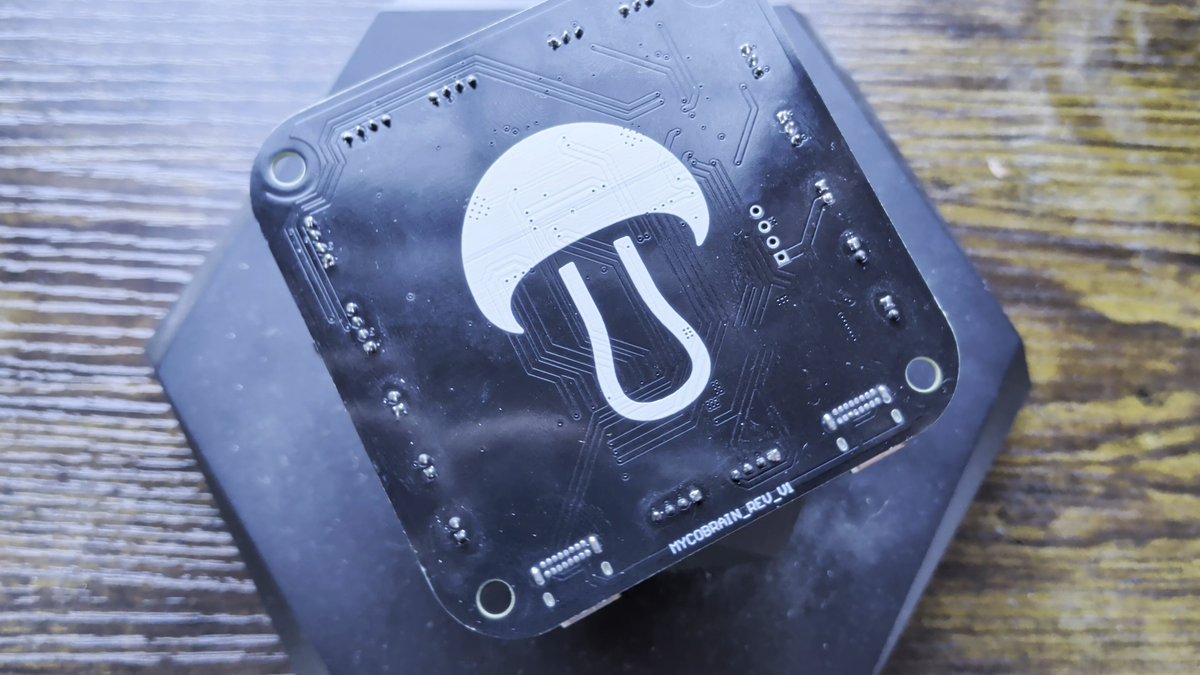
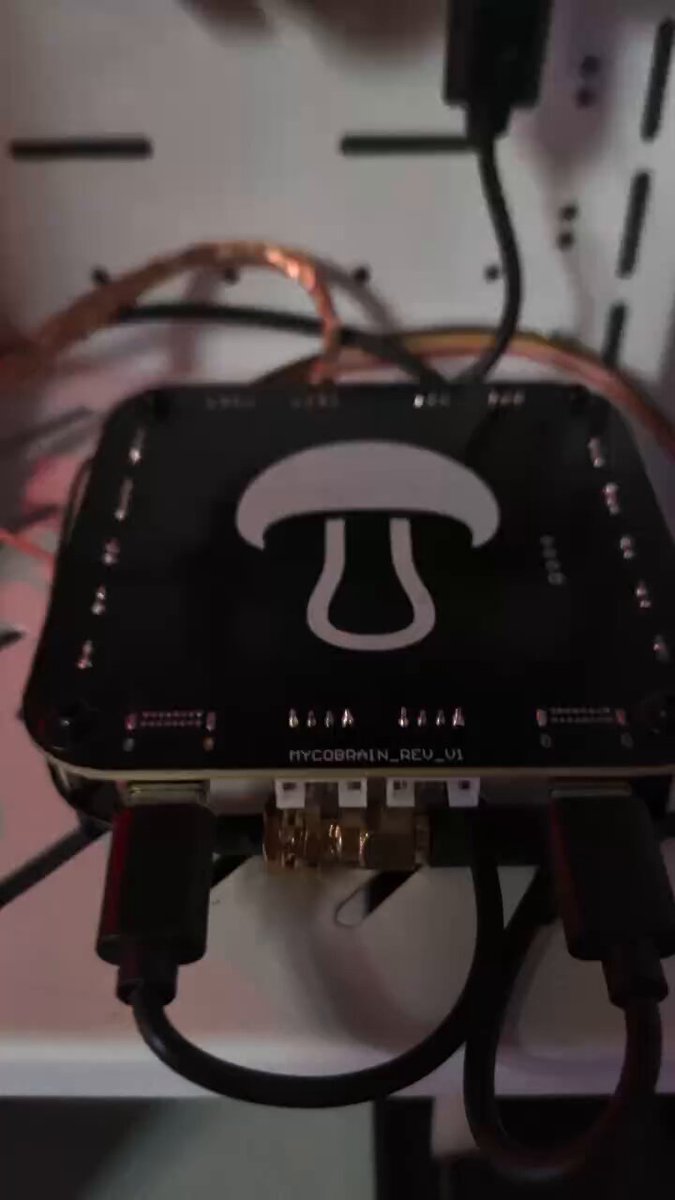
The back of the board carries the mushroom mark because the mushroom is not decoration. It is the design philosophy.
A mushroom is the visible fruiting body of a hidden network. MycoBrain is similar. The board is visible, but the real system is the network behind it: droids, probes, sensors, models, agents, dashboards, datasets, and living substrates.
FCI gives us biological I/O. MycoBrain gives us edge control. Mycorrhizae gives us mesh routing. MINDEX gives us memory and provenance. NLM gives us signal-native learning. MYCA gives us agentic reasoning. AVANI gives us governance.
Together, they form a hybrid biological-digital stack.
1Living Signal2 ↓3FCI / Sensors4 ↓5MycoBrain6 ↓7Mycorrhizae / MDP8 ↓9Jetson / M5Stack / Future Blackwell10 ↓11NLM12 ↓13MYCA14 ↓15AVANI16 ↓17NatureOS / MINDEX / FUSARIUM
A computer that reads the Earth
Most computers sit on desks.
MycoBrain is designed for mud, rain, farms, forests, labs, rooftops, buoys, basements, enclosures, drones, and experimental biological systems. It is designed to be repaired, iterated, 3D-printed around, stacked, expanded, flashed, and redeployed. Mycosoft’s hardware manufacturing philosophy emphasizes 3D printing for rapid iteration and repurposed off-the-shelf enclosures for industrial devices, reducing tooling burden while improving production flexibility.
This matters because Earth-scale intelligence cannot be built from cloud dashboards alone.
We need devices in the world.
We need low-power controllers.
We need mesh networks.
We need local inference.
We need biological interfaces.
We need storage.
We need governance.
We need a way for machines to learn from nature without forcing nature to become language first.
That is MycoBrain.
THE END OF THE VERY LONG MYCOBRAIN DOC
GITHUB: https://github.com/MycosoftLabs/mycobrain
YOUTUBE MYCOBRAIN VIDEO: https://www.youtube.com/watch?v=3WDneg9OHtU
MycoBrain is the first computer we are building for non-humans because it does not assume intelligence begins with words.
It assumes intelligence begins with signal.
- A fungus signals.
- A forest signals.
- A river signals.
- An ocean signals.
- A machine signals.
- An AI agent signals.
- A droid signals.
MycoBrain is the board designed to listen, translate, route, remember, infer, and respond.
Most AI will continue to read the internet, especially its own synthetic data.
MycoBrain read the earth, considering its trillions and trillions of life forms as users, transcending the keyboard, the mouse and even the voice operated agent assistants with the pretty voices.
Its not all about you, but you are part of the entire planet of life.
Dont forget that.


