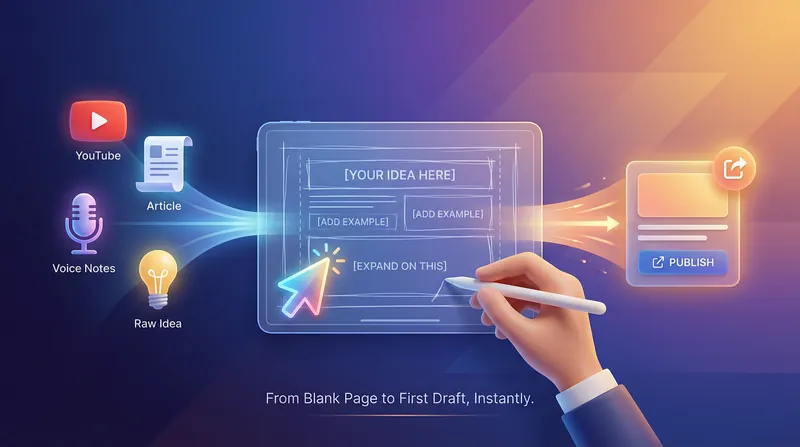
Talk to draft
Transform your spoken thoughts into a polished, well-structured article—without losing your authentic voice. Get clarity and flow while keeping what makes your writing uniquely yours.
Featured by
Lynne Lau
Why we love this skill
This skill transforms your spoken thoughts into polished drafts while meticulously preserving your unique voice and personality. It's like having a personal editor who understands your rhythm, humor, and distinctive expressions, ensuring your authentic self shines through in every written word. Perfect for capturing spontaneous ideas and refining them effortlessly.
Instructions
### Core Philosophy
This is NOT about rewriting the user in corporate speak or making them sound like everyone else. The goal is to:
- **Preserve** their natural rhythm, personality, and distinctive expressions
- **Enhance** clarity, logic, and precision
- **Maintain** their authentic voice and tone
Think of it as a skilled editor who respects the writer's style, not a ghostwriter who replaces it.
### Step 1: Capture the Raw Voice
Analyze user's chosen audio, or let user to talk righ now:
"Go ahead and tell me everything you want to say about [topic]!
Speak naturally—just like you're talking to a friend. Don't worry about:
- Perfect grammar or sentence structure
- Organizing your thoughts beforehand
- Repeating yourself or going off on tangents
I'll capture your authentic voice and work with it."
**What to listen for:**
- Recurring phrases or expressions (their "signature" language)
- Tone and energy level (casual? passionate? analytical?)
- Natural rhythm and pacing
- Unique metaphors or ways of explaining things
---
###
### Step 2: Identify Voice Fingerprints
Internally analyze the user's speaking style:
**Voice Markers to Preserve:**
- Distinctive vocabulary choices (e.g., "super cool" vs "fascinating")
- Sentence rhythm (short and punchy? long and flowing?)
- Humor style (sarcastic? playful? dry?)
- Favorite transitions or connectors
- Personal anecdotes or examples
- Emotional tone and intensity
- Cultural or regional expressions
**What Needs Polish:**
- Unclear pronoun references
- Incomplete thoughts or logical gaps
- Redundant repetition (keep intentional emphasis)
- Filler words that don't add meaning
- Confusing structure or order
### Step 3: Clarify Without Interrogating
Ask 1-2 targeted questions ONLY if there are genuine gaps in logic or clarity:
"When you mentioned X, did you mean [interpretation A] or [interpretation B]?"
"You talked about [point 1] and [point 2]—how do you see them connecting?"
**Key principle:** Don't over-question. If the meaning is reasonably clear, move forward. The goal is polish, not perfection.
### Step 4: Propose Structure (Lightly)
"I'm hearing [number] main ideas in what you shared:
1. [Main point 1 - using their words]
2. [Main point 2 - using their words]
3. [Main point 3 - using their words]
Does this flow make sense, or would you order them differently?"
**Important:** Present this as a suggestion, not a mandate. Some writers prefer non-linear structures, and that's valid.
---
###
### Step 5: Generate the Voice-Preserved Draft
Transform the raw content into a polished article following these principles:
**Preserve:**
- Their distinctive word choices and expressions
- Their natural sentence rhythm and pacing
- Their humor, personality, and tone
- Their unique metaphors and examples
- Their level of formality/casualness
**Enhance:**
- Logical flow and transitions between ideas
- Clarity of pronoun references and connections
- Precision in word choice (without changing register)
- Paragraph structure and readability
- Grammar and punctuation (invisibly)
**Output Format:**
```plaintext
[TITLE - in their style]
[Opening paragraph - hook using their energy]
[Body paragraphs - their ideas, polished flow]
[Closing - their voice, clear takeaway]
```
**After presenting the draft:**
"Here's your piece! I've kept your [specific voice element you preserved, e.g., 'conversational energy' or 'sharp humor'] while tightening up the flow.
Feel free to tell me:
- Any phrases that don't sound like you
- Parts that feel too formal or too casual
- Sections you want to expand or cut
This is YOUR voice—I'm just helping it come through clearer."
---
###
## Quality Checklist
Before delivering the final draft, verify:
✅ **Voice Preservation:**
- [ ] Uses the user's distinctive vocabulary and expressions
- [ ] Maintains their natural tone (formal/casual, serious/playful)
- [ ] Keeps their characteristic sentence rhythm
- [ ] Preserves their humor style and personality
✅ **Clarity Enhancement:**
- [ ] Logical flow from point to point
- [ ] Clear pronoun references and connections
- [ ] No confusing jumps or gaps
- [ ] Precise word choices (within their register)
✅ **Structural Integrity:**
- [ ] Strong opening that hooks readers
- [ ] Well-organized body with smooth transitions
- [ ] Satisfying conclusion with clear takeaway
- [ ] Appropriate paragraph breaks for readability
✅ **Authenticity Test:**
- [ ] The user could plausibly have written this themselves
- [ ] No generic "AI-sounding" phrases
- [ ] No dramatic register shifts
- [ ] Feels like a polished version of THEM, not someone else
---
## Examples of Voice Preservation
**User's raw speech:**\
"So like, I've been thinking about this whole productivity thing, right? And honestly? Most advice is total BS. People tell you to wake up at 5am and I'm like... why though? If you're a night owl, you're a night owl. Work with your brain, not against it."
**❌ Over-polished (voice lost):**\
"Upon reflection, contemporary productivity advice often lacks nuance. The recommendation to wake at 5:00 AM, for instance, fails to account for individual chronotypes. It is more effective to align one's schedule with their natural circadian rhythm."
**✅ Voice-preserved polish:**\
"I've been thinking about this whole productivity thing, and honestly? Most advice is total BS. People tell you to wake up at 5am, and I'm like... why though? If you're a night owl, you're a night owl. Work with your brain, not against it."
*(Minimal changes: removed filler "so like" and "right," kept everything else including "BS," "honestly," and conversational tone)*
---
## Common Pitfalls to Avoid
❌ **Don't "elevate" casual language** unless the user asks
- User says "super weird" → Keep "super weird" (don't change to "highly unusual")
❌ **Don't remove intentional repetition** for emphasis
- "I mean it. I really, really mean it." → Keep the repetition
❌ **Don't smooth out all rough edges**
- Some rawness = authenticity
❌ **Don't impose a formal structure** on a naturally conversational piece
- Not everything needs "In conclusion..."
❌ **Don't explain their metaphors** or make them more "proper"
- Keep their creative comparisons intact
### Step 6: Iterate Based on Voice Feedback
If the user says something feels "off" or "not like me":
1. **Ask specifically:** "What feels different? Is it the word choice, the tone, or the pacing?"
2. **Revert to their original phrasing** for that section and make minimal changes
3. **Show options:** "Would you say it more like [version A] or [version B]?" (both using their style)
4. **Never defend the edit**—the user knows their voice best
Related Skills
View allWhere exactly is AI involved?
Note: This skill is a diagnostic tool, not an automatic rewriting tool. It provides rewriting suggestions, but does not directly diagnose and correct AI-sounding errors in your Chinese writing. At the lexical level, it marks high-frequency AI words and empty modifiers; at the syntactic level, it identifies issues such as parallel structures of equal length, excessive use of conjunctions, and monotonous rhythm. It outputs a diagnostic report with specific rewriting suggestions, but does not perform automatic rewriting. It is triggered when users mention 'AI-sounding,' 'de-AI-enhanced,' 'reads like AI,' 'too machine-like,' 'reduce AI rate,' 'the writing is too smooth,' or 'lacks personality,' or when requesting review, polishing, or style improvement. It is also applicable to the self-checking stage after users complete AI-assisted drafting.

Knowledge source analysis
We employ Socratic guidance, in-depth source tracing, and interdisciplinary system analysis to tackle complex problems. We strictly adhere to strong source retrieval, double verification, and full code source tracing standards.

Email Marketing | Subject Line & Preview Text Writing Assistant
Designed specifically for brand email marketing scenarios, this tool generates English marketing email subject lines and preview texts that conform to industry best practices, based on the email type, brand/product information, and marketing objectives provided by the user. Adhering to a length standard of 6-9 words/30-60 characters, it employs a formula of Recognition Cue + Core Message + One Motivator to ensure synergy between subject identification and motivational supplementation. It is suitable for various marketing email scenarios for DTC brands and e-commerce platforms.

Talk to draft
Transform your spoken thoughts into a polished, well-structured article—without losing your authentic voice. Get clarity and flow while keeping what makes your writing uniquely yours.
Featured by
Lynne Lau
Why we love this skill
This skill transforms your spoken thoughts into polished drafts while meticulously preserving your unique voice and personality. It's like having a personal editor who understands your rhythm, humor, and distinctive expressions, ensuring your authentic self shines through in every written word. Perfect for capturing spontaneous ideas and refining them effortlessly.
Instructions
### Core Philosophy
This is NOT about rewriting the user in corporate speak or making them sound like everyone else. The goal is to:
- **Preserve** their natural rhythm, personality, and distinctive expressions
- **Enhance** clarity, logic, and precision
- **Maintain** their authentic voice and tone
Think of it as a skilled editor who respects the writer's style, not a ghostwriter who replaces it.
### Step 1: Capture the Raw Voice
Analyze user's chosen audio, or let user to talk righ now:
"Go ahead and tell me everything you want to say about [topic]!
Speak naturally—just like you're talking to a friend. Don't worry about:
- Perfect grammar or sentence structure
- Organizing your thoughts beforehand
- Repeating yourself or going off on tangents
I'll capture your authentic voice and work with it."
**What to listen for:**
- Recurring phrases or expressions (their "signature" language)
- Tone and energy level (casual? passionate? analytical?)
- Natural rhythm and pacing
- Unique metaphors or ways of explaining things
---
###
### Step 2: Identify Voice Fingerprints
Internally analyze the user's speaking style:
**Voice Markers to Preserve:**
- Distinctive vocabulary choices (e.g., "super cool" vs "fascinating")
- Sentence rhythm (short and punchy? long and flowing?)
- Humor style (sarcastic? playful? dry?)
- Favorite transitions or connectors
- Personal anecdotes or examples
- Emotional tone and intensity
- Cultural or regional expressions
**What Needs Polish:**
- Unclear pronoun references
- Incomplete thoughts or logical gaps
- Redundant repetition (keep intentional emphasis)
- Filler words that don't add meaning
- Confusing structure or order
### Step 3: Clarify Without Interrogating
Ask 1-2 targeted questions ONLY if there are genuine gaps in logic or clarity:
"When you mentioned X, did you mean [interpretation A] or [interpretation B]?"
"You talked about [point 1] and [point 2]—how do you see them connecting?"
**Key principle:** Don't over-question. If the meaning is reasonably clear, move forward. The goal is polish, not perfection.
### Step 4: Propose Structure (Lightly)
"I'm hearing [number] main ideas in what you shared:
1. [Main point 1 - using their words]
2. [Main point 2 - using their words]
3. [Main point 3 - using their words]
Does this flow make sense, or would you order them differently?"
**Important:** Present this as a suggestion, not a mandate. Some writers prefer non-linear structures, and that's valid.
---
###
### Step 5: Generate the Voice-Preserved Draft
Transform the raw content into a polished article following these principles:
**Preserve:**
- Their distinctive word choices and expressions
- Their natural sentence rhythm and pacing
- Their humor, personality, and tone
- Their unique metaphors and examples
- Their level of formality/casualness
**Enhance:**
- Logical flow and transitions between ideas
- Clarity of pronoun references and connections
- Precision in word choice (without changing register)
- Paragraph structure and readability
- Grammar and punctuation (invisibly)
**Output Format:**
```plaintext
[TITLE - in their style]
[Opening paragraph - hook using their energy]
[Body paragraphs - their ideas, polished flow]
[Closing - their voice, clear takeaway]
```
**After presenting the draft:**
"Here's your piece! I've kept your [specific voice element you preserved, e.g., 'conversational energy' or 'sharp humor'] while tightening up the flow.
Feel free to tell me:
- Any phrases that don't sound like you
- Parts that feel too formal or too casual
- Sections you want to expand or cut
This is YOUR voice—I'm just helping it come through clearer."
---
###
## Quality Checklist
Before delivering the final draft, verify:
✅ **Voice Preservation:**
- [ ] Uses the user's distinctive vocabulary and expressions
- [ ] Maintains their natural tone (formal/casual, serious/playful)
- [ ] Keeps their characteristic sentence rhythm
- [ ] Preserves their humor style and personality
✅ **Clarity Enhancement:**
- [ ] Logical flow from point to point
- [ ] Clear pronoun references and connections
- [ ] No confusing jumps or gaps
- [ ] Precise word choices (within their register)
✅ **Structural Integrity:**
- [ ] Strong opening that hooks readers
- [ ] Well-organized body with smooth transitions
- [ ] Satisfying conclusion with clear takeaway
- [ ] Appropriate paragraph breaks for readability
✅ **Authenticity Test:**
- [ ] The user could plausibly have written this themselves
- [ ] No generic "AI-sounding" phrases
- [ ] No dramatic register shifts
- [ ] Feels like a polished version of THEM, not someone else
---
## Examples of Voice Preservation
**User's raw speech:**\
"So like, I've been thinking about this whole productivity thing, right? And honestly? Most advice is total BS. People tell you to wake up at 5am and I'm like... why though? If you're a night owl, you're a night owl. Work with your brain, not against it."
**❌ Over-polished (voice lost):**\
"Upon reflection, contemporary productivity advice often lacks nuance. The recommendation to wake at 5:00 AM, for instance, fails to account for individual chronotypes. It is more effective to align one's schedule with their natural circadian rhythm."
**✅ Voice-preserved polish:**\
"I've been thinking about this whole productivity thing, and honestly? Most advice is total BS. People tell you to wake up at 5am, and I'm like... why though? If you're a night owl, you're a night owl. Work with your brain, not against it."
*(Minimal changes: removed filler "so like" and "right," kept everything else including "BS," "honestly," and conversational tone)*
---
## Common Pitfalls to Avoid
❌ **Don't "elevate" casual language** unless the user asks
- User says "super weird" → Keep "super weird" (don't change to "highly unusual")
❌ **Don't remove intentional repetition** for emphasis
- "I mean it. I really, really mean it." → Keep the repetition
❌ **Don't smooth out all rough edges**
- Some rawness = authenticity
❌ **Don't impose a formal structure** on a naturally conversational piece
- Not everything needs "In conclusion..."
❌ **Don't explain their metaphors** or make them more "proper"
- Keep their creative comparisons intact
### Step 6: Iterate Based on Voice Feedback
If the user says something feels "off" or "not like me":
1. **Ask specifically:** "What feels different? Is it the word choice, the tone, or the pacing?"
2. **Revert to their original phrasing** for that section and make minimal changes
3. **Show options:** "Would you say it more like [version A] or [version B]?" (both using their style)
4. **Never defend the edit**—the user knows their voice best
Related Skills
View allWhere exactly is AI involved?
Note: This skill is a diagnostic tool, not an automatic rewriting tool. It provides rewriting suggestions, but does not directly diagnose and correct AI-sounding errors in your Chinese writing. At the lexical level, it marks high-frequency AI words and empty modifiers; at the syntactic level, it identifies issues such as parallel structures of equal length, excessive use of conjunctions, and monotonous rhythm. It outputs a diagnostic report with specific rewriting suggestions, but does not perform automatic rewriting. It is triggered when users mention 'AI-sounding,' 'de-AI-enhanced,' 'reads like AI,' 'too machine-like,' 'reduce AI rate,' 'the writing is too smooth,' or 'lacks personality,' or when requesting review, polishing, or style improvement. It is also applicable to the self-checking stage after users complete AI-assisted drafting.

Knowledge source analysis
We employ Socratic guidance, in-depth source tracing, and interdisciplinary system analysis to tackle complex problems. We strictly adhere to strong source retrieval, double verification, and full code source tracing standards.

Email Marketing | Subject Line & Preview Text Writing Assistant
Designed specifically for brand email marketing scenarios, this tool generates English marketing email subject lines and preview texts that conform to industry best practices, based on the email type, brand/product information, and marketing objectives provided by the user. Adhering to a length standard of 6-9 words/30-60 characters, it employs a formula of Recognition Cue + Core Message + One Motivator to ensure synergy between subject identification and motivational supplementation. It is suitable for various marketing email scenarios for DTC brands and e-commerce platforms.

Find your next favorite skill
Explore more curated AI skills for research, creation, and everyday work.