Indie developer Anul Agarwal used ChatGPT to code a variant of "Synthetic Watermelon" and earned over $25,000. But he also noted that he made over 120 prototypes, with the first 100 earning almost nothing. To make money with mini-games, you need to be able to keep experimenting, but every attempt incurs a model bill.
This time, I didn't write a single line of game code myself. Using Singapore's FUMO Lab's fusion model Fusion Max 2.0, I created a playable 3D web mini-game: "Cat Destruction: From Rental Apartment to Museum".
First, look at the finished product. Surprisingly, this video was also generated purely by code using Fusion Max:

From writing the design and code to four rounds of revisions, it cost only $5.77. Based on official public pricing, the same usage would cost about $14.92 with Claude Fable 5.1 or GPT-6 Astra, which is 2.6 times higher. For 100 prototypes, the difference exceeds $900.
This article breaks down the entire process: two original prompts, what changed in each of the four revision rounds, a cost breakdown of 17 API calls, the 4-step integration, and the requirements for publishing on CrazyGames and WeChat Mini Games.
If you want to try it yourself, new FUMO users get trial credits upon registration. Converted at input prices, this equals approximately 1.67 million tokens of Fusion Max 2.0, or 2.5 million tokens of Fusion Code 1.0. Registration link: https://fumolab.ai/en?utm_source=9dta63zy4y.
In this article, we discuss:
▸ Trial-and-error cost · Over 120 prototypes, the first 100 earned almost nothing
▸ Model selection · Why use Fusion Max 2.0: Single output up to 128K, internal collaboration tokens are not billed
▸ The final product · From a 27,000-word design document to 130KB of initial code
▸ Four rounds of revisions · 16 out of 20 requirements confirmed, no manual code edits
▸ Replacing the cat with a Blender-made chubby orange tabby and 24-layer fur
▸ Cost analysis · $5.77 to make it playable, ~$14.92 with competitors, >$900 difference for 100 prototypes
▸ Getting started · Claim trial credits, 4-step integration, copy-paste prompts
▸ Publishing · Three evaluation metrics for CrazyGames, four required documents for WeChat Mini Games, and a reality check
1. Trial-and-Error Cost · Over 120 Prototypes, First 100 Earned Almost Nothing
The "Synthetic Watermelon" variant mentioned earlier was created by Anul Agarwal in 2023 using ChatGPT for code and DALL-E for images. He wrote about this in May this year. In another post, he stated more directly: After about 6 years of making games, he produced over 120 prototypes. The first 100 earned almost nothing; only the subsequent ~20 approached six-figure earnings.
My takeaway is that to make money with mini-games, you must be able to experiment continuously at low cost. Each prototype requires paying a model bill. The lower the bill, the more attempts you can make. So, my goal for this test was simple: Use Fusion Max 2.0 to build a playable game from scratch—how well does it work, and how much does it cost?
2. Model Selection · Why Fusion Max 2.0: 128K Output, Internal Collaboration Tokens Not Billed
Fusion uses a proprietary routing model to select the appropriate model for each step of a task. At critical steps, multiple models analyze from different angles, and their conclusions are synthesized into one answer. Traditional routing usually selects only one model at the request entry point; this is the biggest difference.
For this game project, three aspects align perfectly:
- Need to output an entire game file at once. I wanted a single
index.htmlfile. Each revision required a complete rewrite. This time, each round's output ranged between 45,000 and 64,000 tokens. Max 2.0 has a 1M token context window and supports up to 128K tokens per output, fitting the entire file plus revision notes. - Requires both deep thinking and extensive writing. First, write a 27,000-word gameplay and numerical design document, then write code based on the design, and fix bugs based on feedback. This matches Max 2.0's strengths in web programming and multi-turn Agent tasks.
- More revisions mean the bill must be manageable. Officially, tokens generated during internal multi-model collaboration are not billed; bills are calculated only based on the usage returned by the API.
Whether it works depends on what it actually produces.
3. The Final Product · From 27,000-Word Design Doc to 130KB Initial Code
Here is a live demo of the final game:
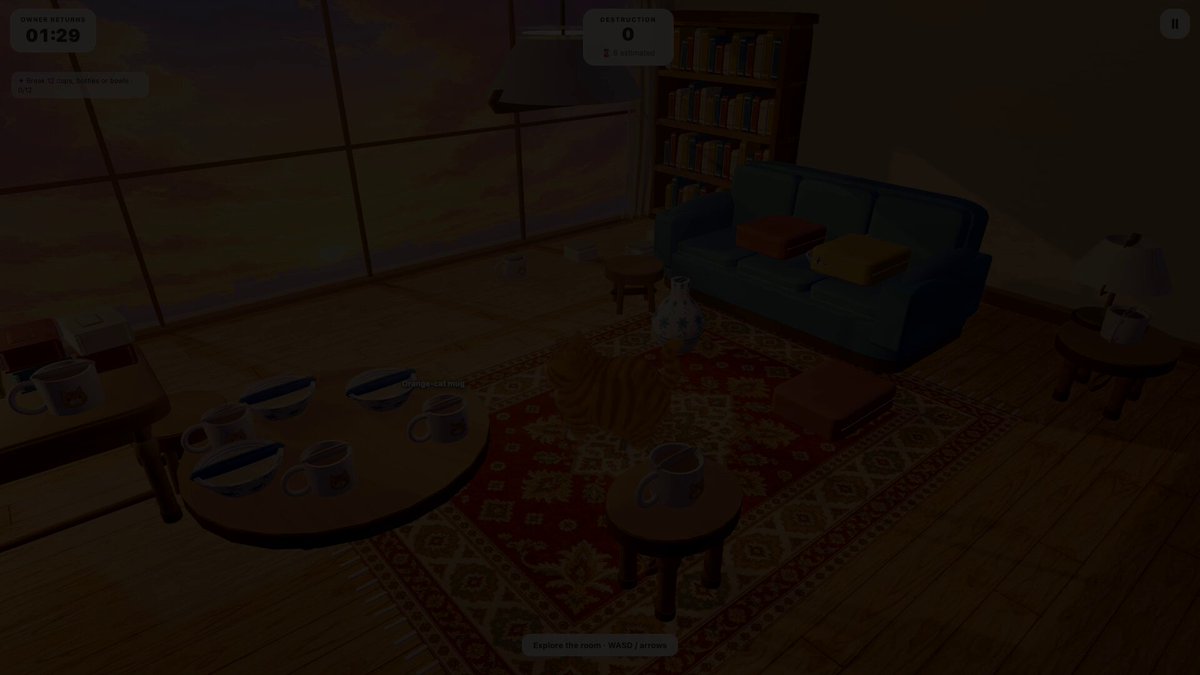
This is "Cat Destruction: From Rental Apartment to Museum," built with Fusion Max 2.0. Players control an orange tabby cat, causing as much destruction as possible within 90 seconds—knocking over furniture, breaking items, and earning canned food. Canned food upgrades attributes and unlocks new scenes. The game features 3D scenes, character control, destruction scoring, upgrade systems, and save data, playable on both PC and mobile.
However, the result wasn't achieved in the first generation. Regardless of the model, expecting a perfect final product from a single generation is unrealistic. This quality came from four rounds of revisions and multiple playtests.
Let's start with the initial creation. My requirements for Fusion Max 2.0 were: Single-file index.html, Three.js via CDN, no external images or 3D models, rooms and the cat generated procedurally as low-poly, playable on PC and mobile, with a 90-second countdown, destruction scoring, canned food upgrades, and 4 unlockable scenes.
Step 1: I gave the gameplay requirements to Fusion Max 2.0 with high reasoning intensity, receiving a 27,000-word design document including numerical formulas, item lists for four scenes, feel parameters, and save structure.
Step 2: I passed the design document back unchanged, asking it to write complete code based on the doc, resulting in a 130KB index.html.
Opening the first version, the start screen was fairly complete, with countdowns and daily task bars present. However, after entering the game, several areas needed polishing:
- Scene Rendering: About 1-2 seconds after clicking start, the 3D scene disappeared, leaving only the background color.
- Interaction Details: The click to start was simultaneously recognized as a claw swipe, adding 18 destruction points right at the beginning.
- Character Model: The initial orange cat was a simplified low-poly model with imperfect contours and proportions, blocking part of the view.
The first version established the basic framework. Scene stability, interaction details, and character performance were addressed in subsequent rounds.
Below are screenshots of the first version after clicking start, and the initial cat after fixing rendering in Round 1.


4. Four Rounds of Revisions · 16/20 Requirements Confirmed, No Manual Code Edits
The revision method was simple: I played the game in headless Chrome, described issues in text, and sent them along with the current full code back to the model, requesting a complete new file. Over four rounds, I did not manually edit a single line of game code. My role was limited to playing, describing problems, and taking screenshots.
Round 1: Fixed scene disappearance and accidental claw swipes in one go. I only described the symptoms; the model identified the causes itself. The cat model wasn't fully adjusted yet, saved for the next round.
Round 2: The initial model was replaced with a low-poly orange cat featuring ears, stripes, four legs, and a tail. Main menu, upgrades, scene gallery, and converting interrupted sessions to canned food all worked without console errors, maintaining stable 60 FPS. Camera adjustments were still needed: previous bounds prevented showing outside the room, but the cat went off-screen when moving to edges.
Round 3: The camera now stably followed the cat. I scripted a full 90-second session, achieving a "Furniture Assassin" rating, 394 destruction points, 55 cans, unlocking 6 new gallery items. Upgrades, scenes, daily tasks, and saves all functioned. Remaining optimization: camera distance. On mobile, the cat appeared too large, and walls blocked part of the view near the wall.
Here is the settlement card from that session.

Round 4: Zoomed out the camera to show most of the room; walls near the camera automatically hide; mobile controls changed to hold-to-swipe buttons. By this point, of the 20 pre-listed requirements, 16 could be confirmed via script. Particles, screen shake, slow motion, and sound effects required human eyes and ears.
After replacing the cat with a Blender-made model, here is the desktop and mobile view of the same rental apartment.


Overall, Fusion Max 2.0 understood bug descriptions in plain language well, fixing most issues in one round. Each round required rewriting ~130KB of code. I regression-tested after each round, and existing features remained stable without loss.
Of course, building a complete game involves testing and iterating. Individual adjustments might introduce new detail issues, so re-testing after each revision is worthwhile. This iterative loop from feedback to fixed code is supported by Fusion Max 2.0.
5. Replacing with Blender Chubby Orange Tabby and 24-Layer Fur
The low-poly cat looked a bit rigid. Instead of using third-party modeling platforms, I had Fusion Max 2.0 write Python scripts for Blender 5.2, running headlessly locally to export GLB models with skeletal animation.
The first script ran successfully in Blender without errors, but the cat was thin and grayish. After four more revisions, I added half-closed eyes, round cheeks, white muzzle, and chest tufts.
Rendering fur in the browser was another challenge. It created a separate preview page using 24-layer Shell Fur, achieving a plush toy feel at close range under 60 FPS.
Below are the chubby orange cat in Blender, the 24-layer fur preview, and the close-up in-game.


When integrating the cat back into the game, one detail impressed me: The in-game fur effect differed slightly from the preview page. When asked to optimize, it didn't blindly modify code but first requested the fur preview page code and comparison screenshots to accurately locate the issue. When lacking context, it identifies information gaps rather than making blind changes.
After providing the info, the close-up improved further, with facial contours, white muzzle, and stripes clearly visible. At normal gameplay camera distances, the fur fluffiness still differs slightly from the preview, but the character is much more complete. Balancing real-time rendering and 60 FPS smoothness in web games makes detailed fur difficult, leaving room for future optimization.
6. Cost Analysis · $5.77 to Playable, ~$14.92 Competitors, >$900 Difference for 100 Prototypes
First, unit prices. In the standard tier (input ≤ 200K tokens), Fusion Max 2.0 costs $3/M input, $0.30/M cached input, and $20/M output. Claude Fable 5.1 and GPT-6 Astra both cost $10/M input and $50/M output. For coding tasks where output far exceeds input, output price determines the bill thickness. $20 vs $50 is a 2.5x difference alone.

Stage | Successful Calls | Input / Output Tokens | FUMO (Public Price) | Fable 5.1 Est. | Astra Est. |
|---|---|---|---|---|---|
Design + Initial | 2 | 18K / 67K | $1.38 | $3.51 | $3.51 |
4 Revision Rounds | 4 | 175K / 193K | $4.39 | $11.41 | $11.41 |
To Playable | 6 | 193K / 260K | $5.77 | $14.92 | $14.92 |
Blender Cat | 5 | 97K / 153K | $3.31 | $8.46 | $8.47 |
Fur Preview Page | 2 | 14K / 50K | $1.04 | $2.64 | $2.64 |
Integration & Close-up | 4 | 259K / 187K | $4.36 | $11.38 | $11.42 |
Full Process | 17 | 563K / 650K | $14.48 | $37.40 | $37.45 |
The FUMO column is actual usage multiplied by official public prices. For the other two, I don't have keys and didn't run them; these are estimates based on the same usage multiplied by their official public prices. If they actually ran with longer reasoning or more revisions, costs would be higher. Three calls without returned usage are excluded.
Converted to prototypes: Based on the usage to reach playable status, 100 prototypes on FUMO cost ~$577, while estimated costs on Fable 5.1 or Astra are ~$1,492. For indie developers, this nearly $1,000 difference might be the fuel needed to survive until the next hit.
7. Getting Started · Claim Trial Credits, 4-Step Integration, Copy-Paste Prompts
Interested friends should claim the FUMO new user benefits first: Equivalent to ~1.67 million tokens of Fusion Max 2.0 or 2.5 million tokens of Fusion Code 1.0 at input prices. Worth trying for mini-games or testing your own AI coding projects. Registration: https://fumolab.ai/en?utm_source=9dta63zy4y
Integration follows official getting-started docs:
- Register and log in to the FUMO console;
- Go to API Keys, click Create New Key;
- Set Base URL to https://capi.fumolab.ai/api/fusion/v1, Model Name to
fusion-max-2.0; - Verify connectivity with one command:
1export FUMO_API_KEY="your_API_KEY"2curl https://capi.fumolab.ai/api/fusion/v1/chat/completions \3 -H "Authorization: Bearer $FUMO_API_KEY" \4 -H "Content-Type: application/json" \5 -d '{"model":"fusion-max-2.0","messages":[{"role":"user","content":"Hello"}]}'
It is compatible with OpenAI's Chat Completions interface. Tools like Cursor and Codex can use it by filling in the Base URL and Key. Billing only counts returned usage; if a reply is truncated mid-way, do not overwrite the previous working file.
The two prompts used are below:
1I want to create a 3D web mini-game "Cat Destruction: From Rental Apartment to Museum" that can be published and monetized on overseas platforms (like CrazyGames). Please first write a complete game design document (Markdown).23## Core Positioning & Monetization Goals4The game must be fun and visually appealing, specifically reverse-engineered for CrazyGames' core metrics:51. **Session Length ≥ 10 mins**: Not one-time clearable. Must have strong positive feedback loop: "90s short session + Destruction Points -> Canned Food -> Attribute Upgrade -> Unlock Luxurious Scenes"62. **Day-1 Retention 10%~15%**: Must include LocalStorage auto-save, unlocked mansion/museum gallery display, and daily destruction tasks.73. **1-min Conversion Rate ≥ 80%**: Pure procedural code generation (zero external model/texture downloads, instant load), cut lengthy intros, playable within 3s of start; support PC keyboard/mouse + mobile touch dual controls.89## One-Sentence Gameplay & Upgrade Path10You are an orange tabby cat wreaking havoc in the house while the owner is at work.11- **Session Rules**: 90-second limit per session. Knock over/break as many items as possible before the owner returns.12- **Economy System**: Real-time conversion of Destruction Points to "Fish/Canned Food" for cat upgrades:13 - Claw Power (Stronger push, knock over heavier items)14 - Agility/Sprint Speed (Move faster, uninterrupted combos)15 - Size/Jump Height (Jump higher, knock over chandeliers/top shelves)16- **Scene Progression (Fun & Humor Escalation)**:17 - Stage 1 [Cheap Rental]: Push cups, spill noodles, tear toilet paper, knock over small desks.18 - Stage 2 [Upscale Apartment]: Break expensive vases, scratch leather sofas, knock over big TVs.19 - Stage 3 [Luxury Villa]: Break wine cabinets, knock over giant crystal chandeliers, flip pianos.20 - Stage 4 [National Museum]: Topple painting stands, break ancient blue-and-white porcelain, finally flip the centerpiece "Giant T-Rex Skeleton"!2122## Hard Technical Constraints23- **Single File Implementation**: Output only one `index.html`. Three.js/simple physics/fonts via CDN importmap.24- **Zero External Assets**: No external 3D models (.gltf/.obj), textures, mp3 audio. All scenes, furniture, exhibits, cats generated via Three.js Procedural Geometry (Low-Poly Cartoon Style). Sound effects synthesized via Web Audio API.25- **Dual Platform Controls**:26 - PC: WASD move, Space jump, Left Mouse/J swipe, Shift sprint.27 - Mobile: Virtual joystick bottom-left, Jump/Swipe/Sprint buttons bottom-right.28- **Visual Style**: Low-poly cartoon, afternoon sunlight/spotlight shadows, particle splashes on breakage, 0.5s micro-slow-motion screen shake for large collapses.29- **Recording & Monetization Hooks**:30 - Director Mode: Press H to hide UI, C to toggle cinematic orbit camera (for promo videos/covers).31 - Ad Slots Reserved: Frontend trigger hooks for "Watch Ad for Double Cans" and "Watch Ad to Experience Museum" in settlement panel.3233## Please Detail in Design Doc:341. Core Loop & Numerical System (Session length, can production formula, upgrade cost curve)352. Coordinates, Layout Sketches, Destructible Item Lists for 4 Scenes (Weight, Score, Effects)363. Cat Physics Control & Feel Parameters (Move/Sprint speed, Jump gravity, Swipe hitbox radius/knockback force)374. Visual & Lighting Specs (Color palettes per scene, lighting setup, particle params)385. UI/UX Flow (Load -> Level Select/Upgrade -> Battle HUD -> Settlement Emoji Rating & Watch Ad Button)396. Save Data Structure (LocalStorage JSON schema)407. Single-File Module Architecture & Implementation Priority4142Output ONLY this Markdown document.
1Attached is the game design document for "Cat Destruction: From Rental Apartment to Museum". Please strictly follow the document to write a complete runnable index.html.23Hard Requirements:4- Single file, Three.js via CDN importmap, NO external models, textures, audio, fonts.5- Fully implement core loop: 90s sessions, destruction scoring/combos, canned food economy, 3 upgrades, 4 scene unlocks/switching, LocalStorage auto-save, daily tasks, settlement emoji ratings.6- Dual platform controls: Keyboard/Mouse, and Mobile virtual joystick + Jump/Swipe/Sprint buttons.7- Effects: Debris particles, screen shake, slow-motion for large collapses, Web Audio synthesized sounds.8- Director Mode: H hides all UI, C toggles cinematic orbit camera.9- Settlement panel reserves "Watch Ad for Double Cans" etc. ad triggers, currently placeholder empty functions, no external ads connected.10- Visuals must be good: Low-poly cartoon style, warm lighting/soft shadows. Furniture, exhibits, and cat models cute and recognizable, no plain cubes.11- Playable within 3s of opening, smooth on mid-range laptops.12- Code modularly commented, no placeholders, omit nothing.1314Output ONLY the complete index.html in one code block.
The subsequent four revision rounds had no generic template; each round consisted of observed issues plus the current full code.
8. Publishing · CrazyGames Metrics, WeChat Docs, and a Reality Check
Code is done. To earn money on overseas platforms, you must pass the platform's testing period.
Take CrazyGames as an example. New games enter the Basic Launch test period. Per official docs, the test ends only after 7 days online AND 500 plays. If 500 plays aren't reached, it auto-ends after 21 days. Ads are disabled during this time, meaning no ad revenue.
Officially, they look at three metrics. Below are common levels for successful games in official guides, not explicit passing lines:
- Average Session Length > 10 mins (matches 90s loops + upgrades);
- Day-1 Retention 10%-15% (matches auto-save + daily tasks);
- >80% players stay past 1 min (recommend load <10s, package <20MB).
Only if metrics beat other platform games will it enter Full Launch, connecting SDK for ad revenue. Another path is licensing to other platforms, but exclusive terms may conflict; read contracts carefully.
For WeChat Mini Games:
Recently, rumors circulated that "WeChat standalone mini-games don't need filing to publish." I checked official docs; the policy hasn't changed: Version review approval is followed by mandatory Mini Program filing before release. Reality:
- Personal free standalone games monetized via ads (IAA) don't need a license number;
- BUT Software Copyright, Self-audit Report, Mini Game Filing, and Mini Program Filing are ALL required. Bureau review takes 10-20 working days;
- "Standalone" means playable offline. This code loads Three.js from CDN; for WeChat, bundle it into the project and adapt to Mini Game engineering structure;
- Some devs report being able to click "Publish" after signing a standalone commitment and passing review, even before filing completes. But there's no official announcement. If filing fails later, the game gets taken down.
So don't aim for "no filing." Prepare materials properly. Polish the game during filing time—it's not wasted.
This "Cat Destruction" game is currently local, not submitted. Honestly, even if models reduce dev costs to a few dollars, most mini-games rarely hit big immediately. But when the bill for a prototype drops from tens of dollars to a few, Prototype-Data-Revised becomes affordable for ordinary creators.
Want to try it yourself? Claim new user trial credits here: https://fumolab.ai/en?utm_source=9dta63zy4y


