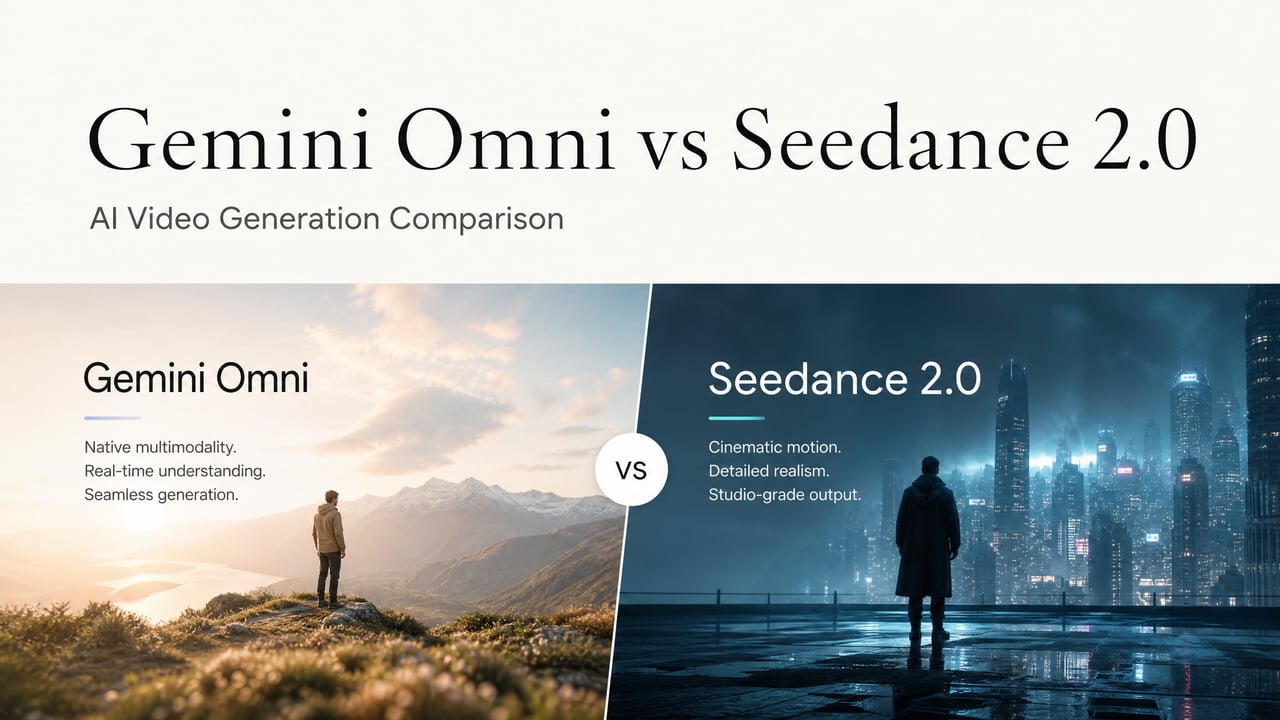
Google's Gemini Omni and ByteDance's Seedance 2.0 represent two distinct philosophies in AI video generation. Gemini Omni positions itself as an editing-first multimodal system with conversational refinement, while Seedance 2.0 focuses on high-quality generation from scratch with superior motion physics. The practical question isn't which model has better demos—it's which one fits your actual workflow.
What Are Gemini Omni and Seedance 2.0?
Gemini Omni is Google's multimodal video generation model announced at Google I/O 2026 on May 19. The first release, Gemini Omni Flash, combines Gemini's reasoning capabilities with video generation and editing. It accepts text, images, audio, and video as input and generates video output up to 10 seconds long with native audio.
The model's defining feature is conversational editing—you can refine videos through natural language instructions that build on previous edits while maintaining character consistency and scene continuity. Gemini Omni Flash is available to Google AI Plus, Pro, and Ultra subscribers through the Gemini app, Google Flow, and YouTube Shorts.
Seedance 2.0 is ByteDance's multimodal video generation model launched in February 2026. It supports text-to-video, image-to-video, video-to-video editing, and audio input—all in a single generation pass. Maximum video length is 15 seconds with synchronized native audio.
Seedance 2.0 topped the Artificial Analysis Video Arena leaderboard in both text-to-video and image-to-video categories as of May 2026, particularly excelling at motion stability, camera presence, and body mechanics. The model is accessible via API through multiple providers and ByteDance's consumer platform Dreamina.
Key Differences at a Glance
The two models optimize for different stages of the creative process. Gemini Omni is built for iterative refinement and structured scene logic, while Seedance 2.0 prioritizes final-generation quality and cinematic motion.
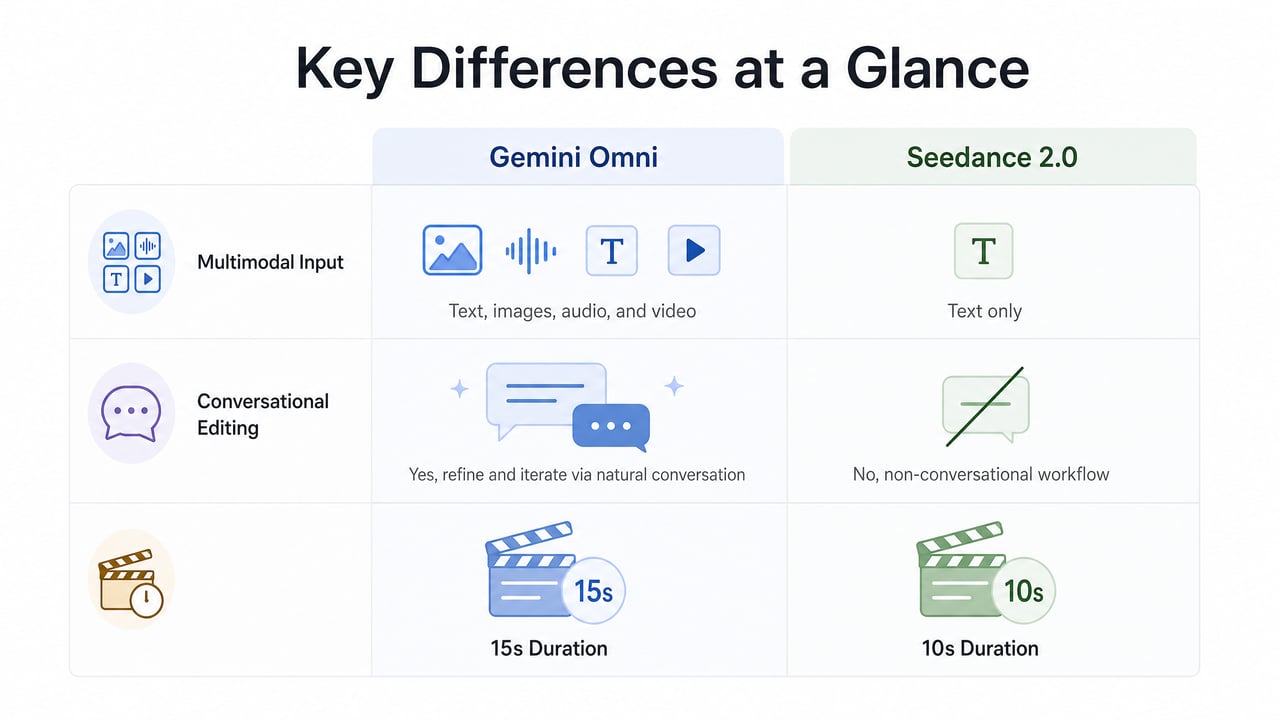
| Feature | Gemini Omni Flash | Seedance 2.0 |
|---|
| Max Duration | 10 seconds | 15 seconds |
| Input Types | Text, Image, Video, Audio | Text, Image, Video, Audio |
| Native Audio | Yes | Yes |
| Conversational Editing | Yes | No |
| Video-to-Video | Yes | Yes |
| API Access | Coming soon | Available now |
| Pricing Model | Subscription-based | Pay-per-use |
| Primary Strength | Editing workflow | Generation quality |

 寫作