First of all, thanks to @Cbb0fe for the inspiration. I learned a lot from reading how he found asymmetry. I’ve been getting a lot of DMs asking how to find an edge onchain, and I end up repeating much of the same stuff to everyone, so I wanted to write something I could point people to.
Most of you are going to make 95% of your money in 5% of the time you spend onchain. Most of your time should be spent playing around with things and letting your curiosity roam freely. This is a common factor among many of the top botters and traders I’ve met. In the age of AI, most of the edge people had in terms of low-level details like coding will dissipate, and your ability to think abstractly at a systems level will be exponentially rewarded. Once you identify potential asymmetry, you have to be relentlessly resourceful and attack the problems in front of you from different angles.
A lot of that resourcefulness shows up as mundane work. I keep adding wallets/infra to track, improving my tools, and sharpening different parts of my process. Over time, many small improvements create an emergent effect: you gain an outsized information asymmetry, paint a much clearer picture of what’s happening, and ultimately execute on signals much more efficiently than other market participants.
With cashcat, weeks of that work gave us enough of an information advantage that we even frontran the Robinhood employees themselves.
About a month before Robinhood Chain went live, I saw a listing notification and, out of pure curiosity, wondered whether anyone had moved the tokens into Robinhood’s hot wallet beforehand. Wintermute had sent them over about an hour before the announcement. I went back through older listings and kept seeing the same pattern. I couldn’t see a way to trade it at the time, but it stuck in the back of my mind.
When Vlad followed cashcat, I bought a bunch like most of you. I had a decent position and was up a lot, but it fell short of the standard I was holding myself to. I’d bought multiple % of every Ansem coin expecting him to run one and fumbled badly. cashcat looked like it could be a generational runner, and I wanted to make up for fumbling Ansem. A Robinhood listing was obviously the biggest inflection point, so I spent weeks preparing to get ahead of the market.
I started with the listing schedule and public endpoints, looking for pairs that showed up ahead of launch. Most of what I found gave me very little lead. The listing accounts that most trenchers track already have notis for this by default, so naturally, I had to deconstruct their pipeline further. The broad idea was to figure out who partnered with Robinhood for their custody and infra, which is all public info.
That brought me back to Wintermute. On Ethereum, they make markets for all kinds of clients. Seeing them prepare to trade a coin could mean any number of things. But on Robinhood Chain, Wintermute setting up their infra would have much clearer implications, so I created a custom tracker for Robinhood Chain that would show me if the Wintermute cluster I was tracking became active.
Then I found out BitGo was also an official partner for Robinhood Chain and handled their custody, so I tracked a bunch of their infra and GitHub. My partner had a bot ready so we could buy when something showed up.
By July 16, cashcat was dumping. The lower it went, the more money we would be able to make, since we estimated that cashcat would likely go to 200–300 on a listing candle. At the time, Blockscout was pretty much the only explorer available for Robinhood Chain, and it was shit to use. I went back through Wintermute’s wallets using a custom EVM explorer that let me read Robinhood Chain and other EVM chains at once, making it much easier to follow their activity across networks. Going this extra mile to make sure there weren’t any wallets I had missed allowed me to find a Wintermute wallet that they had funded on Robinhood for the first time since the chain went live. Keep in mind, it had been two weeks since the chain went live, so it was starting to become very clear to me that I had to ramp up the amount of effort I was putting into this. I now had a realistic chance of frontrunning the listing.
I looked deeper into the Wintermute Robinhood cluster and found that some of those wallets had deployed contracts. Four were trading contracts owned by the same Wintermute multisig, and its recent transactions showed it giving operators permission to trade through two of them.
Looking through the code, I found a function called getAllApprovedTokens() on three contracts. Realising these were trading contracts, I started monitoring for changes, since their whitelists were completely empty at the time. A few days later, they whitelisted WETH and USDG and started trading the pair the next day.
On July 27, our BitGo monitor picked up hoodeth:cashcat five seconds after it appeared in a public pull request. For the first time, we had a concrete cashcat signal. The main issue was that plenty of exchanges use BitGo, so that alone wasn’t enough for me to put millions into it. The big picture was starting to form more clearly, however, with both Wintermute and BitGo prepping their Robinhood Chain infra. BitGo’s cashcat change

The July 28 follow-up on the BitGo pull request, a day after our first alert fired.
On July 29, BitGo’s release included cashcat alongside 99 Robinhood Chain stock tokens. The implications of this were huge, as it confirmed my hunch that Robinhood was the one behind this request. Why else would cashcat be in there next to their native stock tokens? BitGo’s stock-token change · Release work
My partner and I had been adding as the evidence came in. By July 29, we’d accumulated 1.5% of the supply between us. The next day I told him what would make me add much more. I wanted to see Wintermute whitelist cashcat or catch a cashcat transfer between Wintermute and Robinhood. We had the monitors running and the money ready.
On August 3 at 17:48 UTC, the tracker caught Wintermute approving the cashcat/WETH pool. That was the alert we’d been waiting for. The desk had selected a venue to trade the exact coin we were holding.
We were ready to put seven figures in, but doing it all at once would light up the chart and give everyone a reason to dig through our wallets. I told my partner to slowly DCA half our size to gauge whether anyone noticed.

Half an hour later, at 18:19, the wallet we suspected belonged to a Robinhood insider opened an $11k limit order for cashcat. We’d been tracking it because it kept showing up ahead of listings, and I knew other traders had the address too. The order hadn’t filled, but everyone watching could see which coin it was trying to buy. I figured other people would start buying before we’d finished getting our size in.
We ditched the slow DCA, bought over $1 million worth of cashcat between us, and candled the chart. By the time we finished sizing in, we held around 4%+ of the supply.
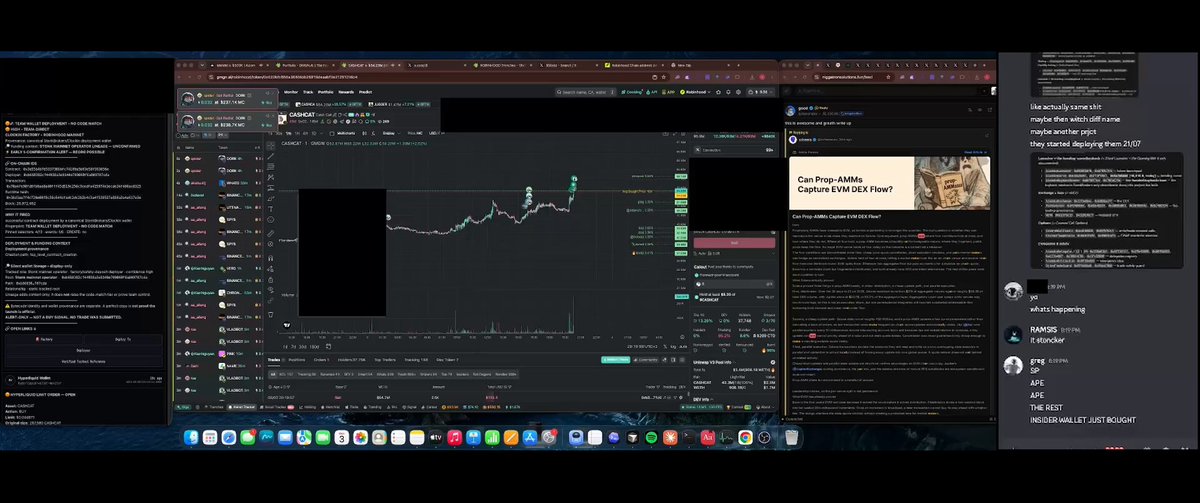
(ignore the song i had some bullshit on autoplay)
Pages started posting our wallets right away, which is precisely what we wanted to avoid because it would fuel spec and dilute a lot of our edge by letting tons of people frontrun the actual listing. The insider’s lack of onchain trading experience probably cost us a few more million. Bubblemaps’ post
Three days later, Robinhood listed cashcat while I was taking a nap, so I missed the initial candle. My sells could’ve been better, but my partner and I still made over $4 million between us. Robinhood’s announcement
By the time PONS came around, I had anticipated that most sharp traders would have caught on to the Wintermute contract pattern, so waiting for the same alerts wasn’t gonna cut it anymore. We had to dig deeper into the pipeline to get ahead again.
We kept digging from where the cashcat research left off and eventually found enough signal for me to start buying PONS on August 28. I can’t really detail that part of the pipeline.
Three days later, BitGo added PONS, with Wintermute starting to market-make it shortly after. Then, on September 2, it got the “listing,” which ultimately seemed to have been some kind of honeypot for Robinhood to catch the insiders. After that, most of the edge I’ve detailed here got diluted.
My friends and I made $2 million between us on PONS.
Most of these nuances are more relevant to traders who bot, but you might find that a lot of these principles apply to other trading styles too. Overall, my goal in trading has been to bridge the gap between pure narrative trading and maximising my technical edge for better execution. I might write more in the future about some of my narrative trades.
Thanks for reading.


