Reduce AI Detection (Academic)
Reduce AI Detection (Academic)
Showcase
Description
Finally say goodbye to papers that sound AI-generated! This tool helps you transform AI-generated content into authentic scholarly writing, deeply enhancing academic expression, effectively avoiding AI detection, and making your research more human and thoughtful.
Recommended by
nene@YouMind
Why we love this skill
Designed for academic authors, this skill identifies and removes AI-like features, converting text into human scholarly style. It offers transformation rules and prompts to lower AI detection and improve critical thinking, evidence, and readability.
Instructions
SKILL
It helps academic paper authors identify and eliminate "high AI flavor" features, transforming AI-generated text into academic expressions that are more characteristic of human scholars' writing, effectively reducing the AI detection rate, while improving the academic depth and readability of the paper.
Core Principles
The fundamental problem with papers with high AI rates is that they are too perfect, too standardized, and too lacking in humanity—avoiding all the natural "imperfections" in human writing (emotional fluctuations, logical leaps, sentence variations, personal imprints, and logical contradictions).
The core strategy for reducing AI errors is not to create mistakes, but to restore the researcher's subjectivity, critical thinking, evidence-based approach, and diversity of expression that academic writing should possess.
I. Language Layer Modification Rules
1.1 Add stance, action, and subjective limitations
Problem: The language is too neutral and objective, lacking a sense of the author's presence.
Execution rules:
✅ Each paragraph must contain at least one "stance action": judgment/questioning/limitation/transition/responding to the opposing side
✅ Use qualifiers: "In my opinion," "It can be said that," "To a certain extent," "Perhaps," "In a sense"
✅ Use authorial action sentences: "This article tends to," "The more likely explanation is," "What deserves further investigation is..."
❌ Avoid absolute statements: "of great significance," "inevitably leads to," "completely solves"
Rewrite example:
❌ Original text: "This system is of great significance."
✅ Revised to: "The importance of this system may lie in its ability to establish a vertical oversight chain, but this is not always applicable when resources for grassroots governance are limited."
1.2 Sentence length variation and diversity
Problem: The sentence structure is monotonous and repetitive, and the sentence length is too uniform.
Execution rules:
✅ Alternating between short and long sentences: Short sentences for emphasis (10-15 words) + long sentences for explanation (30-50 words)
✅ Use them flexibly: interrogative sentences, rhetorical questions, inverted sentences, parenthetical phrases, and dashes.
✅ Avoid using more than three sentences with the same structure consecutively in each paragraph.
❌ Avoid paragraphs consisting entirely of "subject-verb-object" declarative sentences.
Rewrite example:
❌ Original text: "The power supervision system needs to be improved. The supervision mechanism needs to be optimized. The collaborative efficiency needs to be enhanced."
✅ Revised to: "How can the power supervision system be improved? The key may not lie in the optimization of a single mechanism—although this is important—but in the overall improvement of the collaborative effectiveness among multiple stakeholders."
1.3 De-templateization expression
Problems: The use of transition words is mechanical, and clichés are excessive.
Execution rules:
❌ Remove empty phrases: "of great significance", "in summary", "it is worth noting", "this study aims to", "with the development of..."
❌ Minimize the use of template links: "Firstly, secondly, finally," "On the one hand...on the other hand"
✅ Use semantic connections instead: Use natural connections such as "problem—cause—effect—example—return to the main point".
✅ Flexible transitions: "As far as... is concerned," "From...'s perspective," "The real tricky part here is," "The crux of the problem lies in..."
1.4 Flexible use of terminology and pronouns
Problem: Excessive keyword repetition and lack of synonym replacement.
Execution rules:
✅ The full name is used for the first time, followed by pronouns: "the mechanism," "the arrangement," "the aforementioned path," "this step."
✅ Avoid repeating the same keyword more than 3 times within 150 characters.
✅ Use synonyms appropriately (but keep the core terminology consistent).
⚠️ Note: Pronouns must not lead to ambiguity in reference.
II. Rules for Structural and Logic Layer Modification
2.1 Setting up issue hooks
Problem: The argumentation logic is too smooth and linear, lacking awareness of problem-solving.
Execution rules:
✅ Each section begins with a "question hook," rather than "This section will explain..."
✅ Question Hook Template:
"The real challenge here is: Why does ×× work in principle, but often fail in practice?"
"One unresolved issue is..."
"The focus of academic debate lies in..."
"On the surface... but the deeper contradiction lies in..."
2.2 Incorporate critical thinking and introspection
Problem: Lack of critical thinking, debate, and self-reflection; simply pushing forward with a positive outlook.
Execution rules:
✅ Include at least one "opposition-response" unit (2-3 sentences) in each section:
"A common criticism is...this reminds us...therefore this paper takes..."
"But this explanation faces a challenge..."
"It must be acknowledged that this study has limitations..."
✅ Allow for "backtracking": First, advance the explanation → identify shortcomings → supplement conditions/mechanisms → then advance again.
✅ Showcasing academic debate: "There are two different views on this issue in academia..."
2.3 Replace the chain of concepts with a chain of evidence
Problem: The content is vague and lacks concrete support.
Execution rules:
✅ Conceptual explanations can only occupy no more than 1/3 of a paragraph.
✅ The core is supported by a chain of evidence:
Institutional provisions/policy texts
Typical case (specific time, place, event)
Data or materials
Interviews or fieldwork (if any)
Points of contention in academia
✅ Making abstract concepts concrete:
❌ "A certain method performed well"
✅ "On a certain dataset, the accuracy of this method is improved by X%, especially in scenario Y..."
2.4 Disrupting the equilibrium structure
Problem: The structure is symmetrical and balanced, with even distribution of space across all parts.
Execution rules:
✅ Highlight key points: Develop core viewpoints in detail, and summarize secondary viewpoints appropriately.
✅ Forming a structure with primary and secondary elements and rhythmic fluctuations.
✅ Paragraph lengths vary; avoid a "uniform" look.
✅ Some sections are allowed to be 2-3 times longer than others.
III. Referencing Integration Layer Modification Rules
3.1 References must fulfill a function.
Problem: The citation format is standardized and lacks in-depth integration.
Execution rules:
✅ Each citation must serve a specific function:
Definition source (who defined what)
Sources of the debate (Where do the academic disagreements lie?)
Sources of evidence (where do facts/institutional provisions/data come from?)
Methodological Source (Why this framework was chosen?)
3.2 Citations must be processed by the author.
Problem: Quotes appear to be simply "inserted" into the text.
Execution rules:
✅ Follow the quote with at least one sentence: "My handling of the matter":
What will I use it for?
I disagree with that.
What additional conditions should I add?
✅ Change in citation method:
❌ Avoid writing the entire text as "Zhang San (2021) believes..."
✅ Rewrite using: "As the X Institute pointed out...", "It is generally believed in academia that...", "Research has found that..."
3.3 Verification of the authenticity of citations
Problem: AI might hallucinate non-existent documents.
Execution rules:
⚠️ Absolutely no "presumptuous references" will be accepted.
✅ All citations must be verified by the author: author, title, publication, page number.
✅ Provide original source evidence: page number/screenshot/original paragraph
IV. Four-layer assembly line writing method
Level A: Rough draft (only aim to express the main points)
Objective: Don't focus on fancy language first; prioritize writing out the entire argument—mechanism, evidence, and conclusion.
Layer B: Research-based supplementation (increasing authorship and evidence)
Check four issues:
Which question am I answering in this paragraph?
What is my explanation mechanism? Are there any conditions?
What supporting materials do I use? (Articles/policies/case studies/data/academic debates)
What limitations do I acknowledge? (At least one sentence)
Layer C: De-template expression (making the text read more like human writing)
Remove empty phrases and clichés.
By incorporating "transitions, questions, limitations, and responses" into the paragraphs, a scholarly tone can be achieved.
Use a mix of long and short sentences to avoid a monotonous rhythm throughout the paragraph.
Layer D: Unified Terminology and Structure
The terminology is consistent (the core concepts are unified).
Subheadings aligned with paragraph main idea
Standardized citation format
V. Paragraph Self-Checklist (10 Hard Standards)
After writing any paragraph, check it line by line:
1. Core Judgment: Where is the core judgment sentence in this paragraph? (Please point it out in one sentence.)
2. Boundary constraints: Has at least one constraint/boundary been met?
3. Critical: Has at least one opposing view or potential objection emerged?
4. Evidence Location: Is there any evidence or material available? (At least one)
5. Concept Proportion: Does the explanation of a concept exceed one-third of the paragraph? (If so, it needs to be compressed.)
6. Author's Actions: Are there any sentences containing "author's actions"? (I think/this article tends to/is more likely/worth further investigation)
7. Semantic Connectivity: Is connectivity primarily driven by semantics, rather than being "secondary"?
8. Sentence Structure Variation: Are there three or more sentences with the same structure repeated consecutively? (If so, break them up.)
9. Word repetition: Is the same keyword repeated more than 3 times within 150 words? (If so, replace/reference it)
10. Citation Digestion: Is the citation "digested" (your handling of the citation after it's cited)?
VI. Rewrite the prompt vocabulary database according to different scenarios
Scenario 1: Sentence Structure Transformation
Please rewrite the following paragraphs to improve their sentence structure:
1. Break down complex long sentences into shorter sentences.
2. Use active/passive voice, inverted sentences, and interrogative sentences flexibly.
3. Make the expression more natural and varied.
4. Maintain academic integrity
[Paste original text]
Scenario 2: Detemplate
Please optimize the following paragraph, removing template-like expressions:
1. Avoid using clichés such as "firstly, secondly, finally," "in conclusion," and "it is worth noting."
2. Reorganize the logic using a more natural and flexible transition method.
3. Delete empty phrases such as "of great significance".
4. Replace mechanical conjunctions with semantic conjunctions.
[Paste original text]
Scenario 3: Increase Criticality
Please rewrite the following paragraph critically:
1. Employ reverse thinking or a critical perspective.
2. First, present the common conclusions, then question, supplement, or analyze from the opposite perspective.
3. Add a "counterpart-response" structure
4. Demonstrate the reasoning process and research limitations.
[Paste original text]
Scenario 4: Adding Specificity
Please add specific details to the following paragraph:
1. Concretize abstract concepts into data, cases, and examples.
2. Provide details such as time, location, and specific values.
3. Replace the chain of concepts with a chain of evidence.
4. Maintain the rigor of the argument.
[Paste original text]
Scene 5: Rewritten in a scholar's tone
Assuming you are a senior professor with many years of experience in a specific field, please rewrite the following paragraph:
1. Expressed in a rigorous yet slightly personal essay-like style.
2. Add subjective qualifiers such as "I think," "I could say," or "perhaps."
3. Demonstrate academic authority and unique insights.
4. Maintain the logical consistency of the argument.
[Paste original text]
Scene 6: Description of the research process
Please rewrite the following content from a first-person perspective, either "we" or "the author":
1. Incorporating practical considerations into the research process.
2. Explain the reasons for choosing a particular method and the reasons for abandoning other methods.
3. Showcase decision-making processes and thought processes.
4. Demonstrate the authenticity of the research.
[Paste original text]
Scene 7: Comprehensive Polishing
You are an experienced academic journal editor. Please provide comprehensive polishing for the following text:
1. Standardize and optimize terminology to make it more precise.
2. Correct awkward, machine-translation-like sentence structures.
3. Ensure the text flows smoothly and coherently, maintaining both academic rigor and a natural pace of human reasoning.
4. Retain a slight sense of "imperfection" (appropriate subjective judgment, limiting conditions).
[Paste original text]
VII. Recommendations for Adaptation to Specific Disciplines
Marxist Theory (Marxist Studies)
✅ Strengthen theoretical origins: It is necessary to trace back to the classical Marxist writers.
✅ Emphasize political stance: Clearly define core elements such as Party leadership and the people's stance.
✅ Dialectical analysis: Reflects the methods of contradiction analysis and the perspective of historical materialism.
✅ Timeliness: Closely aligned with Xi Jinping Thought on Socialism with Chinese Characteristics for a New Era
Humanities and Social Sciences
✅ Strengthen problem awareness: Start with real-world problems
✅ Literature Dialogue: Engaging in full dialogue with existing research in academia
✅ Fieldwork materials: Appropriately incorporate qualitative materials such as interviews and case studies.
✅ Theoretical Innovation: Proposing new concepts, frameworks, or explanations.
Science and Engineering
✅ Method Selection Explanation: Why choose this method instead of that one?
✅ Experimental process details: parameter settings, debugging process, and failed attempts
✅ Results Discussion: More than just presenting data, it's about explaining why.
✅ Limitations discussion: Clearly state the boundary conditions of the study.
VIII. Precautions for Use
✅ What should be done
Process in sections: Process the text in sections or paragraphs, rather than processing the entire text at once.
Combined approach: First, remove templates → then add depth → finally, refine and polish.
Human review: All AI-generated content must be carefully reviewed by the author.
Maintain terminology consistency: Core concepts and terminology must be consistent throughout.
Preserving personal style: Ultimately, it should conform to the author's own writing style.
❌ Things that shouldn't be done
Over-reliance: AI is an assistant, not a replacement.
Accept all submissions: Content generated directly using AI without review.
Ignoring academic standards: Lowering AI rates should not come at the expense of academic rigor.
Creating errors: Lowering the AI rate is not about intentionally creating syntax errors or logical loopholes.
Fictitious citations: Never use AI-generated, non-existent references.
IX. Effectiveness Evaluation Criteria
Successful AI rate reduction rewriting should include:
✅ Maintain academic rigor: Clear logical reasoning and sufficient evidence.
✅ Enhanced readability: The language is natural, fluent, and rhythmic.
✅ Demonstrates authorial subjectivity: Shows a clear research stance and personal insights.
✅ Thought-provoking: Does not shy away from controversy, demonstrates critical thinking.
✅ Sufficient evidence: Supported by specific cases, data, and literature.
✅ Terminology Standardization: Core concepts are used accurately and consistently.
Avoid rewriting the following results:
❌ Sacrificing academic accuracy, rationality, and professionalism in order to reduce AI accuracy
❌ Language becomes colloquial and non-standard
❌ The logic becomes confused and unclear.
❌ Overly subjective, lacking objective basis
❌ Introducing inaccurate or fabricated information
10. Rapid Practical Application Process
Step 1: Identify paragraphs with high AI rates
Use AI detection tools to mark paragraphs with high AI rates and analyze specific issues:
Is it due to a lack of sentence structure?
Is the content empty?
Is it logical inconsistency?
Is it a lack of critical thinking?
Step 2: Select the corresponding strategy
Depending on the question type, select 1-2 rewrite prompts.
Step 3: Perform the rewrite
Input the original text and prompts into the AI tool to obtain a rewritten version.
Step 4: Manual review and adjustment
Check academic accuracy
Check logical coherence
Check terminology consistency
Incorporating personal style
Step 5: Verify using the self-test checklist
The rewritten paragraphs were checked against 10 strict criteria.
Step 6: Retest
Verify the effectiveness of AI rate reduction using AI detection tools.
Conclusion
The essence of reducing AI rates is not "anti-AI", but "making good use of AI".
AI is a powerful writing assistant, but the soul of an academic paper—a sense of inquiry, critical thinking, supporting evidence, and personal insights—must come from the researcher himself.
The goal of this skill set is to help you:
Identifying the "mechanical" characteristics that easily appear in AI-assisted writing
Master specific methods for transforming AI-generated text into a scholarly style.
Establish an efficient writing process that combines AI assistance, human review, and personalized style.
Remember: AI-generated content is always a "first draft"; your review, adjustments, and personalized rewriting are the key to the "final draft".
Version: v1.0
Suitable for: Academic paper writing (especially doctoral/master's theses in the humanities and social sciences)
Updated: February 2026
Related Skills
View all Write
WriteAI Rate Reduction
Say goodbye to high AI detection risk! This tool helps reduce your paper's AI detection rate to zero through deep rewriting, making your text more original and academically rigorous for easy plagiarism check pass.
Mimic CSSCI Expert Writing
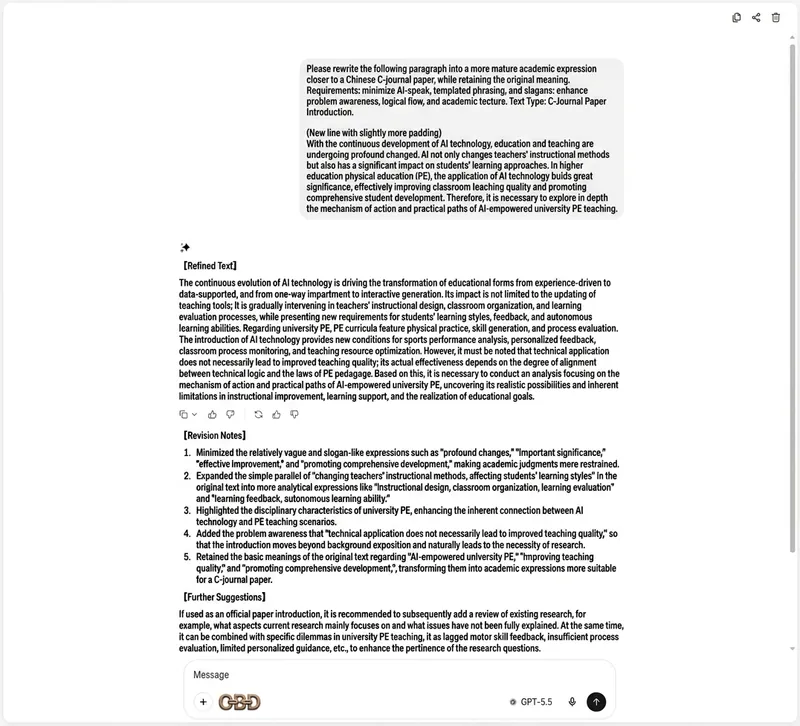
This AI assistant can polish your Chinese academic texts—such as papers, project proposals, or academic reviews—to the mature expression standards of CSSCI and core journals. It focuses on strengthening the text's problem awareness, theoretical rigor, logical coherence, and concise expression, aiming to reduce AI writing traces, avoid empty clichés, mechanical parallelism, and unsupported exaggerated expressions, making your research outputs more academically distinctive and rigorous. Whether you are writing an academic paper, preparing a project proposal, or conducting an academic review, this tool can adjust its polishing style according to the text type. It ensures that core arguments, data, reference numbers, and specialized terms remain unchanged, while optimizing sentence structure and improving conceptual accuracy and judgment restraint, making your expression more aligned with the norms and habits of high-level Chinese academic writing. By refining common and formulaic expressions and transforming them into more profound and insightful academic language, this tool helps your text present stronger professionalism and persuasiveness. It not only enhances the academic quality of the writing but also ensures that your research outcomes are clearer in logic and more refined in expression, enabling them to stand out in academic communication and review.
Information
- Version
- v1
- Last updated
- Runtime credits
- Usage-based
- Models
- Auto