
Interview Outline Master V2
Research, case, and consulting interviews
Interview Outline Master V2
Research, case, and consulting interviews
Showcase
Description
Three primary scenario pathways: 🎓 Scenario A | Academic research (theses and journal articles, including research-question mapping and safeguards against leading questions) 📚 Scenario B | Case development (professional master's and teaching cases, including key-event timelines and triangulation) 💼 Scenario C | Commissioned research and consulting (business and government consulting, following a current state–problems–causes–needs–recommendations framework) Four interviewee-type pathways: automatically adapt wording, ethical requirements, and sensitive-topic anticipation for government officials, business executives, frontline employees or customers, and academic experts. Pre-interview materials checklist: send it with the invitation to request materials for refining the guide; when no materials are available, automatically supplement with public-source research. Ready-to-use structure: each probing point explains “what you are uncovering,” with five follow-up strategies (clarification, deeper probing, comparison, hypothesis, and paradox), informed-consent ethics provisions, and time planning.
Recommended by
Shuting@YouMind
Why we love this skill
Combines academic qualitative research, case reconstruction, and consulting diagnosis with scenario- and role-specific questions, plus materials requests, triangulation, probing labels, and sensitive-topic guidance.
Best for
Researchers, case developers, consultants, and project teams conducting in-depth interviews.
How to use this Skill
Provide your input
Provide the interviewee's identity, interview purpose, content scope, and any available research, case, or project background materials.
Run the Skill
Based on your scenario and interviewee, design a neutral, progressive, ethically sound question structure and organize key preparation points.
Review your result
Get a ready-to-use, structured interview guide covering question areas, follow-up directions, ethical notes, sensitive-topic prompts, and timing.
Related Skills
View all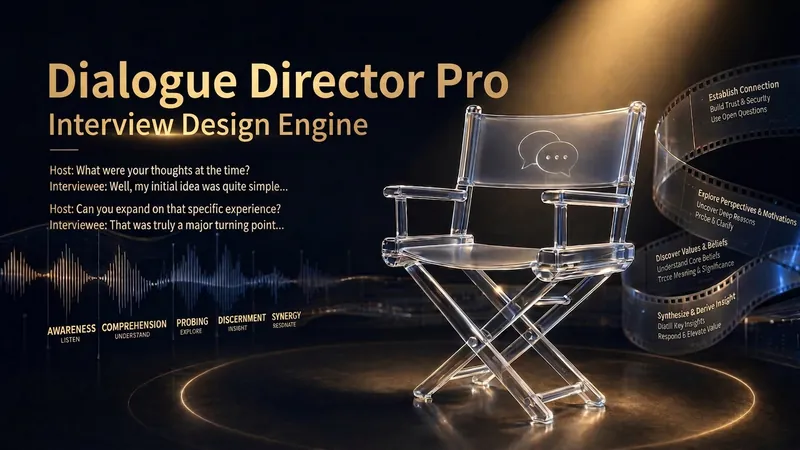
Dialogue Director Pro | Interview Design Engine
This isn't just a list of questions; it helps you design a memorable conversation. A 7-step process, from guest research to finalized materials: Guest Profile → Narrative Structure → Question Matrix → Process Layout → Interview Rehearsal → Material Conversion → Interview Debriefing 💡 Steps 1-3 form the core design process, delivering a complete interview plan independently; Steps 4-7 enhance the experience and can be used as needed. 🔍 Guest Profile | Online search of publicly available guest information generates a five-dimensional in-depth profile—factual skeleton, story vein, core conflict, communication style, and emotional entry point—telling you which direction to dig. Non-public figures automatically switch to interview-style information gathering. 🌿 Follow-up Question Branching Tree | When generating questions, the system pre-predicts the possible directions of the guest's answers for each key question and designs corresponding follow-up questions. You take this "decision tree" to the event, listen to the guest's answer, and then choose the corresponding branch to ask follow-up questions—no need for on-site AI, no need for real-time text transcription; all plans are designed during the preparation stage. It lets you be a chess player on-site, not an improvisational actor. No similar function exists on the market. 🎬 AI Rehearsal | Before the interview, AI plays the role of a guest, simulating three answering styles (in-depth/superficial/evasive), allowing you to practice follow-up questions and identify blind spots in the process. 📝 Five Outputs | Generates from a single interview: interview article/ podcast script/ oral history transcript/ social media content package/documentary script skeleton. 📊 Interview Debriefing | Plan vs. reality comparison, analysis of gold mines and regrets, five-dimensional capability radar chart, allowing you to grow with every interview. Suitable for: podcast interviews, interviews, student interviews, UX in-depth interviews, executive interviews.
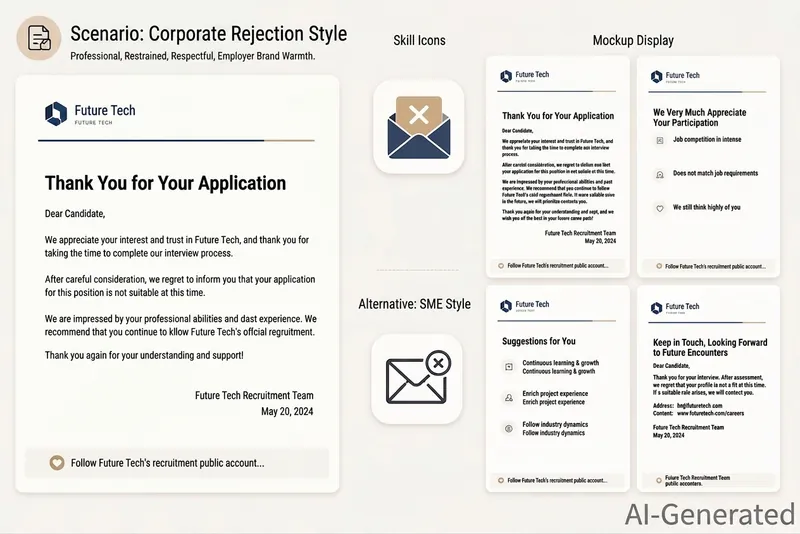
Workplace Script Generator
Need to reject a candidate after five rounds of interviews? Need to send a layoff notice to an employee who's been with the company for three years? Need to negotiate salary with HR but afraid of saying the wrong thing? No one has taught you how to handle these situations – being too harsh hurts people, being too soft is ineffective, and getting it wrong could even lead to legal trouble. Choose a scenario, tell it the situation, and instantly get multiple professional scripts – for Chinese big companies, small/medium companies, English North American companies, and startups. Formal, friendly, or aspirational – pick the tone you need. ✨ Core Capabilities 1. 6 major HR scenarios: rejection letters, layoff notices, salary negotiation, interview scripts, reference checks, daily HR communication 2. Bilingual + multiple styles: Chinese big company/small-medium companies, English North American/startups – 2-3 versions per scenario 3. Context matching: 4 types of layoff reasons (strategic adjustment, bottom elimination, economic downturn, culture fit) each with specific scripts 4. Salary negotiation dual perspective: 5-level HR undercutting scripts + candidate negotiation scripts – both sides can use 5. Legal safety: all scripts are lawful, do not encourage concealment or fraud 📱 Applicable Scenarios - Startup founders/managers: learn how to properly reject, lay off, or negotiate salary - HR professionals: need quick access to different style scripts - Job seekers: understand HR script implications, negotiate with confidence - Freelancers: use professional scripts to manage client relationships from start to end The hardest part isn't making the decision – it's saying it. Let professional scripts help you speak.
 Research
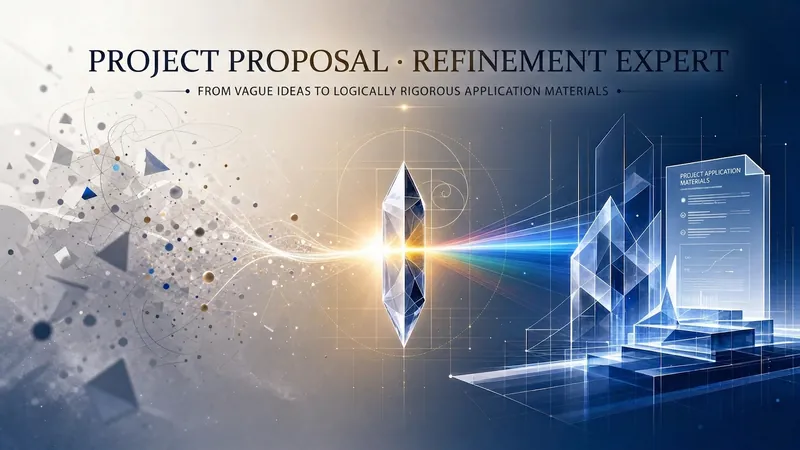
Project Proposal Expert v3.0
From vague ideas to logically rigorous application materials, even ordinary technical personnel can complete a 10,000-word argumentation report in 2 hours. Core Features: Eliminate empty language in applications: automatically strip out filler words like 'high-level' and 'significantly improved', use SCQA framework + Pyramid Principle to write quantified, logically rigorous arguments. Accurately identify innovation patterns: automatically analyze project characteristics, match three modes (autonomous originality, integrated innovation, iterative micro-innovation), give compatibility score and recommendation, avoid failure due to mispositioned innovation. Prevent logic gaps in argumentation: exclusive 'five elements + three chapters' structured output method, from project rationale to innovation points tightly linked, master 10,000-word deep report + high-definition technology roadmap. Zero experience required: no idea? Just input a one-sentence project idea (e.g., 'want to make a quantum sensor for gas leak detection'), system automatically completes 6 phases, outputs complete application materials. Usage: Open the dialogue box and directly input your project idea or upload existing materials; the system will guide you through the entire process: information collection → innovation mode selection → brief argumentation generation → full report generation → technology roadmap generation. Each phase has a confirmation mechanism, and you can flexibly exit and iterate. About V3.2: The new V3.2 version integrates five methodologies: SCQA framework, SMART principles, Pyramid Principle, Comparison-Difference-Advantage method, and Three-Dimensional Value method. It has been refined through real-world cases in quantum detection, smart elderly care, energy management, and other fields, locking in the underlying logic of research proposal success—an essential tool for successful project applications! Application scenarios: ✅ National Natural Science Foundation applications ✅ Provincial/municipal science and technology plan projects ✅ Enterprise technology innovation project initiation ✅ Graduate thesis proposal writing ✅ Technology achievement transformation plan design Core advantages: 🎯 Efficiency increase by 10x: from 2-3 weeks to 2-3 hours 📊 Quality professional guarantee: quantified indicators, rigorous logic, prominent innovation points 🔄 Flexible and controllable: each phase can be confirmed, modified, or exited 📈 Validated by real cases: successfully generated multiple 10,000-word deep reports Typical output examples: ✅ 10,000-word deep argumentation report ✅ High-definition technology roadmap ✅ Structured brief argumentation ✅ SCQA diagnostic analysis report ✅ Innovation mode compatibility assessment
Information
- Version
- v3
- Last updated
- Runtime credits
- Usage-based
- Models
- Auto
- Use cases
- Research & analysisLearning & educationBusiness & strategy
- What you get
- Document