AI Usage Auditor
AI Usage Auditor
Showcase
Description
Helps you audit the AI tools or platforms you're currently using, identify tool redundancy and cognitive blind spots, and generate personalized audit reports and workflow optimization solutions based on the IPOD model (Input-Process-Output-Deposit). Supports quick mode (3 questions, 2500-word report) and deep mode (5 questions, detailed analysis + flowchart).
Why we love this skill
This skill acts like a personal AI tool doctor. It uses the IPOD model to diagnose 'sub-health' issues in your AI tool usage and offers personalized optimization plans to eliminate tool chaos.
Related Skills
View allAI Problem Decomposer
# AI Problem Decomposer **One complex question, one clear analysis diagram.** Why is store traffic unchanged while profits keep falling? Why did video views suddenly drop? Why are projects always delayed? Enter the question you want to understand, and AI will break down possible causes, map out cause-and-effect relationships, determine what to investigate first, and generate a clear, easy-to-understand Chinese-language analysis diagram. It does more than tell you **what the possible causes might be**. More importantly, it tells you: **why they might be happening and what to check next.** ## What you'll get **① Intelligent problem breakdown** Identify the key parts of a problem. For situations that can be analyzed with formulas, the tool prioritizes establishing metric relationships to help identify what needs to be investigated. **② 4–6 possible causes** Each cause includes: - Possible symptoms - The cause-and-effect mechanism behind the outcome - A practical way to verify it Unverified speculation is not presented as fact. **③ Intelligent investigation order** Based on impact, verification difficulty, and the information available, the tool recommends what to check first and what to check later, helping you avoid investigating blindly. **④ One professional Chinese-language analysis diagram** The tool automatically selects a suitable structure based on the question, such as a radial map, causal chain, fishbone diagram, or timeline. Different colors distinguish information types, and specific action prompts are placed next to causes, such as: - Check: impression click-through rate - Check: product gross margin - Review: customer comments and feedback **⑤ Image text check** After generation, the tool checks the Chinese text, number of causes, and consistency between the diagram and its content. If obvious text errors are found, it attempts one automatic correction based on the run settings; additional generation may use more credits. ## What kinds of questions is it suited for? **Business operations** - Why are profits falling even though store traffic is unchanged? - Why are returning customers decreasing despite good reviews? **Content creation** - Why did YouTube views suddenly drop? - Why are impressions high but click-through rates low? **Work and learning** - Why are projects always delayed? - Why hasn't performance improved significantly despite investing more time in learning? ## How to use it 1. Enter a specific question you want to analyze. 2. Include any data, screenshots, or reference materials you have. 3. AI breaks down the causes, analyzes the mechanisms, and provides verification methods. 4. Generate a Chinese-language multifactor analysis diagram to help you investigate each item step by step. ## Usage tips - The more specific the question and the more complete the data, the more targeted the analysis will be. - Do not fabricate statistics, survey results, or external sources. - The causes shown in the diagram are analytical hypotheses and do not mean the actual causes have been confirmed. - Generated images may contain layout or text errors. - A single test run uses approximately 100–200 credits. Actual credit usage depends on the model, task complexity, and whether additional generation is needed. **Make complex questions easier to understand, investigate, and act on.**
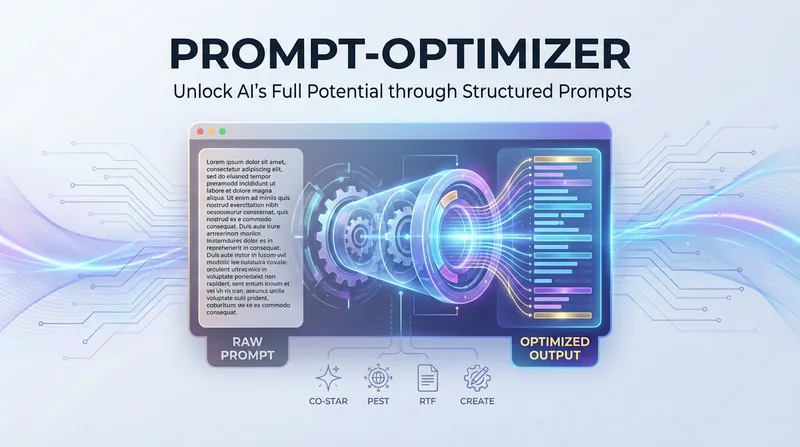
AI Prompt Optimization Expert
The AI Prompt Optimization Expert focuses on improving prompt quality through a systematic framework, helping you convey your intent precisely and making AI output more stable and predictable. Whether you need to refine existing prompts, build complex task descriptions from scratch, or find professional templates for specific scenarios, this skill provides comprehensive support. It can not only restructure vague requests into structured prompts, but also identify and fix common logical flaws through a diagnostic process. The skill includes a variety of proven optimization frameworks and can flexibly switch strategies based on the nature of the task. For example, for formal documents and professional content, it strengthens the background and audience dimensions; while for code generation or data processing tasks, it focuses more on role definition and specific constraints. In this way, it ensures every prompt has a clear goal, a defined style, and a well-structured output format. In addition, it covers specialized templates for a wide range of high-frequency scenarios, from copywriting and data analysis to technical documentation. You can directly use these proven structures and quickly fill in key details such as core selling points, data descriptions, or reader background. During optimization, the skill also checks against a quality checklist and uses multiple iterations and side-by-side comparisons to help you master essential prompt engineering techniques, significantly reducing communication costs and boosting productivity.
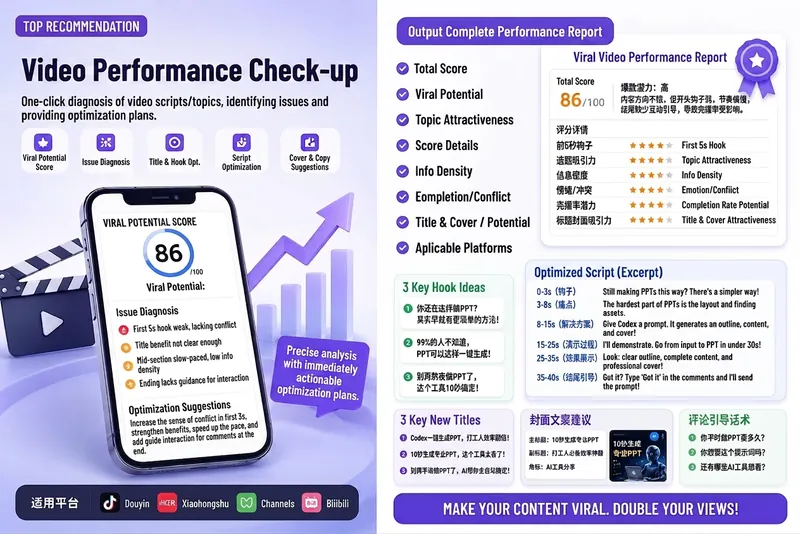
Short Video Hit Inspector
Want your short video content to stand out on TikTok, Xiaohongshu, or WeChat Channels and become the next viral hit? The Short Video Hit Inspector can help you accurately diagnose the viral potential of your content and provide optimization solutions you can directly adopt. Whether you submit a video script, a speaking script, a video link, a screenshot description, or account positioning and topic direction, this tool can deeply analyze its performance on different platforms. It will professionally score your content across multiple dimensions including the first-5-second hook, topic appeal, information density, emotional conflict, completion potential, and title/cover attractiveness. It will also point out specific issues in your content, such as the appeal of the opening, the precision of the title, whether the pacing is sluggish, and the interaction guidance at the end. You will receive a detailed "Short Video Hit Inspection Report" that includes not only a one-sentence conclusion and core problem analysis, but more importantly, it provides optimization content that can be directly replaced and used. This includes 3 brand-new title options, 3 exciting first-5-second hooks, an optimized full script, a set of cover text suggestions, and 3 practical comment section guidance scripts. Say goodbye to vague advice and directly get specific modification plans to increase your view count, making your short video content more competitive.
Information
- Version
- v7
- Last updated
- Runtime credits
- Usage-based
- Models
- Auto
