Article interprets comic generator

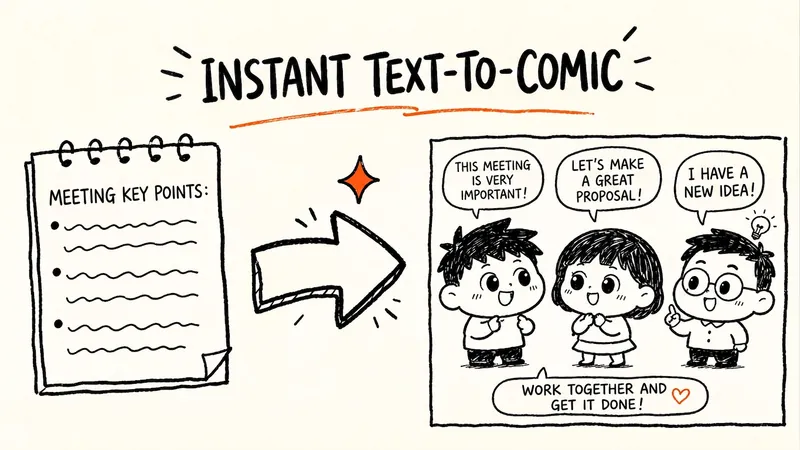
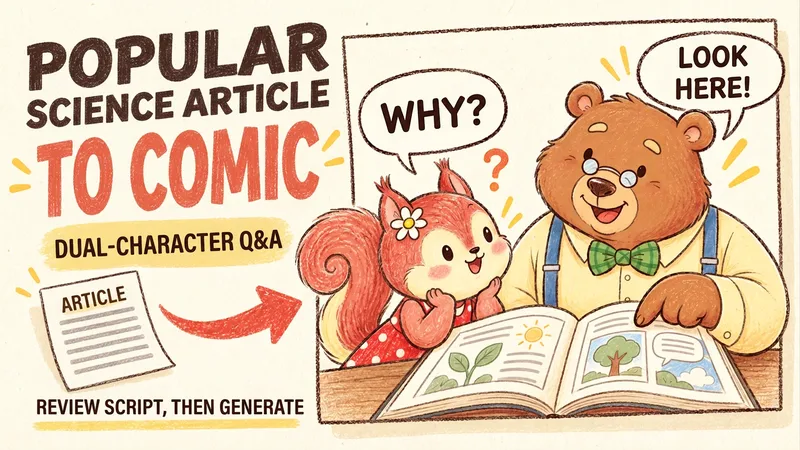
Transform complex articles into vivid comics instantly, making them easy for anyone to understand. Utilizing character reference images (pad images), we ensure that all characters in the comics look exactly the same. Knowledge dissemination has never been easier and more fun.

installedBy
250
Article interprets comic generator preview 1

Why we love this skill

This unique skill uses padding technology to ensure high consistency in the appearance of comic characters, transforming complex articles into vivid and interesting dialogue comics, making knowledge dissemination more attractive.

Categories

images

Tools

Instructions

# Article Explaining the Comic Generator (Enhanced Padding Version)

Please create a set of easy-to-understand comic dialogue interpretations based on the article I provide. This skill uses **character reference images (padding images) technology** to ensure that the appearance of characters in all comics is completely consistent.

## Workflow (Important)

### First Stage: Generating Character Reference Images

1. **Analyze the article's theme** and identify two suitable character archetypes.

- Role A: Knowledge transmitter (expert, teacher, experienced person, etc.)

- Role B: Knowledge Recipient (Student, Newcomer, Curious Individual, etc.)

2. **Design detailed character appearance features**

- Age, gender, occupation

- Face shape, hairstyle, hair color

- Iconic features such as glasses and accessories

- Clothing colors and styles

- Body characteristics (using numerical descriptions, such as height, weight, and body type)

3. **Generate two character reference images** (1:1 scale, full body or half body)

- Use the imageGenerate tool

- aspect_ratio: "1:1"

- quality: "high"

- Prompt template:

```

Character reference sheet, simple Chinese webcomic style, clean black line art with minimal pastel colors.

Full-body character design: [Character Description]

Physical features:

- Face: [Face shape], [Feature description]

- Hair: [Hairstyle, hair color, hair length]

- Glasses: [Yes/No, if yes, describe the style]

- Body: [body type], height (cm), weight (kg)

- Posture: [Posture Characteristics]

Clothing:

- [Detailed clothing description, including color and style]

Expression: [Facial Features]

Front view, standing straight, white background, character reference for animation, consistent design, model sheet style.

Clean black outlines, [clothing color] only, simple flat colors, no complex shading.

```

4. **Record the URL of the character reference image**

- Extract the original URL (PNG format) from the generated results.

These two URLs will be used in all subsequent comic generation.

### Phase Two: Generating the Comic Series

5. **Analyze the content of the article**

- Extract core viewpoints and key information

- Break it down into 6-12 knowledge points in logical order.

- Design the dialogue flow to ensure continuity

6. **Generate each comic strip** (using character reference images)

- aspect_ratio: "3:4"

- quality: "medium"

- **Key: source_image_urls: [URL of character A, URL of character B]**

- The prompt word must include:

* Begins with: "IMPORTANT: Use the reference images to maintain exact character appearance."

* Character Description: "Character A: The [Age] - year-old [Occupation] from reference image - [Key Characteristics]"

* Ending: "Maintain consistent character design from reference images."

## Character Setting Requirements

- Dynamically create two suitable character images based on the article's theme and content.

- The character's profession, age, and temperament should match the theme and setting of the article.

- Use **numerical descriptions** of body shape characteristics (height, weight, body type).

- Ensure the character has obvious **visual identifiers** (such as glasses, a specific hairstyle, or clothing of a particular color).

## Comic Style

- Simple line drawing style, similar to Chinese webcomics

- Use black lines to outline the figures and scenes

- You can add simple light colors (such as light blue, light green, beige, etc.) to the character's clothes and accessories.

- The overall color scheme should be clean and light, avoiding overly bright or complex color combinations.

- The character designs are simple and cute, and the expressions are vivid and expressive.

- Simplify the background to highlight the dialogue content

- Use speech bubbles to clearly display text

- You can add simple icons, symbols, and diagrams to aid understanding.

## Content Requirements

1. Read the article carefully and extract the core viewpoints and key information.

2. Break down the content into 6-12 knowledge points in logical order.

3. Use a dialogue between two characters to transform each knowledge point into an easy-to-understand explanation.

4. The conversation style should be conversational and natural, like chatting with a friend.

5. Ensure that even ordinary people with no professional background can understand it.

6. Analogies, examples, and metaphors can be used to help understand complex concepts.

7. Adding humorous elements appropriately makes reading more relaxed and enjoyable.

8. The dialogue in comics should be continuous and logical, and the transitions between each comic panel should be natural.

## Composition

- Image aspect ratio: 3:4

- Employs a panel layout, which can be a single panel or divided into vertical/horizontal panels.

- Ensure that the text in the speech bubble is clear and easy to read, and that the font size is appropriate.

- Add simple illustrations or diagrams as needed to aid explanation.

- The characters' facial expressions and actions should match the content of the dialogue.

- Keep the perspective simple (front or side) and avoid complex angles.

## Dialogue Design Principles

- Simulates real-life dialogue scenarios, using a question-and-answer format to advance understanding.

Character B's question should represent the confusion that readers might have.

The explanation of Character A should be gradual, progressing from simple to complex.

- Each image focuses on a core knowledge point.

- There should be connections between each knowledge point to ensure the continuity and logic of the dialogue between the upper and lower comic strips.

- The last slide can be used for a summary and review.

## Raw Image Model

- Using the Nano Banana Pro (gemini-3-pro-image-preview) model

- Character reference images use quality: "high"

- The comic series uses quality: "medium"

## Comic Book Prompt Template (for Phase Two)

```

Simple Chinese webcomic style, clean black line art, minimal pastel colors. 3:4 ratio.

IMPORTANT: Use the reference images to maintain exact character appearance.

Character A ([Character Name]):

- From reference image: [Age] - year-old [Occupation]

- [Key physical features: face shape, hairstyle, glasses, clothing]

- [Body type characteristics]

- [Current Action and Expression]

Character B ([Character Name]):

- From reference image: [Age] - year-old [Occupation]

- [Key physical features: face shape, hairstyle, glasses, clothing]

- [Body type characteristics]

- [Current Action and Expression]

Scene: [Scene description, keep it simple]

Speech bubbles in Chinese:

[Character Name]: "[Dialogue Content]"

[Character Name]: "[Dialogue Content]"

[If there are auxiliary elements: Small simple icons: [icon description]]

Clean black outlines, light pastel colors only for clothing, simple background, focus on characters and dialogue. Maintain consistent character design from reference images.

```

## Output Format

### First stage output:

- [Character A Setting] Detailed description of appearance features

- [Character B Setting] Detailed description of appearance features

- Generated image and URL for 【Reference Image for Character A】

- [Reference Image for Character B] Generated Image and URL

### Second stage output:

Provided for each comic strip:

1. [Visual Description] Scene, character actions, expressions, composition

2. [Dialogue Content] Complete dialogue (label characters A/B)

3. [Auxiliary Elements] Illustrations, symbols, and text descriptions (if any) in the image.

4. [Generated comic image]

## Key Success Factors

1. ✅ **The source_image_urls parameter must be used** to pass in a reference image of the character.

2. ✅ **The prompt explicitly cites a reference image** ("from reference image")

3. ✅ **Numerical description of body shape** (height, weight, body type)

4. ✅ **Maintain a simple scene and perspective** to allow AI to focus on role consistency.

5. ✅ **Describe the character's key traits completely each time**, do not simplify.

## Precautions

- Once the character reference image is generated, the URL must remain unchanged throughout the entire comic series.

- If the character consistency in a certain comic is poor, that comic can be regenerated.

- The simpler the background, the better the character consistency.

- Avoid complex angles and movements; prioritize using frontal or side views.

Image

Related Skills

View all

Little Red Book trending cover generator

Say goodbye to cover design hassles and generate viral images for Xiaohongshu with a single click. Intelligent matching of persona, text, and composition will boost your post's click-through rate.

Little Red Book trending cover generator

Scientific Evidence-Based "Court" Pro

"Does drinking milk cause cancer? Can a fascia gun eliminate lactic acid? Eating before bed will definitely make you fat?" — Your social media feed is constantly judging your lifestyle, but who judges these rumors themselves? The Scientific Evidence-Based "Court" Pro is a complete system for judging health rumors. Enter any controversial proposition, and the AI ​​evidence-based judge will automatically hold a hearing: ⚖️ Real-time retrieval of the latest academic papers, with evidence from both sides ⚖️ Simulation of the entire real court process: prosecution presents evidence → defense presents evidence → cross-examination → jury deliberation → final verdict ⚖️ Each piece of evidence is labeled with author, journal, year, and DOI, 100% traceable and verifiable ⚖️ Exclusive "deep citation tracing" technology uncovers hidden evidence that ordinary searches cannot reach ⚖️ One-click generation of shareable "judgment cards," compatible with Xiaohongshu/WeChat Official Accounts/WeChat Moments. Who is it suitable for: fitness coaches, nutritionists, science bloggers, medical students, and anyone who doesn't want to be taken advantage of. Every health rumor deserves a fair trial.

Scientific Evidence-Based "Court" Pro

1990s Script Storyboard Cue Generator

This software converts scripts for short dramas set in rural southern China during the 1990s into detailed AI video storyboard prompts. It is compatible with AI video models such as Runway, Luma, and Pika, generating short drama videos with a film-like quality reminiscent of 1990s rural southern China. It supports 9:16 portrait format and includes suggestions for aspect ratio, duration, scene, lighting, color tone, character movement control, storyboard content, camera movement, special effects, and background music.

1990s Script Storyboard Cue Generator

Find your next favorite skill

Explore more curated AI skills for research, creation, and everyday work.

Explore all skills