
Audience Psychology Engine 3.0
Find drop-off points with minimal changes
Audience Psychology Engine 3.0
Find drop-off points with minimal changes
Showcase
Description
Judges the content experience through the psychology of a real viewer sitting in front of a screen. It supports four types of work: script review (scripts, outlines, episode breakdowns, and dialogue), storyboard guidance (storyboard tables, shot scripts, storyboards, director plans, and AI video shot prompts), cut review (rough cuts, fine cuts, finished films, AI-generated videos, and sample short dramas or comic dramas), and film analysis (breaking down others’ work and extracting techniques worth adapting). It defaults to simulating an average casual viewer, switching to the best-fit core audience for niche, IP, or platform content. It gives the conclusion first, followed by a human-like viewing curve and 1–3 minimal revision suggestions. It includes human-aesthetic and AI-feel checks, checks for immersion breaks in AI-generated visuals, anti-pleasing guardrails, and evidence anchors. It does not fabricate viewer data or conduct heavy audits.
Recommended by
Dancang
Why we love this skill
Grounded in real-viewer reactions, it pinpoints hooks, drop-off points, and immersion breaks, then prioritizes the smallest fixes using genre psychology, aesthetic texture, and evidence anchors.
Best for
Ideal for screenwriters, directors, and editors who need to quickly find drop-off points and actionable minimal revisions.
How to use this Skill
Provide your input
Provide a script, outline, dialogue, storyboard, shot script, video clip, frame grab, or other work, and say what you want to improve.
Run the Skill
Evaluate the viewing experience for the target audience, identify moments that attract, lose, or drive viewers away, and analyze why using the source text, shot numbers, or timecodes.
Review your result
Get a conclusion-first viewing curve, the biggest issue, 1–3 minimal revision suggestions, and highlights worth keeping.
Related Skills
View all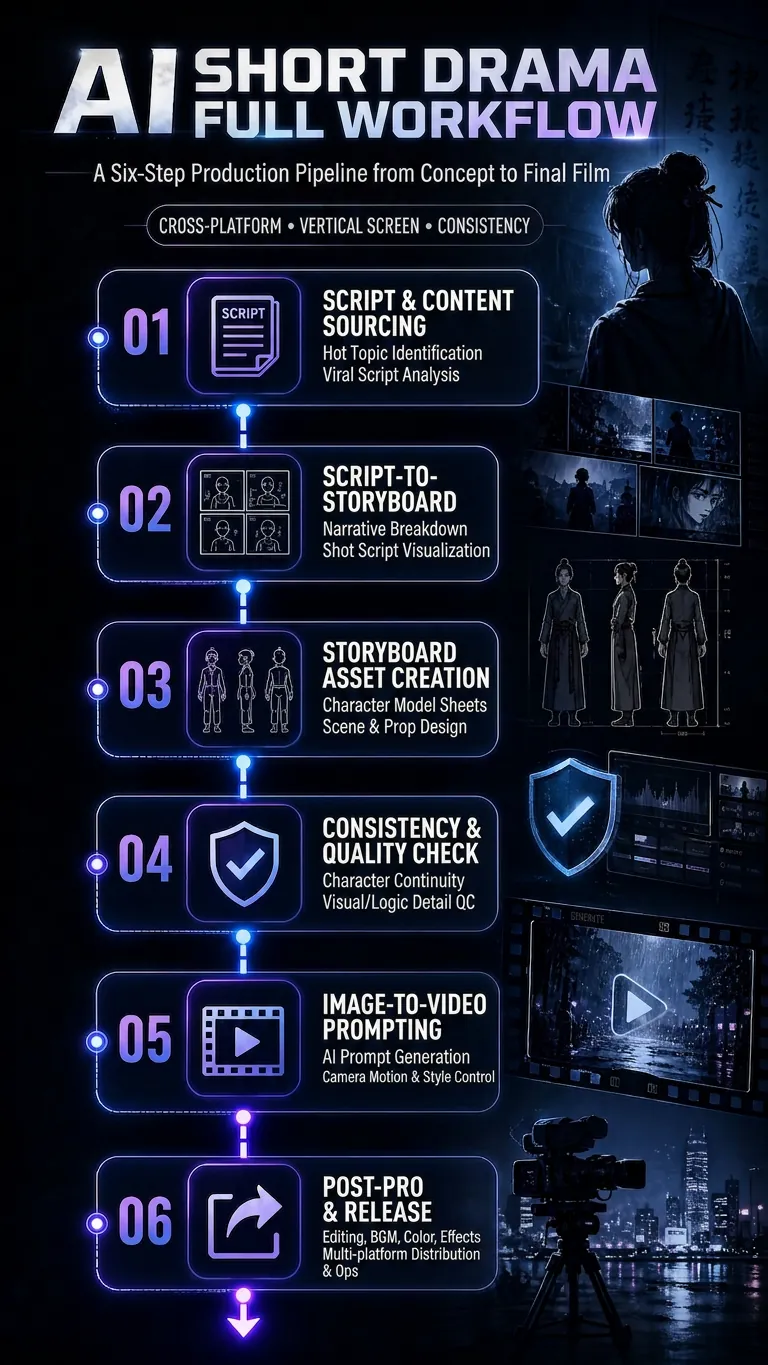
AI Short-Drama Workflow v5
Turn a concept, novel, or script into an executable AI video production plan, covering three formats: AI short drama, AI comic drama, and AI live-action drama. The Skill includes a complete six-step production pipeline: find scripts and hit copy → adapt the script into a shot list (including shot language and dialogue-duration adjustments) → design shot assets (character turnarounds, scene concept art with physical lighting, and material details) → consistency checks and pre-generation quality control (asset binding, cross-shot consistency, and P0/P1 blocking gates) → image-to-video prompts (Vidu/Jimeng/Doubao standard templates + Jimeng Seedance first/last-frame template) → final-cut production and publishing quality control. By default, the workflow uses no subtitles or background music, retaining only dialogue and necessary sound effects. Supports locked visual styles including realistic cinematic, 2D Chinese animation, and 3DCG Chinese animation. Designed for scaled production on vertical platforms such as Douyin, Kuaishou, WeChat Channels, and Xiaohongshu.

AI Short Play & Storyboard Gen
This is a set of full-process prompts for developing vertical short dramas, AI manga, and viral story content. It first confirms with the user the target total number of episodes, single episode duration, and generation method. Options include episode-by-episode confirmation, batch generation for a specified range, or one-time generation of the full script after authorization. The workflow covers topic research, core idea, outline, character biographies, episode planning, single/full episode script text, script quality check and revision. After the script is completed, it can be further converted into AI manga storyboard scripts, generating keyframe/storyboard base image prompts and image-to-video prompts for each shot. Suitable for short drama scriptwriters, AI manga creators, and story content teams.
 Write
WriteShort Drama Engine v2.0 · AFP
An episodic vertical short drama and comic drama writing system based on the AFP super-prompt architecture. Supports platforms including Douyin, Kuaishou, Hongguo, WeChat short dramas, and ReelShort, producing professional scripts with complete shot-by-shot directions. Includes a genre adaptation matrix (sweet romance and angst, comeback and revenge, time travel and rebirth, mystery and twists, and family drama), 30-second pacing rules, an end-of-episode hook library, paywall cliffhanger design, a character performance guidance system, and scene budget management. A four-core adversarial engine—screenwriter, sharp-tongued producer, audience simulator, and serialization manager—monitors quality in real time. Rolling-window memory management helps overcome context limits and supports long-form series of 60–100 episodes.
Information
- Version
- v4
- Last updated
- Runtime credits
- Usage-based
- Models
- Auto
- Use cases
- Writing & contentImages & designResearch & analysis
- What you get
- ReportPlan