B2B Collaboration Feasibility
Client Partnership & Business Profiling
B2B Collaboration Feasibility
Client Partnership & Business Profiling
Description
Input a client name, output a deal feasibility report ready for decision meetings. Process: Company profiling research → Value chain breakdown (including in-house/outsourcing assessment) → Scenario matching matrix → Hard constraint veto → Six-dimension weighted scoring (1-10) → Decision chain and 30/60/90-day action plan → Verification checklist. Produces both YouMind document and web report. Three key differences from ordinary client analysis: ① Will say 'no'. Things your solution cannot do are recorded in the 'Solution Profile', and boundary-crossing scenarios are directly vetoed, without masking through rhetoric. ② First determine whether the process is in-house or outsourced. No matter how painful the client's problem is, if that process has already been outsourced, the buyer is their supplier; the client entity has changed, and it must be assessed separately. ③ Check if value metrics can align. You talk about defect rate, the client talks about government assessment scores; proposals without a 'conversion rate' between the two languages will be rejected during financial review. Our capabilities are injected once via the 'Solution Profile' and reused long-term, applicable to any industry and any B2B solution (hardware/software/service/integration). Built-in value chain decomposition for seven types of industries: discrete manufacturing, retail chain, software/internet, B2B services & finance, energy & infrastructure, healthcare/education/government, and project-based integration, along with a mixed-ownership decision chain template. Every key piece of information is required to be labeled as fact/inference/unknown to avoid using inference as fact. Trigger words: client assessment, cooperation feasibility, client analysis, deal assessment, worth pursuing, can we take it, client screening.
Showcase
Related Skills
View all
Competitive Intel Analyst
Start with a broad view to build a persuasive competitor database, then focus the output on the company’s core business and decision-making needs. This elevates competitor research from “case hunting” to a decision basis that can be verified, compared, and acted on. This is not a prompt that merely lists a few competitors and stitches together webpage screenshots, nor one that crams every database detail into a PPT. “Competitive Intel Analyst” is suitable for consumer goods, technology products, software services, healthcare, education, retail, manufacturing, and other industries. It first defines the research scope and builds a multidimensional search framework covering markets, companies, products/services, user value, technology paths, business models, pricing and channels, intellectual property, partners, and evidence sources. It then creates a continuously updateable, deduplicated, traceable competitor database. Finally, based on the company’s core business, intended use cases, and leadership’s decision questions, it selects a small number of highly relevant benchmarks and produces a conclusion-first leadership briefing PPT, opportunity gaps, and an action roadmap. Suitable for: Panoramic scans of new markets or product categories Product planning, technology planning, and annual strategy research Tracking key competitors, patents, suppliers, or partner ecosystems Adding to, cleaning, and updating evidence in existing competitor databases or PPTs Investment, business development, and management decision briefings Condensing large volumes of material into conclusions that leaders can understand and teams can act on Typical deliverables include a complete competitor database, a shortlist of core competitors, a leadership briefing PPT, technology/patent/ecosystem maps (as needed), an opportunity and risk list, 90/180/365-day action roadmaps, and a source index.
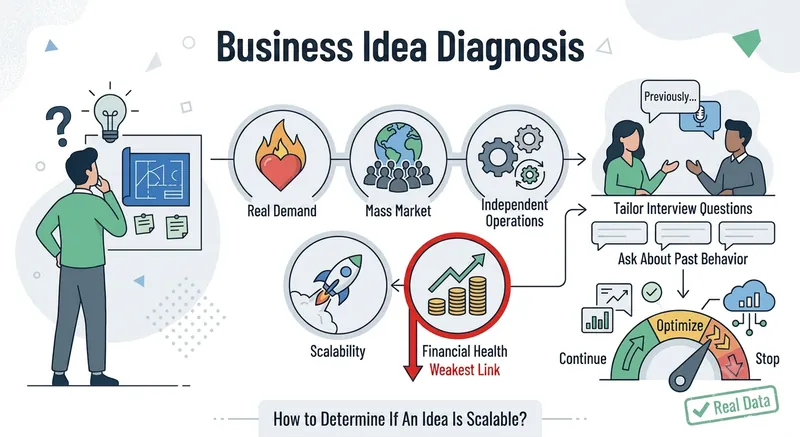
Can Your Business Idea Scale?
One-person company founders and side-hustle explorers: before you invest time and money, do a final calm check with customer data. Supports uploading business plans/BP (PDF/Word/PPT). Unlike the free version—which gives you a quick diagnosis and 3 interview questions to go talk to customers—the full version picks up after you've talked to customers: use customers' real answers (not your own feelings) to rescore the five switches, apply the one-vote veto system, automatically match validation experiments, GO gives a scaling roadmap, PIVOT gives a hypothesis adjustment path, and NO GO helps you extract reusable assets. If you haven't talked to customers yet, the full version can also give you interview questions directly—but it's recommended to first get the quick diagnosis and questions from the free version, talk to customers, and come back with their verbatim responses. The five switches: Is the need real? Can users represent the masses? Can it still run without you? What happens when you scale it 100x? Does selling more make more profit or more loss? If one switch breaks, the whole thing breaks—one-vote veto. Output includes: a customer-data-driven scoring report + 3 types of validation experiment plans (interview / landing page / Wizard of Oz, automatically matched) + GO → scaling roadmap + PIVOT → hypothesis adjustment path + NO GO → reusable asset extraction. Methodology: John List's The Voltage Effect + Rob Fitzpatrick's The Mom Test + Bland & Osterwalder's Testing Business Ideas.

Startup Opportunity Radar
Turn “I think this could make money” into “What evidence is worth testing?” Discover and screen early-stage business opportunities suited to solo businesses, micro-SaaS, AI tools, digital products, data products, physical goods based on supply chains, and transaction services. It starts with real user friction, substitute behaviors, payment actions, and industry changes, helping you avoid mistaking popular trends, search volume, or scattered complaints for genuine demand. You can ask it to scan for new startup directions, or submit a product idea, market, link, screenshot, plan, sales feedback, or historical opportunity list for an individual health check, validation design, or periodic review. The analysis distinguishes facts, inferences, assumptions, and opposing evidence. It examines buyers, use cases, competitive gaps, data and supply chain legality, customer acquisition channels, standardization potential, maintenance costs, and related liability risks. When evidence is insufficient, it states that clearly instead of inventing market size or purchase intent. You will receive a clear opportunity assessment, an evaluation of opportunity quality and user adoption readiness, and a minimum validation plan focused on the riskiest assumptions. This includes validation actions, a stage budget, the maximum acceptable loss, and criteria for proceeding or stopping. It helps you decide which opportunities are worth investigating further while allowing conclusions such as “monitor,” “gather more evidence,” or “do not pursue this cycle,” making startup investment more manageable and gradually building repeatably sellable products and long-term assets.
Information
- Last updated
- Runtime credits
- Usage-based
- Models
- Auto