
Plan Vulnerability Scanner
AI red-teams your plan to find hidden risks.
Plan Vulnerability Scanner
AI red-teams your plan to find hidden risks.
Showcase
Description
🛡️ **One-sentence value**: Enter your plan, proposal, or decision, and an AI red-team expert systematically surfaces every potential vulnerability, so you can see the risk before you fail. 🔍 **Core features**: - **Five-dimensional red-team scan**: logical assumptions, market and users, competition and substitutes, execution and resources, finance and profitability—attack from every angle - **Severity rating**: Critical🔴 / High🟠 / Medium🟡 / Low🟢—so you know what to tackle first - **Transparent attack logic**: every risk point includes the red team's reasoning, not guesswork - **Scoring system**: independent score for each of the five dimensions + an overall confidence score - **Actionable mitigation recommendations**: not just criticism—it tells you what to do 🎯 **Use cases**: - 📄 Business plan/BP: plug all logic gaps before meeting investors - 🚀 New product/feature planning: run a red-team test before launch to avoid pitfalls - 📊 Strategic decisions: assess risks in major decisions such as market entry, M&A, and transformation - 💰 Fundraising/budget proposals: find the most fragile assumptions in financial forecasts - 🏗️ Project execution plans: spot traps on the execution path before work begins 👩💼 **Who it's for**: founders, product managers, strategy leads, investors, project managers—anyone who needs to make decisions based on a plan.
Related Skills
View all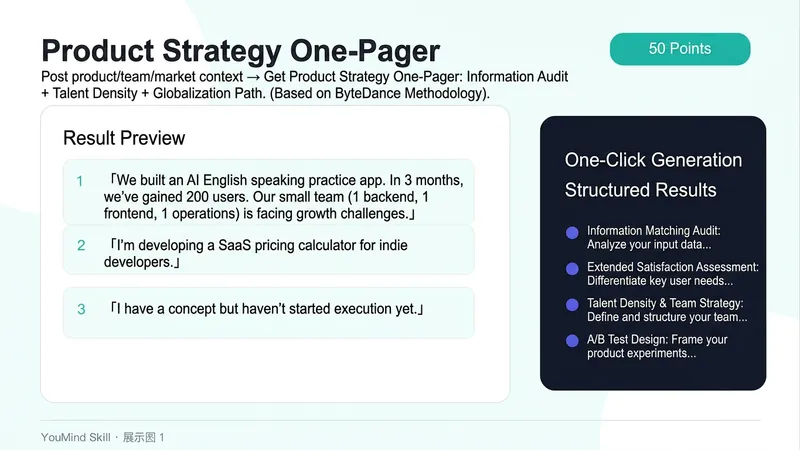
Product Strategy One-Pager
Building a product is like driving in the fog—what do users want? Is the team right? Should we go global? Which metric to optimize first? Every decision gambles the team's time and investors' money. Feed it your product info and data, and it uses ByteDance-style product methodology to help you clarify: What information and needs is your product matching? Are your current resources solving 'problems that will matter in three years' or 'urgent matters this month'? Is your team's talent density sufficient? What A/B tests can validate your core assumptions? ✨ Core Capabilities 1. Information match efficiency diagnosis: What is your product essentially matching? Where are the friction points? 2. Delayed gratification assessment: Distinguish 'important in three years' vs 'urgent this month', provide resource reallocation recommendations 3. Talent density and team strategy: Core role talent assessment + Context/Control boundary recommendations 4. A/B test design: Turn your gut assumptions into verifiable experimental plans 5. Global feasibility assessment: Language, culture, compliance, and payment four-dimensional check 📱 Use Cases - Early-stage startup teams making directional decisions - Product managers' quarterly reviews and strategy adjustments - Investors quickly evaluating a project's product logic - Developers building side projects validating ideas It doesn't give you a standard answer—it gives you a framework to ask the right questions.

Startup Opportunity Radar
Turn “I think this could make money” into “What evidence is worth testing?” Discover and screen early-stage business opportunities suited to solo businesses, micro-SaaS, AI tools, digital products, data products, physical goods based on supply chains, and transaction services. It starts with real user friction, substitute behaviors, payment actions, and industry changes, helping you avoid mistaking popular trends, search volume, or scattered complaints for genuine demand. You can ask it to scan for new startup directions, or submit a product idea, market, link, screenshot, plan, sales feedback, or historical opportunity list for an individual health check, validation design, or periodic review. The analysis distinguishes facts, inferences, assumptions, and opposing evidence. It examines buyers, use cases, competitive gaps, data and supply chain legality, customer acquisition channels, standardization potential, maintenance costs, and related liability risks. When evidence is insufficient, it states that clearly instead of inventing market size or purchase intent. You will receive a clear opportunity assessment, an evaluation of opportunity quality and user adoption readiness, and a minimum validation plan focused on the riskiest assumptions. This includes validation actions, a stage budget, the maximum acceptable loss, and criteria for proceeding or stopping. It helps you decide which opportunities are worth investigating further while allowing conclusions such as “monitor,” “gather more evidence,” or “do not pursue this cycle,” making startup investment more manageable and gradually building repeatably sellable products and long-term assets.
 Research
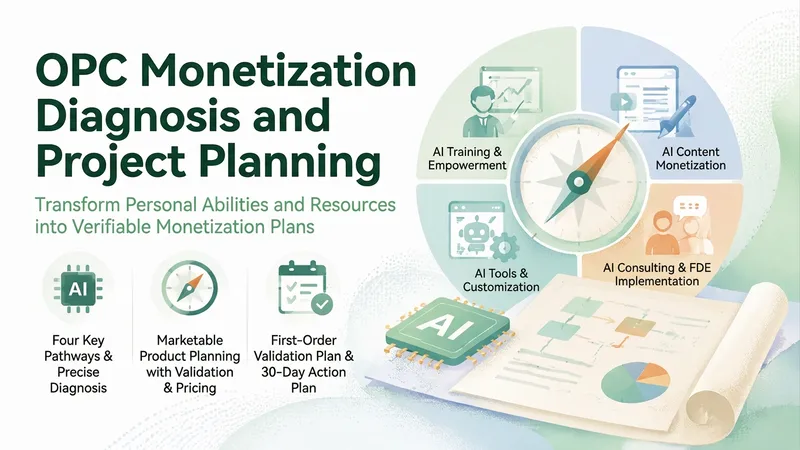
OPC Monetization Planner
A monetization diagnosis and planning assistant for solo entrepreneurs (OPCs) in the AI era. Enter your professional experience, skills, reachable customer resources, available time, and budget; if you already have a project, add its current status and validation results. The Skill first reviews your existing strengths and key gaps, asking only the critical questions that affect the assessment when information is missing. It then compares four monetization paths: AI training and enablement, AI content monetization, custom AI tools and agents, and AI consulting and FDE implementation services. You’ll receive a concise diagnosis with one primary recommendation, one alternative, the biggest obstacle, and the core assumption to validate first. After you choose a direction, it designs a minimum sellable product—including target customers, deliverables and acceptance criteria, service boundaries, trial pricing and cost assumptions, and a repeat-purchase strategy—then provides a first-customer validation plan covering channels, interview questions, outreach scripts, and criteria for assessing willingness to pay, along with a 30-day action plan. The result is a complete, saveable plan. Suitable for beginners exploring from scratch, career changers with industry experience, and entrepreneurs with existing projects. No income guarantees are made, market data is never fabricated, and all policy, market, and salary information must be verified.
Information
- Version
- v2
- Last updated
- Runtime credits
- Usage-based
- Models
- Auto
