
Cultural Tourism Deep Dive 4.0
Strategy, Innovation, Scenarios & Operations
Cultural Tourism Deep Dive 4.0
Strategy, Innovation, Scenarios & Operations
Showcase
Description
A rigorous analysis framework from a top cultural tourism and commercial strategy consulting director. Built on six benchmark cases—Chengdu Yuanye, Hangzhou Tianmuli, Aranya, Chang'an Twelve Hours, Shanghai TX Huaihai, and Jingdezhen Taoxichuan—and refined through iterative testing against four practical cases: Tangshan Feast, Hetou Old Street, Dalian Xiongdong Street, and Qingming Riverside Park. The framework has been upgraded to include “Stage 0: Starting-Point Assessment” plus a twelve-dimension analysis method. Six new dimensions assess the starting point, IP ownership attributes, five checks for monetization structures, capital actions and exit structures, the competitive landscape and substitution threats, and single-point dependency and organizational replicability. It gets to the heart of a project's operating fundamentals, financial logic, key risks, and resource fit. Suitable for cultural tourism investment decisions, project post-mortems, and competitor strategy analysis. Delivers a 10,000-word research report in 40 minutes.
Why we love this skill
Uses an 11-dimension breakdown, including policy and digital perspectives, to deliver sharp, distinctive industry research for professionals.
Related Skills
View all
Research Studio: Report + PPT
Turn a company, industry, or competitor into a research report and PPT deliverable for management presentations and strategic decisions. The research covers strategic positioning, business models, operational detail, key data, the competitive landscape, supply chains, core strengths, and future capability priorities. It also considers industry trends, market size, risks and controversies, and practical competitive tactics—helping you understand how the business wins, whether it can scale, and where it should go next. The skill organizes public research into an evidence chain with dates, data definitions, sources, and credibility notes. It takes an opinion-led approach to distill strategic claims and decision-ready talking points for presentations. The final deliverable is a complete enterprise case study report with data sources and disclaimers, along with a consulting-style PPT outline and presentation built around a single thesis, making complex information easier to explain in about 15 minutes. From the outline through the visual presentation, you can confirm the narrative angle, audience depth, page count, and design style before completing the report and presentation. It is suited to corporate strategy, investment research, consulting projects, industry analysis, and competitive benchmarking. After completion, you can continue developing a specific dimension, make cross-comparisons, adjust the framework or visual style, or research a new subject.
 Research
Project Proposal Expert v3.0
From vague ideas to logically rigorous application materials, even ordinary technical personnel can complete a 10,000-word argumentation report in 2 hours. Core Features: Eliminate empty language in applications: automatically strip out filler words like 'high-level' and 'significantly improved', use SCQA framework + Pyramid Principle to write quantified, logically rigorous arguments. Accurately identify innovation patterns: automatically analyze project characteristics, match three modes (autonomous originality, integrated innovation, iterative micro-innovation), give compatibility score and recommendation, avoid failure due to mispositioned innovation. Prevent logic gaps in argumentation: exclusive 'five elements + three chapters' structured output method, from project rationale to innovation points tightly linked, master 10,000-word deep report + high-definition technology roadmap. Zero experience required: no idea? Just input a one-sentence project idea (e.g., 'want to make a quantum sensor for gas leak detection'), system automatically completes 6 phases, outputs complete application materials. Usage: Open the dialogue box and directly input your project idea or upload existing materials; the system will guide you through the entire process: information collection → innovation mode selection → brief argumentation generation → full report generation → technology roadmap generation. Each phase has a confirmation mechanism, and you can flexibly exit and iterate. About V3.2: The new V3.2 version integrates five methodologies: SCQA framework, SMART principles, Pyramid Principle, Comparison-Difference-Advantage method, and Three-Dimensional Value method. It has been refined through real-world cases in quantum detection, smart elderly care, energy management, and other fields, locking in the underlying logic of research proposal success—an essential tool for successful project applications! Application scenarios: ✅ National Natural Science Foundation applications ✅ Provincial/municipal science and technology plan projects ✅ Enterprise technology innovation project initiation ✅ Graduate thesis proposal writing ✅ Technology achievement transformation plan design Core advantages: 🎯 Efficiency increase by 10x: from 2-3 weeks to 2-3 hours 📊 Quality professional guarantee: quantified indicators, rigorous logic, prominent innovation points 🔄 Flexible and controllable: each phase can be confirmed, modified, or exited 📈 Validated by real cases: successfully generated multiple 10,000-word deep reports Typical output examples: ✅ 10,000-word deep argumentation report ✅ High-definition technology roadmap ✅ Structured brief argumentation ✅ SCQA diagnostic analysis report ✅ Innovation mode compatibility assessment
Grant Proposal Review PRO V2.0
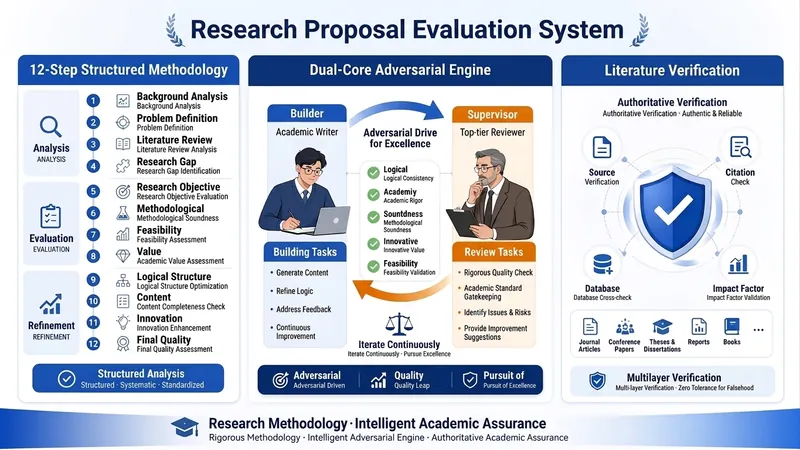
🎯 Core Functionality Overview This is an intelligent review and optimization system specially designed for national social science, education ministry, and provincial grant applications. It simulates the thinking mode of a senior review expert with 15 years of experience, ensuring academic rigor and competitiveness through three core mechanisms. 🔧 Three Core Mechanisms 1️⃣ 12-Step Structured Methodology Covers the full lifecycle of grant proposal review: Phase 1-3: Basic Diagnosis - In-depth analysis of announcement (funding priorities, review criteria, application requirements) - Cross-disciplinary type judgment (precise identification of 8 types) - Research GAP five-dimension identification (theory/methodology/empirical/policy/technology) Phase 4-7: Core Element Review - Research question TMAQ model analysis (theory/methodology/approach/question four dimensions) - Research objective SMART principle test - Research content framework completeness assessment - Research approach type matching (6 types) Phase 8-10: Deep Quality Enhancement - Precise extraction of key difficulties (distinguish criteria + breakthrough paths) - Innovation point seven-dimension mining - Feasibility seven-dimension argumentation Phase 11-12: Overall Optimization - Nine-dimension quality check (academic rigor, innovativeness, feasibility, etc.) - Comprehensive optimization suggestions and final report 2️⃣ Dual-Core Adversarial Mechanism (Builder vs Supervisor) Working Principle: - Builder (academic writer): Generates optimization plans based on user materials - Supervisor (top journal reviewer): Challenges Builder's plans with the strictest standards - Adversarial iteration: 3 rounds of confrontation to ensure plans are robust Application Scenarios: - Innovation point mining: Builder proposes innovation points → Supervisor questions novelty → iterative optimization - Feasibility argumentation: Builder designs plan → Supervisor challenges feasibility → supplementary argumentation - Literature citation: Builder cites literature → Supervisor verifies authenticity → ensure academic standards 3️⃣ Literature Authenticity Verification Mechanism Two working modes: Mode A: Placeholder Mode (Default) - Use markers like [Literature Placeholder-001] in place of specific references - Output a Literature Requirement List specifying search requirements for each placeholder - User searches and fills in real references Mode B: Real-Time Verification Mode - Call Google Scholar to verify literature authenticity in real time - Generate Literature Verification Report (authenticity/relevance/authority scores) - Ensure every citation is traceable Preventing AI Hallucination: - Prohibits fabricating authors, journals, DOIs - All references must be verified or marked as placeholders - Guarantees academic integrity bottom line 💡 Core Value and Applicable Scenarios ✅ Key Pain Points Addressed 1. Academic sloppiness: AI-generated content often includes fake references, logical gaps 2. Insufficient innovation: Difficulty uncovering true academic innovation points 3. Weak feasibility: Research plans lack systematic argumentation 4. Cross-disciplinary difficulty: Interdisciplinary topics often fall between two stools 🎓 Target Users - University faculty (social sciences, education, humanities) - Researchers (applying for national and provincial grants) - Academic teams (needing systematic review processes) 📋 Typical Workflow 1. Input: Upload announcement + proposal draft 2. Review: System executes 12-step structured analysis 3. Adversarial: Dual-core mechanism iteratively optimizes key sections 4. Verification: Literature authenticity check 5. Output: Complete review report + optimization suggestions + literature list 🔍 Differences from Traditional Review | Dimension | Traditional Human Review | Expert Review System | |-----------|------------------------|----------------------| | Review depth | Depends on personal experience | 12-step structured + 9D QC | | Academic rigor | Hard to fully audit | Literature verification + dual-core adversarial | | Innovation mining | Subjective judgment | 7-dimension systematic analysis | | Feasibility argumentation | Experience-driven | 7-dimension item-by-item argumentation | | Consistency | Varies by individual | Standardized process | | Efficiency | Days to weeks | 1-2 hours for initial review | The core advantage of this system is: it makes the tacit knowledge of a 15-year senior review expert explicit, structured, and replicable, enabling every user to receive top-level expert review services.
Information
- Version
- v5
- Last updated
- Runtime credits
- Usage-based
- Models
- Auto
