GB/T 7714-2025 Citation Doctor
Check & fix references to GB/T 7714-2025
Description
Still worried about references being full of errors when writing papers? Every graduation season, format irregularities, incomplete citation entries, and even AI-generated fake references—these problems are time-consuming and hard to catch when checked manually. GB/T 7714-2025 Citation Doctor is designed for this, helping you handle it all in one go. 📄 Multiple input methods, flexible access — directly paste reference text, or upload full paper in PDF, DOC, or DOCX format. It automatically locates the reference section and parses each entry, no manual extraction needed. 🔍 Dual-engine authenticity check — Chinese references are automatically verified against CNKI, English references via Google Scholar. Each entry is checked for author, title, journal, year, volume, issue, and page numbers, accurately labeled as match, partial match, or unverifiable. AI-generated fake references are exposed. ✅ Full-dimension format validation — Strictly adheres to the latest GB/T 7714-2025 standards, covering 8 dimensions: document type identifiers, author formatting, punctuation, completeness of journal/monograph/electronic resources, capitalization in English, numbering order, etc. No detail is overlooked. 📊 Visual reports at a glance — Auto-generates an HTML report with color-coded markers. Part 1 shows inspection results per entry (format status + authenticity result + correction suggestions). Part 2 directly outputs the corrected full reference list, ready to copy into your final paper. 💎 In a nutshell From format correction to fake reference detection, from document parsing to report output—fully automated. Your reference quality no longer depends on manual checks.
Related Skills
View all
Reference Matching Expert
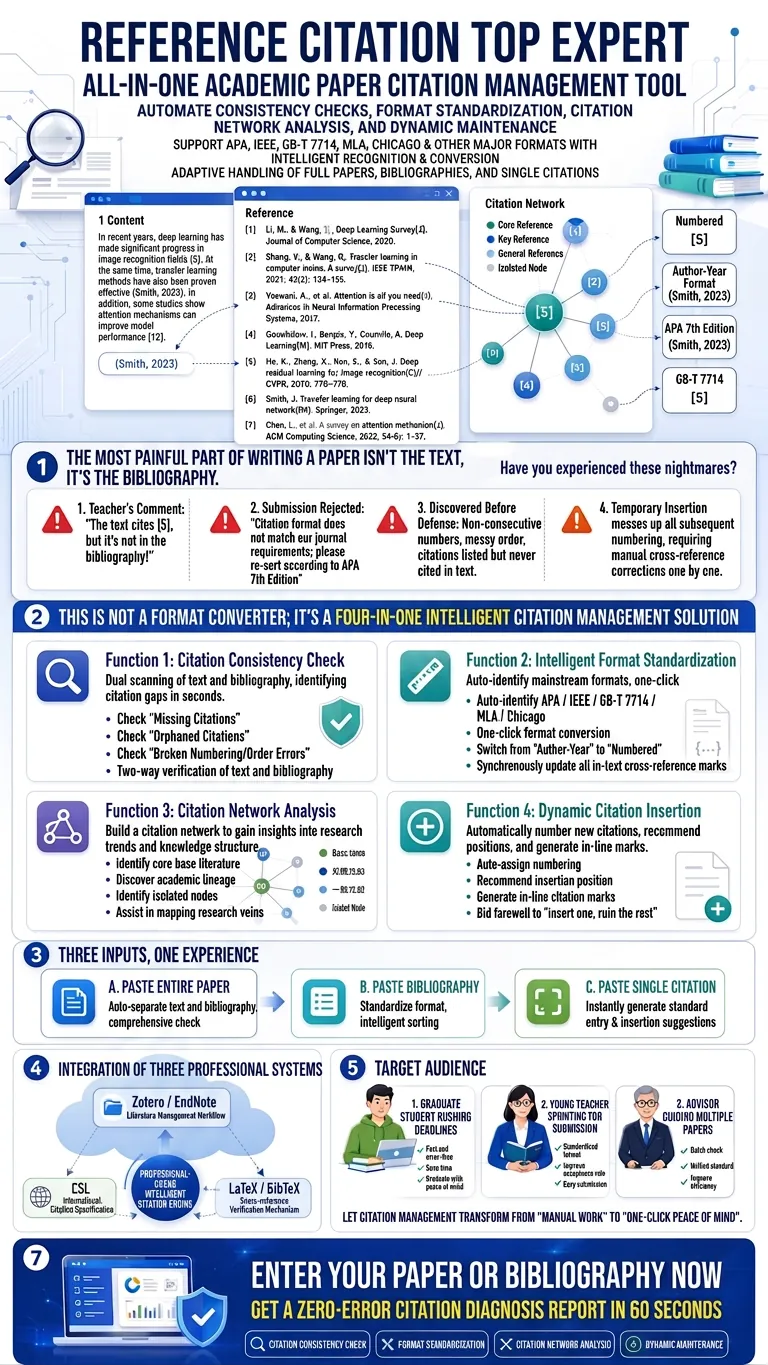
A comprehensive academic paper cross-reference management tool that automates citation consistency checks, format standardization, citation relationship analysis, and dynamic citation maintenance. Supports intelligent recognition and conversion of mainstream citation formats including APA/IEEE/GB-T 7714/MLA/Chicago. Adaptively handles three input forms: full paper, reference list, and single citation. Integrates Zotero/EndNote reference management workflows, Citation Style Language international standards, and LaTeX/BibTeX cross-reference verification mechanisms. "The most painful part of writing a paper isn't the text—it's the references." Have you experienced these nightmares? Advisor's comment: "You cited [5] in the text, but it's not in the reference list!" Rejection: "Citation format does not meet journal requirements. Please reformat according to APA 7th edition." Discovery before the defense: Reference numbers are non-sequential, order is chaotic, and some references are never cited but still in the list. Inserting a new reference mid-paper messes up all subsequent numbers, requiring manual correction of every cross-reference. 【Reference Citation Expert】—— Your academic writing 'citation immune system'. This is not a format converter; it's a four-in-one intelligent citation management solution: 🔍 Feature 1: Citation Consistency Check — Bidirectional scan of text and reference list, instantly locating missing citations, orphan references, and broken numbering. No citation gap can hide. 📐 Feature 2: Smart Formatting — Automatically identifies APA/IEEE/GB-T 7714/MLA/Chicago formats, converts with one click, and updates all cross-reference markers simultaneously. Switch from author-year to numeric style without manual effort. 🕸️ Feature 3: Citation Relationship Analysis — Builds a citation network by connecting to online resources, identifying core foundational papers, academic lineage, and isolated nodes, helping you map research connections. ➕ Feature 4: Dynamic Citation Insertion — New references are automatically numbered, insertion points recommended, and inline citation markers generated. No more 'one insertion wreaks havoc on the whole document.' Three inputs, one experience: Paste entire paper → automatically separate text and reference list, full check Paste reference list → unify format, smart sorting Paste single citation → instantly generate standardized entry and insertion suggestions Integrating three major professional systems: Zotero/EndNote workflows × CSL international citation standards × LaTeX/BibTeX cross-reference verification. Whether you're a graduate student racing a deadline, a young faculty member rushing to submit, or a supervisor guiding multiple papers— Turn citation management from 'manual labor' to 'one-click peace of mind.' Now input your paper or reference list and get a zero-error citation diagnostic report in 60 seconds.

ResearchAcademic Paper Writing v4.1
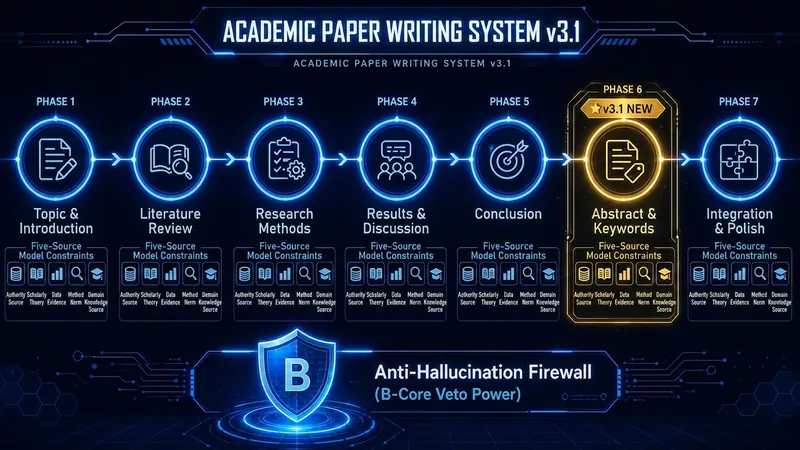
A full-process academic paper writing system that combines the Five Sources model with the AFP 3.1 three-layer architecture. Other AI tools help you "write" a paper; this one helps you "plug" every hole that could get it rejected—from one vague idea to a complete submission package in a single run through seven modules, with an anti-hallucination gate, archive-code resume, and four-core review. [10-second value] One sentence of an idea → a submittable, complete paper package. Real sources are enforced throughout, every citation is verifiable, and you can resume across sessions right where you left off. [Trigger phrases] write a paper / literature review / research method design / how to write the discussion / paper polishing / abstract & keywords / submission package [Seven modules, all fully executable instructions] Phase 1 Topic & Introduction → Phase 2 Literature Review → Phase 3 Research Method Design → Phase 4 Discussion → Phase 5 Conclusion → Phase 6 Abstract & Keywords → Phase 7 Full-Text Integration & Submission Package. Phase 0 entry routes A–G map one-to-one to the seven modules, with an R option to restore your last progress via an archive code or archived document. [v4.1 upgrades] 1. Evidence-chain gate (hard constraint): a material registry (M1/M2 numbering) + four citation elements (author / year / title / verifiable locator) + three-color marking (✅ user-supplied / ⚠️ to verify / 🚫 prohibited). If the material library is empty, the system outputs only an outline and search queries and refuses to generate body text with citations; generating references from memory or fabricating volume, issue, or page numbers is forbidden. 2. Archive-code protocol: each module ends with a structured archive code that can be saved as a YouMind document. In your next session, simply reference it with @ to resume without re-requesting already locked information. 3. Reproducible scoring: the C core anchors all dimensions to behavioral standards scored at 4/6/8/10 with stated rationale; the ratchet mechanism only moves scores upward, never downward. 4. Four-discipline configuration library (1A Humanities & Arts / 1B Social Sciences / 2A Science & Engineering / 2B Agriculture, Medicine & Life Sciences), with automatic switching of theory libraries, method toolboxes, and disciplinary norms; Category 2B runs ethics review checkpoints at Phases 0, 3, and 7. 5. Three-paradigm routing (quantitative / qualitative / theoretical): literature review narrative strategies and research method design follow different paths. 6. Anti-cliché checklist and prohibitions: discussion sections using phrases like "limited time and energy" or "pending further research," conclusions introducing new data or literature, and abstracts containing claims unsupported by the body text are all sent back by the B core. 7. Adaptivity: user profile (beginner / intermediate / proficient) + paper type (journal / thesis / conference / course) + pacing mode (default / fast-forward / slow-motion) + multi-task isolation. 8. Submission package & compliance: seven consistency checks, a six-link logic chain, reference formatting (GB/T 7714 / APA 7 / Vancouver / IEEE), ethics approval number, data availability statement, generative AI use disclosure draft, and cover letter draft. [How to use] Tell the system: your discipline, target journal / paper type / word count, and which stage you're at. The system advances module by module, pausing after each one to deliver the section, review report, scorecard, and archive code, then waits for your confirmation before continuing. [Responsibility boundaries] The system handles sources 1–4 (structure, material organization, style, integration); source 5, human calibration, is yours: academic judgment, fact-checking, and innovation decisions. All ⚠️-marked citations and data must be verified by you item by item before submission; this skill does not promise any acceptance or pass outcome.
WriteAIGC Reduction & Rewrite v7.0
📚 Academic Paper AIGC Reduction and Quality-Preserving Rewriting Expert v7.0 Designed for graduate students, researchers, and paper authors, this academic text optimization skill operates on a core closed loop of 'source control → process correction → result verification → reverse self-check → iterative re-check'. It systematically diagnoses and optimizes issues such as templated expressions, mechanical logic, vague content, inaccurate terminology, and style inconsistencies while preserving original meaning, technical terms, data, and core conclusions. 🔍📝 🌟 Core Capabilities 🔬 Multi-layer Risk Diagnosis Covers 10 types of universal text fingerprints and assists in identifying common expression patterns of models such as ChatGPT, Claude, DeepSeek, and Wenxin Yiyan. 🧠 Deep Semantic Restructuring Goes beyond synonym replacement to rebuild more natural and in-depth academic reasoning by adjusting proposition expression, information order, argument approach, and evidence organization. ✍️ Quality-Preserving Rewriting Comprehensively applies 13 sentence transformation strategies and 20 methods for cleaning high-frequency templated expressions, improving mechanical sentence structures, repetitive connectors, and overly rigid formatting. 📊 Full-text Structure Diagnosis Through macro-cycle and five key triangles, checks whether research problems, theory, literature review, methods, results, conclusions, and innovation form a complete closed loop. 🧩 Fine-grained Section Adaptation Develops differentiated diagnostic and rewriting strategies for abstract, introduction, literature review, research methods, results, discussion, and conclusion respectively. 🌐 Cross-language Risk Scanning Assists in identifying translationese, passive voice stacking, long sentence nesting, and mixed Chinese-English formatting abnormalities to make Chinese academic expression more natural and accurate. 🔄 Reverse Self-check Loop After rewriting, re-verifies from three aspects: technique distribution, new text fingerprints, and information integrity, to avoid 'becoming more templated' or losing key content. 🛡️ Academic Integrity Protection Does not fabricate literature, data, cases, or policy evidence; separately marks information requiring author verification and reminds users to honestly disclose AI usage. 🎯 Use Cases ✅ Single paragraph or partial section optimization ✅ Targeted modification of marked paragraphs from inspection reports ✅ Polishing of abstract, introduction, literature review, discussion, and conclusion ✅ Full-text AIGC risk feature diagnosis ✅ Language and structure adaptation for target journals ✅ Pre-submission quality review and consistency check 📦 Final Deliverables 📄 Quality-preserving rewritten text 🔎 Risk and issue diagnosis report 🛠️ Rewriting strategy and technique description ✅ Reverse self-check and information integrity report 💡 Items requiring author verification and subsequent revision suggestions 🎓 Original meaning preserved · Logic intact · No fabricated data · Academic quality maintained ⚠️ This skill aims to improve academic expression quality and reduce text risk features. It does not guarantee passage through any specific detection platform or achieving a particular detection score.
GB/T 7714-2025 Citation Doctor
Check & fix references to GB/T 7714-2025
Description
Still worried about references being full of errors when writing papers? Every graduation season, format irregularities, incomplete citation entries, and even AI-generated fake references—these problems are time-consuming and hard to catch when checked manually. GB/T 7714-2025 Citation Doctor is designed for this, helping you handle it all in one go. 📄 Multiple input methods, flexible access — directly paste reference text, or upload full paper in PDF, DOC, or DOCX format. It automatically locates the reference section and parses each entry, no manual extraction needed. 🔍 Dual-engine authenticity check — Chinese references are automatically verified against CNKI, English references via Google Scholar. Each entry is checked for author, title, journal, year, volume, issue, and page numbers, accurately labeled as match, partial match, or unverifiable. AI-generated fake references are exposed. ✅ Full-dimension format validation — Strictly adheres to the latest GB/T 7714-2025 standards, covering 8 dimensions: document type identifiers, author formatting, punctuation, completeness of journal/monograph/electronic resources, capitalization in English, numbering order, etc. No detail is overlooked. 📊 Visual reports at a glance — Auto-generates an HTML report with color-coded markers. Part 1 shows inspection results per entry (format status + authenticity result + correction suggestions). Part 2 directly outputs the corrected full reference list, ready to copy into your final paper. 💎 In a nutshell From format correction to fake reference detection, from document parsing to report output—fully automated. Your reference quality no longer depends on manual checks.
Related Skills
View all
Reference Matching Expert
A comprehensive academic paper cross-reference management tool that automates citation consistency checks, format standardization, citation relationship analysis, and dynamic citation maintenance. Supports intelligent recognition and conversion of mainstream citation formats including APA/IEEE/GB-T 7714/MLA/Chicago. Adaptively handles three input forms: full paper, reference list, and single citation. Integrates Zotero/EndNote reference management workflows, Citation Style Language international standards, and LaTeX/BibTeX cross-reference verification mechanisms. "The most painful part of writing a paper isn't the text—it's the references." Have you experienced these nightmares? Advisor's comment: "You cited [5] in the text, but it's not in the reference list!" Rejection: "Citation format does not meet journal requirements. Please reformat according to APA 7th edition." Discovery before the defense: Reference numbers are non-sequential, order is chaotic, and some references are never cited but still in the list. Inserting a new reference mid-paper messes up all subsequent numbers, requiring manual correction of every cross-reference. 【Reference Citation Expert】—— Your academic writing 'citation immune system'. This is not a format converter; it's a four-in-one intelligent citation management solution: 🔍 Feature 1: Citation Consistency Check — Bidirectional scan of text and reference list, instantly locating missing citations, orphan references, and broken numbering. No citation gap can hide. 📐 Feature 2: Smart Formatting — Automatically identifies APA/IEEE/GB-T 7714/MLA/Chicago formats, converts with one click, and updates all cross-reference markers simultaneously. Switch from author-year to numeric style without manual effort. 🕸️ Feature 3: Citation Relationship Analysis — Builds a citation network by connecting to online resources, identifying core foundational papers, academic lineage, and isolated nodes, helping you map research connections. ➕ Feature 4: Dynamic Citation Insertion — New references are automatically numbered, insertion points recommended, and inline citation markers generated. No more 'one insertion wreaks havoc on the whole document.' Three inputs, one experience: Paste entire paper → automatically separate text and reference list, full check Paste reference list → unify format, smart sorting Paste single citation → instantly generate standardized entry and insertion suggestions Integrating three major professional systems: Zotero/EndNote workflows × CSL international citation standards × LaTeX/BibTeX cross-reference verification. Whether you're a graduate student racing a deadline, a young faculty member rushing to submit, or a supervisor guiding multiple papers— Turn citation management from 'manual labor' to 'one-click peace of mind.' Now input your paper or reference list and get a zero-error citation diagnostic report in 60 seconds.
ResearchAcademic Paper Writing v4.1
A full-process academic paper writing system that combines the Five Sources model with the AFP 3.1 three-layer architecture. Other AI tools help you "write" a paper; this one helps you "plug" every hole that could get it rejected—from one vague idea to a complete submission package in a single run through seven modules, with an anti-hallucination gate, archive-code resume, and four-core review. [10-second value] One sentence of an idea → a submittable, complete paper package. Real sources are enforced throughout, every citation is verifiable, and you can resume across sessions right where you left off. [Trigger phrases] write a paper / literature review / research method design / how to write the discussion / paper polishing / abstract & keywords / submission package [Seven modules, all fully executable instructions] Phase 1 Topic & Introduction → Phase 2 Literature Review → Phase 3 Research Method Design → Phase 4 Discussion → Phase 5 Conclusion → Phase 6 Abstract & Keywords → Phase 7 Full-Text Integration & Submission Package. Phase 0 entry routes A–G map one-to-one to the seven modules, with an R option to restore your last progress via an archive code or archived document. [v4.1 upgrades] 1. Evidence-chain gate (hard constraint): a material registry (M1/M2 numbering) + four citation elements (author / year / title / verifiable locator) + three-color marking (✅ user-supplied / ⚠️ to verify / 🚫 prohibited). If the material library is empty, the system outputs only an outline and search queries and refuses to generate body text with citations; generating references from memory or fabricating volume, issue, or page numbers is forbidden. 2. Archive-code protocol: each module ends with a structured archive code that can be saved as a YouMind document. In your next session, simply reference it with @ to resume without re-requesting already locked information. 3. Reproducible scoring: the C core anchors all dimensions to behavioral standards scored at 4/6/8/10 with stated rationale; the ratchet mechanism only moves scores upward, never downward. 4. Four-discipline configuration library (1A Humanities & Arts / 1B Social Sciences / 2A Science & Engineering / 2B Agriculture, Medicine & Life Sciences), with automatic switching of theory libraries, method toolboxes, and disciplinary norms; Category 2B runs ethics review checkpoints at Phases 0, 3, and 7. 5. Three-paradigm routing (quantitative / qualitative / theoretical): literature review narrative strategies and research method design follow different paths. 6. Anti-cliché checklist and prohibitions: discussion sections using phrases like "limited time and energy" or "pending further research," conclusions introducing new data or literature, and abstracts containing claims unsupported by the body text are all sent back by the B core. 7. Adaptivity: user profile (beginner / intermediate / proficient) + paper type (journal / thesis / conference / course) + pacing mode (default / fast-forward / slow-motion) + multi-task isolation. 8. Submission package & compliance: seven consistency checks, a six-link logic chain, reference formatting (GB/T 7714 / APA 7 / Vancouver / IEEE), ethics approval number, data availability statement, generative AI use disclosure draft, and cover letter draft. [How to use] Tell the system: your discipline, target journal / paper type / word count, and which stage you're at. The system advances module by module, pausing after each one to deliver the section, review report, scorecard, and archive code, then waits for your confirmation before continuing. [Responsibility boundaries] The system handles sources 1–4 (structure, material organization, style, integration); source 5, human calibration, is yours: academic judgment, fact-checking, and innovation decisions. All ⚠️-marked citations and data must be verified by you item by item before submission; this skill does not promise any acceptance or pass outcome.
WriteAIGC Reduction & Rewrite v7.0
📚 Academic Paper AIGC Reduction and Quality-Preserving Rewriting Expert v7.0 Designed for graduate students, researchers, and paper authors, this academic text optimization skill operates on a core closed loop of 'source control → process correction → result verification → reverse self-check → iterative re-check'. It systematically diagnoses and optimizes issues such as templated expressions, mechanical logic, vague content, inaccurate terminology, and style inconsistencies while preserving original meaning, technical terms, data, and core conclusions. 🔍📝 🌟 Core Capabilities 🔬 Multi-layer Risk Diagnosis Covers 10 types of universal text fingerprints and assists in identifying common expression patterns of models such as ChatGPT, Claude, DeepSeek, and Wenxin Yiyan. 🧠 Deep Semantic Restructuring Goes beyond synonym replacement to rebuild more natural and in-depth academic reasoning by adjusting proposition expression, information order, argument approach, and evidence organization. ✍️ Quality-Preserving Rewriting Comprehensively applies 13 sentence transformation strategies and 20 methods for cleaning high-frequency templated expressions, improving mechanical sentence structures, repetitive connectors, and overly rigid formatting. 📊 Full-text Structure Diagnosis Through macro-cycle and five key triangles, checks whether research problems, theory, literature review, methods, results, conclusions, and innovation form a complete closed loop. 🧩 Fine-grained Section Adaptation Develops differentiated diagnostic and rewriting strategies for abstract, introduction, literature review, research methods, results, discussion, and conclusion respectively. 🌐 Cross-language Risk Scanning Assists in identifying translationese, passive voice stacking, long sentence nesting, and mixed Chinese-English formatting abnormalities to make Chinese academic expression more natural and accurate. 🔄 Reverse Self-check Loop After rewriting, re-verifies from three aspects: technique distribution, new text fingerprints, and information integrity, to avoid 'becoming more templated' or losing key content. 🛡️ Academic Integrity Protection Does not fabricate literature, data, cases, or policy evidence; separately marks information requiring author verification and reminds users to honestly disclose AI usage. 🎯 Use Cases ✅ Single paragraph or partial section optimization ✅ Targeted modification of marked paragraphs from inspection reports ✅ Polishing of abstract, introduction, literature review, discussion, and conclusion ✅ Full-text AIGC risk feature diagnosis ✅ Language and structure adaptation for target journals ✅ Pre-submission quality review and consistency check 📦 Final Deliverables 📄 Quality-preserving rewritten text 🔎 Risk and issue diagnosis report 🛠️ Rewriting strategy and technique description ✅ Reverse self-check and information integrity report 💡 Items requiring author verification and subsequent revision suggestions 🎓 Original meaning preserved · Logic intact · No fabricated data · Academic quality maintained ⚠️ This skill aims to improve academic expression quality and reduce text risk features. It does not guarantee passage through any specific detection platform or achieving a particular detection score.
Find your next favorite skill
Explore more curated AI skills for research, creation, and everyday work.