Evidence-Based 'Court' Pro
Evidence-Based 'Court' Pro
Showcase
Description
'Does milk cause cancer?' 'Can foam rollers eliminate lactic acid?' 'Will eating before bed make you gain weight?' — Your social feed judges your lifestyle every day, but who judges these rumors themselves? Evidence-Based 'Court' Pro is a complete health rumor trial system. Enter any controversial claim, and the AI evidence judge automatically opens court: ⚖️ Real-time search of latest academic papers, evidence confrontation between prosecution and defense ⚖️ Simulates the full courtroom process: prosecution presents evidence → defense presents evidence → cross-examination → jury deliberation → final verdict ⚖️ Each piece of evidence is annotated with author, journal, year, and DOI—100% verifiable ⚖️ Exclusive 'Deep Citation Tracing' technology uncovers hidden evidence beyond ordinary search ⚖️ One-click generation of shareable 'verdict cards' optimized for Xiaohongshu, WeChat Official Accounts, and Moments Who it's for: fitness trainers, nutritionists, science communicators, medical students, and everyone who refuses to be fooled by pseudoscience. Every health rumor deserves a fair trial.
Why we love this skill
This skill uses a courtroom trial format to scientifically evidence health controversies. It not only retrieves evidence from multiple sources, but also uses citation network tracing to provide in-depth, visual verdicts, ensuring conclusions are rigorous and trustworthy.
Related Skills
View all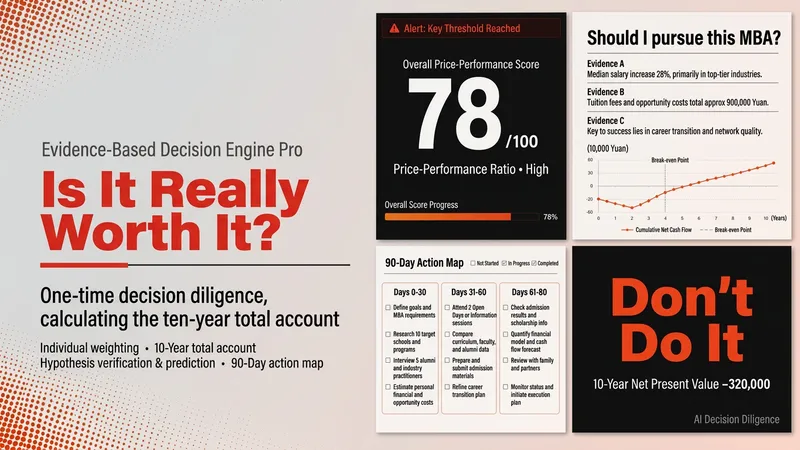 Research
Is It Worth It? Decision Pro
One decision due diligence, delivered as a four-part package. “Is It Worth It?” doesn’t give you a simple “do it” or “don’t do it.” Instead, it treats a life decision like an investment due diligence process: first, it measures your personal priorities (the answer can differ for someone earning 5,000 a month versus 50,000), then checks four red lines—legal, health, financial, and relationship risks. It searches academic papers and official data, models the costs, benefits, and evidence levels, calculates a 10-year total, and runs sensitivity analysis. Finally, it stress-tests the decision with a pre-mortem, base rates, and a bias checklist, then designs a “minimum viable experiment” to buy information at low cost. You’ll receive: ① An interactive decision dashboard (web): a four-dimension radar, value-for-money gauge, 10-year cash flow, draggable sensitivity sliders to see when the conclusion flips, an evidence pyramid, risk matrix, 90-day action map, saveable review ledger, and 3:4 share cards. ② A decision due diligence report (document): conclusion, calculations, evidence chain, risks, and actions—ready to archive or print. ③ A 90-day action map: what to validate in week 1, where the stop-loss line is, what conditions trigger an exit, and when to review. ④ A decision review ledger: record predictions and outcomes to improve your judgment calibration. Suitable for: graduate school vs. work, whether to change jobs, whether to buy a home, whether to start a business, whether to pursue a PhD, whether to end a relationship, whether to accept an offer, whether to have surgery, and whether to move to another city. The method is rigorous: every piece of evidence is labeled A/B/C with its original source; figures are recorded together with confidence intervals; if something can’t be found, it says so plainly; and all rating formulas are公开 so you can recalculate them yourself. The methodology pays tribute to the open-source project “The High Value-for-Money Life Guide” (github.com/eternity4719/HowToLiveBetter), with four upgrades: personalized weighting, a 10-year total, falsification stress tests, and “buying information.”

Fact Check
Hand any opinion, conclusion, data point, or proposal to an AI fact-checker: online source tracing, five-level credibility ratings, and reasoning-chain analysis—followed by a fact-check report you can share directly. 【What it does】Paste any claim, and the skill completes three checks automatically: 🔍 Break it down—separates the claim into “verifiable facts / inferred conclusions / value judgments,” keeping positions distinct from facts 🌐 Trace sources online—verifies sources, samples, statistical definitions, dates, and full context point by point, with cross-checking across multiple channels 🧩 Check the reasoning chain—identifies hidden assumptions, correlation-versus-causation errors, omitted alternative explanations, and the conditions under which the conclusion holds or fails 【Why choose it】 ✅ Five-level credibility ratings: Confirmed / Generally sound but should be narrowed / Contested / Insufficient evidence / Clearly false, with source links for every item ✅ Four-part report: Reliable facts and corrections / The most critical flaws in the reasoning chain / The strongest revised version / How much you can trust it ✅ No made-up answers: When a claim cannot be verified, it is honestly marked “Insufficient evidence” instead of being passed off as “possibly true” ✅ Report-ready output: Share it directly with readers, clients, or your community 【Who it’s for】Independent media and content creators, investors and analysts, students and researchers, and anyone who needs to quickly decide whether a statement can be trusted. 【How to use it】Paste the claim you want checked—anything from one sentence to a paragraph. For example, enter “People with Hashimoto’s thyroiditis often have low energy” to get a source-backed, tiered fact-check report. ⚠️ For medical, legal, investment, and other professional questions, use this for information verification only and rely on qualified professionals for advice.
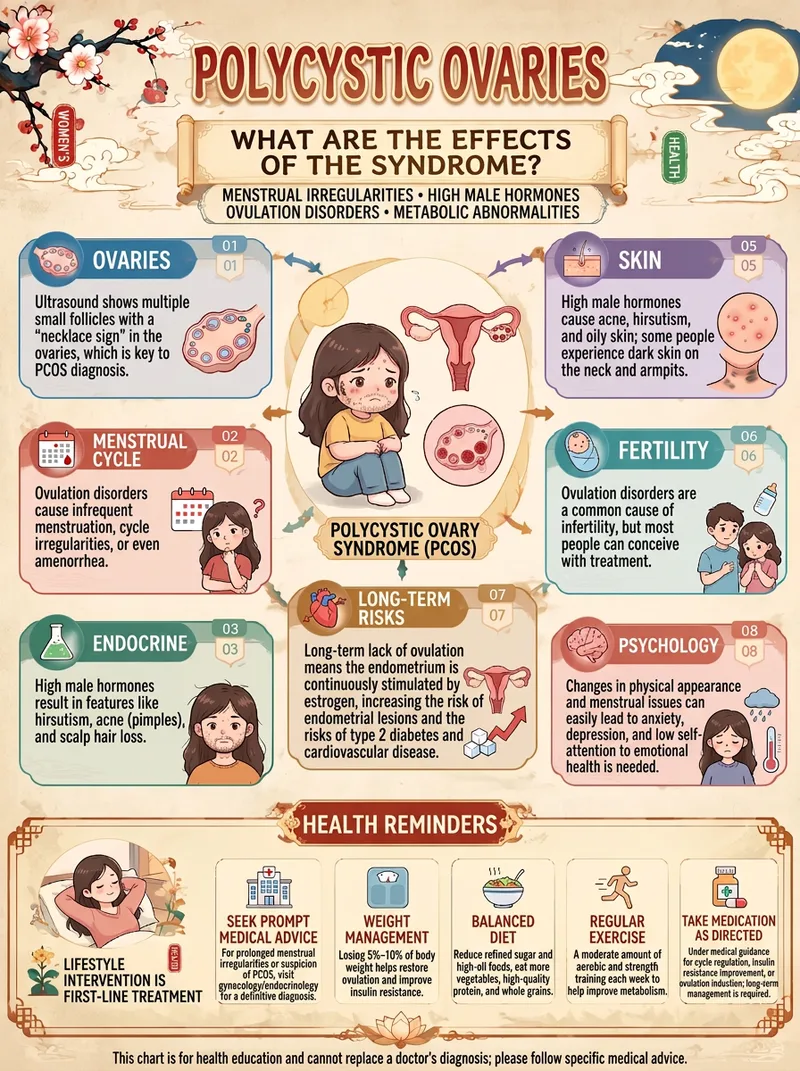
One-Click Health Infographic
Enter just one topic to transform complex health knowledge into an elegant Chinese-style educational infographic. You can use it to create: • Guides to the five internal organs, other body organs, and their physiological functions • Explainers on bodily changes caused by staying up late, insomnia, fatigue, and more • Guides to hydration, diet, nutrition, and healthy lifestyle habits • Everyday health knowledge about exercise, prolonged sitting, and weight management • Visual explainers on seasonal wellness, traditional Chinese medicine theories, and health culture Default: a distinctive modern Chinese visual style Rice-paper-inspired off-white backgrounds, traditional Chinese plaques, auspicious clouds, plum blossoms, seals, refined borders, cartoon organ illustrations, and modular knowledge cards create cohesive, polished visuals with a strong series identity. More than just attractive—the focus is also on knowledge quality It prioritizes the most representative knowledge from each topic and avoids piling on irrelevant information. Modern medical evidence is distinguished from traditional Chinese medicine theories, and health claims are not invented just to fill the layout. Flexible for different creative needs The default format is a 3:4 portrait layout. You can also specify 9:16, 4:5, 1:1, or 16:9, making it suitable for health education accounts, social media posts, short-video visuals, and series content. How to use it: Enter a topic → Extract key knowledge → Design the layout → Generate the image. No need to design from scratch—give every health topic its own visual guide. Note: Generated content is for health education and does not replace professional medical diagnosis or treatment advice. Medical content and text in images should still be verified before publication.
Information
- Version
- v3
- Last updated
- Runtime credits
- Usage-based
- Models
- Auto
