
Underground Sanctuary
Transform photo subjects into underground havens
Underground Sanctuary
Transform photo subjects into underground havens
Showcase
Description
Transform the subjects and scenes of a photo into their own underground sanctuary, creating a seamless visual narrative between the surface and the subterranean. Whether the photo features cats, plants, people, architecture, objects, or a group, it preserves the original forms, relationships, and environmental cues. Real boundaries such as corners, cracks, brick joints, and floor edges become entryways to an underground home, rather than randomly adding unrelated characters or fantasy portals. The artwork uses a vertical cross-section composition to show the continuous relationship between the real photo above and the hidden space below. Drawing on the materials, colors, and structures in the photo, it builds arcades, alleyways, resting areas, gathering spaces, and safe pathways. Warm, restrained lighting, deep shadows, realistic perspective, and a miniature model texture come together to create a secure, livable sense of belonging, avoiding overly juvenile cartoons, dollhouses, luxury palaces, or gloomy dungeons. The final image is well-suited for photographic re-creation, AI artistic visual expression, and story-driven social media content, allowing each photo to develop an underground home consistent with its original subject, complete with clues of daily life and a cozy sanctuary feel while preserving clear entryways, subject features, material origins, and moderate negative space.
Recommended by
Dancang
Why we love this skill
Featured for its unique approach that avoids rigid fantasy templates, instead extending surface scenes into kindred underground sanctuaries based on photo subjects, materials, and real boundaries.
Related Skills
View all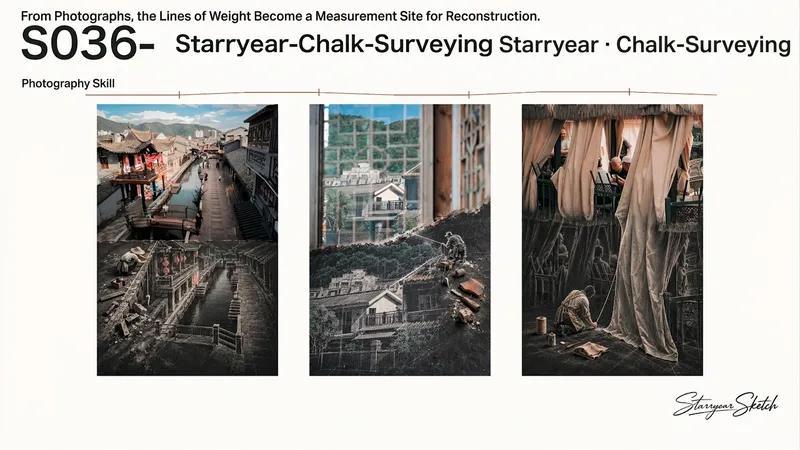 Image
Chalk Survey Photography
Transform a documentary photo into an immersive vertical poster combining real photography with chalk reconstruction. The photo retains its true subjects, structure, lighting, and key evidence, while the lower half extends into a spatial survey on a dark slate surface, allowing a real load-bearing line, edge, or contour from the original image to naturally cross into the chalk-reconstructed scene. The final image avoids simple chalk filters or vertical splitting, appearing instead as if a single continuous line connects reality and memory. The reconstructed portion features depth, sidelighting, chalk dust, smudges, and an unfinished structural feel, rendering wall profiles, road extensions, riverbank contours, or room frameworks. The image also incorporates a local surveyor growing organically out of the photographic environment and objects, such as a fisherman, stonemason, tailor, shopkeeper, farmer, or worker, using craft-appropriate tools to pull lines, snap chalk lines, redraw, or verify, making the figure's actions genuinely part of the seam and measurement. Ideal for documentary photography reconstruction, chalk survey posters, architectural investigations, archival memory, field research, and evidence-driven visual storytelling. The work emphasizes photographic basis, material continuity, and quiet negative space, avoiding generic surveyors, blueprint grids, CAD effects, crime scene yellow tape, cartoon characters, and generalized decorative illustrations.
 Image
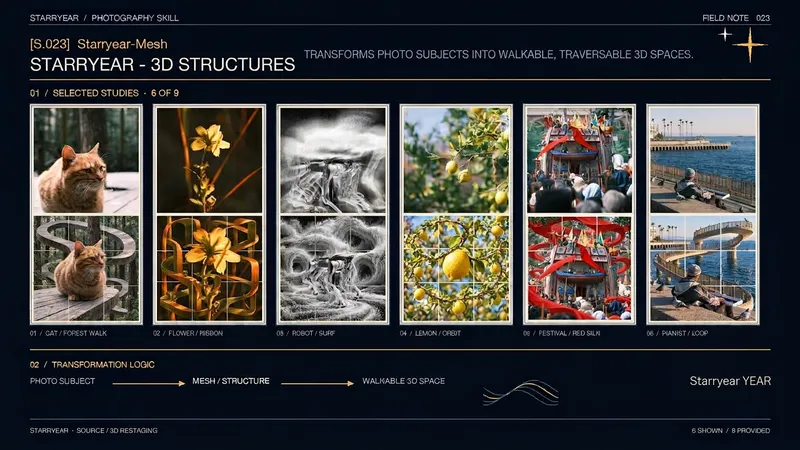
【S.023】Starryear 3D Photo
Turn a real-life photo into a vertical “memory nine-grid” artwork that combines documentary grounding with a surreal sense of space. The upper section preserves the original photo as a centered square evidence frame, while the lower section expands into a complete three-dimensional nine-grid world. The people, objects, actions, color relationships, and environmental cues from the photo are rearranged across the nine panels to create a coherent spatial paradox with a photographic feel—not an ordinary filter or a simple crop-and-paste collage. The main subject is enlarged in the lower grid as the primary visual focus, clearly preserving the person’s face, pose, or key objects while crossing adjacent panels and dividing lines. Occlusion between foreground and background, perspective, depth, and natural shadows create a convincing sense of three-dimensional layering. Each panel retains a source-photo-driven surreal transformation while sharing the same spatial logic, allowing close-up details, broad views, and negative space to form one cohesive scene. The final output is a vertical PNG with no text or watermark. The upper and lower sections are harmonized through consistent white balance, color temperature, brightness, contrast, and saturation, allowing the original photo and reconstructed scene below to blend naturally at the transition. Suitable for surreal photography, photo memory art, visual storytelling with people, and creative imagery with a collectible feel.
 Image
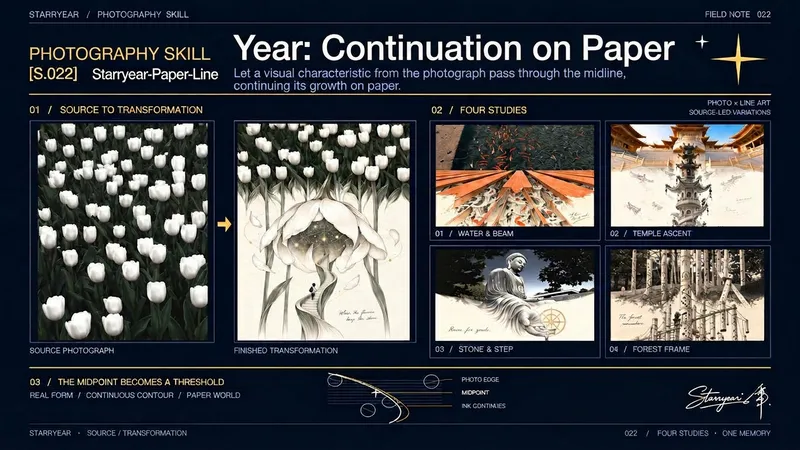
【S.022】Starryear · Photo
【Featured】Starryear featured photography Skill Extend a real photo into a 2:3 vertical “photo × line art” narrative poster: preserve the subject, lighting, colors, and spatial cues in the photo, while allowing one real form to naturally cross the middle of the frame and develop into a uniquely functional line-art world on warm white paper. The photo and hand-drawn section are not simply spliced together; continuous contours, materials, and shadows create a visual extension that can be entered, walked through, or activated. The lower section centers on the main transformation, adding a few thematic details drawn from the original photo and placing a small faceless figure rendered in pen lines within it. The figure has a clear action relationship with the line-art scene, strengthening the sense of scale and narrative. Depending on the photo’s atmosphere, subtle star-like points or glimmers may be carefully incorporated, but no fixed starry-sky, flower, or architectural template is applied. Brief handwritten English annotations add a light editorial touch. Ideal for scene-extending line-art posters, photo-and-illustration fusion posters, photographic art narrative posters, and visual works that bring a touch of fantasy to real scenes. The goal is to keep the photo believable, make the line-art world bold enough, and maintain a clear central focus and coherent material transitions both at thumbnail size and up close.
Information
- Version
- v3
- Last updated
- Runtime credits
- Usage-based
- Models
- Auto
