
All-in-One Review Response V3.0
Got review comments? One-step solution.
All-in-One Review Response V3.0
Got review comments? One-step solution.
Showcase
Description
A full-process system for responding to peer review comments in social sciences and economics/management academic papers — from comment analysis, strategy formulation, and hard flaw defense to one-click assembly of a Rebuttal Letter. V3.0 Core Upgrades: · Governance layer: unified dashboard + 3 step modes (Standard/Fast/Slow) + ratchet version management + mid-process join logic · All 12 quick commands implemented (/quick /jump /skip /rerun /export /resume /tone /hardcase /conflict /cover /draft /lang) · Cross-step comment tracking table: tracks the status of each comment from Step 1 to Step 6 for closed-loop management · Complete library of 7 hard flaw diagnostics + subfield adaptation (Accounting/Finance/Management/Marketing/Labor Economics/Macroeconomics/Qualitative Research) · Full language pair support: Chinese→English / English→English / Chinese→Chinese, with automatic detection of review comment language · New revision Cover Letter generation + summary table of changes · Tone calibration system upgrade: forbidden expression list (20 items) + auto-correction + politeness score · Enhanced safety boundaries: anti-hallucination citation check + anti-overpromising check + AI-generated content transparency statement Applicable scenario: One-stop response writing for PhD students and early-career researchers in social sciences and management after receiving review comments.
Related Skills
View all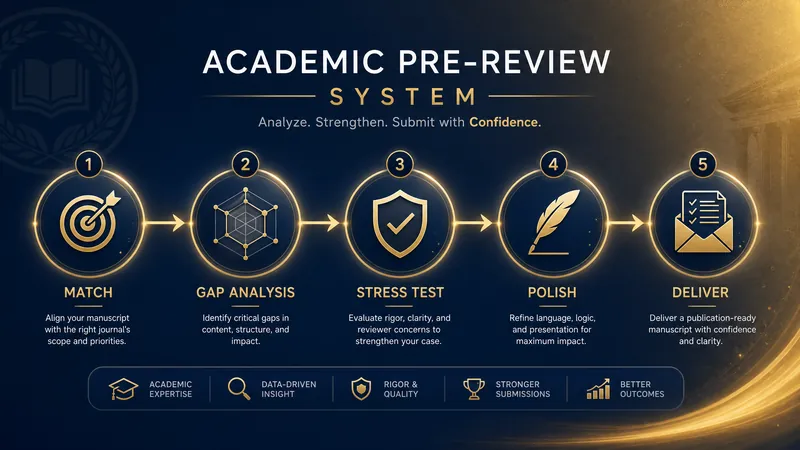
Journal Pre-review Expert V7.0
Top Journal Submission Pre-review Expert V7.0 is a full-process pre-review Skill for social sciences and humanities scholars. It simulates the perspective of senior reviewers at Nature/Science/ASR/AJS-level journals, driven by a dual-core engine (Reviewer Butcher + Polishing Craftsman) across six phases. V7.0 core upgrades: · Governance layer: unified dashboard + step mode (default/fast-forward/slow-motion) + ratchet version management + mid-join logic · All 15 quick commands implemented (/express /jump /benchmark /ethics-scan /cover-letter /polish /abstract /checklist /audit /resume /skip /rerun /export /persona /lang) · Cross-phase vulnerability tracking table: tracks from Phase 2 to Phase 5 with status closure · 6 virtual reviewer personas (methodology hawk, theoretical purist, contextualist, ethics reviewer, etc.), each with 4-5 typical criticisms, automatically activating 3-4 based on research type · Full language pair support: Chinese→English, English→English, Chinese→Chinese, with Chinglish terminator engine covering 7 categories of high-frequency errors · Benchmark paper five-dimensional comparison + no-benchmark degradation path · New AI usage transparency check and citation quality deep audit Applicable scenarios: PhD students/early-career faculty pre-submission self-check, advisors guiding students to revise manuscripts, research group submission strategy discussions. Supports full-process guidance for Chinese native speakers submitting in English.
SCI Rebuttal Generator
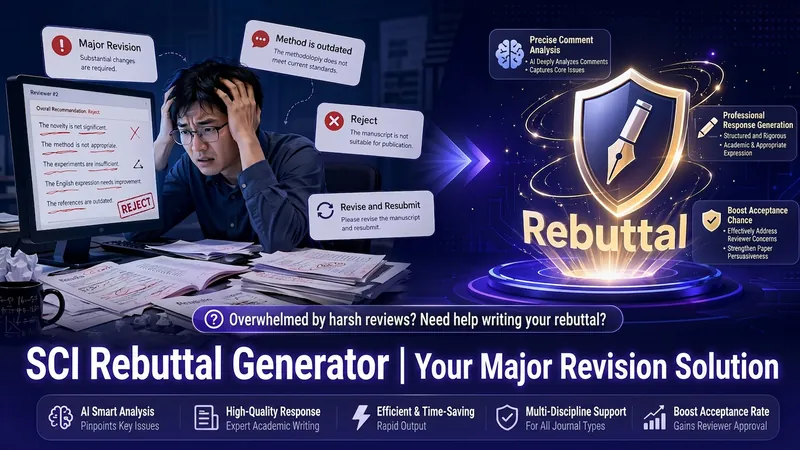
At the final stage of SCI paper publication, properly handling peer review comments is crucial. When facing a Major Revision or harsh review comments, authors often spend significant effort deciphering the reviewer's intent and crafting a response in rigorous, appropriate academic English. A single misstep in tone, logic, or format in the rebuttal letter can trigger negative emotions from reviewers, leading to eventual rejection and severely delaying research dissemination. This skill is specifically designed for graduate students, university faculty, and researchers, built on established best practices from top international journals and academic publishing standards. Simply input the reviewer's original comment and briefly describe your actual response in Chinese (no matter how straightforward), and the engine will automatically restructure the logic to generate: ✅ Academic Tone Restructuring: Convert plain Chinese ideas into objective, humble, and professional top-tier academic English, avoiding misunderstandings due to language habits. ✅ Standardized Point-by-Point Response: Strictly follow the point-by-point response paradigm favored by top international journals, with clear structure for rapid verification by editors and reviewers. ✅ Multi-Scenario Strategy Matching: Includes 5 professional response strategies (accept suggestion and revise, agree but need extensive revision, acknowledge limitations, define research scope, politely refute), providing airtight defensive phrasing. ✅ Taboo Expression Filter: Automatically identify and correct implied offensive expressions in rebuttals (like 'obviously', 'the reviewer is wrong'), ensuring tone remains appropriate. [Use Case Demo] 📝 Your Input: Reviewer's Comment: The experimental method is somewhat outdated. Why not use the latest Method X? Your Chinese Idea: Method X is indeed new, but it doesn't suit the specific materials of this study, and current experimental conditions cannot realize it. I have already added an explanation in the discussion section for why the current method was chosen. ✨ AI-Generated Top-Tier Response: Reviewer's Comment: The experimental method is somewhat outdated. Why not use the latest Method X? Author's Response: We are grateful for this insightful suggestion. While we recognize the value of Method X as a highly advanced approach, it falls outside the primary focus of the current study because our material system requires specific characterization conditions that Method X does not currently support. We have explicitly discussed this methodological choice and its rationale in the revised manuscript (Discussion Section, Page 8, Lines 234-241) to clarify this point. Action Taken: Added a new paragraph in the Discussion section (Page 8) explaining the rationale for the chosen method. [Academic Integrity Commitment] This skill strictly adheres to academic ethics: it does not fabricate references, invent experimental data, or make academic judgments for you. All response strategies are reconstructed based on the real information you provide; AI is only responsible for language restructuring and logical optimization. When your input is insufficient to generate a complete response, AI will clearly indicate what needs to be supplemented, never making up scientific reasons on its own. [Scope of Application] SCI / SSCI / EI journal revision submissions, conference paper rebuttals, peer review communications. Eliminate cross-language communication barriers, reduce energy loss during revision. Hand over the tedious response work to AI, allowing you to focus on research itself. Help your academic work achieve acceptance!
 Research
Academic Paper Writing v4.1
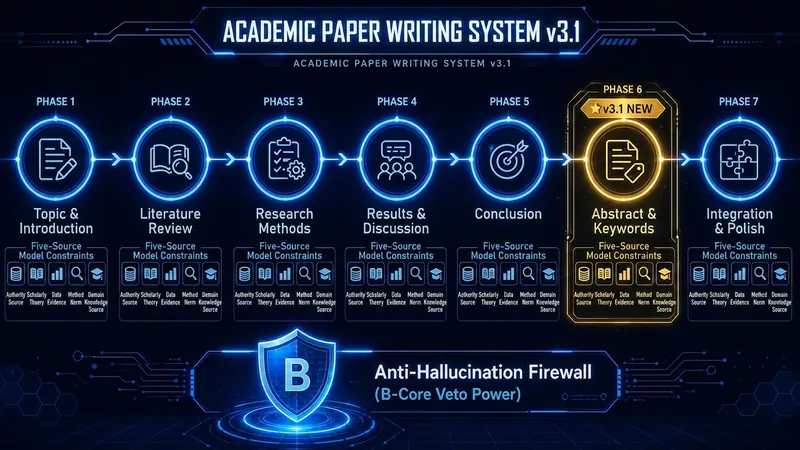
A full-process academic paper writing system that combines the Five Sources model with the AFP 3.1 three-layer architecture. Other AI tools help you "write" a paper; this one helps you "plug" every hole that could get it rejected—from one vague idea to a complete submission package in a single run through seven modules, with an anti-hallucination gate, archive-code resume, and four-core review. [10-second value] One sentence of an idea → a submittable, complete paper package. Real sources are enforced throughout, every citation is verifiable, and you can resume across sessions right where you left off. [Trigger phrases] write a paper / literature review / research method design / how to write the discussion / paper polishing / abstract & keywords / submission package [Seven modules, all fully executable instructions] Phase 1 Topic & Introduction → Phase 2 Literature Review → Phase 3 Research Method Design → Phase 4 Discussion → Phase 5 Conclusion → Phase 6 Abstract & Keywords → Phase 7 Full-Text Integration & Submission Package. Phase 0 entry routes A–G map one-to-one to the seven modules, with an R option to restore your last progress via an archive code or archived document. [v4.1 upgrades] 1. Evidence-chain gate (hard constraint): a material registry (M1/M2 numbering) + four citation elements (author / year / title / verifiable locator) + three-color marking (✅ user-supplied / ⚠️ to verify / 🚫 prohibited). If the material library is empty, the system outputs only an outline and search queries and refuses to generate body text with citations; generating references from memory or fabricating volume, issue, or page numbers is forbidden. 2. Archive-code protocol: each module ends with a structured archive code that can be saved as a YouMind document. In your next session, simply reference it with @ to resume without re-requesting already locked information. 3. Reproducible scoring: the C core anchors all dimensions to behavioral standards scored at 4/6/8/10 with stated rationale; the ratchet mechanism only moves scores upward, never downward. 4. Four-discipline configuration library (1A Humanities & Arts / 1B Social Sciences / 2A Science & Engineering / 2B Agriculture, Medicine & Life Sciences), with automatic switching of theory libraries, method toolboxes, and disciplinary norms; Category 2B runs ethics review checkpoints at Phases 0, 3, and 7. 5. Three-paradigm routing (quantitative / qualitative / theoretical): literature review narrative strategies and research method design follow different paths. 6. Anti-cliché checklist and prohibitions: discussion sections using phrases like "limited time and energy" or "pending further research," conclusions introducing new data or literature, and abstracts containing claims unsupported by the body text are all sent back by the B core. 7. Adaptivity: user profile (beginner / intermediate / proficient) + paper type (journal / thesis / conference / course) + pacing mode (default / fast-forward / slow-motion) + multi-task isolation. 8. Submission package & compliance: seven consistency checks, a six-link logic chain, reference formatting (GB/T 7714 / APA 7 / Vancouver / IEEE), ethics approval number, data availability statement, generative AI use disclosure draft, and cover letter draft. [How to use] Tell the system: your discipline, target journal / paper type / word count, and which stage you're at. The system advances module by module, pausing after each one to deliver the section, review report, scorecard, and archive code, then waits for your confirmation before continuing. [Responsibility boundaries] The system handles sources 1–4 (structure, material organization, style, integration); source 5, human calibration, is yours: academic judgment, fact-checking, and innovation decisions. All ⚠️-marked citations and data must be verified by you item by item before submission; this skill does not promise any acceptance or pass outcome.
Information
- Version
- v3
- Last updated
- Runtime credits
- Usage-based
- Models
- Auto