
Top Journal Reviewer (SSCI)
See rejection risks like a top journal editor
Top Journal Reviewer (SSCI)
See rejection risks like a top journal editor
Description
Upload your paper. I will act like a real reviewer, directly checking whether the theoretical contribution is sufficient, whether the logic is sound, whether the methods are rigorous, where it is most likely to be rejected, and what areas need priority revision. Suitable for pre-submission screening, rejection risk diagnosis, advisor review, generating Comments to Author, and major revision restructuring. This is not ordinary proofreading—it's proactively uncovering the issues that reviewers are most likely to flag for you.
Why we love this skill
This skill serves as your dedicated top journal reviewer, accurately diagnosing rejection risks and core issues using strict SSCI standards, and providing targeted revision suggestions that address pain points.
Showcase
1 / 4
Related Skills
View all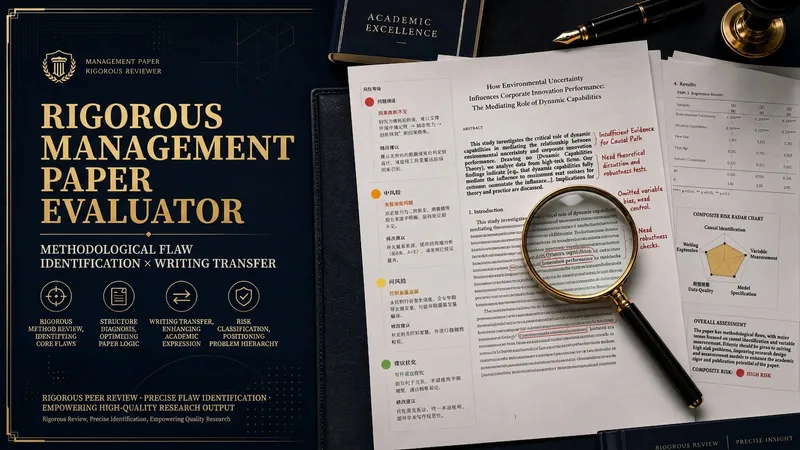
Management Paper Strict Review
Have you encountered these problems? ❌ You cited a seemingly authoritative paper, only to have reviewers question, 'This study has severe endogeneity issues.' ❌ When writing a literature review, you're unsure whether a paper's conclusions are trustworthy. ❌ After reading dozens of papers, you still don't know how to apply others' writing techniques to your own paper. ❌ Before submission, you want to check for methodological risks but don't know which hard flaws top journal reviewers focus on. This Skill helps you: ✅ Quick mode (15–25 min): Determine whether a paper is worth reading in depth and can be cited confidently. ✅ Deep mode (45–60 min): Check methodological flaws item by item like an AMJ/ASQ/SMJ reviewer. ✅ Quantitative credibility rating: 🔴 Not citable / 🟠 Use with caution / 🟡 Reference only / 🟢 Safe to cite – at a glance. ✅ Writing transfer task card: Turn techniques from others' papers into executable tasks for your own Introduction/Methods/Results/Discussion sections. Covers seven methodology types: Quantitative regression, experimental studies, quasi-experimental causal identification, fsQCA, case studies, grounded theory, mixed methods. Output includes: - Six-area deep reading (theoretical dialogue, mechanism pathways, construct operationalization, method-data fit, contribution critique, writing techniques) - P1/P2/P3 risk levels (fatal/important/arguable) - Counterfactual testing (can the model explain reverse scenarios?) - Boundary condition check (5 dimensions: market/regulation/capital/technology/competition) - Writing transfer task card (specific techniques directly applicable to your own paper) In a nutshell: It is not a gentle paper summarizer. It's a strict academic writing assistant that helps you discover, 'Where can't this paper be trusted? What is worth learning from it? How can I apply it to my paper?' Suitable for you if you are: 📚 PhD/master's students writing literature reviews 📝 Management researchers preparing submissions to top journals 🔍 Reviewers needing quick paper quality assessments 📖 Paper writers wanting to learn top journal writing techniques
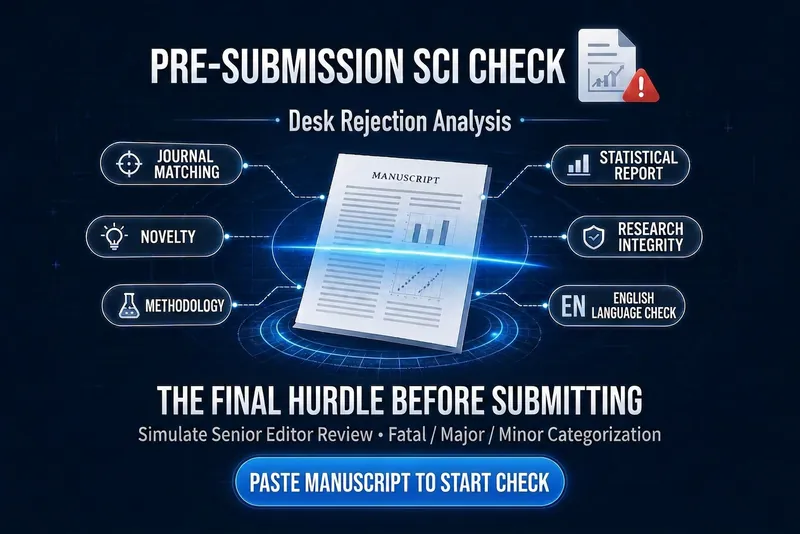
SCI Desk Reject Pre-check
You spend months writing a manuscript, submit it—and three days later receive a rejection letter with no review comments. The editor-in-chief didn't even send it out for peer review; it was a desk rejection. 「SCI Desk Reject Pre-check」offers the initial screening perspective of a seasoned handling editor, helping you ensure quality before submission. What does it check? 📌 Journal Fit — Whether the topic aligns with the target journal's scope 🔍 Novelty and Contribution — Can the editor-in-chief identify your core contribution in 30 seconds? ⚗️ Methodology and Reproducibility — Design flaws and description gaps that trigger red flags 📊 Statistics and Quantitative Reporting — Issues in data presentation, significance, sample size, etc. 🛡️ Research Integrity and Ethics — Ethics approval, conflicts of interest, plagiarism check, AI disclosure, data availability 📝 Structure and Readability — Broken logic chains, weak abstracts, buried key information 🌐 English Language Risk — Whether language quality might trigger a language-based desk rejection All issues are categorized as 'Fatal / Major / Minor', each with actionable revision suggestions. Suitable for any SCI discipline: physics, chemistry, materials, engineering, life sciences, computer science, environment, geosciences, and more. Send your manuscript (or abstract + methods section) and start the check.
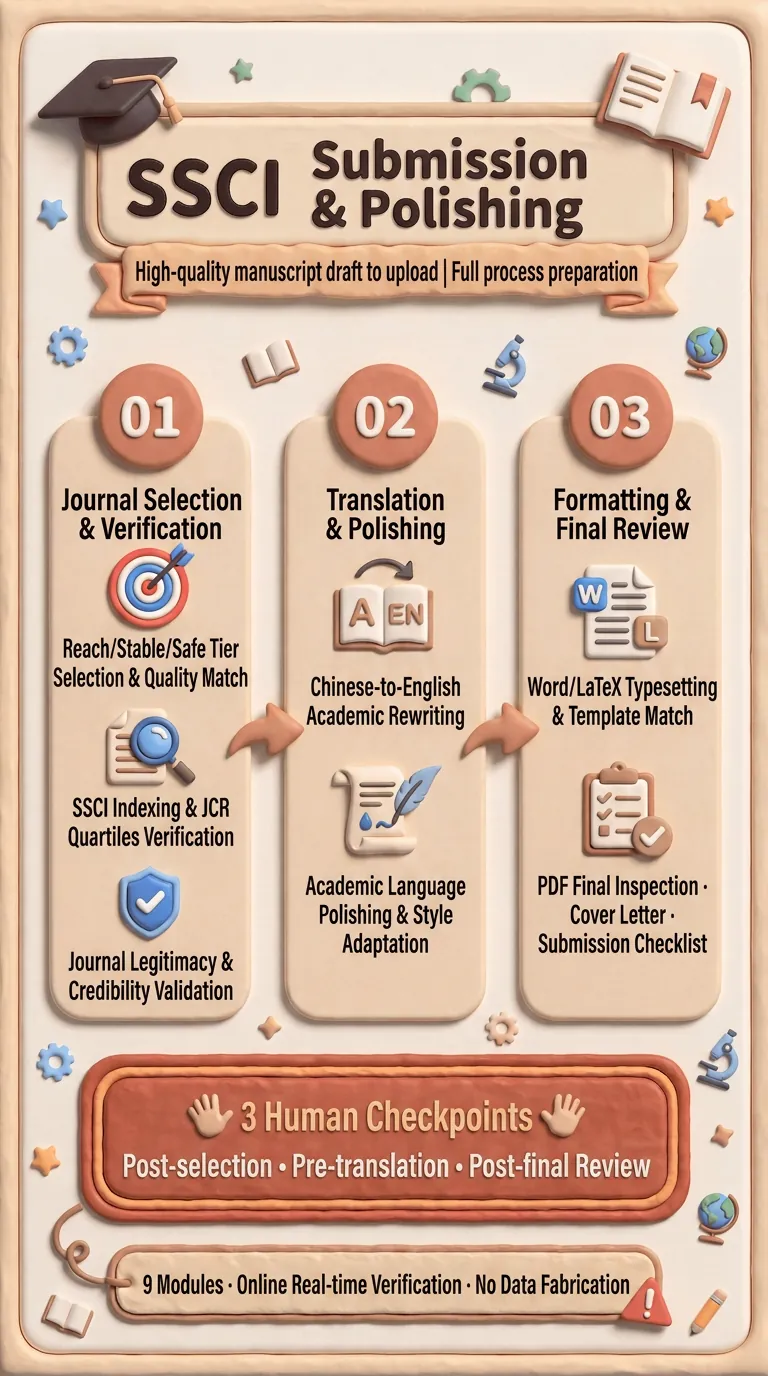
SSCI Submission & Polish
Overview: A full-process Skill for pre-submission preparation of SSCI papers, supporting journal recommendations, native language translation, English editing, target journal adaptation, format checking, reference verification, Cover Letter and submission material organization. Core Capabilities: SSCI journal recommendation and legitimacy verification, aggressive/stable/safe submission strategy, target journal Author Guidelines analysis, sample literature style anchoring, Chinese-to-English academic paper conversion, English editing, Word/LaTeX/journal template format checking, reference and DOI verification, PDF submission file final check, Cover Letter drafting, plagiarism report interpretation, and submission material checklist organization. Keywords: SSCI, academic paper, submission, journal selection, English editing, academic translation, Cover Letter, Author Guidelines, references, Zotero, DOI, Word formatting, LaTeX, PDF final check, plagiarism check and reduction Notes: This Skill does not design research from scratch, rewrite theoretical frameworks, reanalyze data, or fabricate data/literature/reviewers. Its focus is to help users prepare their existing manuscripts into a state more suitable for submission.