Short Drama Planning Assistant
Short Drama Planning Assistant
Showcase
Description
Automatically generates a complete TK planning document based on short drama scripts, including genre analysis, benchmark drama data, target audience, core expectations, innovative settings, character bios, synopsis, and more. Suitable for short drama production companies, scriptwriters, and producers.
Instructions
**Step 1: Read the script and understand the requirements**
1. Confirm user requirements:
Did the user provide a script file?
- Are there any specific project proposal templates?
Are there any special requirements (such as target platform, target audience, etc.)?
2. Use the `read` tool to read the file:
- If the user provides a proposal template, first read the template to understand the format requirements.
- Read the script file to understand the story content, character relationships, and plot development.
- If the script is very long, it may need to be read in segments (using the offset and limit parameters).
3. Analyze the core elements of the script:
- Story type and theme (e.g., domineering CEO, revenge, contract marriage, identity reversal, etc.)
- Main characters and their relationships
- Core conflict and key moments
- Plot pacing and turning points
Hook design for the first 10 episodes
4. Confirm with the user that they understand correctly, then proceed to the next step.
**Step Two: Market Analysis and Positioning**
Market analysis based on the script content:
**1. Subject Matter Identification**
- Identify the core thematic tags of the story (3-6 tags)
- Common themes: domineering CEO, contract marriage, revenge drama, reconciliation after divorce, post-divorce comeback, playing dumb to outsmart others, identity reversal, Cinderella story, family feuds, etc.
**2. Selection of Comparative Dramas**
- Find 2-3 similar successful short dramas based on the theme.
- You can use the `googleSearch` tool to search for popular short drama data.
- Search keyword examples: "[Theme] Popularity of the short drama 'Red Fruit'" "[Theme] Views of the short drama"
**3. Target Audience Analysis**
- Male-oriented/Female-oriented/Dual-oriented
- Age groups: YA (young adults 18-25), main workforce (25-35), senior citizens (35+)
- Audience preferences
**4. Set Planning**
- Recommended number of episodes based on plot complexity (usually 60-100 episodes)
- Episode length: 1-2 minutes
- Total Duration Estimation
After completing the analysis, proceed to the next step.
**Step 3: Extracting Core Content**
Extract the core content of the proposal:
**1. Core Expectations (5-8)**
What's the most appealing aspect of this show?
What emotional value can viewers gain from watching this show?
- Examples: the exhilarating feeling of instant revenge, the surprise of a role reversal, the bittersweetness of a contract marriage, the constant back-slapping of faces, etc.
**2. Innovative Design and Differentiated Advantages**
- Differences from traditional dramas of the same genre
- The unique selling point of this drama
- Presented using a contrasting approach:
- Traditional drama: [Description]
- This drama: [Description]
- List at least 4-6 differences
**3. Suspense and Clue Design**
- Suspenseful clues planted in the drama
- Stems that can continue to ferment
- Space reserved for later plot developments
**4. A one-sentence story**
Summarize the whole story in 50-100 words.
- Includes: protagonist + predicament + turning point + goal
- It needs to be attractive and memorable.
After refining, proceed to the next step.
**Step 4: Writing the Biography**
Write character biographies for at least four main characters:
**Biographical Format Requirements (CRITICAL):**
- **Do not use subheadings.** Combine all the information about each character into one coherent paragraph.
- 200-300 words per character
- Format: Character Name (Character Role, Age): Body Content...
**Key elements of a biographical sketch (integrated into paragraphs):**
1. Identity Information: If an identity is concealed, please specify the apparent identity and the true identity.
2. Personality Traits: 3-5 core personality tags, the contradictory and complex nature of personality.
3. Core Motivation: What does this character want? Why does he/she want it?
4. Character Relationships: Relationships with other main characters, and the evolution of these relationships.
5. Growth Arc: Connect the dots with arrows (→), showing the process from a certain state → through what → to what state.
6. Secrets/Suspense (if any): Unsolved mysteries surrounding the characters, foreshadowing later plot developments.
**Example Format:**
Georgia Elliot (Female lead, 23 years old): An award-winning pianist at the peak of her career, she is the only daughter of billionaire Paul Elliot and yearns for a complete family after losing her mother. She is elegant, kind, innocent, resilient, and filial. As a public figure, she is mature and confident, yet retains a girlish innocence and a longing for maternal love within her family. She longs for a complete family... [continued]
**Required roles:**
- Female lead
- Male protagonist
- Main villains (at least 1-2)
- Important supporting characters (such as assistants, best friends, etc.)
After completing the character biography, proceed to the next step.
**Step 5: Writing the Outline**
Write a story synopsis of 1500-2000 words:
**Synopsis Structure (Three-Act Play):**
**Act One: Setting and Conflict (corresponding to episodes 3-4)**
- Character introduction and relationship establishment
- Initial contradictions and conflicts
Turning point: The protagonist encounters a major change.
- Word count: 500-600 words
**Act Two: Development and Confrontation (corresponding to the main body of the story)**
- The protagonist's response and counterattack
- The power struggle among various forces
- Changes and deepening of relationships
- New suspense and twists
- Word count: 600-800 words
**Act Three: Climax and Ending (corresponding to the final episodes)**
- The concentrated outbreak of contradictions
- The revelation of the truth
- The protagonist's final choice
- Possible ending (open-ended)
- Word count: 400-600 words
**Subsequent plot developments (bullet points)**
- List possible subsequent plot developments in point form
- 5-10 key points
- Reserve space for sequels or expansions
**Principles for Writing a Synopsis:**
- The narrative flows smoothly and is visually engaging.
- Highlight the core conflict and the exciting moments
- Keep it in suspense, don't spoil everything.
- Reflecting character growth and changes in relationships
After completing the outline, proceed to the next step.
**Step Six: Hook Design for the First Ten Episodes**
Analyze the hook design of the first 10 episodes (or existing episodes):
**The function of Hook:**
- Makes viewers want to see the next episode
- Create suspense and anticipation
- Stuck at the crucial moment
**Hook Type:**
1. **Suspense Type:** Posing a question but not providing the answer.
Example: "Will she agree?" "What is his true identity?"
2. **Conflict Type:** Conflict is about to erupt.
- Examples: "The two are about to confront each other." "The truth is about to be revealed."
3. **Reversal**: Unexpected events occur.
- Examples: "A mysterious person suddenly appears" "An unexpected identity revealed"
4. **Crisis Type:** The protagonist is in danger.
Example: "Will she get hurt?" "Can he defuse the crisis?"
**Output Format:**
Add an ending hook to each episode:
- **Episode X Ending**: [Specific Plot Details] → Suspense: [Question]
Example:
- **Episode 1 Ending:** Minnie realizes the person in front of her isn't Luke and backs away in fear → Suspense: What will she do?
- **Episode 2 Ending:** Minnie hears Luke's voice outside the door and realizes she's been tricked → Suspense: How will she save herself?
After completing the Hook design, proceed to the next step.
**Step 7: Generate the complete project proposal**
Use the `write` tool to create a complete project proposal document.
**CRITICAL - Strictly adhere to template requirements:**
- Only include the items required by the template; do not add any content not specified in the template.
- If the template does not include sections such as "Production Suggestions" or "Business Value Analysis," then do not include them.
- Organize content strictly according to the template's order and structure.
**Standard Structure for a Project Proposal (Adjusted based on a template):**
1. Movie Title (in Chinese and English)
2. Original/Adapted Description
3. Theme tags (3-6)
4. Original IP address (if any)
5. Matching TV series titles (2-3)
6. Benchmark data for TV dramas (Red Fruit popularity, number of favorites, popularity index, overseas data)
7. Target audience (male/female channel, age group, preferences)
8. Target number of episodes and total duration
9. Core Expectations (5-8, each with a detailed description)
10. Innovative settings and tropes (comparing 4-6 differences from traditional dramas)
11. A one-sentence story (50-100 words)
12. Character biographies (at least 4 main characters, **each character should be presented in a separate paragraph, without subheadings**)
13. Synopsis (1500-2000 words, three-act structure + subsequent development)
14. Hook Design for the First Ten Episodes
**Document Title Format:** Proposal for "[Drama Title]"
**Content Writing Principles:**
- Professional and persuasive
- The data is accurate and reliable; if no concrete data is available, mark it as "to be investigated" or provide a reasonable estimate.
- Highlighting differentiation and innovation
- Reserve space for future development
- **Concise and refined**, delete any content that can be removed without affecting information retrieval.
Proceed to the next step after completing document creation.
**Step 8: Output Results and Follow-up Suggestions**
1. **Report completion status to users:**
- ✅ Market analysis and positioning completed
- ✅ Core expectations and innovative settings have been extracted
- ✅ Character biographies have been written for [X] characters.
- ✅ A story synopsis has been written ([X] words)
- ✅ Hooks for previous episodes [X] have been designed.
- ✅ A complete project proposal document has been created.
- 📄 Provide document link
2. **Suggestions for using the proposal:**
- Applicable scenarios: Project initiation, investment roadshows, reference production
- Can be used in conjunction with: scripts, storyboards, budget sheets
- Note: Adjust data and positioning according to actual conditions.
3. **Ask the user if they need it:**
- Adjust the content of a certain section
- Add more data on comparable TV series (searchable via Google Search).
- Expand a chapter
- Generate a simplified or PowerPoint presentation of the project proposal.
- Optimization plan for specific platforms
- Other modifications or additions
**Important Notes:**
- Maintain objective analysis and avoid exaggeration.
- The data should be truthful and reliable.
- Reserve possibilities for future development
Related Skills
View all
AI Short Play & Storyboard Gen
This is a set of full-process prompts for developing vertical short dramas, AI manga, and viral story content. It first confirms with the user the target total number of episodes, single episode duration, and generation method. Options include episode-by-episode confirmation, batch generation for a specified range, or one-time generation of the full script after authorization. The workflow covers topic research, core idea, outline, character biographies, episode planning, single/full episode script text, script quality check and revision. After the script is completed, it can be further converted into AI manga storyboard scripts, generating keyframe/storyboard base image prompts and image-to-video prompts for each shot. Suitable for short drama scriptwriters, AI manga creators, and story content teams.
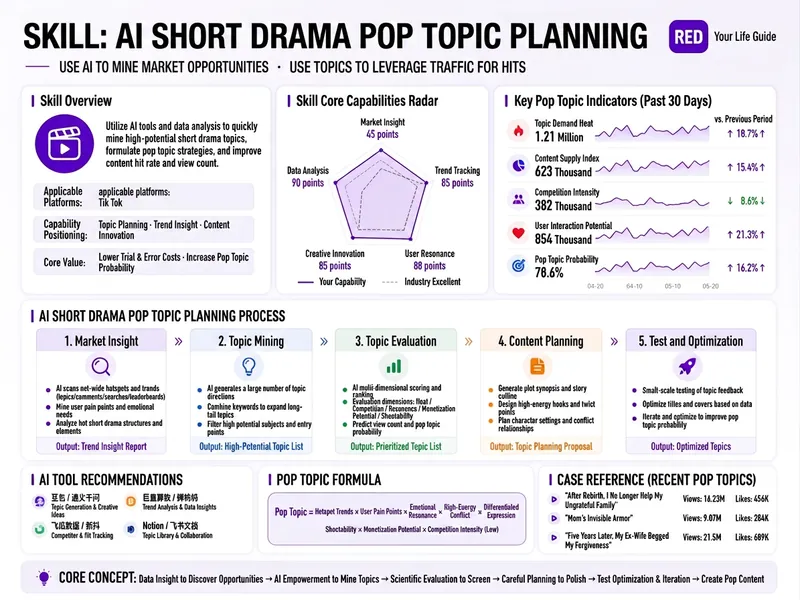
AI Short Drama Topic Planner
An end-to-end AI planning tool built for short drama content creators. It deeply integrates the latest market trends and hit formulas from mainstream platforms like Hongguo, Douyin, and Kuaishou. Working from your rough inspiration, a chosen content track, or a benchmark title, it taps into real-time web search to break down the 'gratification points' powering today's hot genres, and crafts AI-ready, hit-level topic proposals just for you. During planning, it rigorously evaluates the complexity of AI-generated scenes and character consistency to ensure every concept is highly executable visually. It supplies five hit-level initial proposals covering topic positioning, audience personas, and core selling points; once you pick a direction, it goes further to generate a deep 15-section planning document. This document includes episode-by-episode outlines for the first 20 episodes, professional scene-by-scene breakdowns for the first 5 episodes, character visual anchor settings, and estimated advertising costs. Whether you're exploring new angles in the female-oriented rebirth genre or building visual spectacles in the male-oriented counterattack genre, this tool offers professional guidance—from emotional tone tagging to AI prompt generation—so you can quickly create commercially valuable content and stay competitive in both overseas and domestic short drama markets.
Script Translation Assistant
A professional film and television script translation and formatting tool. It can accurately translate English scripts into Chinese and standardize them according to short drama production industry standard formats (scene sequence, action descriptions, dialogue, subtitles, etc.). Supports bidirectional formatting output in Chinese and English. Use cases: ✨ Localization of imported overseas scripts ✨ Translation of domestic scripts for international audiences ✨ Script format standardization ✨ Production team collaboration documents I used it to process a 50-episode short drama: Translation time: from 2 days to 10 minutes Format accuracy: 100% Production team feedback: Perfect, ready to shoot! Target audience: 📌 Short drama producers/writers 📌 Film and TV translation professionals 📌 Content export teams 📌 Script planners/developers Before, dealing with English scripts took a whole day: ❌ Manual translation, exhausting ❌ Formatting chaos, production team couldn't understand Now, one skill does it all ✅
Information
- Version
- v1
- Last updated
- Runtime credits
- Usage-based
- Models
- Auto
