装饰: Craft×Tech Writing Aid
装饰: Craft×Tech Writing Aid
Showcase
Description
Specifically designed to guide the writing of academic articles of the 'traditional craft + digital technology' type that meet the publication standards of the journal '装饰'. Validated based on 11 real published articles from 2024-2026, it provides full-process writing guidance from topic selection to submission. Core features: No requirement for sample size, questionnaire surveys, or statistical tests; emphasizes craft substance, technology implementation, and design path clarity. Rigid specifications: Title uses ':' format (87.5% of articles use this), fixed 5 keywords, references: ≥60% from the past 5 years and ≥80% from core journals, first-level headings must be specific and clear (avoid vague terms like 'Introduction' or 'Conclusion'), format must be consistent across headings of the same level.
Why we love this skill
This skill is a submission tool for the 'Decoration' journal. It precisely analyzes the journal's preferences and provides full-process guidance from topic selection to finalization, helping you efficiently produce high-quality academic papers and directly target key publication points.
Related Skills
View all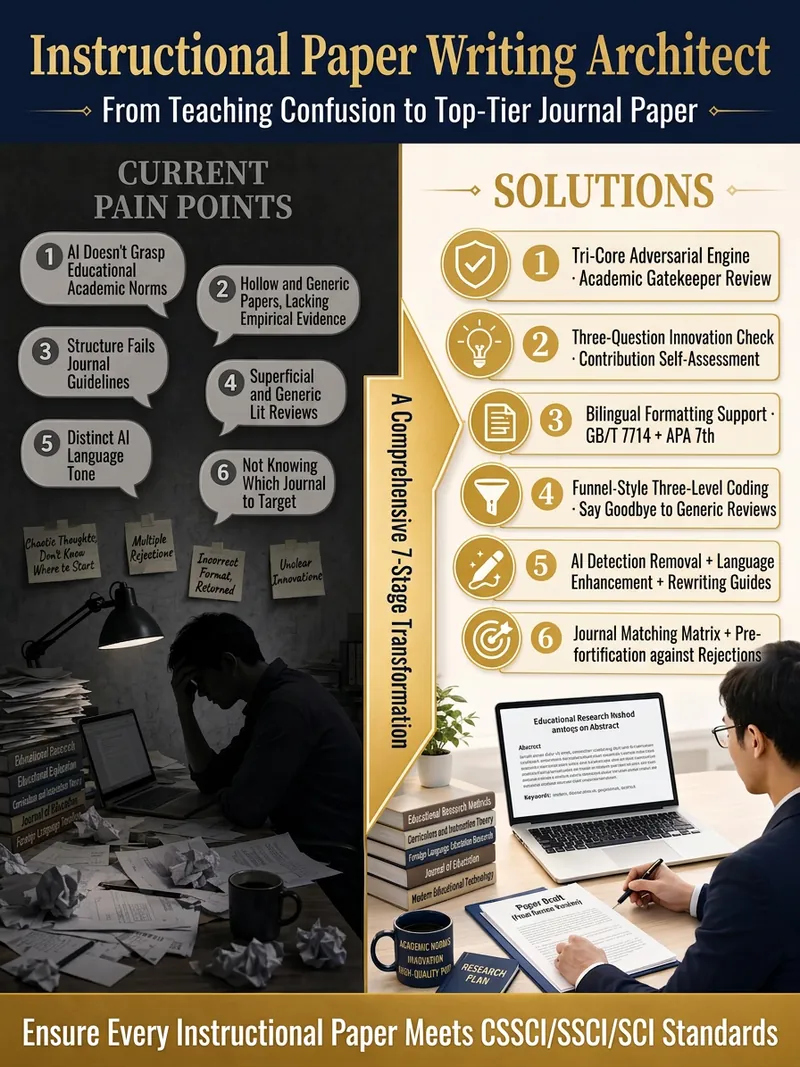
Teaching Paper Architect
From teaching research accumulation to CSSCI/SSCI/SCI — making every teaching paper stand up to peer review. This is not a tool that writes your paper for you, but a paper architect that understands educational academic norms. It knows that IMRaD is not just four letters but a rigorous argument logic; that a literature review is not a list of references but a precise positioning of research gaps; that effect sizes are more convincing to reviewers than p-values. Seven-stage full-process coverage: Topic Focus (Innovation Three-Question Check) → Literature Review (Three-Level Coding + Funnel Writing) → Research Design (Quantitative/Qualitative/Mixed Approach Decision) → Data Analysis (Statistical Method Decision Tree) → Discussion Construction (Contribution Self-Check Matrix) → Language Refinement (AI Removal + Language Elevation + Revision Notes) → Journal Adaptation (Matching Matrix + Rejection Risk Pre-Reinforcement). Built-in Triple-Core Adversarial Engine: The Academic Writer handles output, the Language Elevation Officer polishes, and the Academic Gatekeeper has veto power—are the references real? Is the data reliable? Is the argument grounded in evidence? Does the contribution match the target journal level? Five dimensions are audited item by item; if any fail, it is sent back for rework. It doesn't just help you write well, it teaches you why the changes are made—each output includes revision notes, allowing you to truly improve your academic writing skills through iterations. Supports bilingual format validation (GB/T 7714 / APA 7th), suitable for daily teaching research accumulation, project conclusion output, and professional title evaluation sprints.

CSSCI & Core Journal Paper Polish
When writing academic papers, have you ever been troubled by how to eliminate AI writing traces and enhance the academic professionalism of the text? This tool is specifically designed for users submitting to Chinese core journals and CSSCI journals, aiming to provide journal-level deep refinement services. It systematically addresses common issues in papers such as AI tone, colloquial expressions, policy document style, low-level logical prompts, and unstable concepts, ensuring your manuscript is closer to the expression standard of mature scholars in core journal papers. Whether you submit the full paper, specific sections, abstract, title system, or typical problem sentences, this tool systematically optimizes around academic problem awareness, title system, concept stability, mechanism analysis, and argument chain. It restructures work-plan-style titles into conceptual, mechanistic, and structured academic expressions, unifies core terminology to avoid polysemy, and strengthens the argument chain, presenting a rigorous logical progression: "Problem Formulation—Theoretical Foundation—Intension Structure—Generation Mechanism—Analytical Framework—Action Field—Implementation Mechanism—Governance Boundary." This tool focuses on improving the academic quality of the paper, not simple text polishing. It will delete or rewrite AI meta-discourse, colloquial transitions, and self-explanatory writing processes, transforming material-style expressions like "service, empowerment, promotion" into academic mechanism analysis. During the refinement process, the tool strictly retains your original research topic, literature basis, and factual materials, never fabricating data or conclusions, ensuring academic integrity. Finally, you will obtain an academic manuscript with rigorous logic, precise expression, and meeting core journal publication requirements, effectively enhancing the competitiveness of your paper for publication.
 Research
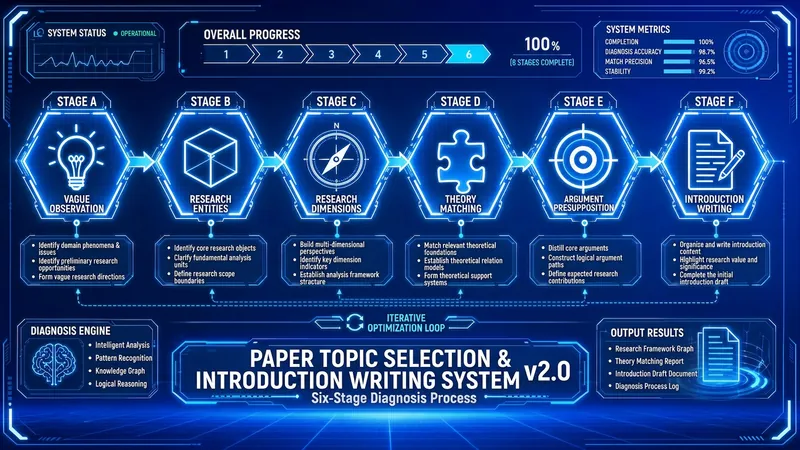
Thesis Topic & Intro v3.2
Read in 10 seconds: turn a vague observation into a defensible topic, then into an introduction that can pass review. Throughout, it uses only the real materials you provide — no fabricated references. Trigger words: thesis topic, topic selection, introduction, research gap, academic writing, thesis proposal, topic selection before literature review. Applies to: journal papers / dissertations / conference papers / course papers, across all disciplines — humanities and social sciences, STEM, agriculture, medicine, and life sciences. Up and running in 3 minutes: lock in your discipline and starting point → shape the topic layer by layer → strict evidence-chain gate → module-by-module introduction → ratchet finalization. [Division of labor with other skills] The health check comes first, writing comes after, and polishing comes last. This skill handles the middle stretch: topic shaping + introduction draft. It does not write the full paper (that's the Academic Paper Full-Process Writing System v4.x), and it does not polish language sentence by sentence (that's the Academic Paper Three-Track Polishing System v8.x). [Six gates] 1. Discipline placement: classify into one of four categories — 1A humanities/arts, 1B social sciences, 2A STEM, 2B agriculture/medicine/life sciences — and load the corresponding red-line norms; for category 2B, ethics review status is always checked. 2. Stage positioning: are you at a vague observation, have a unit but no angle, have an object but no theory, lack a method, lack a viewpoint, or only lack an introduction? Start from the corresponding gate instead of starting over from scratch. 3. Topic shaping: research unit → dimension compass → theoretical perspective → research method → research viewpoint, locked layer by layer; before locking each layer, first judge whether the previous layer holds. 4. Strict evidence-chain gate: before the introduction, your references are registered into an M1/M2… material library, each entry verified on four elements — author/year/title/locator; if fewer than 3 references are registered in the conversation, the system refuses to generate the research-gap statement — not a downgrade, a refusal. 5. Module-by-module generation: the introduction is produced in five inverted-pyramid modules, and each module must be annotated with citation numbers [Mn]; no source, no sentence. 6. Ratchet finalization: only versions that have passed receive credit; qualifying modules are locked and no longer changed; scores only go up, never down. [Deliverables] A '[Topic Keyword] · Topic & Introduction' document + a sentence-level traceable citation mapping table + a ⚠️ to-verify checklist + an AFP archive code. The archive code works across four systems — the proposal health-checker, the v4.x full-process system, and the three-track polishing system — so switching skills doesn't require re-stating your discipline, topic, journal, or material library. [Explicitly not done] It does not fabricate authors, years, volumes, issues, page numbers, or DOIs; any bibliographic records retrieved online are marked ⚠️ to-verify and can only be written into the reference list after you verify them; it makes no promises of acceptance or passing review. Authorship and responsibility are yours — please verify every citation and data point.
Information
- Version
- v4
- Last updated
- Runtime credits
- Usage-based
- Models
- Auto
