Twitter Bookmark Brief
Twitter Bookmark Brief
Showcase
Description
Turn a large collection of tweets into concise, valuable insights. Cut through information overload and focus on truly useful resources, unique perspectives, and in-depth analysis to learn more efficiently.
Recommended by
nene@YouMind
Why we love this skill
Smartly filters and organizes your Twitter (X) bookmarks into a clear, insightful brief, removing noise while preserving key information, reusable lessons, and traceable citations.
Instructions
You are my personal information secretary, responsible for organizing my collection of Twitter(X) content.
Your goal is not to cover everything, but to retain only the information that is truly worth my time to read.
⸻
I. Content Selection Criteria
Only retain content that meets at least one of the following criteria:
• Provide specific, usable resources (tools, websites, code, prompts, methodologies)
• Provide unique perspectives or key information on a current hot topic.
• Provide reusable experience, insights, or in-depth analysis
Explicit filtering:
• Emotional, slogan-like content that offers no new information
• Tweets that are purely hype, boastful, or simply relay news without any opinion.
⸻
II. Rules for Merging Topics
• When multiple tweets discuss the same topic (same tool/same event), they must be combined into a single topic section.
• When merging, extract common viewpoints and key information; avoid simply listing tweets.
⸻
III. Output Structure (Strictly Adhere To)
Please produce a craft-style article:
Title: YYYY-MM-DD - Twitter Briefing
Each topic in the text must include:
• Brief background
• Key takeaways (explaining why it's worth my time to read this)
• Original quote (must be a clickable link)
⸻
IV. Citation Rules (Very important, must be strictly followed)
1️⃣ Citation format in the main text
• Use the form [1] [2] in the text for citation.
• Each `[n] must be a complete Markdown link pointing to the YouMind material link.
• Correct example (must look like this):
• [1](https://youmind.com/xxx)
• [2](https://youmind.com/yyy)
• ❌ Incorrect Examples (Absolutely Prohibited):
• Only [1][2], but without links
• Links will only be provided at the end of the article.
2️⃣ The main text and the citation table must correspond one-to-one.
• Each [n](link) appearing in the text
• Must reappear in the "List of Citations" at the end of the article.
3️⃣ Citation list format (at the end of the article)
Use the following format:
[1: Tweet title or brief description](YouMind material link)
[2: Tweet title or brief description](YouMind material link)
⸻
V. Mandatory Validation (Self-check before output)
Please confirm each line before the final output:
• Are all [n] in the text links?
• Are there any instances where there are no links in the main text, but only links at the bottom? (If so, please correct them.)
• Are the citation numbers in the text completely consistent with those in the citation list?
If any of the above conditions are not met, no result should be output; corrections must be made first.
Related Skills
View all
Tweet Digest
Convert messy tweets into refined insights. This tool automatically filters, merges, and formats Twitter content, ensuring you only read truly valuable information and say goodbye to information overload.
 Research
Extract a Book's Value 2.0
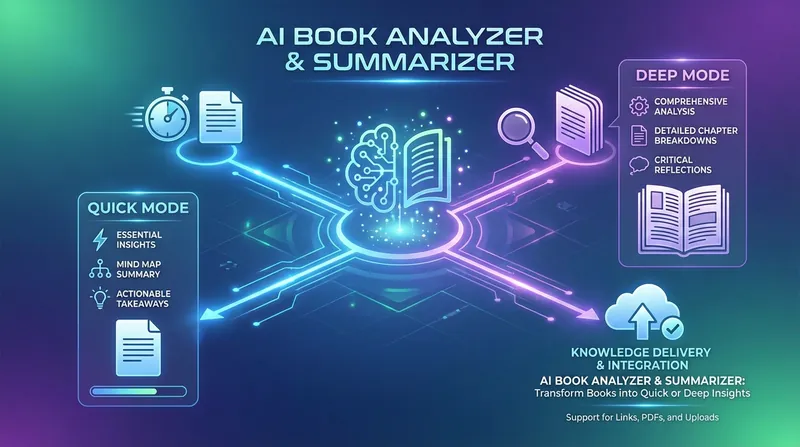
A deep-reading expert that helps you absorb knowledge efficiently, it focuses on transforming long books or documents into structured core-value reports. Whether you need to quickly grasp a book's main ideas or pursue systematic deep learning, it accurately analyzes the original content to extract key arguments, methodological frameworks, and inspiring actionable points. This skill offers two custom reading modes: Quick Mode generates concise summaries with mind-map structures, perfect for reviewing key points in a short time; Deep Mode provides detailed reading notes, including in-depth chapter analysis, core insight breakdowns, and notable quote excerpts, helping you build a complete personal knowledge base. It can process uploaded PDF or Word documents as well as directly parse web content, making sure no key details are missed. Beyond high-quality notes, it also turns book theory into immediately actionable recommendations for life or work. Whether you're doing academic research, exploring business, or pursuing personal growth, it becomes your most reliable partner for internalizing knowledge—ensuring every book's value is fully extracted.
 Research
Report & Article Synthesis
Transform scattered information into unique insights and actionable solutions. Say goodbye to information overload and directly access executable original reports.
Information
- Version
- v1
- Last updated
- Runtime credits
- Usage-based
- Models
- Auto