
Conversion Rate Health Check
Expert UI/UX review from screenshots or links
Description
You've built a page but can't see what's wrong with it. Send a screenshot or a link, and I'll review it like a design director — going through layout, color, spacing, motion, interaction, responsiveness, and copy one by one. I score each of the seven dimensions, pinpoint issues, and offer fixes you can apply right away. No vague "looks good, could be better" fluff. I get specific: this button's contrast doesn't meet WCAG AA, this spacing inconsistency breaks the rhythm, this copy leaves users unsure what will happen if they click. Issues are classified as Critical / Major / Minor, and recommendations are prioritized so you can see at a glance what to fix first and what impact it will have. Landing pages prioritize conversion, dashboards prioritize efficiency, documentation sites prioritize readability — the review weights adjust automatically based on page type. Perfect for product managers, indie developers, and small teams that need professional design oversight but don't yet have a full-time designer.
Related Skills
View all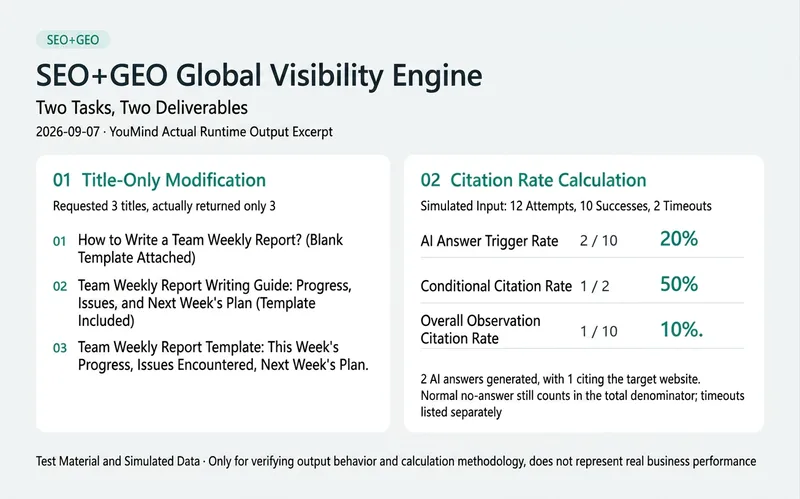
SEO+GEO Visibility Engine
Optimize the search performance and AI citation readiness of your articles, product pages, and landing pages. Quickly identify the issues most worth fixing, or get ready-to-use titles, rewrites, content briefs, technical fix lists, or performance retest plans. Four modes route tasks appropriately: send only a link or body copy for a quick diagnosis by default; request writing to get usable text first; use a full audit to break findings down by target engine and page; or use a performance retest with clearly defined data sources, numerators, denominators, and comparison conditions. Simple tasks do not require a full-length report. Supports platform-specific checks for Google AI Overviews / AI Mode, Bing / Copilot, ChatGPT Search, Perplexity, and Claude. Search, training, and user-triggered visits are assessed separately. For Chinese platforms, checks are adapted to actually available sources and direct observations rather than applying rules from other engines. v8 standardizes scoring and evidence criteria, limits the scope of local blocks, distinguishes answer trigger rate, conditional citation rate, and overall citation rate, and updates Google site-level AI control checks. Use it for your own websites, articles on third-party platforms, and unpublished drafts. Recommendations distinguish what you can change from items that require platform-side validation. Each key finding includes evidence or clearly stated limitations. Scores are provided when needed; data, authors, or citations are never fabricated, and rankings, indexing, or AI citations are not guaranteed. Actual run example (2026-09-07; test material, not business results) Title mode: Given test copy for “How to write a team weekly report” with a request to return only 3 titles, the actual output was: 1. How to Write a Team Weekly Report: Blank Template Included 2. Team Weekly Report Writing Guide: Progress, Issues, and Next Week’s Plan (Template Included) 3. Team Weekly Report Template: This Week’s Progress, Issues, and Next Week’s Plan Calculation mode: Simulated 12 attempts, with 10 successes and 2 timeouts; 2 successful runs generated AI answers, and 1 cited the target website. Actual output: AI answer trigger rate 2/10 = 20%, conditional citation rate 1/2 = 50%, and overall observed citation rate 1/10 = 10%. Normal no-answer cases remain in the overall denominator, while timeouts are listed separately. These figures validate the calculation criteria only and do not represent actual citation performance.
Product Strategy One-Pager
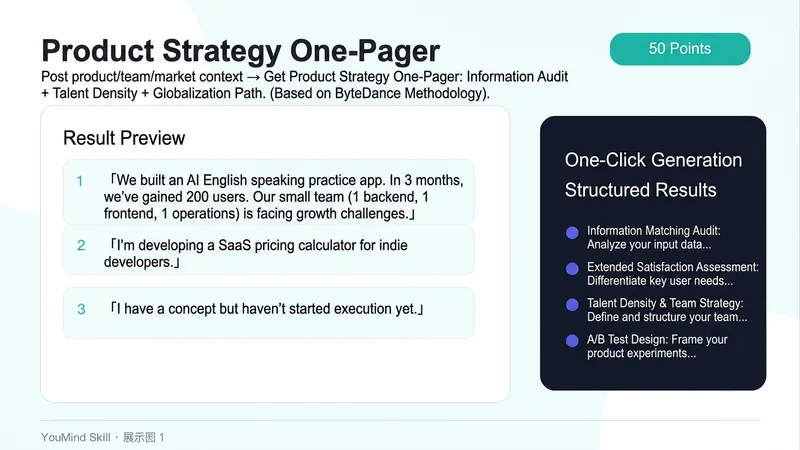
Building a product is like driving in the fog—what do users want? Is the team right? Should we go global? Which metric to optimize first? Every decision gambles the team's time and investors' money. Feed it your product info and data, and it uses ByteDance-style product methodology to help you clarify: What information and needs is your product matching? Are your current resources solving 'problems that will matter in three years' or 'urgent matters this month'? Is your team's talent density sufficient? What A/B tests can validate your core assumptions? ✨ Core Capabilities 1. Information match efficiency diagnosis: What is your product essentially matching? Where are the friction points? 2. Delayed gratification assessment: Distinguish 'important in three years' vs 'urgent this month', provide resource reallocation recommendations 3. Talent density and team strategy: Core role talent assessment + Context/Control boundary recommendations 4. A/B test design: Turn your gut assumptions into verifiable experimental plans 5. Global feasibility assessment: Language, culture, compliance, and payment four-dimensional check 📱 Use Cases - Early-stage startup teams making directional decisions - Product managers' quarterly reviews and strategy adjustments - Investors quickly evaluating a project's product logic - Developers building side projects validating ideas It doesn't give you a standard answer—it gives you a framework to ask the right questions.
 Webpage
Webpage Quality Assessment
This skill is designed to provide users with professional evaluation and optimization services for webpage content. Whether you are a website designer, developer, or content creator, you can use this tool to conduct in-depth analysis of your own or others' webpages and obtain actionable improvement suggestions. The skill can comprehensively evaluate the design quality, originality, craftsmanship, and functionality of a webpage. It provides detailed scoring across multiple dimensions such as color matching, typography layout, visual theme, interactive effects, and responsive design, and identifies potential AI-generated traces or templated designs. After evaluation, you will receive a detailed report containing specific strengths, issues, improvement suggestions, and even directions for code modifications in CSS, HTML, and JavaScript. After generating the evaluation report, you can also choose to let the AI immediately optimize the webpage based on the recommendations in the report. The optimization process follows the priority order of design quality, originality, craftsmanship, and functionality. Finally, you will receive an optimization completion report that clearly shows the score comparison across all dimensions before and after optimization, as well as the key improvements.
Conversion Rate Health Check
Expert UI/UX review from screenshots or links
Description
You've built a page but can't see what's wrong with it. Send a screenshot or a link, and I'll review it like a design director — going through layout, color, spacing, motion, interaction, responsiveness, and copy one by one. I score each of the seven dimensions, pinpoint issues, and offer fixes you can apply right away. No vague "looks good, could be better" fluff. I get specific: this button's contrast doesn't meet WCAG AA, this spacing inconsistency breaks the rhythm, this copy leaves users unsure what will happen if they click. Issues are classified as Critical / Major / Minor, and recommendations are prioritized so you can see at a glance what to fix first and what impact it will have. Landing pages prioritize conversion, dashboards prioritize efficiency, documentation sites prioritize readability — the review weights adjust automatically based on page type. Perfect for product managers, indie developers, and small teams that need professional design oversight but don't yet have a full-time designer.
Related Skills
View allSEO+GEO Visibility Engine
Optimize the search performance and AI citation readiness of your articles, product pages, and landing pages. Quickly identify the issues most worth fixing, or get ready-to-use titles, rewrites, content briefs, technical fix lists, or performance retest plans. Four modes route tasks appropriately: send only a link or body copy for a quick diagnosis by default; request writing to get usable text first; use a full audit to break findings down by target engine and page; or use a performance retest with clearly defined data sources, numerators, denominators, and comparison conditions. Simple tasks do not require a full-length report. Supports platform-specific checks for Google AI Overviews / AI Mode, Bing / Copilot, ChatGPT Search, Perplexity, and Claude. Search, training, and user-triggered visits are assessed separately. For Chinese platforms, checks are adapted to actually available sources and direct observations rather than applying rules from other engines. v8 standardizes scoring and evidence criteria, limits the scope of local blocks, distinguishes answer trigger rate, conditional citation rate, and overall citation rate, and updates Google site-level AI control checks. Use it for your own websites, articles on third-party platforms, and unpublished drafts. Recommendations distinguish what you can change from items that require platform-side validation. Each key finding includes evidence or clearly stated limitations. Scores are provided when needed; data, authors, or citations are never fabricated, and rankings, indexing, or AI citations are not guaranteed. Actual run example (2026-09-07; test material, not business results) Title mode: Given test copy for “How to write a team weekly report” with a request to return only 3 titles, the actual output was: 1. How to Write a Team Weekly Report: Blank Template Included 2. Team Weekly Report Writing Guide: Progress, Issues, and Next Week’s Plan (Template Included) 3. Team Weekly Report Template: This Week’s Progress, Issues, and Next Week’s Plan Calculation mode: Simulated 12 attempts, with 10 successes and 2 timeouts; 2 successful runs generated AI answers, and 1 cited the target website. Actual output: AI answer trigger rate 2/10 = 20%, conditional citation rate 1/2 = 50%, and overall observed citation rate 1/10 = 10%. Normal no-answer cases remain in the overall denominator, while timeouts are listed separately. These figures validate the calculation criteria only and do not represent actual citation performance.
Product Strategy One-Pager
Building a product is like driving in the fog—what do users want? Is the team right? Should we go global? Which metric to optimize first? Every decision gambles the team's time and investors' money. Feed it your product info and data, and it uses ByteDance-style product methodology to help you clarify: What information and needs is your product matching? Are your current resources solving 'problems that will matter in three years' or 'urgent matters this month'? Is your team's talent density sufficient? What A/B tests can validate your core assumptions? ✨ Core Capabilities 1. Information match efficiency diagnosis: What is your product essentially matching? Where are the friction points? 2. Delayed gratification assessment: Distinguish 'important in three years' vs 'urgent this month', provide resource reallocation recommendations 3. Talent density and team strategy: Core role talent assessment + Context/Control boundary recommendations 4. A/B test design: Turn your gut assumptions into verifiable experimental plans 5. Global feasibility assessment: Language, culture, compliance, and payment four-dimensional check 📱 Use Cases - Early-stage startup teams making directional decisions - Product managers' quarterly reviews and strategy adjustments - Investors quickly evaluating a project's product logic - Developers building side projects validating ideas It doesn't give you a standard answer—it gives you a framework to ask the right questions.
WebpageWebpage Quality Assessment
This skill is designed to provide users with professional evaluation and optimization services for webpage content. Whether you are a website designer, developer, or content creator, you can use this tool to conduct in-depth analysis of your own or others' webpages and obtain actionable improvement suggestions. The skill can comprehensively evaluate the design quality, originality, craftsmanship, and functionality of a webpage. It provides detailed scoring across multiple dimensions such as color matching, typography layout, visual theme, interactive effects, and responsive design, and identifies potential AI-generated traces or templated designs. After evaluation, you will receive a detailed report containing specific strengths, issues, improvement suggestions, and even directions for code modifications in CSS, HTML, and JavaScript. After generating the evaluation report, you can also choose to let the AI immediately optimize the webpage based on the recommendations in the report. The optimization process follows the priority order of design quality, originality, craftsmanship, and functionality. Finally, you will receive an optimization completion report that clearly shows the score comparison across all dimensions before and after optimization, as well as the key improvements.
Find your next favorite skill
Explore more curated AI skills for research, creation, and everyday work.