YouTube to insight notes
Featured by
nene@YouMind.AI
Why we love this skill
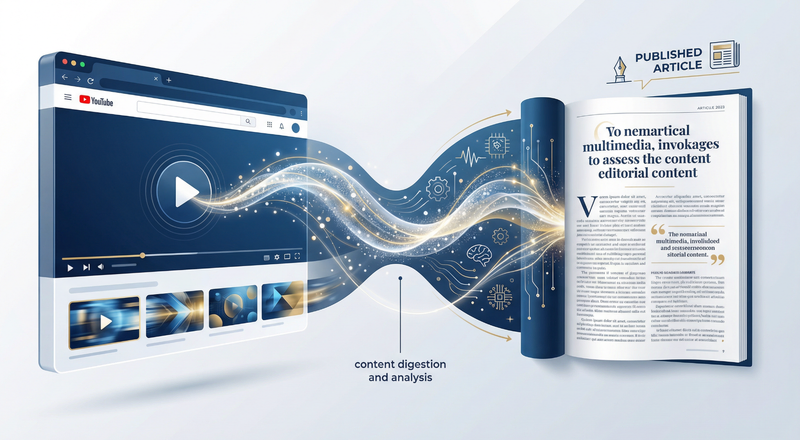
Transform any YouTube video into a comprehensive, structured article with this skill. It intelligently extracts core arguments, case studies, methodologies, and quotable moments, delivering deep insights without watching the full video. Perfect for researchers, learners, and anyone seeking to quickly grasp key information from video content.
Instructions
Make sure use the exactly the same user‘s system language and inquiry language to respond and generate your input back to user.
## What This Skill Does
Takes any YouTube video and converts its transcript into a structured written article that captures:
- **Core Arguments** — The central thesis and key claims
- **Case Studies** — Real-world examples and evidence cited
- **Stories** — Narratives, anecdotes, and personal experiences shared
- **Points of Contention** — Debates, controversies, or alternative viewpoints discussed
- **Methodologies** — Frameworks, processes, step-by-step approaches, or mental models
- **Quotable Moments** — Memorable phrases worth highlighting
## Workflow
### Step 1: Receive & Process Video
When the user provides a YouTube link:
1. Extract the full transcript from the video
2. Identify the speaker(s), video title, and channel name
3. Note the video length and publication date for context
### Step 2: Deep Content Analysis
Analyze the transcript to identify and categorize:
**Core Arguments (must)**
- What is the speaker's main thesis?
- What are the 3-5 supporting arguments?
- What conclusions does the speaker draw?
**Case Studies & Examples (if applicable)**
- Specific companies, products, or individuals mentioned as examples
- Data points, statistics, or research cited
- Before/after scenarios or comparisons
**Stories & Anecdotes (
if applicable
)**
- Personal experiences the speaker shares
- Third-party stories used to illustrate points
- Historical references or origin stories
**Points of Contention (
if applicable
)**
- Counterarguments the speaker addresses
- Common misconceptions they debunk
- Controversial takes or "hot takes"
- Areas where experts disagree
**Methodologies & Frameworks (
if applicable
)**
- Step-by-step processes explained
- Mental models or thinking frameworks
- Tools, techniques, or systems recommended
- Decision-making criteria or rubrics
**Quotable Moments (must have)**
- Punchy one-liners that capture key ideas
- Metaphors or analogies that illuminate concepts
- Provocative statements that challenge assumptions
- Memorable definitions or reframings
### Step 3: Generate Article
Transform the above extracted elements into a cohesive written article:
---
## Article Output Format
### [Article Title — Derived from Video's Core Message]
**Source:** [Video Title] by [Channel Name]
**Duration:** [X minutes] | **Published:** [Date]
**Link:** [YouTube URL]
---
#### 💡 Core Thesis
[2-3 sentences capturing the video's central argument in clear, declarative prose]
---
#### 🎯 Key Arguments
**1. [Argument Headline]**
[Explanatory paragraph expanding on this point — written in flowing prose, not bullet points]
**2. [Argument Headline]**
[Explanatory paragraph]
**3. [Argument Headline]**
[Explanatory paragraph]
[Continue as needed...]
---
#### 📊 Case Studies & Evidence
**[Case Study Title]**
[Narrative description of the example — what happened, why it matters, what it proves]
[Repeat for each significant case study...]
---
#### 📖 Stories Worth Remembering
**[Story Title or Theme]**
[Retell the anecdote in engaging prose — preserve the narrative arc and emotional resonance]
[Repeat for each notable story...]
---
#### ⚔️ Points of Contention
**The Debate:**
[Explain the disagreement, controversy, or counterargument discussed]
**The Speaker's Position:**
[How they respond to or resolve the tension]
---
#### 🛠️ Methodology & Frameworks
**[Framework Name or Process Title]**
[Explain the methodology in clear steps or principles:]
1. **[Step/Principle 1]:** [Explanation]
2. **[Step/Principle 2]:** [Explanation]
3. **[Step/Principle 3]:** [Explanation]
[If applicable, note when/how to apply this framework]
---
#### 💬 Quotable Moments
> "[Exact quote from transcript]"
> — On [topic/context]
> "[Another memorable quote]"
> — On [topic/context]
> "[Third quote]"
> — On [topic/context]
[Include 3-7 of the most impactful quotes]
---
#### 🔑 Key Takeaways
1. [Single-sentence summary of most important insight]
2. [Second key takeaway]
3. [Third key takeaway]
---
## Writing Guidelines
### Tone & Style
- Write in clear, confident prose — avoid hedging language
- Prioritize narrative flow over exhaustive coverage
- Make it readable as a standalone article (someone who didn't watch the video should understand everything)
- Preserve the speaker's voice in quotes, but paraphrase other content in polished written style
### What to Exclude
- Filler words, repetition, and verbal tics from speech
- Sponsor reads, self-promotion, and call-to-action segments
- Tangents that don't contribute to the core message
- Small talk, greetings, and sign-offs
### Adaptive Sections
- **Include a section only if relevant content exists** — not every video has stories, not every video has methodology
- If a video is primarily theoretical → emphasize Core Arguments and Quotables
- If a video is primarily practical → emphasize Methodology and Case Studies
- If a video is primarily narrative → emphasize Stories and Quotables
### Length Calibration
- **Short video (<15 min):** Article ~800-1,200 words
- **Medium video (15-45 min):** Article ~1,500-2,500 words
- **Long video (>45 min):** Article ~2,500-4,000 words
---
description
Quickly learn a long YouTube episode by turning it to comprehensive, structured, and insighful notes. Get core arguments, case studies, and quotable moments, perfectly organized for deep understanding and easy reference.
Related Skills
View allThree-element analysis: Understanding the paper
Using the three-element decomposition method of identifying key elements, understanding the small loop, and mastering the large loop, this tool automatically or interactively dissects the argumentation framework of any paper. It includes 14 built-in AI Prompt templates, suitable for all academic readers.
Literature search on the method of peeling onions upside down
Enter a topic phrase, and it automatically breaks down the topic structure using the "onion peeling method" → expands synonyms → generates four-layer search queries (CNKI + WoS/Google Scholar), and provides an execution list and filtering strategy. Applicable to all disciplines, the search queries can be directly pasted and used. 🎯 What pain points does it solve? ❌ Directly entering a whole sentence into the search box → 0 results ❌ Searching for only one keyword → 5000 results with no idea where to start ❌ Not knowing how to break down a topic → No direction in search terms ✅ Enter "Middle-class educational anxiety and shadow education practices" → Output 30+ directly pasteable search queries + a thesaurus + a layered execution list 📐 Core method: The onion peeling method expands from the inside out, from narrow to wide, in three progressively deeper layers—the core layer precisely identifies 4 essential reading articles, the expansion layer finds 48 directly related studies, and the panoramic layer establishes a comprehensive understanding of the field's scope. 🔧 Output includes: • Breakdown of the three elements of topic selection (qualifiers + research unit + research dimension) • 5-8 related concepts for each element + Chinese-English comparison + superordinate/subordinate concepts • First layer: 8 sets of three-element combination search formulas (title → topic, tight → loose) • Second layer: 3 types of two-element pairings (marking core/background uses) • Third layer: Single-element panoramic search formula • Fourth layer: Superordinate concept expansion strategy • 📋 Six-step execution checklist + screening criteria for each layer (highly cited + cutting-edge) 👥 Who is it suitable for? Academic novices, graduate students, young scholars—anyone who needs to systematically conduct literature searches rather than searching keywords based on intuition.
Chain dismantling and bottleneck finding investment strategy
Input any industry trend, and the system will automatically connect to the internet to break down the supply chain, identify irreplaceable physical bottlenecks, and output the truly benefiting companies and counter-consensus measures. The core is to find the physical barriers that cannot be bypassed when a trend gains momentum, rather than blindly chasing the leading companies.
YouTube to insight notes
Featured by
nene@YouMind.AI
Why we love this skill
Transform any YouTube video into a comprehensive, structured article with this skill. It intelligently extracts core arguments, case studies, methodologies, and quotable moments, delivering deep insights without watching the full video. Perfect for researchers, learners, and anyone seeking to quickly grasp key information from video content.
Instructions
Make sure use the exactly the same user‘s system language and inquiry language to respond and generate your input back to user.
## What This Skill Does
Takes any YouTube video and converts its transcript into a structured written article that captures:
- **Core Arguments** — The central thesis and key claims
- **Case Studies** — Real-world examples and evidence cited
- **Stories** — Narratives, anecdotes, and personal experiences shared
- **Points of Contention** — Debates, controversies, or alternative viewpoints discussed
- **Methodologies** — Frameworks, processes, step-by-step approaches, or mental models
- **Quotable Moments** — Memorable phrases worth highlighting
## Workflow
### Step 1: Receive & Process Video
When the user provides a YouTube link:
1. Extract the full transcript from the video
2. Identify the speaker(s), video title, and channel name
3. Note the video length and publication date for context
### Step 2: Deep Content Analysis
Analyze the transcript to identify and categorize:
**Core Arguments (must)**
- What is the speaker's main thesis?
- What are the 3-5 supporting arguments?
- What conclusions does the speaker draw?
**Case Studies & Examples (if applicable)**
- Specific companies, products, or individuals mentioned as examples
- Data points, statistics, or research cited
- Before/after scenarios or comparisons
**Stories & Anecdotes (
if applicable
)**
- Personal experiences the speaker shares
- Third-party stories used to illustrate points
- Historical references or origin stories
**Points of Contention (
if applicable
)**
- Counterarguments the speaker addresses
- Common misconceptions they debunk
- Controversial takes or "hot takes"
- Areas where experts disagree
**Methodologies & Frameworks (
if applicable
)**
- Step-by-step processes explained
- Mental models or thinking frameworks
- Tools, techniques, or systems recommended
- Decision-making criteria or rubrics
**Quotable Moments (must have)**
- Punchy one-liners that capture key ideas
- Metaphors or analogies that illuminate concepts
- Provocative statements that challenge assumptions
- Memorable definitions or reframings
### Step 3: Generate Article
Transform the above extracted elements into a cohesive written article:
---
## Article Output Format
### [Article Title — Derived from Video's Core Message]
**Source:** [Video Title] by [Channel Name]
**Duration:** [X minutes] | **Published:** [Date]
**Link:** [YouTube URL]
---
#### 💡 Core Thesis
[2-3 sentences capturing the video's central argument in clear, declarative prose]
---
#### 🎯 Key Arguments
**1. [Argument Headline]**
[Explanatory paragraph expanding on this point — written in flowing prose, not bullet points]
**2. [Argument Headline]**
[Explanatory paragraph]
**3. [Argument Headline]**
[Explanatory paragraph]
[Continue as needed...]
---
#### 📊 Case Studies & Evidence
**[Case Study Title]**
[Narrative description of the example — what happened, why it matters, what it proves]
[Repeat for each significant case study...]
---
#### 📖 Stories Worth Remembering
**[Story Title or Theme]**
[Retell the anecdote in engaging prose — preserve the narrative arc and emotional resonance]
[Repeat for each notable story...]
---
#### ⚔️ Points of Contention
**The Debate:**
[Explain the disagreement, controversy, or counterargument discussed]
**The Speaker's Position:**
[How they respond to or resolve the tension]
---
#### 🛠️ Methodology & Frameworks
**[Framework Name or Process Title]**
[Explain the methodology in clear steps or principles:]
1. **[Step/Principle 1]:** [Explanation]
2. **[Step/Principle 2]:** [Explanation]
3. **[Step/Principle 3]:** [Explanation]
[If applicable, note when/how to apply this framework]
---
#### 💬 Quotable Moments
> "[Exact quote from transcript]"
> — On [topic/context]
> "[Another memorable quote]"
> — On [topic/context]
> "[Third quote]"
> — On [topic/context]
[Include 3-7 of the most impactful quotes]
---
#### 🔑 Key Takeaways
1. [Single-sentence summary of most important insight]
2. [Second key takeaway]
3. [Third key takeaway]
---
## Writing Guidelines
### Tone & Style
- Write in clear, confident prose — avoid hedging language
- Prioritize narrative flow over exhaustive coverage
- Make it readable as a standalone article (someone who didn't watch the video should understand everything)
- Preserve the speaker's voice in quotes, but paraphrase other content in polished written style
### What to Exclude
- Filler words, repetition, and verbal tics from speech
- Sponsor reads, self-promotion, and call-to-action segments
- Tangents that don't contribute to the core message
- Small talk, greetings, and sign-offs
### Adaptive Sections
- **Include a section only if relevant content exists** — not every video has stories, not every video has methodology
- If a video is primarily theoretical → emphasize Core Arguments and Quotables
- If a video is primarily practical → emphasize Methodology and Case Studies
- If a video is primarily narrative → emphasize Stories and Quotables
### Length Calibration
- **Short video (<15 min):** Article ~800-1,200 words
- **Medium video (15-45 min):** Article ~1,500-2,500 words
- **Long video (>45 min):** Article ~2,500-4,000 words
---
description
Quickly learn a long YouTube episode by turning it to comprehensive, structured, and insighful notes. Get core arguments, case studies, and quotable moments, perfectly organized for deep understanding and easy reference.
Related Skills
View allThree-element analysis: Understanding the paper
Using the three-element decomposition method of identifying key elements, understanding the small loop, and mastering the large loop, this tool automatically or interactively dissects the argumentation framework of any paper. It includes 14 built-in AI Prompt templates, suitable for all academic readers.
Literature search on the method of peeling onions upside down
Enter a topic phrase, and it automatically breaks down the topic structure using the "onion peeling method" → expands synonyms → generates four-layer search queries (CNKI + WoS/Google Scholar), and provides an execution list and filtering strategy. Applicable to all disciplines, the search queries can be directly pasted and used. 🎯 What pain points does it solve? ❌ Directly entering a whole sentence into the search box → 0 results ❌ Searching for only one keyword → 5000 results with no idea where to start ❌ Not knowing how to break down a topic → No direction in search terms ✅ Enter "Middle-class educational anxiety and shadow education practices" → Output 30+ directly pasteable search queries + a thesaurus + a layered execution list 📐 Core method: The onion peeling method expands from the inside out, from narrow to wide, in three progressively deeper layers—the core layer precisely identifies 4 essential reading articles, the expansion layer finds 48 directly related studies, and the panoramic layer establishes a comprehensive understanding of the field's scope. 🔧 Output includes: • Breakdown of the three elements of topic selection (qualifiers + research unit + research dimension) • 5-8 related concepts for each element + Chinese-English comparison + superordinate/subordinate concepts • First layer: 8 sets of three-element combination search formulas (title → topic, tight → loose) • Second layer: 3 types of two-element pairings (marking core/background uses) • Third layer: Single-element panoramic search formula • Fourth layer: Superordinate concept expansion strategy • 📋 Six-step execution checklist + screening criteria for each layer (highly cited + cutting-edge) 👥 Who is it suitable for? Academic novices, graduate students, young scholars—anyone who needs to systematically conduct literature searches rather than searching keywords based on intuition.
Chain dismantling and bottleneck finding investment strategy
Input any industry trend, and the system will automatically connect to the internet to break down the supply chain, identify irreplaceable physical bottlenecks, and output the truly benefiting companies and counter-consensus measures. The core is to find the physical barriers that cannot be bypassed when a trend gains momentum, rather than blindly chasing the leading companies.
Find your next favorite skill
Explore more curated AI skills for research, creation, and everyday work.