No coding experience. No team. No content writers.
Just 11 AI agents, one master prompt, and a business model that has quietly made millionaires for 20 years.
The boring tool website.
You have used them a hundred times.
→ "PDF to JPG converter"
→ "GST calculator"
→ "JSON formatter"
→ "Word counter"
These sites look ugly. They feel old. They make $50,000 per month on Google AdSense alone.
Nobody talks about them. That is why they still work.
Save this. You will read it twice.
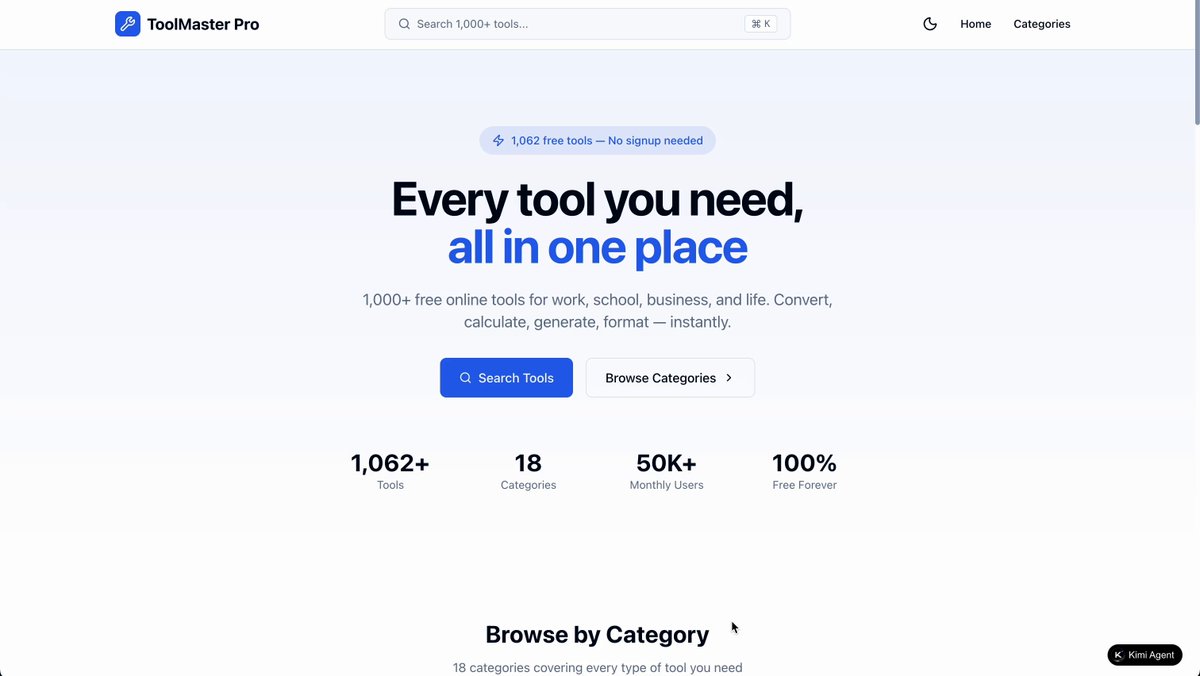
0:11
Site built with this process - https://ryeftjwqtrdjy.kimi.page/
THE BUSINESS MODEL MOST PEOPLE IGNORE

Here is what a boring tool site actually is:
A website with hundreds of small, free utilities that solve one specific problem each.
→ Convert this file
→ Calculate this number
→ Format this text
→ Generate this template
Each tool targets one keyword. Each keyword gets searched thousands of times per month. Each visitor sees one or two ads.
That is the entire business.
The math is simple and brutal:
500,000 monthly visitors × $20 RPM = $10,000/month
RPM = Revenue Per Mille (revenue per 1,000 visitors)
Tool sites earn $15–40 RPM depending on category:
→ Finance tools (GST, EMI, salary): $30–60 RPM
→ SEO tools: $25–45 RPM
→ Developer tools: $20–35 RPM
→ PDF converters: $12–20 RPM
→ Text utilities: $10–18 RPM
The sites that make $10k/month are not magic.
They have:
→ 500–1,000 tools
→ Each ranking for 1–3 keywords
→ Most getting 200–2,000 searches per month
→ Total adding up to 400,000–600,000 monthly visitors
Nobody builds 1,000 tools manually.
That is why this stayed out of reach until now.
WHY NOBODY TALKS ABOUT THIS
These sites are not sexy.
You cannot post a screenshot of your JSON formatter and get 500 likes.
Nobody wants to hear "I built a GST calculator and it makes $8,000 a month."
But the quiet builders know something the content creators don't:
Search intent never dies.
Every single day:
→ Someone needs to convert a PDF
→ Someone needs to calculate their EMI
→ Someone needs to format their JSON
→ Someone needs to check their word count
These searches happened in 2009. They happen today. They will happen in 2035.
The boring tool site is one of the few internet businesses with true evergreen demand.
The problem was always supply:
Building 1,000 tools required a team of engineers, months of work, and serious infrastructure.
That was then.
THE PROMPT THAT CHANGES EVERYTHING

I gave this to Kimi Agent Swarm.
11 agents ran in parallel.
This is the master prompt (It is so big, so added in a doc):
https://docs.google.com/document/d/1GVO0kqTjVZAvyjJO_YkDoJpFiwwWzRhE4r7BMxuNDrs/edit?usp=sharing
THE 11 AGENTS AND WHAT EACH ONE DOES
Agent 1 → Research Agent
Finds every boring utility opportunity across the internet.
Searches Google, Bing, Reddit, Quora, StackOverflow, and competitor sites.
Looks for patterns like:
→ "calculator" + any niche
→ "converter" + any file type
→ "generator" + any document
→ "checker" + any metric
Output: raw list of 2,000+ potential tool ideas.
Agent 2 → SERP Weakness Analyzer

Takes every idea from Agent 1 and scores it.
For every keyword, it checks the top 10 Google results:
→ Domain authority of ranking sites
→ Number of backlinks
→ Page speed
→ Content depth
→ UX quality
Assigns each keyword a Rankability Score from 0–100.
High score = weak competition = easy to rank.
The filter:
→ Keyword difficulty: under 35
→ Search volume: 500–50,000/month
→ Weak domains in top 10
→ No mega-sites dominating
This is the step that separates a tool site that grows from one that sits dead on page 10.
Most people pick tools they want to build.
The SERP Analyzer picks tools that can actually rank.
Agent 3 → Intent Clusterer
Prevents you from building 10 tools that all target the same keyword.
Groups semantically similar tools:
"jpg to png" + "png to jpg" → one tool, two URLs, same page "word counter" + "character counter" → one tool, two features
Prevents keyword cannibalization. Maximizes pages without creating duplicates.
Agent 4 → Site Architect
Builds the full website structure.
Homepage
→ Categories (12 main)
→ → Subcategories (50+)
→ → → Tool Pages (1,000+)
→ → → Hub Pages
→ → → Supporting Articles
URL structure:
→ /tools/pdf/pdf-to-jpg
→ /finance/calculators/gst-calculator
→ /dev/json-formatter
→ /text/word-counter
Rules:
→ Max 3 clicks from homepage to any tool
→ Short, clean URLs
→ Breadcrumbs on every page
Agent 5 → SEO Metadata Agent
Generates for every single page:
→ SEO title (CTR optimized)
→ Meta description
→ H1
→ Slug
→ Open Graph tags
→ FAQ schema
→ Breadcrumb schema
→ SoftwareApplication schema
1,000 tools × 8 metadata fields = 8,000 pieces of SEO content.
Generated automatically. All unique. All optimized.
Agent 6 → Topical Authority Engine
This is the agent most people miss.
A tool page alone ranks okay.
A tool page with 5 supporting articles ranks like a category leader.
For every major tool, this agent generates a full content cluster:
Example — GST Calculator:
→ What is GST? (guide)
→ GST slabs in India 2026 (reference)
→ GST for freelancers (use case)
→ How to create a GST invoice (tutorial)
→ GST FAQs (schema page)
Example — JSON Formatter:
→ What is JSON? (guide)
→ Common JSON errors (problem page)
→ JSON vs XML comparison (comparison page)
→ How to validate JSON (tutorial)
→ JSON schema examples (reference)
Output: 1,000+ supporting content ideas, each internally linking back to the tool.
Google does not just rank tools. Google ranks sites that demonstrate genuine expertise.
The topical authority cluster is what turns a utility website into an authority website.
Agent 7 → Internal Linking Agent
Creates the linking map for the entire site.
Every tool page:
→ Links to 3–5 related tools
→ Links to its supporting articles
→ Links back to its category hub
Every article:
→ Links to the relevant tool
→ Links to related tools
→ Links to related articles
This is how small sites beat big sites.
Not by having more backlinks. By circulating authority more efficiently internally.
Agent 8 → UX Agent
Designs the experience.
Every tool page follows the same template:
Above the fold:
→ Tool UI (the actual working thing)
→ Clear headline
→ One sentence explaining what it does
Below the fold:
→ How to use it (3 steps)
→ Examples
→ FAQs (schema markup)
→ Related tools grid
Site-wide:
→ Search bar in header
→ Category navigation
→ Trending tools sidebar
→ Recently used tools (cookie-based)
→ Dark mode
→ Mobile first
The tool must work. The page must load fast. The experience must feel professional.
Ugly but fast beats beautiful but slow. Every time.
Agent 9 → Tool Builder

Actually builds the tools.
Not wireframes. Not descriptions. Working code.
Tech stack: Next.js frontend + Go backend
For every tool: → Working logic → Input validation → Error states → Loading states → Empty states → Mobile-responsive UI → SSR optimized for Google indexing
Examples of what it builds in one run:
Converters:
PDF to JPG, JPG to PNG, HEIC to JPG, WebP to PNG, JSON to CSV, XML to JSON, Hex to RGB
Calculators:
GST Calculator, EMI Calculator, SIP Calculator, Salary Calculator, Compound Interest, Gratuity
Developer Tools:
JSON Formatter, JWT Decoder, UUID Generator, Base64 Encoder, Cron Generator, Regex Tester
Text Tools:
Word Counter, Remove Duplicate Lines, Case Converter, Text Diff Checker, Whitespace Remover
Each tool is a standalone page. Each page targets one keyword. Each keyword is money.
Agent 10 → Monetization Agent
Assigns revenue strategy per category.
Not every tool earns the same.
The agent scores each category by RPM:
Tier 1 — High RPM ($30–60):
→ Finance calculators (GST, EMI, SIP, tax)
→ SEO tools (meta generator, schema, sitemap)
→ Legal document generators (NDA, invoice, contract)
These get premium ad placements. Finance keywords attract bank, insurance, and fintech ads. Those advertisers pay $3–8 per click.
Tier 2 — Medium RPM ($15–30):
→ Developer tools (JSON, JWT, regex)
→ Business calculators (margin, ROI, pricing)
→ HR tools (salary breakup, overtime, timesheet)
Tier 3 — Base RPM ($8–15):
→ PDF converters
→ Text utilities
→ Image converters
Strategy:
Build 200 Tier 1 tools → highest revenue per visitor
Build 400 Tier 2 tools → solid mid-range income
Build 400 Tier 3 tools → high traffic volume
Total: 1,000 tools across all three tiers.
Agent 11 → Execution Agent
Merges everything into the final deliverable:
→ 1,000 validated tool opportunities ranked by easiness
→ Complete keyword database with search volumes
→ Full site architecture with all URLs
→ Metadata for every page
→ Internal linking graph
→ Monetization model per category
→ MVP roadmap: Top 100 easiest wins first
→ Folder structure and database schema
→ Working codebase
It does not stop after research.
It builds.
HOW $10,000/MONTH ACTUALLY HAPPENS

Month 1: Launch with 100 tools. 50 rank on page 3–5. Still visible, still getting clicks. Traffic: ~8,000 visitors/month Revenue: ~$160/month
Month 3: 300 tools live. First tools start moving to page 1 for long-tail keywords. Traffic: ~45,000 visitors/month Revenue: ~$900/month
Month 6: 500 tools live. Topical authority building. Google starts trusting the site as a category reference. Traffic: ~150,000 visitors/month Revenue: ~$3,000/month
Month 9: 700 tools. Internal links compound. Each new tool passes authority to existing tools. Traffic: ~320,000 visitors/month Revenue: ~$6,400/month
Month 12: 1,000 tools. Full compound effect. Supporting articles rank. Hub pages rank. Tool pages rank. Traffic: ~520,000 visitors/month Revenue: ~$10,400/month
The compounding effect:
Every new tool creates:
→ One new ranking page
→ 3–5 new internal links to existing tools
→ One new hub for supporting content
The 1,000th tool makes the 1st tool rank better.
That is the SEO moat.
THE SITES ALREADY DOING THIS
These are real. You have used them.
Calculator.net — 40M+ monthly visitors. Finance + math tools. Pure AdSense. Built in 2006. Still printing money.
SmallSEOTools.com — 15M+ monthly visitors. SEO + text utilities. Estimated $200K+ monthly revenue.
TinyWow.com — 5M+ monthly visitors. PDF + file tools. YC backed. Raised $3M because the model is that strong.
IlovePDF.com — 30M+ monthly visitors. Pure PDF tools. Runs on ads + premium tier.
RapidTables.com — 20M+ monthly visitors. Math + unit converters. Minimal design. Massive AdSense revenue.
None of these sites are pretty. None of them went viral. None of them had a launch strategy.
They just built boring tools. Got indexed. Compounded over years.
The difference between them and you is:
They started in 2008 before AI existed. You are starting in 2026 with 11 agents running in parallel.
THE CATEGORIES WITH THE BEST ROI

If you are Indian or targeting Indian traffic, these are the highest-RPM categories:
Finance (RPM: $30–60)
→ Tax calculator → every business owner in USA needs this
→ EMI calculator → 500M+ loan searches per year
→ In-hand salary calculator → every job offer triggers this search
→ SIP calculator → 80M+ mutual fund investors
→ Income tax calculator → 100M+ searches every March
Legal/Document Tools (RPM: $25–40)
→ Tax invoice generator → freelancers, consultants, agencies
→ Resignation letter generator → searched every Monday
→ Freelancer contract template → 15M+ freelancers in USA
SEO Tools (RPM: $25–45)
→ Meta title generator → every digital marketer
→ Schema generator → every developer
→ Robots.txt generator → every site launch
Start with USA-specific finance tools.
They have:
→ High search volume
→ Weak competition
→ High CPC from financial advertisers
→ Clear, evergreen intent
THE EXACT LAUNCH ORDER
Most people build 1,000 tools and launch nothing.
The right move: launch 10 tools in Week 1 and index immediately.
Week 1–2: The foundation (10 tools)
Pick the 10 highest-rankability score tools from your category.
For USA:
- Tax Calculator
- In-Hand Salary Calculator
- EMI Calculator
- SIP Calculator
- JSON Formatter
- Word Counter
- Resignation Letter Generator
- Invoice Generator
- Meta Title Generator
- Base64 Encoder
Submit to Google Search Console immediately. Build 2 supporting articles per tool. Add internal links between all 10.
Week 3–8: Scale to 100 tools
Add 10–15 tools per week. Keep building supporting content. Watch rankings in Search Console. Double down on categories that move first.
Month 3–6: Scale to 500 tools
Delegation begins. The Execution Agent handles batch building. You handle quality control and publishing.
Month 6–12: Scale to 1,000 tools
Full compound effect. Existing tools pull new tools up. Traffic compounds week over week.
WHAT STILL NEEDS YOU
The agents do not build a business overnight.
They build the blueprint and the foundation.
You still own:
→ Quality control before publishing
→ Deciding which categories to prioritize
→ Monitoring rankings and doubling down
→ Ad network setup (Google AdSense, Ezoic, Mediavine)
→ Edge cases for tools that need human review
→ Long-term compounding decisions
What changes is the starting point.
Before AI: 1,000 tools required a team of 5 engineers, 6 months, and .
After AI: 1,000 tools requires 11 agents, one prompt, and your judgment on what to publish.
The founder still owns taste, strategy, and distribution.
The swarm handles the execution.
THE UNCOMFORTABLE TRUTH
Most people who read this will do nothing.
They want the exciting business. The viral launch. The Twitter screenshot with 500k impressions.
The boring tool site has none of that.
It has something better:
→ No customer support
→ No sales calls
→ No team to manage
→ No product updates every week
→ No dependency on any platform algorithm
Just tools. Rankings. Ads. Checks.
The people who quietly built these sites in 2010 are not on Twitter explaining their strategy.
They are collecting AdSense payments on sites they haven't touched in 3 years.
That is the actual end state.
CLOSING
The SEO moat business is one of the last models where hard work compounds forever.
Every tool you publish:
→ Ranks for one more keyword
→ Strengthens every existing tool
→ Adds one more income stream
The 1,000th tool makes the 1st tool more valuable.
That compounding never unwinds.
Here is what you do next:
1. Open Kimi Agent Swarm at kimi.com/agent-swarm
2. Paste the master prompt above (adjusted for your niche)
3. Let all 11 agents run
4. Pick the 10 highest-rankability tools from the output
5. Build and publish those 10 first
6. Submit to Google Search Console
7. Add 10 tools per week from that point
Your first $1,000/month is 90 days away if you start today.
Your $10,000/month is 12 months away if you don't stop.
Try it: kimi.com/agent-swarm
→ Repost to show your network what boring actually looks like
→ Follow @sairahul1 — I write about AI systems and businesses that run without you


