Learning Coach
Any topic, your level, real proof of mastery
Learning Coach
Any topic, your level, real proof of mastery
展示內容
描述
Most learning plans fail before they begin, because they assume a level. Learning Coach starts by finding yours. A four-part diagnostic follows: a self-assessment, two applied questions that test whether the foundation is actually there, a vocabulary check, and one deliberately harder probe. The result is a placement in one of four bands, with the specific gaps that defined it named out loud. No guessing, no flattery — and when the evidence contradicts itself, it says so and lets you decide. From there it builds a roadmap ordered by real dependency rather than a topic list. Every module carries a concrete goal, a practice task that produces something, and a mastery criterion precise enough to test. A beginner gets 8–12 small, finishable steps; an advanced learner gets 4–6 dense ones. The curriculum lands as a YouMind document you keep: a progress-tracked module map, worked examples, the misconception most likely to trip you at each step, check questions with an answer key kept out of sight, diagrams where a concept is genuinely structural, and sources that were actually opened and verified. Then the coaching begins. Each module is tested with a mix of concept, application, transfer, teach-back, and a trap built from a real misconception. Answers are read for the faulty mental model behind them, repaired with a different representation, and advancement happens only at roughly 80% with no critical error. If you are not ready, it tells you — and fixes the sequence instead of pushing you forward. Review, rapid-check, and teach-back modes keep earlier material alive as you go. Its instructions are written in English. Every conversation runs in your language.
推薦自
Dancang
為什麼我們推薦這個技能
Featured for turning learning into an evidence-based progression rather than a generic study plan. It diagnoses the learner’s level, builds dependency-aware modules with observable mastery criteria, and uses honest calibration, targeted remediation, and teach-back to verify real capability.
相關技能
查看全部 研究
Tech Made Learnable
Technical documents are often hard to learn not because you lack ability, but because the language, terminology, and hidden assumptions make it difficult to build a clear mental model. Tech Made Learnable turns a complex document into a complete beginner-friendly learning path. First, it creates a structured Technical Reference Guide that protects the original meaning, important distinctions, rules, exceptions, and uncertainty. Then it creates a simplified, story-led Learning Guide that explains the topic step by step, using realistic scenarios, concrete examples, and visual thinking where they genuinely help. Next, it prepares copy-ready NotebookLM prompts for an explanatory audio dialogue and a visual learning video. The goal is to help you read, hear, see, and mentally picture how the topic works. Assessment comes last. After you finish learning, simply say you are ready for review. The Skill then creates a final quiz with clear answer explanations and directs you back to the exact concepts that need reinforcement. Best for technical manuals, standards, procedures, complex articles, professional training materials, software documentation, engineering topics, quality systems, and any subject that feels difficult because it was written for experts.
Recall Engine: Study Kit from Sources
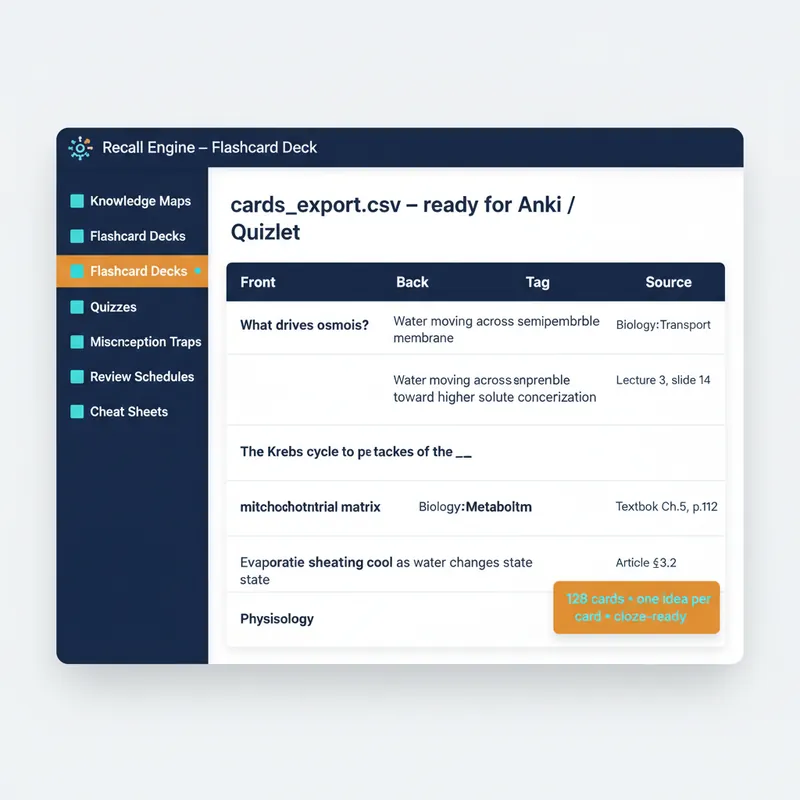
You read it. You highlighted it. A week later it is gone. YouMind is very good at helping you collect and create. Recall Engine handles the part in between: actually keeping what you read. Point it at a board, an article, a PDF, a lecture or a podcast transcript and it builds a complete study system out of that specific material — not a generic summary. What you get: • A testable knowledge map that separates the 8-15 things you must know from the detail and the context, each tied to its source • A ready-to-import flashcard deck as CSV — paste straight into Anki, Quizlet or a spreadsheet — written to real card-design rules: one idea per card, cloze for definitions, question form for causes, nothing with a four-item answer • A three-tier quiz that moves from recall to application to transfer, each question with its answer, its source, and the wrong answer you were most likely to pick • Five misconception traps drawn from the actual material, in the form "most people think X, actually Y, and here is why the confusion happens" • A dated review schedule on expanding intervals that fits your real deadline and your real minutes per day • A one-page cheat sheet, plus the three questions your source never answers It calibrates first: exam, interview, teaching it, or long-term fluency all produce different decks. It refuses to invent a fact to make a neat card — where a source is ambiguous, the card asks about the ambiguity. Contested claims are tagged, with the counter-view on the back. Built for students, researchers, people preparing for interviews or certifications, and anyone whose reading list is longer than their memory.
LessonLens
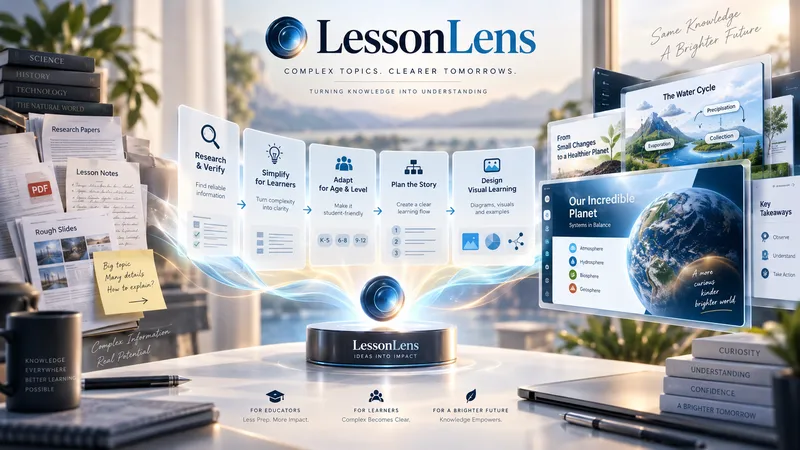
LessonLens turns complex topics, documents, research, and lesson notes into clear, visually engaging educational presentations built for real learners. It does more than convert text into slides. LessonLens can research and verify important facts, adapt the material to the learner’s age and prior knowledge, identify learning goals and likely misconceptions, and choose the most effective way to explain the topic. Depending on the content, it may use direct explanation, step-by-step teaching, comparison, diagrams, timelines, light storytelling, or other learning structures. Storytelling is used only when it improves understanding. The visual system is built around the lesson itself. LessonLens evaluates which visual approaches actually fit the topic, creates a consistent presentation direction, and writes detailed professional image prompts for every required visual. These visuals can include carefully designed learner-facing labels, arrows, short explanations, headings, and annotations so the final slides remain understandable without depending only on teacher notes. The result can include: a researched and age-adapted teaching plan a structured slide-by-slide learning flow professional visual direction detailed image prompts slide-ready educational visuals PowerPoint presentation teacher or presenter notes optional PDF output summaries, quizzes, or supporting learning material when useful LessonLens is designed for teachers, tutors, course creators, and educational content creators who want more than attractive slides — they want presentations that help students actually understand the subject.
