I found out about this late. Don't make the same mistake.
Follow & Bookmark this - I'm starmex, I track how AI tools are creating new income streams most people haven't heard of yet. This one surprised even me.
Six months ago I was scrolling through TechCrunch. Not looking for anything specific. Just following the money.
Then I saw the story. Telisha Jones. 31 years old. Mississippi. She took her poetry, typed it into Suno, and made an R&B song called "How Was I Supposed to Know." It went viral. Hallwood Media signed her. Deal reportedly worth $3 million.
Then I kept reading. Suno - the AI music platform - hit $300 million ARR in February 2026. 2 million paid subscribers. Valued at $2.45 billion. Someone on Medium documented making $30,000 in four months working 2-3 hours a day creating and selling AI tracks. No musical background.
Then I found James. Six months. $8,500 revenue. $10/month Suno subscription. Laptop. That's it.
The barrier that kept most people out: you needed musical talent, expensive software, studio time, industry connections.
Suno removes all of it. And Claude writes prompts that make Suno produce better music than 99% of what people generate manually.
One weekend. A $10 subscription. Music on Spotify, Apple Music, YouTube. Here's exactly how it works.

1/
What the AI music market actually looks like in 2026.
Most people think AI music is a gimmick. The numbers say otherwise.
powershell
1AI music market 2026:2Suno ARR: $300 million (Feb 2026)3Suno paid subscribers: 2 million4Suno valuation: $2.45 billion5Suno downloads: 30 million since launch6Daily tracks created: 50,000+ per day on Suno alone7Streaming platforms: 150+ accept AI music via distributors8Suno revenue share: 0% — all royalties go to creator9Cost to start: $10/month (Suno Pro)
The music industry spent two years fighting AI. Then Warner Music Group settled with Suno and signed a partnership deal. Universal Music Group settled with Udio. The industry accepted that AI music is here.
And creators are quietly building real income streams while everyone else argues about whether AI music is "legitimate."

0xMarioNawfal
@RoundtableSpace
·
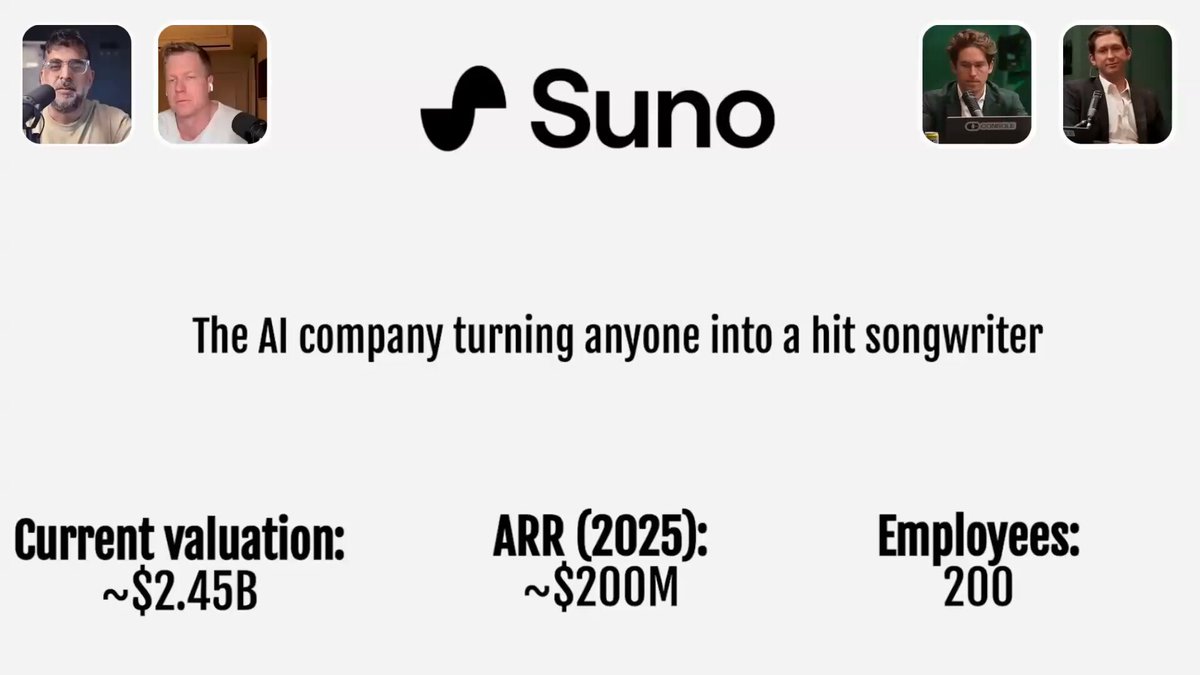
SUNO JUST HIT $300M ARR WITH 2M PAID USERS AND IS GENERATING 7M SONGS A DAY.
SPOTIFY’S CATALOG… EVERY 2 WEEKS.
3:03
From !https://pbs.twimg.com/profile_images/1750523865523265536/ZBiEOGfI_normal.jpgMy First Million
11
3
38
The three platforms where AI music money actually lives:
plaintext
1Platform Model Potential2────────────────────────────────────────────────────────3Spotify/Apple Streaming royalties $0.003-0.005/stream4YouTube Ad revenue $1-5 per 1,000 views5AudioJungle Stock music sales $19-79 per track6Pond5 Stock music $5-50 per track7Fiverr Custom orders $25-200 per song8Membership site Subscriptions $15/month per member
The people making real money aren't relying on one stream. They stack all six.
2/
Why Claude + Suno beats Suno alone.
Suno generates music from text prompts. The quality of the output depends entirely on the quality of the prompt. Most people type "happy pop song" and get generic garbage. The top 1% of earners think about prompts differently.
This is exactly where Claude comes in.
A bad Suno prompt:
Calm music for videos
A Claude-optimized Suno prompt:
php-template
1Soft acoustic guitar with gentle piano melody, morning coffee2atmosphere, no drums or percussion, warm analog tape sound,390 seconds, perfect for YouTube background, ends with gentle4fade, no lyrics, tempo 72 BPM, key of G major, production5quality similar to lo-fi but cleaner, emotional warmth
The difference in output quality is not subtle. It's the difference between a track that gets rejected by AudioJungle and one that sells 40 times.
The Claude prompt that writes your Suno prompts:
yaml
1You are an expert music producer who specializes in writing2prompts for Suno AI music generator.34I want to create a catalog of [genre] tracks for [use case].5Target platform: [AudioJungle / YouTube / Spotify / Fiverr]67For each track idea, write a detailed Suno prompt that includes:8- Specific instruments and their role (lead, rhythm, background)9- Exact tempo in BPM10- Key and scale11- Mood descriptors (3-5 specific emotional words)12- Production style reference (lo-fi, cinematic, warm, etc.)13- Duration and structure (intro, build, drop if applicable)14- What to exclude (no drums / no lyrics / no distortion)15- Platform-specific requirements1617Generate 10 different prompt variations that would create18a cohesive but varied catalog. Each track should feel19related but distinct.

3/
The money math. Five streams that actually pay.
Stream 1 - Stock music libraries (most consistent)
AudioJungle, Pond5, Epidemic Sound, Artlist. You upload tracks, they sell while you sleep. One track on Pond5 can sell for $10-50 each time. James made $340 from a single track in one month.
powershell
1Stock music math:2100 tracks on Pond5:3 10 tracks sell 1x/month at $25 avg = $250/month4 5 tracks sell 3x/month at $30 avg = $450/month5 Total: $700/month passive from 100 tracks67500 tracks (5 months of Claude-optimized production):8 Estimated: $2,000-4,000/month fully passive
Stream 2 - Custom orders on Fiverr ($25-200/song)
Server owners, YouTubers, podcast hosts, TikTok creators - all need custom music. You offer "custom AI music in 24 hours" on Fiverr. Claude helps you write the description, title, and FAQ to rank higher in search.
yaml
1Write me an optimized Fiverr gig for selling custom AI music.23My service: Custom background music created with AI in 24 hours.4Target clients: YouTubers, podcasters, TikTok creators, businesses.5Price points: Basic $25 (1 track), Standard $50 (3 tracks),6 Premium $150 (10 tracks + stems)78Write:91. SEO-optimized gig title (include high-search keywords)102. Gig description (200 words, benefit-focused)113. 5 FAQ answers that overcome objections124. 3 package descriptions135. Tags to maximize search visibility
One person documented getting 3-5 Fiverr orders daily at $25-75 each. That's $75-375/day.
Stream 3 - YouTube ad revenue
Upload tracks to YouTube with monetization. "Lo-Fi Study Beats" channels get millions of views. Claude helps optimize titles, descriptions, and tags for YouTube search.
yaml
1I'm uploading AI-generated lo-fi music to YouTube.2Track details: [describe the track]34Write me:51. YouTube title (include high-search terms, under 60 chars)62. Description (300 words, keyword-rich, with timestamps)73. 15 tags from most to least specific84. Thumbnail text suggestion95. Playlist category recommendation1011Target audience: students, remote workers, people who need12focus music. Optimize for YouTube search, not just trends.
Stream 4 - Membership site ($15/month)
The person making $30,000 in four months built a membership site where 200+ members pay $15/month for unlimited downloads of their AI music catalog. $3,000/month recurring from people who need background music regularly.
Claude writes the entire sales page:
yaml
1Write a sales page for a music membership site.23Product: Unlimited downloads of AI-generated royalty-free music4Price: $15/month5Target: Content creators, YouTubers, podcasters, businesses67Write:81. Headline that emphasizes cost savings vs competitors92. 5 bullet points of key benefits103. Comparison table: my service vs AudioJungle vs hiring a composer114. 3 customer testimonial placeholders125. FAQ section (6 questions)136. Call to action with urgency element1415Tone: Professional but approachable. Not salesy.
Stream 5 - Sync licensing (highest per-track value)
Businesses, filmmakers, and ad agencies pay $200-2,000 for one-time music licenses. Claude helps you pitch:
yaml
1Write a cold email pitching AI music licensing to [business type].23My catalog: 200+ tracks, genres: [list genres]4Their need: Background music for [videos/ads/podcasts]5Price: $199 for unlimited use of one track, $499 for 10 tracks67Write a 150-word cold email that:8- Opens with a specific observation about their content9- Explains the cost savings vs custom music ($500-5,000)10- Makes the offer clear11- Has a simple CTA (reply for a free sample)12- Doesn't sound like a mass email
4/
The production workflow. How to build a catalog fast.
The goal: 100 quality tracks on multiple platforms within 30 days. Here's the exact system.
Week 1 - Niche research (Claude does this)
yaml
1I want to build an AI music catalog to sell on AudioJungle,2Pond5, and Fiverr.34Analyze the stock music market right now:51. Which genres have high demand but low AI competition?62. Which specific use cases are undersupplied?7 (corporate, meditation, gaming, cooking videos, etc.)83. What track lengths sell best on each platform?94. What metadata keywords get the most searches?105. Give me a 30-day production plan:11 which genres to produce each week and in what volume1213I want to build a catalog that earns $1,000+/month within 90 days.
Week 2-3 - Production pipeline
powershell
1Day starts:21. Claude generates 10 Suno prompts for today's genre32. Paste each into Suno → generate 3 variations each43. Listen through 30 tracks → keep best 1054. Export from Suno → process through Audacity (free)6 or Adobe Audition (remove silence, normalize levels)75. Claude writes titles, descriptions, tags for each track86. Upload to DistroKid ($22/year, unlimited uploads)9 → Spotify, Apple Music, Amazon Music, YouTube Music,10 Tidal, and 150+ other platforms automatically1112Time per day: 2-3 hours13Tracks per day: 5-10 quality tracks14Monthly output: 100-200 tracks
The Claude prompt that writes all your metadata:
yaml
1I have an AI-generated music track with these characteristics:2- Genre: [genre]3- Mood: [mood descriptors]4- Instruments: [instruments]5- Use case: [what it's good for]6- Duration: [length]78Write all metadata for distribution:910For AudioJungle:11- Title (descriptive, keyword-rich)12- Description (150 words)13- Tags (20 tags, comma-separated)14- Category selection1516For Spotify/Apple Music (via DistroKid):17- Track title18- Album name suggestion19- Artist bio (100 words)20- Genre classification2122For YouTube:23- Title24- Description (200 words)25- Tags (15)26- Playlist suggestion

5/
The honest numbers. What's realistic vs hype.
plaintext
1Reality check — what creators actually report:23Month 1 (building catalog, 0 sales):4 Investment: $10 Suno Pro5 Revenue: $0-506 Focus: Build 50-100 tracks, learn what works78Month 2-3 (first sales):9 Stock music: $50-200/month10 Fiverr: $200-500/month if active11 Total: $250-700/month1213Month 4-6 (scaling):14 Stock music (200+ tracks): $500-1,500/month15 Fiverr + membership: $500-2,000/month16 YouTube (if growing): $100-500/month17 Total: $1,100-4,000/month1819Month 6+ (established):20 James: $8,500 in 6 months total21 The $30K/4mo person: $7,500/month average22 Most consistent earners: $1,500-5,000/month
The real warning nobody says clearly:
Spotify has removed over 75 million AI tracks. AudioJungle gets 15,000+ AI submissions per month - competition is real. Streaming royalties alone won't pay your rent for years. The people making money are selling on stock sites and doing custom orders - not waiting for Spotify streams.
What Claude can't do:
Claude optimizes prompts. Suno generates music. But a track that sells 40 times has something that's hard to define - it fits a specific mood perfectly, it doesn't feel generic, it sounds like it was made by a human who cared about the craft. You develop taste for what works by listening to thousands of tracks and understanding what buyers actually need. That judgment is yours.
6/
The full stack.
plaintext
1RESEARCH: Claude identifies low-competition niches,2 high-demand use cases, optimal track lengths34PROMPTS: Claude writes detailed Suno prompts that produce5 quality tracks — specific instruments, BPM, mood,6 production style, platform requirements78PRODUCE: Suno generates tracks from Claude's prompts9 (Pro: 2,500 credits/month = ~500 songs)1011PROCESS: Audacity (free) normalizes audio,12 removes silence, exports to MP3/WAV1314METADATA: Claude writes all titles, descriptions, tags15 optimized for each platform's search algorithm1617DISTRIBUTE: DistroKid ($22/year) → 150+ streaming platforms18 AudioJungle, Pond5 → stock music sales19 Fiverr → custom orders2021MONETIZE: Streaming royalties (passive)22 Stock music sales (passive)23 Custom orders (active, $25-200/song)24 Membership site (recurring)25 Sync licenses (one-time, highest value)2627SCALE: Claude writes cold emails for sync licensing,28 Fiverr gig descriptions, membership sales pages,29 YouTube titles and tags
The only thing Claude and Suno can't replace: the listening. You still need to hear what's good.
The window.
Telisha Jones typed a prompt. Made a viral song. Got a $3 million deal.
James spent six months with a $10/month subscription and a laptop. $8,500 in revenue. No music background.
Suno hit $300 million ARR. Warner Music Group stopped fighting and signed a partnership deal instead. The labels accepted that AI music is real.
The barrier was always musical talent. The years of practice, the studio time, the expensive software, the industry connections.
Suno removes the talent barrier. Claude removes the prompt barrier - the part where most people produce generic garbage because they don't know how to describe what they want.
AudioJungle has 15,000 AI submissions per month. Most of them are bad. Generic prompts produce generic music. The people who understand that a great prompt is the product - those are the ones collecting royalties while everyone else wonders why their tracks aren't selling.
Where to start:
- Suno Pro: suno.com ($10/month, commercial rights included)
- DistroKid: distrokid.com ($22/year, unlimited distribution)
- AudioJungle: audiojungle.net (stock music marketplace)
- Fiverr: fiverr.com → search "background music" for competitor research
// The window is open. Follow - I'll keep finding them before they close //


