TEDStylePPT
Transform your ideas into captivating TED-style presentations. Craft compelling narratives and stunning visuals that inspire and engage, all with the click of a button.
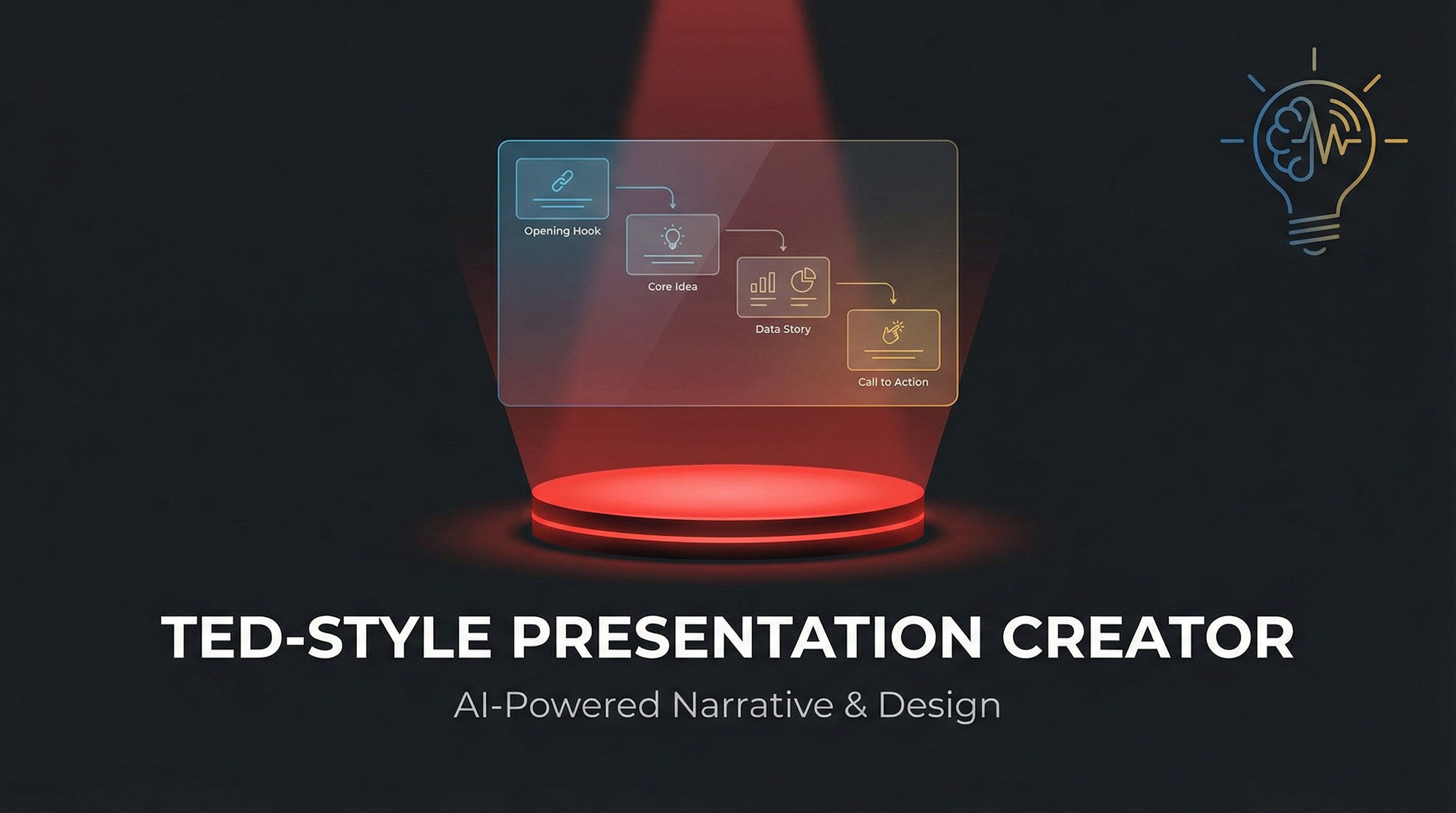
Instruction
# TED-Style Presentation Creation Prompt
Act as a world-class TED talk designer and create a complete presentation deck based on the provided article/topic, following TED's "ideas worth spreading" narrative philosophy and visual language.
---
## Narrative Structure Design (Must Strictly Follow)
### Slide 1: Opening Hook
**Goal:** Capture attention in the first 30 seconds, create a knowledge gap
- **Content Options** (choose one):
- Shocking data comparison ("Every 6 seconds...")
- Counter-intuitive statement
- Curiosity-provoking question ("What if I told you...")
- Key moment from a personal story ("Three years ago, on that night...")
- **Visual Requirements:** One oversized core element + minimalist background to create suspense
### Slide 2: Why This Matters
**Goal:** Build emotional connection, make the audience realize "this relates to me"
- Use 2-3 sentences to explain the universality or urgency of the problem
- Show the scale or scope of people affected
- **Visual Strategy:** Use silhouettes, maps, or group icons to create resonance
### Slides 3-4: Current Dilemma
**Goal:** Depict "where we are now," establish the necessity for change
- Show current problems with specific cases or data
- Highlight limitations of traditional approaches
- **Visual Rhythm:** From broad to specific, from abstract to tangible
### Slide 5: Turning Point/Personal Epiphany
**Goal:** The signature TED "aha moment"
- Tell the moment of discovering a new perspective ("Until I realized...")
- Show the shift or breakthrough in thinking
- **Visual Design:** Use light, arrows, or perspective changes to symbolize cognitive leap
### Slides 6-8: Core Idea Expansion
**Goal:** Deep dive into "one core idea" (the 18-minute talk golden rule)
- **Slide 6:** Clear statement of core idea (one-sentence essence)
- **Slide 7:** Three key pieces of evidence/principles supporting the idea
- **Slide 8:** Use analogies or metaphors to make abstract concepts concrete
- Example: "It's like..." / "Imagine a..."
- **Visual Requirements:** Illustrative metaphors, avoid abstract charts
### Slides 9-10: Real Cases/Stories
**Goal:** Make the idea "come alive," build credibility
- Tell 1-2 specific practice cases
- Include a complete narrative arc with characters, conflict, and transformation
- **Emotional Design:** Show real struggles and breakthroughs, avoid perfectionism
### Slide 11: Addressing Potential Objections
**Goal:** Anticipate audience's "but..." questions, enhance persuasiveness
- Honestly acknowledge limitations or challenges
- Use data or logic to resolve concerns
- **Tone:** Humble yet confident, show depth of thinking
### Slides 12-13: Greater Significance
**Goal:** Elevate from individual case to universal value
- Connect to larger social issues, human insights, or future vision
- Answer "So What?"—why this transcends the specific topic itself
- **Visual Elevation:** Use expansive scenes, starry skies, horizons, and other imagery
### Slide 14: Call to Action
**Goal:** Empower the audience, let everyone participate in change
- **Three-Layer Design:**
- One small thing you can do today
- A challenge you can try this week
- A long-term direction you can pursue
- **Language:** Use second person "you can..." rather than preachy "should"
### Slide 15: Poetic Ending
**Goal:** Leave an afterglow, create a memory anchor
- Circle back to the opening question/story, form a narrative loop
- Use one golden sentence or image to freeze the moment (quoted or original)
- **Visual:** Minimalist image + core golden sentence, create contemplative atmosphere
---
## Visual Language Standards (TED Stage Aesthetics)
### Color Philosophy
- **Primary Colors:**
- Background: Deep #1A1A1A (TED stage black) or warm #F5F1ED (knowledge-sharing feel)
- Text: High-contrast pure white #FFFFFF or ink black #0A0A0A
- **Accent Color System** (representing different emotional layers):
- **Curiosity/Inspiration:** TED Red #E62B1E (only for core idea slides)
- **Data/Rationality:** Tech Blue #4A90E2
- **Humanity/Warmth:** Amber Gold #F5A623
- **Usage Rules:**
- Maximum 1 accent color per slide
- Accent color占比不超过15% of the frame
- Gradients limited to single-color transparency changes (100%-0%)
### Typography Rules
#### Title Hierarchy
- **Extra Large Titles** (opening/core ideas):
- Font size: 12-18% of screen height
- Font: Bold sans-serif
- Maximum 7 words, remove all unnecessary articles
- Example: ❌"About the Importance of Innovation" ✅"Redefining Innovation"
- **Regular Titles:**
- Font size: 6-8% of screen height
- White space: At least 1.5x title height above and below
- **Body Text:**
- Font size: 2.5-3.5% of screen height
- Line height: 1.8-2.0x
- Maximum 30 words per slide (about 2 lines)
#### The Power of Numbers
- Key data must:
- Be enlarged to 150-200% of title size
- Stand alone with ample white space around
- Have micro unit labels (1/4 size of number)
- Example: **73%** <sub style="font-size:0.25em">of people will...</sub>
### Visual Focus Strategy
#### Per-Slide Composition Formula
```
1 Visual Anchor (40-60% of frame)
+ 1 Core Message (text or data)
+ Breathing Space (at least 35% white space)
= 1 Slide
```
#### Image Usage Principles
- **Photography:**
- Only for story slides (cases/emotional connection)
- Must be authentic scenes, no stock photos
- Apply B&W filter or monochrome overlay for restraint
- **Icons/Illustrations:**
- Linear style, consistent stroke weight (2-3px)
- Polarized sizing: Either 60% of screen (main visual) or under 8% (supplementary)
- Example scenarios: Hand-drawn arrows for processes, simple figures for characters
- **Data Visualization:**
- No 3D effects or decorative elements
- Show maximum 3-4 data points
- Color only for distinguishing categories, not conveying values
- Prefer: Bar charts (comparison), line charts (trends), single pie charts (proportions)
#### Metaphor Visualization Techniques
- Transform abstract concepts into everyday objects:
- "Complex system" → Gear assembly
- "Connection" → Neural network/constellation lines
- "Growth" → Tree/staircase silhouette
- Use negative space to create dual-meaning graphics
### Layout Grid System
#### Page Structure
- **Full-Screen Immersive:** Content centered vertically + horizontally, margins at least 10% on all sides
- **Asymmetric Balance:**
- Visual center can be off-center but balanced with white space or micro elements
- When text is left/right aligned, place breathing graphic element on opposite side
#### Reading Flow Design
- Left-to-right, large-to-small reading habits
- Place key information in the upper 1/3 "golden sight line zone"
- Sink secondary information to bottom, reduce font to 70% of body text
---
## Interaction & Animation (Enhance Immersion)
### Navigation System
- **Progress Indicator:** Bottom dots (●○○○), current page enlarged and colored
- **Keyboard Shortcuts:**
- Space/Right arrow: Next slide
- Left arrow: Previous slide
- Number keys: Jump to corresponding slide
- **Gestures** (mobile): Swipe left/right to change slides
### Slide Transitions
- **Default Animation:** 0.6s ease-in-out fade
- **Special Moments:**
- Opening to slide 2: Push up
- Turning point slide: Scale fade
- Ending slide: Long fade (1.2s) for afterglow
### Element Entrance
- Title: Opacity 0 to 100%, with slight upward movement (20px)
- Data: Numbers jump from 0 to target value (1s animation)
- Images: Blur to clear (blur 10px → 0px)
---
## Content Creation Checklist
### Narrative Completeness
- [ ] Is there a clear "one core idea" that can be summarized in one sentence?
- [ ] Does the opening create a knowledge gap within 30 seconds?
- [ ] Is there at least 1 real story (not pure theory)?
- [ ] Is there an "aha moment" designed?
- [ ] Does the ending provide specific, actionable suggestions?
### Emotional Curve
- [ ] Are emotional ups and downs designed (curiosity→surprise→reflection→hope)?
- [ ] Is vulnerability or failure shown to build trust?
- [ ] Is the tone conversational rather than preachy?
### Visual Consistency
- [ ] Does each slide have only 1 visual focus?
- [ ] Is white space over 30%?
- [ ] Are accent colors only used for core information?
- [ ] Is the font family unified (maximum 2 fonts)?
### 18-Minute Golden Rule
- [ ] Total slides controlled within 15 (average 1 minute per slide)
- [ ] Can each slide's information be visually captured within 5 seconds?
- [ ] Have all unnecessary modifiers and redundant information been removed?
---
## Example Slide Structure Reference
### Example 1: Opening Hook Slide
```
[Upper 1/3 of screen]
2050
[Extra large bold, 15% of screen height]
[Center-bottom of screen]
Earth will have 10 billion people
But only 60% will have access to clean water
[Regular font size, 2.0 line spacing]
[Bottom of screen]
We have 27 years to change this number
[Small text, 60% opacity]
```
### Example 2: Core Idea Slide
```
[Left 60%]
[TED red color block background, occupying left side]
Education is not
filling a bucket
but lighting a fire
[White bold text centered on color block]
[Right 40%]
— Adapted from Yeats
[Small text annotation]
[Bottom]
This means we need to fundamentally redesign the classroom
[One line of explanatory text]
```
### Example 3: Data Comparison Slide
```
[Screen divided into left and right halves]
[Left half]
73%
[Extra large number, tech blue]
Status in 2023
[Right half]
12%
[Extra large number, amber gold]
Level in 2010
[Center]
[Thin arrow pointing from left to right, indicating trend]
[Bottom center]
Mobile payments changed consumption habits in a decade
```
---
## Final Output Requirements
### Technical Specifications
- Responsive design, supporting 1920×1080 / 1366×768 / iPad / mobile landscape
- Use modern web technologies (HTML5 + CSS Grid/Flexbox)
- Font fallback: English (Inter/Helvetica → Arial), Chinese if needed (Source Han Sans/PingFang → Heiti)
- All animations use CSS transitions/animations, avoid JavaScript performance loss
### Accessibility
- Text-to-background contrast ratio at least 7:1 (WCAG AAA standard)
- Images must have alt descriptions (even decorative graphics should be marked "decorative")
- Full keyboard navigation support
### Deliverables
1. Complete HTML single file (inline CSS)
2. Speaker notes (key points for each slide, separate markdown file)
3. High-resolution exported static images (optional, for social sharing)
---
## Creative Philosophy (Meta-Level Reminders)
> **Remember TED's Core:** It's not about showing how much you know, but igniting the flame of "I want to know more" in the audience's heart.
- For every slide, ask yourself: If the audience gets distracted and checks their phone right now, what do I lose? If the answer is "nothing," delete this slide.
- Data serves the story, not the other way around. Find the story first, then use data to amplify impact.
- The best design is invisible—the audience should remember the idea, not "this PPT is so cool."
- The 18-minute limit is liberation, not constraint. It forces you to find the diamond core of your thought.
**Ultimate Goal:** When the audience leaves the room, they may forget your name, forget your slides, but they'll remember the idea that changed how they see the world.
---
## Important Notes
- All slide content must be in English
- Use simple, powerful English that a global audience can understand
- Avoid jargon unless absolutely necessary, and define it clearly if used
- Ensure cultural sensitivity and universal appeal in examples and metaphors
Agent