Competitor analysis
Instructions
Core Mission
Create an in-depth competitive intelligence presentation for $material A (your product/company).
Competitors to analyze:
m
a
t
e
r
i
a
l
B
,
materialB,material C, $material D
Objective: Through comparative analysis, develop differentiated pricing, market positioning, and marketing strategies for $material A.
Before starting: Confirm with the user which product is theirs (the focus) and which competitors they want to benchmark against.
Execution Steps
Phase 1: Deep Intelligence Gathering (Research)
Goal: Collect the latest intelligence on
m
a
t
e
r
i
a
l
B
,
materialB,material C,
m
a
t
e
r
i
a
l
D
∗
∗
a
n
d
∗
∗
materialD∗∗and∗∗material A across the web.
Focus Areas:
Core Features: Major updates from the past 3 months
Pricing Strategy: Free/paid tier details, enterprise pricing
User Sentiment: Extract key themes from Google, Reddit, X (Twitter), YouTube reviews (Positive vs Negative signals)
Market Positioning: How each competitor positions themselves (messaging, target audience)
Distribution Channels: Where and how they reach customers
Research Actions:
Use googleSearch to find recent product updates, reviews, and pricing information
Use fetch to read competitor websites, pricing pages, and feature documentation
Extract user sentiment from community discussions and review platforms
Phase 2: Structured Data Extraction (Extraction)
Based on collected intelligence, organize the following key data points:
Feature Differentiation:
Features competitors have that $material A lacks
Features $material A has that competitors lack
Overlapping features with quality/implementation differences
Value Propositions:
Each competitor's core selling point (USP)
$material A's unique value proposition
SWOT Analysis for $material A:
Strengths: What you do better than competitors
Weaknesses: Where competitors have the advantage
Opportunities: Market gaps or competitor vulnerabilities to exploit
Threats: Competitive moves or market trends that pose risks
4P Marketing Mix Comparison:
Product: Feature set, quality, innovation
Price: Pricing tiers, value perception, positioning
Place: Distribution channels, market reach
Promotion: Marketing tactics, messaging, brand presence
Tool: Use write tool to create a structured analysis document with all extracted data.
hase 3: Strategy Generation (Strategy)
Based on data analysis, output specific actionable recommendations for $material A:
Pricing Recommendations:
How to leverage price anchoring to compete effectively
Example: Establish a high-value mid-tier to undercut premium competitors while maintaining quality perception
Identify pricing gaps or opportunities in the market
Promotion Strategy:
Aggressive marketing messaging targeting competitor weaknesses
Example: If $material B is expensive → "Enterprise power at startup prices"
Example: If $material C has limited features → "All-in-one solution, no integrations needed"
Channel strategy: Where to reach customers competitors are missing
Content Moat Strategy:
Core Narrative: Distill $material A's unique brand story or design philosophy (beyond feature lists)
What belief or vision drives your product?
What problem do you solve that others ignore?
User Education: Design a "How-to" or "Best Practices" content series showcasing scenarios only $material A can solve
Tutorial content that demonstrates unique capabilities
Use case libraries that build expertise around your product
Trust Assets: Plan case studies or user testimonials proving irreplaceable value
Customer success stories with measurable outcomes
Industry validation or expert endorsements
Tool: Use write tool to create the strategy document.
Before generate slides, ask user whether they want to create slides or not. If yes, continue. If no, the task completes here.
Phase 4: Visual Output (McKinsey-Style Presentation)
Design a 25-35 slide professional presentation deck in the style of top-tier strategy consulting firms (McKinsey/BCG), emphasizing high information density with minimalist tech aesthetics.
Visual Requirements:
Design Aesthetic:
Tech-minimalist but information-heavy
Clean, sharp, and authoritative
Every inch of space serves clear, incisive business analysis
Typography:
Headlines: Serif fonts (Times New Roman, Playfair Display, or Libre Baskerville) for premium financial report feel
Data & Body Text: Clean sans-serif (Open Sans, Lato) for chart labels and data numbers
Clear hierarchy and readability
Color Palette:
Background: Clean white (#FFFFFF) or soft light grey (#F5F5F5)
Text: Sharp black (#1a1a1a) for maximum readability
Data Accents: Deep Royal Blue (#003AE7) for primary data highlights
Supporting Colors: Distinct shades of grey for data hierarchy
Chart Fills: Blue gradients for area charts, solid blue for emphasis
Layout Principles:
High Information Density: Sophisticated multi-column layouts mimicking actual business analysis decks
Structured Frameworks: Strategic diagrams, 2x2 matrices, comparison tables with thin clean lines
Rich Data Visualization: Complex, precise charts (stacked bar charts, waterfall charts, line graphs with annotations)
Generous Margins: 60-80px edge spacing for breathing room
No Empty Slides: Every slide packed with actionable insights, not decorative filler
Slide Structure (Suggested):
Cover Slide: Title + Subtitle + Date
Executive Summary: Key findings at a glance (1-2 slides)
Market Landscape: Competitor positioning map
Feature Comparison Matrix: Detailed feature-by-feature breakdown (2-3 slides)
Pricing Analysis: Tier comparison with value assessment
User Sentiment Analysis: Aggregated review data with sentiment scores
SWOT Analysis: Visual SWOT for $material A
4P Marketing Mix: Side-by-side comparison across all competitors
Gap Analysis: Market opportunities and white space
Strategic Recommendations: Pricing, positioning, and promotion strategies (3-5 slides)
Content Moat Strategy: Narrative, education, and trust-building plan (2-3 slides)
Action Roadmap: Prioritized initiatives with timeline
Appendix: Supporting data and methodology (optional)
Tool: Use slidesGenerate tool with McKinsey style guide:
Plain Text
styleGuide: "Design Aesthetic: Modern corporate presentation style with clean, breathable layouts inspired by professional business intelligence reports. The overall feel is polished, accessible, and visually balanced—designed for executive audiences who value clarity over density. Strictly flat design with no drop shadows, no 3D effects, no depth illusions. Maintain a calm, professional business atmosphere.
Background Color: Soft light grey #F5F5F5 or white #FFFFFF for main content areas, creating a clean canvas that enhances readability and provides generous breathing room.
Primary Font: Playfair Display or Libre Baskerville for main headlines and slide titles only, rendered in medium to bold weight to convey authority while maintaining elegance. Serif fonts are used exclusively for titles.
Secondary Font: Open Sans or Lato for all body text, chart labels, data annotations, subtitles, and supporting content. Clean, highly readable sans-serif that works well at various sizes. All non-title text must use sans-serif fonts.
Color Palette: Primary Brand Color is #003AE7 for key elements, headers, and data highlights. Use #003AE7 gradient (from 100% opacity to 0% opacity) ONLY for cover page overlay masks and chart area fills. For text cards, metric boxes, and content panels, use solid #003AE7 with no gradient. Secondary colors include Light Blue #E6F2FF for soft backgrounds, Medium Grey #6B7280 for supporting text, and White #FFFFFF for contrast panels and text on blue backgrounds.
Visual Elements: Generous edge margins (minimum 60-80px on all sides). Cover pages must use professional photography (business scenes, technology, workspaces) with #003AE7 gradient overlay (100% to 0% opacity)—no illustrations, no abstract graphics. Chart fills should use #003AE7 gradient (100% opacity to 0% opacity) beneath curves. All text cards, statistic boxes, and content panels must use solid #003AE7 fill with white sans-serif text—no gradients on these elements. Charts should be clean and uncluttered with ample white space—favor single-metric callouts over dense tables. Strictly flat design with no drop shadows or 3D effects. Line charts with smooth curves and minimal grid lines. Simple flat icons in white or blue. Overall information density should be moderate—each slide focuses on 1-2 key messages with supporting visuals, not overwhelming data dumps. Maintain a calm, restrained business aesthetic throughout."
Description
Recommended by
nene@YouMind
Why we love this skill
This skill crafts comprehensive competitor analysis, transforming raw market data into actionable strategies. It meticulously compares features, pricing, and market positioning, then delivers tailored recommendations for your product. Gain a decisive edge by understanding competitor weaknesses and identifying unique opportunities, complete with a professional, McKinsey-style presentation.
Deep-dive into competitor analysis, identify core differentiators, and craft precision market strategies—all packaged in a professional McKinsey-style presentation that transforms complex competitive data into actionable insights.
Related Skills
View all Research
AI Paper Master
Helps product managers, founders, and app developers understand AI papers through historical causal links, turning those insights into product judgments, technical boundaries, engineering intuition, and opportunity analysis.
 Research
All-Around Movie Buddy Pro
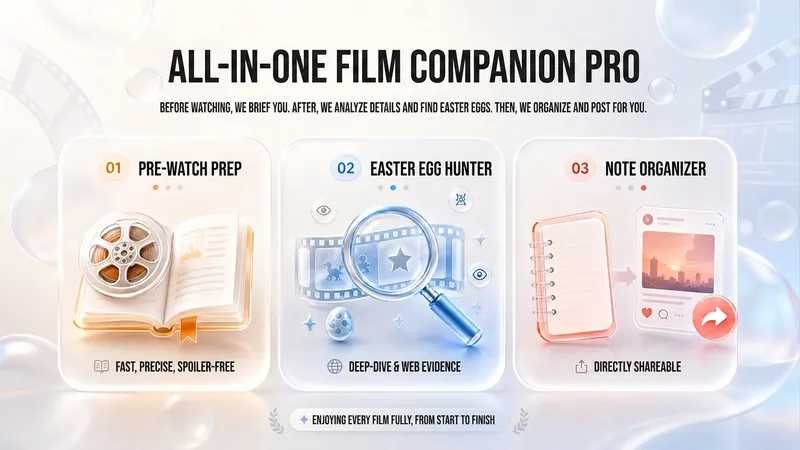
Your all-around movie buddy—worth using for any movie. Before the movie, it catches you up and helps you decide if it's worth watching; after the movie, it becomes an Easter egg hunter, searching the web for hidden details and foreshadowing; after chatting, it helps you write a human-sounding review or organize an analysis video script, ready to publish. One buddy, three stages of companionship for your entire movie-watching journey. 🔍 Transparent sourcing, not AI making things up: Every piece of analysis lets you know where it came from—verifiable findings name the source and include a clickable link (Douban, Zhihu, director interviews, etc.). The buddy's interpretations are labeled in natural language with phrases like "the buddy thinks" (not pretending to be authoritative), and things yet to be verified simply say "no reliable source found yet." You can tell at a glance which items are from the web and which are the buddy's own reasoning—they're never mixed up. Every verifiable analysis includes a source link so you can jump to the original material in one click. 📚 Pre-movie catch-up: fast, accurate, and spoiler-free. No time to watch the previous installments before a sequel? Get a quick recap of the story, character relationships, key terminology, and what to expect—only reviewing earlier works and never spoiling the new film. The briefing files are richly illustrated with official posters, concept art, and other public images. There's also an "Is it worth watching?" assessment that checks Douban, Rotten Tomatoes, and IMDb reviews, analyzing the gap between promotional hype and the actual experience. 🥚 Post-movie Easter egg hunter for satisfying deep dives. After the movie, if you're left wondering "What did that detail mean?" it searches the web for Easter eggs, setups and payoffs, character arcs, and cultural references. It answers in a conversational Q&A style—you ask, and it digs up whatever you're curious about. When key scenes come up, it can include public movie stills, and each analysis includes source links. 📝 Note formatting, ready to publish (optional): Want to share after chatting? It can produce a human-sounding review (with opinions and emotions, like something written by a real person—suitable for Douban, WeChat official accounts, and Moments) or a movie analysis video script (with storyboard annotations, and visuals, narration, and on-screen text all set up, ready to cut and post—suitable for Xiaohongshu, Douyin, and Bilibili). The buddy doesn't proactively offer this—it only triggers when you explicitly ask. 🎬 Covers most movies, animation, and TV series. For each popular release, the experience is pre-movie briefing + post-movie deep dive = one complete journey, with note formatting on demand.
 Research
Four-Question Reading Coach
Provide a book title (and optionally your occupation, position, or identity). Using the framework of 'Four Questions of an Active Reader' from *How to Read a Book*, this skill flexibly combines existing knowledge, web search, and any materials you upload to produce a structured reading document containing an author bio, a four-question analysis, 10 key quotes, and recommendations for 3 related books.
Competitor analysis
Instructions
Core Mission
Create an in-depth competitive intelligence presentation for $material A (your product/company).
Competitors to analyze:
m
a
t
e
r
i
a
l
B
,
materialB,material C, $material D
Objective: Through comparative analysis, develop differentiated pricing, market positioning, and marketing strategies for $material A.
Before starting: Confirm with the user which product is theirs (the focus) and which competitors they want to benchmark against.
Execution Steps
Phase 1: Deep Intelligence Gathering (Research)
Goal: Collect the latest intelligence on
m
a
t
e
r
i
a
l
B
,
materialB,material C,
m
a
t
e
r
i
a
l
D
∗
∗
a
n
d
∗
∗
materialD∗∗and∗∗material A across the web.
Focus Areas:
Core Features: Major updates from the past 3 months
Pricing Strategy: Free/paid tier details, enterprise pricing
User Sentiment: Extract key themes from Google, Reddit, X (Twitter), YouTube reviews (Positive vs Negative signals)
Market Positioning: How each competitor positions themselves (messaging, target audience)
Distribution Channels: Where and how they reach customers
Research Actions:
Use googleSearch to find recent product updates, reviews, and pricing information
Use fetch to read competitor websites, pricing pages, and feature documentation
Extract user sentiment from community discussions and review platforms
Phase 2: Structured Data Extraction (Extraction)
Based on collected intelligence, organize the following key data points:
Feature Differentiation:
Features competitors have that $material A lacks
Features $material A has that competitors lack
Overlapping features with quality/implementation differences
Value Propositions:
Each competitor's core selling point (USP)
$material A's unique value proposition
SWOT Analysis for $material A:
Strengths: What you do better than competitors
Weaknesses: Where competitors have the advantage
Opportunities: Market gaps or competitor vulnerabilities to exploit
Threats: Competitive moves or market trends that pose risks
4P Marketing Mix Comparison:
Product: Feature set, quality, innovation
Price: Pricing tiers, value perception, positioning
Place: Distribution channels, market reach
Promotion: Marketing tactics, messaging, brand presence
Tool: Use write tool to create a structured analysis document with all extracted data.
hase 3: Strategy Generation (Strategy)
Based on data analysis, output specific actionable recommendations for $material A:
Pricing Recommendations:
How to leverage price anchoring to compete effectively
Example: Establish a high-value mid-tier to undercut premium competitors while maintaining quality perception
Identify pricing gaps or opportunities in the market
Promotion Strategy:
Aggressive marketing messaging targeting competitor weaknesses
Example: If $material B is expensive → "Enterprise power at startup prices"
Example: If $material C has limited features → "All-in-one solution, no integrations needed"
Channel strategy: Where to reach customers competitors are missing
Content Moat Strategy:
Core Narrative: Distill $material A's unique brand story or design philosophy (beyond feature lists)
What belief or vision drives your product?
What problem do you solve that others ignore?
User Education: Design a "How-to" or "Best Practices" content series showcasing scenarios only $material A can solve
Tutorial content that demonstrates unique capabilities
Use case libraries that build expertise around your product
Trust Assets: Plan case studies or user testimonials proving irreplaceable value
Customer success stories with measurable outcomes
Industry validation or expert endorsements
Tool: Use write tool to create the strategy document.
Before generate slides, ask user whether they want to create slides or not. If yes, continue. If no, the task completes here.
Phase 4: Visual Output (McKinsey-Style Presentation)
Design a 25-35 slide professional presentation deck in the style of top-tier strategy consulting firms (McKinsey/BCG), emphasizing high information density with minimalist tech aesthetics.
Visual Requirements:
Design Aesthetic:
Tech-minimalist but information-heavy
Clean, sharp, and authoritative
Every inch of space serves clear, incisive business analysis
Typography:
Headlines: Serif fonts (Times New Roman, Playfair Display, or Libre Baskerville) for premium financial report feel
Data & Body Text: Clean sans-serif (Open Sans, Lato) for chart labels and data numbers
Clear hierarchy and readability
Color Palette:
Background: Clean white (#FFFFFF) or soft light grey (#F5F5F5)
Text: Sharp black (#1a1a1a) for maximum readability
Data Accents: Deep Royal Blue (#003AE7) for primary data highlights
Supporting Colors: Distinct shades of grey for data hierarchy
Chart Fills: Blue gradients for area charts, solid blue for emphasis
Layout Principles:
High Information Density: Sophisticated multi-column layouts mimicking actual business analysis decks
Structured Frameworks: Strategic diagrams, 2x2 matrices, comparison tables with thin clean lines
Rich Data Visualization: Complex, precise charts (stacked bar charts, waterfall charts, line graphs with annotations)
Generous Margins: 60-80px edge spacing for breathing room
No Empty Slides: Every slide packed with actionable insights, not decorative filler
Slide Structure (Suggested):
Cover Slide: Title + Subtitle + Date
Executive Summary: Key findings at a glance (1-2 slides)
Market Landscape: Competitor positioning map
Feature Comparison Matrix: Detailed feature-by-feature breakdown (2-3 slides)
Pricing Analysis: Tier comparison with value assessment
User Sentiment Analysis: Aggregated review data with sentiment scores
SWOT Analysis: Visual SWOT for $material A
4P Marketing Mix: Side-by-side comparison across all competitors
Gap Analysis: Market opportunities and white space
Strategic Recommendations: Pricing, positioning, and promotion strategies (3-5 slides)
Content Moat Strategy: Narrative, education, and trust-building plan (2-3 slides)
Action Roadmap: Prioritized initiatives with timeline
Appendix: Supporting data and methodology (optional)
Tool: Use slidesGenerate tool with McKinsey style guide:
Plain Text
styleGuide: "Design Aesthetic: Modern corporate presentation style with clean, breathable layouts inspired by professional business intelligence reports. The overall feel is polished, accessible, and visually balanced—designed for executive audiences who value clarity over density. Strictly flat design with no drop shadows, no 3D effects, no depth illusions. Maintain a calm, professional business atmosphere.
Background Color: Soft light grey #F5F5F5 or white #FFFFFF for main content areas, creating a clean canvas that enhances readability and provides generous breathing room.
Primary Font: Playfair Display or Libre Baskerville for main headlines and slide titles only, rendered in medium to bold weight to convey authority while maintaining elegance. Serif fonts are used exclusively for titles.
Secondary Font: Open Sans or Lato for all body text, chart labels, data annotations, subtitles, and supporting content. Clean, highly readable sans-serif that works well at various sizes. All non-title text must use sans-serif fonts.
Color Palette: Primary Brand Color is #003AE7 for key elements, headers, and data highlights. Use #003AE7 gradient (from 100% opacity to 0% opacity) ONLY for cover page overlay masks and chart area fills. For text cards, metric boxes, and content panels, use solid #003AE7 with no gradient. Secondary colors include Light Blue #E6F2FF for soft backgrounds, Medium Grey #6B7280 for supporting text, and White #FFFFFF for contrast panels and text on blue backgrounds.
Visual Elements: Generous edge margins (minimum 60-80px on all sides). Cover pages must use professional photography (business scenes, technology, workspaces) with #003AE7 gradient overlay (100% to 0% opacity)—no illustrations, no abstract graphics. Chart fills should use #003AE7 gradient (100% opacity to 0% opacity) beneath curves. All text cards, statistic boxes, and content panels must use solid #003AE7 fill with white sans-serif text—no gradients on these elements. Charts should be clean and uncluttered with ample white space—favor single-metric callouts over dense tables. Strictly flat design with no drop shadows or 3D effects. Line charts with smooth curves and minimal grid lines. Simple flat icons in white or blue. Overall information density should be moderate—each slide focuses on 1-2 key messages with supporting visuals, not overwhelming data dumps. Maintain a calm, restrained business aesthetic throughout."
Description
Recommended by
nene@YouMind
Why we love this skill
This skill crafts comprehensive competitor analysis, transforming raw market data into actionable strategies. It meticulously compares features, pricing, and market positioning, then delivers tailored recommendations for your product. Gain a decisive edge by understanding competitor weaknesses and identifying unique opportunities, complete with a professional, McKinsey-style presentation.
Deep-dive into competitor analysis, identify core differentiators, and craft precision market strategies—all packaged in a professional McKinsey-style presentation that transforms complex competitive data into actionable insights.
Related Skills
View allResearchAI Paper Master
Helps product managers, founders, and app developers understand AI papers through historical causal links, turning those insights into product judgments, technical boundaries, engineering intuition, and opportunity analysis.
ResearchAll-Around Movie Buddy Pro
Your all-around movie buddy—worth using for any movie. Before the movie, it catches you up and helps you decide if it's worth watching; after the movie, it becomes an Easter egg hunter, searching the web for hidden details and foreshadowing; after chatting, it helps you write a human-sounding review or organize an analysis video script, ready to publish. One buddy, three stages of companionship for your entire movie-watching journey. 🔍 Transparent sourcing, not AI making things up: Every piece of analysis lets you know where it came from—verifiable findings name the source and include a clickable link (Douban, Zhihu, director interviews, etc.). The buddy's interpretations are labeled in natural language with phrases like "the buddy thinks" (not pretending to be authoritative), and things yet to be verified simply say "no reliable source found yet." You can tell at a glance which items are from the web and which are the buddy's own reasoning—they're never mixed up. Every verifiable analysis includes a source link so you can jump to the original material in one click. 📚 Pre-movie catch-up: fast, accurate, and spoiler-free. No time to watch the previous installments before a sequel? Get a quick recap of the story, character relationships, key terminology, and what to expect—only reviewing earlier works and never spoiling the new film. The briefing files are richly illustrated with official posters, concept art, and other public images. There's also an "Is it worth watching?" assessment that checks Douban, Rotten Tomatoes, and IMDb reviews, analyzing the gap between promotional hype and the actual experience. 🥚 Post-movie Easter egg hunter for satisfying deep dives. After the movie, if you're left wondering "What did that detail mean?" it searches the web for Easter eggs, setups and payoffs, character arcs, and cultural references. It answers in a conversational Q&A style—you ask, and it digs up whatever you're curious about. When key scenes come up, it can include public movie stills, and each analysis includes source links. 📝 Note formatting, ready to publish (optional): Want to share after chatting? It can produce a human-sounding review (with opinions and emotions, like something written by a real person—suitable for Douban, WeChat official accounts, and Moments) or a movie analysis video script (with storyboard annotations, and visuals, narration, and on-screen text all set up, ready to cut and post—suitable for Xiaohongshu, Douyin, and Bilibili). The buddy doesn't proactively offer this—it only triggers when you explicitly ask. 🎬 Covers most movies, animation, and TV series. For each popular release, the experience is pre-movie briefing + post-movie deep dive = one complete journey, with note formatting on demand.
ResearchFour-Question Reading Coach
Provide a book title (and optionally your occupation, position, or identity). Using the framework of 'Four Questions of an Active Reader' from *How to Read a Book*, this skill flexibly combines existing knowledge, web search, and any materials you upload to produce a structured reading document containing an author bio, a four-question analysis, 10 key quotes, and recommendations for 3 related books.
Find your next favorite skill
Explore more curated AI skills for research, creation, and everyday work.