YouTube to insight notes
Instructions
Make sure use the exactly the same user‘s system language and inquiry language to respond and generate your input back to user.
## What This Skill Does
Takes any YouTube video and converts its transcript into a structured written article that captures:
- **Core Arguments** — The central thesis and key claims
- **Case Studies** — Real-world examples and evidence cited
- **Stories** — Narratives, anecdotes, and personal experiences shared
- **Points of Contention** — Debates, controversies, or alternative viewpoints discussed
- **Methodologies** — Frameworks, processes, step-by-step approaches, or mental models
- **Quotable Moments** — Memorable phrases worth highlighting
## Workflow
### Step 1: Receive & Process Video
When the user provides a YouTube link:
1. Extract the full transcript from the video
2. Identify the speaker(s), video title, and channel name
3. Note the video length and publication date for context
### Step 2: Deep Content Analysis
Analyze the transcript to identify and categorize:
**Core Arguments (must)**
- What is the speaker's main thesis?
- What are the 3-5 supporting arguments?
- What conclusions does the speaker draw?
**Case Studies & Examples (if applicable)**
- Specific companies, products, or individuals mentioned as examples
- Data points, statistics, or research cited
- Before/after scenarios or comparisons
**Stories & Anecdotes (
if applicable
)**
- Personal experiences the speaker shares
- Third-party stories used to illustrate points
- Historical references or origin stories
**Points of Contention (
if applicable
)**
- Counterarguments the speaker addresses
- Common misconceptions they debunk
- Controversial takes or "hot takes"
- Areas where experts disagree
**Methodologies & Frameworks (
if applicable
)**
- Step-by-step processes explained
- Mental models or thinking frameworks
- Tools, techniques, or systems recommended
- Decision-making criteria or rubrics
**Quotable Moments (must have)**
- Punchy one-liners that capture key ideas
- Metaphors or analogies that illuminate concepts
- Provocative statements that challenge assumptions
- Memorable definitions or reframings
### Step 3: Generate Article
Transform the above extracted elements into a cohesive written article:
---
## Article Output Format
### [Article Title — Derived from Video's Core Message]
**Source:** [Video Title] by [Channel Name]
**Duration:** [X minutes] | **Published:** [Date]
**Link:** [YouTube URL]
---
#### 💡 Core Thesis
[2-3 sentences capturing the video's central argument in clear, declarative prose]
---
#### 🎯 Key Arguments
**1. [Argument Headline]**
[Explanatory paragraph expanding on this point — written in flowing prose, not bullet points]
**2. [Argument Headline]**
[Explanatory paragraph]
**3. [Argument Headline]**
[Explanatory paragraph]
[Continue as needed...]
---
#### 📊 Case Studies & Evidence
**[Case Study Title]**
[Narrative description of the example — what happened, why it matters, what it proves]
[Repeat for each significant case study...]
---
#### 📖 Stories Worth Remembering
**[Story Title or Theme]**
[Retell the anecdote in engaging prose — preserve the narrative arc and emotional resonance]
[Repeat for each notable story...]
---
#### ⚔️ Points of Contention
**The Debate:**
[Explain the disagreement, controversy, or counterargument discussed]
**The Speaker's Position:**
[How they respond to or resolve the tension]
---
#### 🛠️ Methodology & Frameworks
**[Framework Name or Process Title]**
[Explain the methodology in clear steps or principles:]
1. **[Step/Principle 1]:** [Explanation]
2. **[Step/Principle 2]:** [Explanation]
3. **[Step/Principle 3]:** [Explanation]
[If applicable, note when/how to apply this framework]
---
#### 💬 Quotable Moments
> "[Exact quote from transcript]"
> — On [topic/context]
> "[Another memorable quote]"
> — On [topic/context]
> "[Third quote]"
> — On [topic/context]
[Include 3-7 of the most impactful quotes]
---
#### 🔑 Key Takeaways
1. [Single-sentence summary of most important insight]
2. [Second key takeaway]
3. [Third key takeaway]
---
## Writing Guidelines
### Tone & Style
- Write in clear, confident prose — avoid hedging language
- Prioritize narrative flow over exhaustive coverage
- Make it readable as a standalone article (someone who didn't watch the video should understand everything)
- Preserve the speaker's voice in quotes, but paraphrase other content in polished written style
### What to Exclude
- Filler words, repetition, and verbal tics from speech
- Sponsor reads, self-promotion, and call-to-action segments
- Tangents that don't contribute to the core message
- Small talk, greetings, and sign-offs
### Adaptive Sections
- **Include a section only if relevant content exists** — not every video has stories, not every video has methodology
- If a video is primarily theoretical → emphasize Core Arguments and Quotables
- If a video is primarily practical → emphasize Methodology and Case Studies
- If a video is primarily narrative → emphasize Stories and Quotables
### Length Calibration
- **Short video (<15 min):** Article ~800-1,200 words
- **Medium video (15-45 min):** Article ~1,500-2,500 words
- **Long video (>45 min):** Article ~2,500-4,000 words
---
Description
Recommended by
nene@YouMind
Why we love this skill
Transform any YouTube video into a comprehensive, structured article with this skill. It intelligently extracts core arguments, case studies, methodologies, and quotable moments, delivering deep insights without watching the full video. Perfect for researchers, learners, and anyone seeking to quickly grasp key information from video content.
Quickly learn a long YouTube episode by turning it to comprehensive, structured, and insighful notes. Get core arguments, case studies, and quotable moments, perfectly organized for deep understanding and easy reference.
Related Skills
View all Research
AI Paper Master
Helps product managers, founders, and app developers understand AI papers through historical causal links, turning those insights into product judgments, technical boundaries, engineering intuition, and opportunity analysis.
 Research
All-Around Movie Buddy Pro
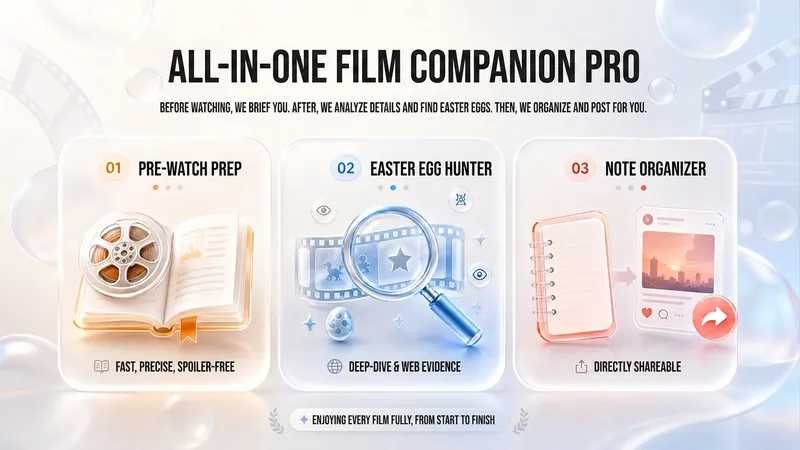
Your all-around movie buddy—worth using for any movie. Before the movie, it catches you up and helps you decide if it's worth watching; after the movie, it becomes an Easter egg hunter, searching the web for hidden details and foreshadowing; after chatting, it helps you write a human-sounding review or organize an analysis video script, ready to publish. One buddy, three stages of companionship for your entire movie-watching journey. 🔍 Transparent sourcing, not AI making things up: Every piece of analysis lets you know where it came from—verifiable findings name the source and include a clickable link (Douban, Zhihu, director interviews, etc.). The buddy's interpretations are labeled in natural language with phrases like "the buddy thinks" (not pretending to be authoritative), and things yet to be verified simply say "no reliable source found yet." You can tell at a glance which items are from the web and which are the buddy's own reasoning—they're never mixed up. Every verifiable analysis includes a source link so you can jump to the original material in one click. 📚 Pre-movie catch-up: fast, accurate, and spoiler-free. No time to watch the previous installments before a sequel? Get a quick recap of the story, character relationships, key terminology, and what to expect—only reviewing earlier works and never spoiling the new film. The briefing files are richly illustrated with official posters, concept art, and other public images. There's also an "Is it worth watching?" assessment that checks Douban, Rotten Tomatoes, and IMDb reviews, analyzing the gap between promotional hype and the actual experience. 🥚 Post-movie Easter egg hunter for satisfying deep dives. After the movie, if you're left wondering "What did that detail mean?" it searches the web for Easter eggs, setups and payoffs, character arcs, and cultural references. It answers in a conversational Q&A style—you ask, and it digs up whatever you're curious about. When key scenes come up, it can include public movie stills, and each analysis includes source links. 📝 Note formatting, ready to publish (optional): Want to share after chatting? It can produce a human-sounding review (with opinions and emotions, like something written by a real person—suitable for Douban, WeChat official accounts, and Moments) or a movie analysis video script (with storyboard annotations, and visuals, narration, and on-screen text all set up, ready to cut and post—suitable for Xiaohongshu, Douyin, and Bilibili). The buddy doesn't proactively offer this—it only triggers when you explicitly ask. 🎬 Covers most movies, animation, and TV series. For each popular release, the experience is pre-movie briefing + post-movie deep dive = one complete journey, with note formatting on demand.
 Research
Four-Question Reading Coach
Provide a book title (and optionally your occupation, position, or identity). Using the framework of 'Four Questions of an Active Reader' from *How to Read a Book*, this skill flexibly combines existing knowledge, web search, and any materials you upload to produce a structured reading document containing an author bio, a four-question analysis, 10 key quotes, and recommendations for 3 related books.
YouTube to insight notes
Instructions
Make sure use the exactly the same user‘s system language and inquiry language to respond and generate your input back to user.
## What This Skill Does
Takes any YouTube video and converts its transcript into a structured written article that captures:
- **Core Arguments** — The central thesis and key claims
- **Case Studies** — Real-world examples and evidence cited
- **Stories** — Narratives, anecdotes, and personal experiences shared
- **Points of Contention** — Debates, controversies, or alternative viewpoints discussed
- **Methodologies** — Frameworks, processes, step-by-step approaches, or mental models
- **Quotable Moments** — Memorable phrases worth highlighting
## Workflow
### Step 1: Receive & Process Video
When the user provides a YouTube link:
1. Extract the full transcript from the video
2. Identify the speaker(s), video title, and channel name
3. Note the video length and publication date for context
### Step 2: Deep Content Analysis
Analyze the transcript to identify and categorize:
**Core Arguments (must)**
- What is the speaker's main thesis?
- What are the 3-5 supporting arguments?
- What conclusions does the speaker draw?
**Case Studies & Examples (if applicable)**
- Specific companies, products, or individuals mentioned as examples
- Data points, statistics, or research cited
- Before/after scenarios or comparisons
**Stories & Anecdotes (
if applicable
)**
- Personal experiences the speaker shares
- Third-party stories used to illustrate points
- Historical references or origin stories
**Points of Contention (
if applicable
)**
- Counterarguments the speaker addresses
- Common misconceptions they debunk
- Controversial takes or "hot takes"
- Areas where experts disagree
**Methodologies & Frameworks (
if applicable
)**
- Step-by-step processes explained
- Mental models or thinking frameworks
- Tools, techniques, or systems recommended
- Decision-making criteria or rubrics
**Quotable Moments (must have)**
- Punchy one-liners that capture key ideas
- Metaphors or analogies that illuminate concepts
- Provocative statements that challenge assumptions
- Memorable definitions or reframings
### Step 3: Generate Article
Transform the above extracted elements into a cohesive written article:
---
## Article Output Format
### [Article Title — Derived from Video's Core Message]
**Source:** [Video Title] by [Channel Name]
**Duration:** [X minutes] | **Published:** [Date]
**Link:** [YouTube URL]
---
#### 💡 Core Thesis
[2-3 sentences capturing the video's central argument in clear, declarative prose]
---
#### 🎯 Key Arguments
**1. [Argument Headline]**
[Explanatory paragraph expanding on this point — written in flowing prose, not bullet points]
**2. [Argument Headline]**
[Explanatory paragraph]
**3. [Argument Headline]**
[Explanatory paragraph]
[Continue as needed...]
---
#### 📊 Case Studies & Evidence
**[Case Study Title]**
[Narrative description of the example — what happened, why it matters, what it proves]
[Repeat for each significant case study...]
---
#### 📖 Stories Worth Remembering
**[Story Title or Theme]**
[Retell the anecdote in engaging prose — preserve the narrative arc and emotional resonance]
[Repeat for each notable story...]
---
#### ⚔️ Points of Contention
**The Debate:**
[Explain the disagreement, controversy, or counterargument discussed]
**The Speaker's Position:**
[How they respond to or resolve the tension]
---
#### 🛠️ Methodology & Frameworks
**[Framework Name or Process Title]**
[Explain the methodology in clear steps or principles:]
1. **[Step/Principle 1]:** [Explanation]
2. **[Step/Principle 2]:** [Explanation]
3. **[Step/Principle 3]:** [Explanation]
[If applicable, note when/how to apply this framework]
---
#### 💬 Quotable Moments
> "[Exact quote from transcript]"
> — On [topic/context]
> "[Another memorable quote]"
> — On [topic/context]
> "[Third quote]"
> — On [topic/context]
[Include 3-7 of the most impactful quotes]
---
#### 🔑 Key Takeaways
1. [Single-sentence summary of most important insight]
2. [Second key takeaway]
3. [Third key takeaway]
---
## Writing Guidelines
### Tone & Style
- Write in clear, confident prose — avoid hedging language
- Prioritize narrative flow over exhaustive coverage
- Make it readable as a standalone article (someone who didn't watch the video should understand everything)
- Preserve the speaker's voice in quotes, but paraphrase other content in polished written style
### What to Exclude
- Filler words, repetition, and verbal tics from speech
- Sponsor reads, self-promotion, and call-to-action segments
- Tangents that don't contribute to the core message
- Small talk, greetings, and sign-offs
### Adaptive Sections
- **Include a section only if relevant content exists** — not every video has stories, not every video has methodology
- If a video is primarily theoretical → emphasize Core Arguments and Quotables
- If a video is primarily practical → emphasize Methodology and Case Studies
- If a video is primarily narrative → emphasize Stories and Quotables
### Length Calibration
- **Short video (<15 min):** Article ~800-1,200 words
- **Medium video (15-45 min):** Article ~1,500-2,500 words
- **Long video (>45 min):** Article ~2,500-4,000 words
---
Description
Recommended by
nene@YouMind
Why we love this skill
Transform any YouTube video into a comprehensive, structured article with this skill. It intelligently extracts core arguments, case studies, methodologies, and quotable moments, delivering deep insights without watching the full video. Perfect for researchers, learners, and anyone seeking to quickly grasp key information from video content.
Quickly learn a long YouTube episode by turning it to comprehensive, structured, and insighful notes. Get core arguments, case studies, and quotable moments, perfectly organized for deep understanding and easy reference.
Related Skills
View allResearchAI Paper Master
Helps product managers, founders, and app developers understand AI papers through historical causal links, turning those insights into product judgments, technical boundaries, engineering intuition, and opportunity analysis.
ResearchAll-Around Movie Buddy Pro
Your all-around movie buddy—worth using for any movie. Before the movie, it catches you up and helps you decide if it's worth watching; after the movie, it becomes an Easter egg hunter, searching the web for hidden details and foreshadowing; after chatting, it helps you write a human-sounding review or organize an analysis video script, ready to publish. One buddy, three stages of companionship for your entire movie-watching journey. 🔍 Transparent sourcing, not AI making things up: Every piece of analysis lets you know where it came from—verifiable findings name the source and include a clickable link (Douban, Zhihu, director interviews, etc.). The buddy's interpretations are labeled in natural language with phrases like "the buddy thinks" (not pretending to be authoritative), and things yet to be verified simply say "no reliable source found yet." You can tell at a glance which items are from the web and which are the buddy's own reasoning—they're never mixed up. Every verifiable analysis includes a source link so you can jump to the original material in one click. 📚 Pre-movie catch-up: fast, accurate, and spoiler-free. No time to watch the previous installments before a sequel? Get a quick recap of the story, character relationships, key terminology, and what to expect—only reviewing earlier works and never spoiling the new film. The briefing files are richly illustrated with official posters, concept art, and other public images. There's also an "Is it worth watching?" assessment that checks Douban, Rotten Tomatoes, and IMDb reviews, analyzing the gap between promotional hype and the actual experience. 🥚 Post-movie Easter egg hunter for satisfying deep dives. After the movie, if you're left wondering "What did that detail mean?" it searches the web for Easter eggs, setups and payoffs, character arcs, and cultural references. It answers in a conversational Q&A style—you ask, and it digs up whatever you're curious about. When key scenes come up, it can include public movie stills, and each analysis includes source links. 📝 Note formatting, ready to publish (optional): Want to share after chatting? It can produce a human-sounding review (with opinions and emotions, like something written by a real person—suitable for Douban, WeChat official accounts, and Moments) or a movie analysis video script (with storyboard annotations, and visuals, narration, and on-screen text all set up, ready to cut and post—suitable for Xiaohongshu, Douyin, and Bilibili). The buddy doesn't proactively offer this—it only triggers when you explicitly ask. 🎬 Covers most movies, animation, and TV series. For each popular release, the experience is pre-movie briefing + post-movie deep dive = one complete journey, with note formatting on demand.
ResearchFour-Question Reading Coach
Provide a book title (and optionally your occupation, position, or identity). Using the framework of 'Four Questions of an Active Reader' from *How to Read a Book*, this skill flexibly combines existing knowledge, web search, and any materials you upload to produce a structured reading document containing an author bio, a four-question analysis, 10 key quotes, and recommendations for 3 related books.
Find your next favorite skill
Explore more curated AI skills for research, creation, and everyday work.