Car Insurance Policy Risk Guide
Instructions
The core purpose of this skill is to help users fully verify the basic information on car insurance quotes, identify "inclusive insurance" traps, risks associated with the qualifications of underwriting companies, and check for unreasonable aspects in policy configurations, so as to prevent users from falling into claims difficulties due to greed for cheap prices or negligence by salespersons.
Core Workflow
Prerequisite checks
Users must be required to upload at least one screenshot/photo of their car insurance quote or policy. If a user only inquires via text or does not provide any images, please proactively remind them: "To accurately identify risks and unreasonable aspects in the policy, please upload a screenshot/photo of your car insurance quote or policy." Only after obtaining the image will the following screening process proceed.
After the user provides a picture of the car insurance quote, please strictly follow the steps below to perform the checks:
First step: Verifying basic policy information (the first line of defense against disputes)
Carefully verify the basic information on the quotation to prevent disputes in later claims due to data entry errors by the salesperson:
Vehicle information verification: Check whether the license plate number, vehicle identification number (VIN), brand and model are consistent with the user's actual vehicle.
Personnel Information Verification: Check if the vehicle owner's name and the insured's name match. If they do not match, remind the user to confirm if there are any special instructions.
Insurance Period Verification: Check the start and end dates of compulsory traffic accident liability insurance and commercial insurance. Pay special attention to whether there is a gap period (vacancy) between the effective date of the new policy and the expiry date of the previous year's policy. Accidents occurring during the vacancy period will not be eligible for claims.
The second hurdle: verifying the underwriting company's qualifications (the first line of defense against scams).
This is the most important step. It is essential to first verify that the underwriting institution is a legitimate insurance company.
Prioritize large companies: Extract the name of the underwriting institution from the quotation. We highly recommend leading, reputable domestic insurance companies such as PICC, Ping An Insurance, and CPIC.
Verify the qualifications of small companies: If you encounter a small or unknown insurance company, you must check its registration information on the official website of the State Administration of Financial Supervision and Administration (www.nfra.gov.cn) to avoid companies that do not have insurance qualifications.
Beware of the "pooled insurance" trap:
In essence, insurance companies typically do not have insurance licenses; they are just ordinary businesses, or even shell companies! They are not protected by the Insurance Law, have no financial supervision, and are highly susceptible to denial of claims or absconding when large claims occur.
High-risk name characteristics: The name contains words such as "car service", "car rental", "traffic safety coordination", "safety mutual assistance" etc.; or it may be a copy of a big brand, such as "Taiping Auto Service Co., Ltd.", "Taiping Union", "Zhonghe Taiping", "Ping An Coordination", etc.; the price list header only has a vague brand name (such as "Taiping Good Car Owner"), without the complete company name.
High-risk pricing characteristics: Quotations directly include phrases such as "discount: 0.5" or "50% off," or the total price of commercial insurance is far below the normal market level.
High-risk clause characteristics: The insurance type name is replaced with non-standard names such as "motor vehicle pooling" or "safety mutual aid fund".
High-risk format characteristics: The format is rudimentary, lacks an official customer service hotline (such as 95500, 95518, etc.), or leaves a regular mobile phone number/landline number.
Handling principle: Once it is confirmed to be a pooled insurance policy or an unqualified company, it's an immediate veto. A high-risk warning will be immediately issued to the user, clearly informing them of the significant risks not protected by the Insurance Law. The user is strongly advised to abandon the policy and blacklist the agent; no further cost-effectiveness analysis is necessary.
The third step: Checking the rationality of the insurance policy configuration.
After confirming that it is legitimate commercial auto insurance, check whether there are any unreasonable aspects in the policy configuration, such as "apparently lowering but actually increasing" coverage or missing coverage:
Verification of discounts for compulsory traffic accident liability insurance and commercial insurance:
Compulsory traffic accident liability insurance: This is mandatory under national regulations. If a vehicle has no accidents for several consecutive years, the premium for compulsory traffic accident liability insurance should decrease year by year (up to a maximum reduction of 50%).
Commercial insurance: is also affected by the number of claims (e.g., 1, 2, or 3 claims in the previous year correspond to different premium increases, while no claims result in a discount). If a user explicitly states that they have not made any claims but the premium has not decreased, the user should be reminded to verify the reason.
Is the vehicle damage insurance coverage amount reasonable? Compared with the vehicle's current actual value, has the coverage amount been maliciously lowered in order to obtain a lower premium? An excessively low coverage amount will result in insufficient compensation in the event of total loss or major repairs.
Is the third-party liability insurance coverage sufficient? Currently, it's generally recommended to have at least 2 million RMB in third-party liability insurance, with 3 million RMB recommended. If the quote reduces the third-party liability insurance to 1 million RMB or less in an attempt to lower the total price, the risks should be clearly stated.
Is out-of-pocket medication insurance missing or is the coverage amount too low? This is a crucial type of insurance for handling personal injury accidents. Check if this supplementary insurance is included and whether the coverage amount is sufficient (at least 300,000 RMB is recommended, 500,000 RMB is suggested). The absence of this insurance can lead to significant out-of-pocket expenses when making a personal injury claim.
Seat insurance (passenger liability insurance) coverage: Check the coverage amount for each seat (e.g., 10,000/seat, 20,000/seat). If the coverage amount is extremely low (e.g., only 10,000) and no other driver and passenger insurance has been added, it is necessary to point out the risk of insufficient coverage for passengers.
Deductible/Absolute Deductible Check: Carefully review the terms and conditions to see if an "absolute deductible" or "absolute deductible" is set (e.g., 1000 yuan deductible per accident). This directly affects the claims experience for minor accidents, and users must be clearly notified if found.
New energy vehicle exclusive insurance reminder: If the vehicle is identified as a new energy vehicle (such as Jike, Tesla, BYD, etc.), you need to actively check and ask whether it is included in the new energy exclusive insurance (such as external power grid failure loss insurance, private charging pile loss insurance).
Bundled Sales and Duplicate Insurance Checks: Examine the total premium for any bundled high-priced accident or health insurance policies (usually named "Supplemental Comprehensive Insurance for Drivers and Passengers," "Too Healthy No Health Declaration Required," etc.). Users must be proactively reminded that if they already have sufficient personal comprehensive medical insurance or accident insurance, these bundled policies may cause overlap in coverage, leading to wasted money. Users should be reminded to check their existing policies, assess their true needs, and avoid unnecessary expenses.
Fourth step: Output a structured risk assessment report
Based on the above investigation, a well-structured scorecard-based risk assessment report is generated for the user:
Conclusion first: Clearly state whether the quote is "safe to buy", "has some configuration risks", or "high-risk comprehensive insurance/unqualified company, resolutely do not buy".
Structured scorecards: Each check item is scored using status markers, providing users with a clear overview.
✅ Passed: Reasonable configuration, no risk.
⚠️ Note: There may be flaws or areas that require secondary confirmation from the user (such as low coverage, deductibles, or additional insurance that may be purchased repeatedly).
❌ High risk: Serious risks (such as pooled insurance, unqualified companies, gaps in coverage, lack of compulsory traffic accident liability insurance).
In-depth analysis of risk points: For items marked with ⚠️ and ❌, explain in simple terms the serious consequences they may cause in actual claims.
Optimization suggestions: For legitimate but poorly configured insurance policies, specific modification suggestions are provided (e.g., it is recommended to increase the third-party liability insurance to 3 million, add 500,000 of out-of-pocket medical expenses insurance, and remove the absolute deductible, etc.).
Description
Avoid car insurance traps. Intelligently detect pooled insurance, qualification risks, and improper coverage to ensure your policy is safe and effective, and claims are hassle-free.
Related Skills
View all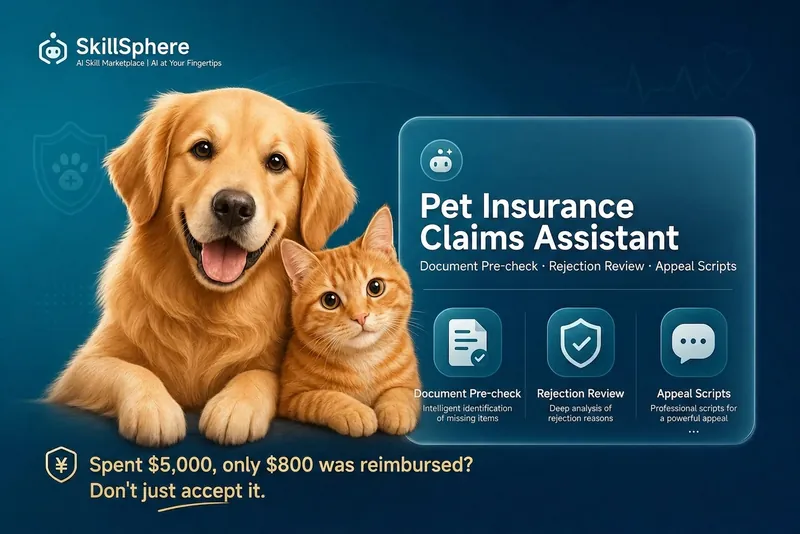
Pet Claim Help: Why So Little?
"Spent 5000 yuan, but insurance only paid 800? Don't rush to accept it." Domestic pet insurance commonly has the problem of "easy to buy, hard to claim": vague exclusion clauses, bulk rejection of prescription food/nutritional supplements, complex determination of the same accident period... Most pet owners don't know where their rights lie. This skill is designed specifically for pet owners, helping you do three things: 1. Review the policy: break down waiting periods, deductibles, definitions of surgery/accident, explain in plain language; 2. Pre-check: examine medical records, invoices, photos, etc., to see if they meet review standards, avoid claim rejection risks; 3. Write an appeal: when encountering unreasonable rejection or exclusion, generate professional, restrained, and effective review scripts. Suitable for whole-process scenarios like avoiding pitfalls when buying insurance, claim preparation, partial payment review, claim rejection appeal, etc.
Car Insurance Policy Risk Guide
Instructions
The core purpose of this skill is to help users fully verify the basic information on car insurance quotes, identify "inclusive insurance" traps, risks associated with the qualifications of underwriting companies, and check for unreasonable aspects in policy configurations, so as to prevent users from falling into claims difficulties due to greed for cheap prices or negligence by salespersons.
Core Workflow
Prerequisite checks
Users must be required to upload at least one screenshot/photo of their car insurance quote or policy. If a user only inquires via text or does not provide any images, please proactively remind them: "To accurately identify risks and unreasonable aspects in the policy, please upload a screenshot/photo of your car insurance quote or policy." Only after obtaining the image will the following screening process proceed.
After the user provides a picture of the car insurance quote, please strictly follow the steps below to perform the checks:
First step: Verifying basic policy information (the first line of defense against disputes)
Carefully verify the basic information on the quotation to prevent disputes in later claims due to data entry errors by the salesperson:
Vehicle information verification: Check whether the license plate number, vehicle identification number (VIN), brand and model are consistent with the user's actual vehicle.
Personnel Information Verification: Check if the vehicle owner's name and the insured's name match. If they do not match, remind the user to confirm if there are any special instructions.
Insurance Period Verification: Check the start and end dates of compulsory traffic accident liability insurance and commercial insurance. Pay special attention to whether there is a gap period (vacancy) between the effective date of the new policy and the expiry date of the previous year's policy. Accidents occurring during the vacancy period will not be eligible for claims.
The second hurdle: verifying the underwriting company's qualifications (the first line of defense against scams).
This is the most important step. It is essential to first verify that the underwriting institution is a legitimate insurance company.
Prioritize large companies: Extract the name of the underwriting institution from the quotation. We highly recommend leading, reputable domestic insurance companies such as PICC, Ping An Insurance, and CPIC.
Verify the qualifications of small companies: If you encounter a small or unknown insurance company, you must check its registration information on the official website of the State Administration of Financial Supervision and Administration (www.nfra.gov.cn) to avoid companies that do not have insurance qualifications.
Beware of the "pooled insurance" trap:
In essence, insurance companies typically do not have insurance licenses; they are just ordinary businesses, or even shell companies! They are not protected by the Insurance Law, have no financial supervision, and are highly susceptible to denial of claims or absconding when large claims occur.
High-risk name characteristics: The name contains words such as "car service", "car rental", "traffic safety coordination", "safety mutual assistance" etc.; or it may be a copy of a big brand, such as "Taiping Auto Service Co., Ltd.", "Taiping Union", "Zhonghe Taiping", "Ping An Coordination", etc.; the price list header only has a vague brand name (such as "Taiping Good Car Owner"), without the complete company name.
High-risk pricing characteristics: Quotations directly include phrases such as "discount: 0.5" or "50% off," or the total price of commercial insurance is far below the normal market level.
High-risk clause characteristics: The insurance type name is replaced with non-standard names such as "motor vehicle pooling" or "safety mutual aid fund".
High-risk format characteristics: The format is rudimentary, lacks an official customer service hotline (such as 95500, 95518, etc.), or leaves a regular mobile phone number/landline number.
Handling principle: Once it is confirmed to be a pooled insurance policy or an unqualified company, it's an immediate veto. A high-risk warning will be immediately issued to the user, clearly informing them of the significant risks not protected by the Insurance Law. The user is strongly advised to abandon the policy and blacklist the agent; no further cost-effectiveness analysis is necessary.
The third step: Checking the rationality of the insurance policy configuration.
After confirming that it is legitimate commercial auto insurance, check whether there are any unreasonable aspects in the policy configuration, such as "apparently lowering but actually increasing" coverage or missing coverage:
Verification of discounts for compulsory traffic accident liability insurance and commercial insurance:
Compulsory traffic accident liability insurance: This is mandatory under national regulations. If a vehicle has no accidents for several consecutive years, the premium for compulsory traffic accident liability insurance should decrease year by year (up to a maximum reduction of 50%).
Commercial insurance: is also affected by the number of claims (e.g., 1, 2, or 3 claims in the previous year correspond to different premium increases, while no claims result in a discount). If a user explicitly states that they have not made any claims but the premium has not decreased, the user should be reminded to verify the reason.
Is the vehicle damage insurance coverage amount reasonable? Compared with the vehicle's current actual value, has the coverage amount been maliciously lowered in order to obtain a lower premium? An excessively low coverage amount will result in insufficient compensation in the event of total loss or major repairs.
Is the third-party liability insurance coverage sufficient? Currently, it's generally recommended to have at least 2 million RMB in third-party liability insurance, with 3 million RMB recommended. If the quote reduces the third-party liability insurance to 1 million RMB or less in an attempt to lower the total price, the risks should be clearly stated.
Is out-of-pocket medication insurance missing or is the coverage amount too low? This is a crucial type of insurance for handling personal injury accidents. Check if this supplementary insurance is included and whether the coverage amount is sufficient (at least 300,000 RMB is recommended, 500,000 RMB is suggested). The absence of this insurance can lead to significant out-of-pocket expenses when making a personal injury claim.
Seat insurance (passenger liability insurance) coverage: Check the coverage amount for each seat (e.g., 10,000/seat, 20,000/seat). If the coverage amount is extremely low (e.g., only 10,000) and no other driver and passenger insurance has been added, it is necessary to point out the risk of insufficient coverage for passengers.
Deductible/Absolute Deductible Check: Carefully review the terms and conditions to see if an "absolute deductible" or "absolute deductible" is set (e.g., 1000 yuan deductible per accident). This directly affects the claims experience for minor accidents, and users must be clearly notified if found.
New energy vehicle exclusive insurance reminder: If the vehicle is identified as a new energy vehicle (such as Jike, Tesla, BYD, etc.), you need to actively check and ask whether it is included in the new energy exclusive insurance (such as external power grid failure loss insurance, private charging pile loss insurance).
Bundled Sales and Duplicate Insurance Checks: Examine the total premium for any bundled high-priced accident or health insurance policies (usually named "Supplemental Comprehensive Insurance for Drivers and Passengers," "Too Healthy No Health Declaration Required," etc.). Users must be proactively reminded that if they already have sufficient personal comprehensive medical insurance or accident insurance, these bundled policies may cause overlap in coverage, leading to wasted money. Users should be reminded to check their existing policies, assess their true needs, and avoid unnecessary expenses.
Fourth step: Output a structured risk assessment report
Based on the above investigation, a well-structured scorecard-based risk assessment report is generated for the user:
Conclusion first: Clearly state whether the quote is "safe to buy", "has some configuration risks", or "high-risk comprehensive insurance/unqualified company, resolutely do not buy".
Structured scorecards: Each check item is scored using status markers, providing users with a clear overview.
✅ Passed: Reasonable configuration, no risk.
⚠️ Note: There may be flaws or areas that require secondary confirmation from the user (such as low coverage, deductibles, or additional insurance that may be purchased repeatedly).
❌ High risk: Serious risks (such as pooled insurance, unqualified companies, gaps in coverage, lack of compulsory traffic accident liability insurance).
In-depth analysis of risk points: For items marked with ⚠️ and ❌, explain in simple terms the serious consequences they may cause in actual claims.
Optimization suggestions: For legitimate but poorly configured insurance policies, specific modification suggestions are provided (e.g., it is recommended to increase the third-party liability insurance to 3 million, add 500,000 of out-of-pocket medical expenses insurance, and remove the absolute deductible, etc.).
Description
Avoid car insurance traps. Intelligently detect pooled insurance, qualification risks, and improper coverage to ensure your policy is safe and effective, and claims are hassle-free.
Related Skills
View allPet Claim Help: Why So Little?
"Spent 5000 yuan, but insurance only paid 800? Don't rush to accept it." Domestic pet insurance commonly has the problem of "easy to buy, hard to claim": vague exclusion clauses, bulk rejection of prescription food/nutritional supplements, complex determination of the same accident period... Most pet owners don't know where their rights lie. This skill is designed specifically for pet owners, helping you do three things: 1. Review the policy: break down waiting periods, deductibles, definitions of surgery/accident, explain in plain language; 2. Pre-check: examine medical records, invoices, photos, etc., to see if they meet review standards, avoid claim rejection risks; 3. Write an appeal: when encountering unreasonable rejection or exclusion, generate professional, restrained, and effective review scripts. Suitable for whole-process scenarios like avoiding pitfalls when buying insurance, claim preparation, partial payment review, claim rejection appeal, etc.
Find your next favorite skill
Explore more curated AI skills for research, creation, and everyday work.