
PainGap
Turn customer pain into business opportunities.
PainGap
Turn customer pain into business opportunities.
Showcase
Description
PainGap turns real customer complaints, unmet needs, and weak existing solutions into evidence-backed business opportunities. It researches real market pain, checks competitors, identifies commercial signals, and creates practical validation plans before you build.
Related Skills
View all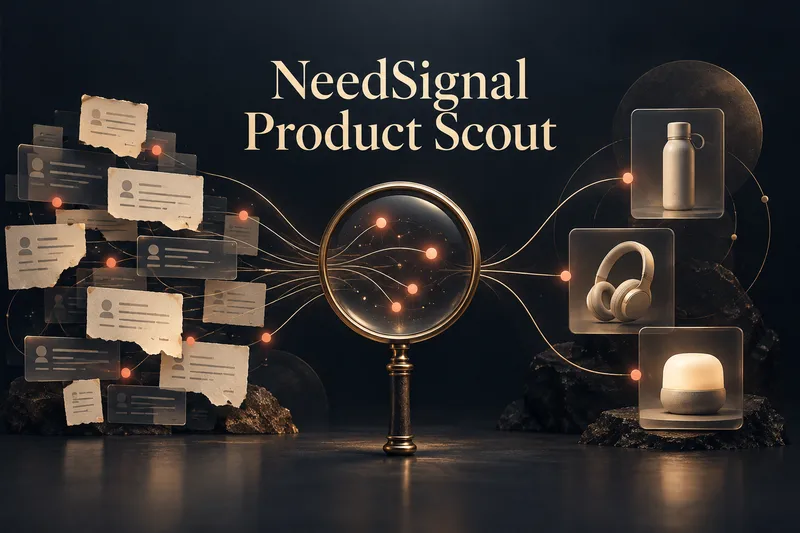
NeedSignal Product Scout
NeedSignal Product Scout turns real user problems, workarounds, unmet requests, product reviews, links, and observations into evidence-backed product opportunities. Instead of producing generic idea lists, it expands each signal across independent sources, identifies the underlying need, checks current solutions and competitors, and separates verified evidence from inference and hypotheses. You receive 3–5 focused opportunity cards with their evidence trail, user, solution gap, differentiation, risks, and next validation step. Choose one to develop into a practical product plan, prototype path, user-test plan, and two professional reports. Optional visualisation begins with complete image prompts first. You decide whether to generate visuals, revise the prompts, or take the prompt package to another image tool.
 Research
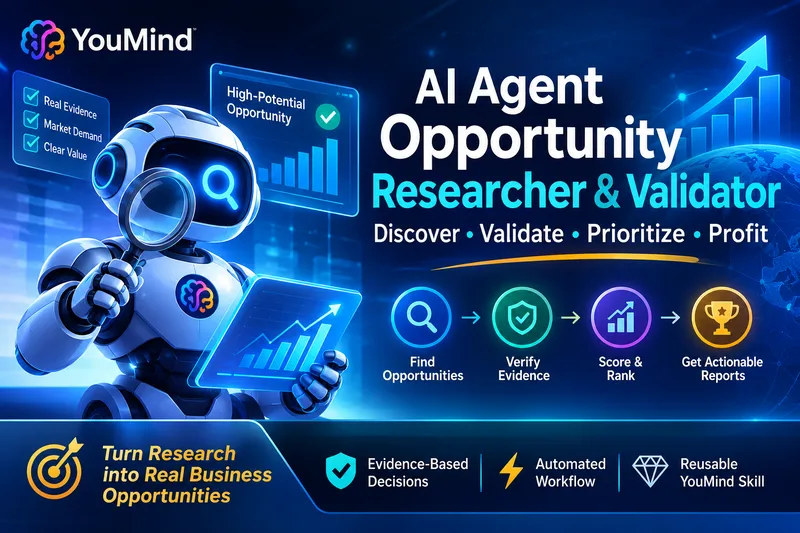
AI Agent Opportunity Researcher
AI Agent Opportunity Researcher & Validator is an evidence-first market research and product validation skill that discovers, investigates, scores, and documents real-world problems you can turn into sellable AI Agent Skills, automated workflows, developer utilities, downloadable digital products, and micro-SaaS tools. Instead of generating generic startup ideas, this skill runs a repeatable 6-stage validation workflow: 1. Discover: Scans official changelogs, API deprecations, GitHub issues, support forums, reviews, and regulatory updates (prioritizing the last 24-72 hours plus persistent problems with recent triggers). 2. Extract the Problem: Maps who experiences the pain, workflow triggers, frequency, consequences, and current workaround costs. 3. Verify Evidence: Tags every claim as FACT, DIRECT_EVIDENCE, INFERENCE, HYPOTHESIS, or UNKNOWN and tracks 4 dates (publication, event, reported, and accessed) to filter out stale or republished news. 4. Analyze Competition: Compares commercial SaaS, open-source tools, existing skills, built-in platform features, and manual workflows—rejecting AI complexity whenever a simple script, checklist, or spreadsheet suffices. 5. Score & Gate (100-Point Rubric): Evaluates candidates across 9 weighted dimensions, 4 independent confidence ratings (Problem, Solution, Demand, Willingness to Pay), and hard override gates for contradicted claims, tool infeasibility, or critical security/licensing risks. 6. Design Validation Experiments: Assigns GO TO PROTOTYPE, VALIDATE FURTHER, or REJECT OR DEFER, complete with a $0-$50, <=7-day validation experiment, measurable pass/fail thresholds, a 16-section Markdown report, and a JSON export ready for downstream prototyping.
Information
- Version
- v4
- Last updated
- Runtime credits
- Usage-based
- Models
- Auto
