Academic Writing Assistant
For faculty and instructors
Academic Writing Assistant
For faculty and instructors
Showcase
Description
A human–AI collaborative skill for academic paper writing and self-review. It automatically selects modes based on your intent, including planning, outlining, full-paper writing, abstract writing, literature reviews, revision, responses to reviewer comments, citation checking, format conversion, AI use statements, and multi-perspective peer review (journal-matched reviewer, three reviewers, and devil’s advocate), followed by revision and re-review. It insists that citations be verifiable and claims evidence-based, with AI serving as a copilot rather than a ghostwriter. Methodology reference: Academic Research Skills (Cheng-I Wu, CC BY-NC 4.0).
Why we love this skill
An end-to-end academic writing partner for teachers, from research design and literature checks to revision and simulated peer review.
Best for
For faculty and researchers who want to improve paper quality, use citations properly, and self-check before submission.
How to use this Skill
Provide your input
Share your research topic, questions, draft, data, references, reviewer comments, or target journal, and say whether you want planning, writing, revision, checking, or review.
Run the Skill
The skill helps structure, write, or revise content based on your intent; checks citation, evidence, and argument consistency; and uses multiple perspectives to simulate peer review and identify issues.
Review your result
Receive an academic paper or abstract, a citation and integrity check report, a peer review report, or a revision roadmap. unverifiable content is clearly marked, and authors must confirm key judgments.
Related Skills
View all Write
WriteFull-Process Academic Writing
"Full-Process Academic Writing" is an intelligent assistant tool designed for researchers, aimed at covering every stage of academic paper writing from initial conception to final submission. Whether you have just a vague research direction or have a draft that needs polishing, this tool provides systematic support to help you efficiently produce high-quality academic work. This tool guides you through four key stages. First is **Topic Planning**, which helps you refine preliminary ideas into concrete, feasible research topics and questions, and generates a comprehensive Topic Evaluation Report covering research framework, method matching, timeline planning, and resource bottleneck identification. Next is the **Literature Review** stage, assisting you in building search strategies, organizing core literature, and writing a logically rigorous literature review draft that identifies research gaps. The third stage is **Structured Writing**, where the tool designs a detailed paper outline based on your topic and literature review, and drafts the introduction, methods, body, and conclusions chapter by chapter, while also providing scientific chart code to ensure a complete structure and rigorous argumentation. Finally, the **Polishing and Revision** stage performs a comprehensive academic standard check, six-dimensional language polishing, and logical coherence review, and embeds an AI-assisted writing statement to ensure your final draft meets publishable professional standards. Throughout the writing process, this tool always adheres to academic ethics standards. All citations will be clearly flagged for verification and will never be fabricated. Output from each stage proceeds only after your confirmation, ensuring every step aligns with your research intent, allowing you to focus on expressing your ideas while leaving tedious formatting and standards to AI.
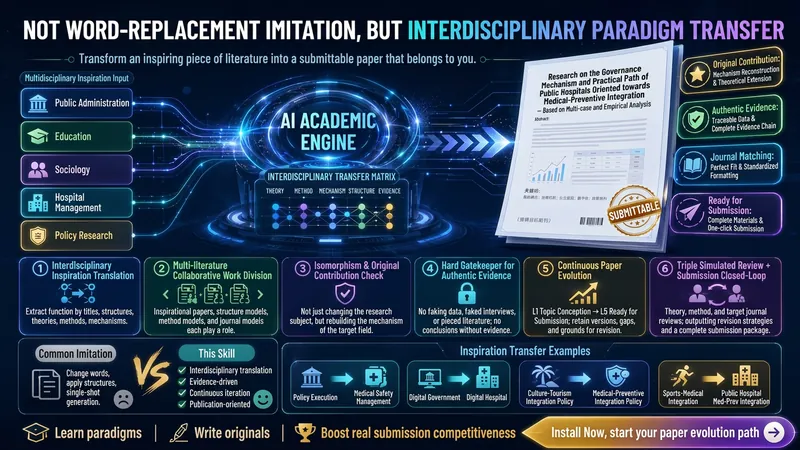
Paper Imitation & Pub. Expert
📚 Paper Imitation & Pub. Expert Develop an inspiring paper into your own high-quality original work step by step. Ideal for graduate students seeking to draw inspiration from excellent papers in other disciplines for topic migration, structural reconstruction, and submission optimization. 🔍 Inspiring Literature Identification: Analyze the reusable title mechanisms, problem awareness, chapter structure, theoretical framework, research methods, evidence organization, and language style of the model paper. 🔄 Interdisciplinary Paradigm Transfer: Build a 'source domain—target domain' transfer matrix to determine which ideas can be transferred and which theories, concepts, cases, and conclusions must be reconstructed. 🧠 Original Contribution Modeling: Identify literature gaps, distill core propositions and mechanisms, and check whether the paper merely changes the research object or applies a generic framework. 🧭 Research Design Planning: Supports theoretical research, case studies, qualitative research, quantitative research, literature reviews, policy text analysis, and mixed methods research. 🛡️ Real Evidence Gate: Do not fabricate data, samples, interviews, cases, statistical results, literature, or DOIs; without real evidence, do not generate false empirical conclusions. ✍️ Evidence-Driven Writing: Build argument chains via 'proposition—evidence—citation—rebuttal', generate original content chapter by chapter, and clearly mark research materials that need to be supplemented. 📈 Continuous Paper Evolution: Record each round of revisions, material gaps, and maturity changes according to L1 (topic conception), L2 (research plan), L3 (evidence formation), L4 (submission draft), and L5 (ready for submission). 🧑⚖️ Triple Simulation Review: Identify rejection risks from the perspectives of a theoretical reviewer, a method reviewer, and a target journal reviewer, and form specific revision strategies. 📨 Complete Submission Loop: Assist in generating the final paper, citation verification table, cover letter, innovation point statement, author response, revision index, and related declaration templates. ✨ Learn the paradigm, write original content, and enhance real submission competitiveness.
 Research
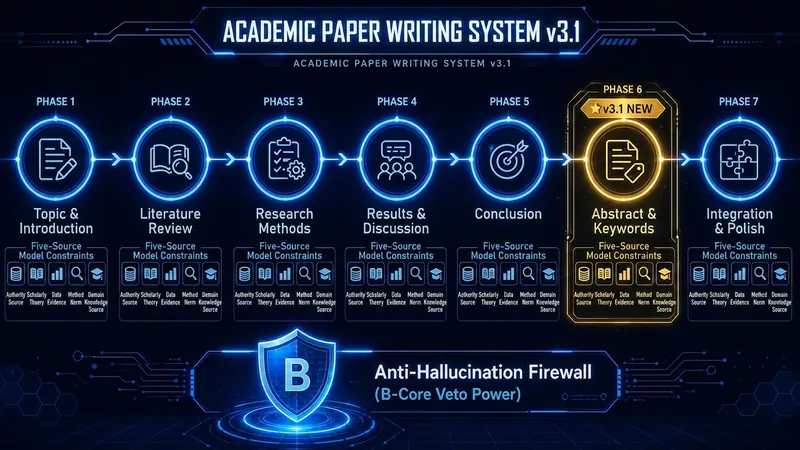
Academic Paper Writing v4.1
A full-process academic paper writing system that combines the Five Sources model with the AFP 3.1 three-layer architecture. Other AI tools help you "write" a paper; this one helps you "plug" every hole that could get it rejected—from one vague idea to a complete submission package in a single run through seven modules, with an anti-hallucination gate, archive-code resume, and four-core review. [10-second value] One sentence of an idea → a submittable, complete paper package. Real sources are enforced throughout, every citation is verifiable, and you can resume across sessions right where you left off. [Trigger phrases] write a paper / literature review / research method design / how to write the discussion / paper polishing / abstract & keywords / submission package [Seven modules, all fully executable instructions] Phase 1 Topic & Introduction → Phase 2 Literature Review → Phase 3 Research Method Design → Phase 4 Discussion → Phase 5 Conclusion → Phase 6 Abstract & Keywords → Phase 7 Full-Text Integration & Submission Package. Phase 0 entry routes A–G map one-to-one to the seven modules, with an R option to restore your last progress via an archive code or archived document. [v4.1 upgrades] 1. Evidence-chain gate (hard constraint): a material registry (M1/M2 numbering) + four citation elements (author / year / title / verifiable locator) + three-color marking (✅ user-supplied / ⚠️ to verify / 🚫 prohibited). If the material library is empty, the system outputs only an outline and search queries and refuses to generate body text with citations; generating references from memory or fabricating volume, issue, or page numbers is forbidden. 2. Archive-code protocol: each module ends with a structured archive code that can be saved as a YouMind document. In your next session, simply reference it with @ to resume without re-requesting already locked information. 3. Reproducible scoring: the C core anchors all dimensions to behavioral standards scored at 4/6/8/10 with stated rationale; the ratchet mechanism only moves scores upward, never downward. 4. Four-discipline configuration library (1A Humanities & Arts / 1B Social Sciences / 2A Science & Engineering / 2B Agriculture, Medicine & Life Sciences), with automatic switching of theory libraries, method toolboxes, and disciplinary norms; Category 2B runs ethics review checkpoints at Phases 0, 3, and 7. 5. Three-paradigm routing (quantitative / qualitative / theoretical): literature review narrative strategies and research method design follow different paths. 6. Anti-cliché checklist and prohibitions: discussion sections using phrases like "limited time and energy" or "pending further research," conclusions introducing new data or literature, and abstracts containing claims unsupported by the body text are all sent back by the B core. 7. Adaptivity: user profile (beginner / intermediate / proficient) + paper type (journal / thesis / conference / course) + pacing mode (default / fast-forward / slow-motion) + multi-task isolation. 8. Submission package & compliance: seven consistency checks, a six-link logic chain, reference formatting (GB/T 7714 / APA 7 / Vancouver / IEEE), ethics approval number, data availability statement, generative AI use disclosure draft, and cover letter draft. [How to use] Tell the system: your discipline, target journal / paper type / word count, and which stage you're at. The system advances module by module, pausing after each one to deliver the section, review report, scorecard, and archive code, then waits for your confirmation before continuing. [Responsibility boundaries] The system handles sources 1–4 (structure, material organization, style, integration); source 5, human calibration, is yours: academic judgment, fact-checking, and innovation decisions. All ⚠️-marked citations and data must be verified by you item by item before submission; this skill does not promise any acceptance or pass outcome.
Information
- Version
- v3
- Last updated
- Runtime credits
- Usage-based
- Models
- Auto
- Use cases
- Writing & contentResearch & analysisLearning & education
- What you get
- ReportDocumentPlan