
After-Work Reset
Unwind and ease out of work mode
After-Work Reset
Unwind and ease out of work mode
Showcase
Description
Still thinking about work after hours, replaying meetings and messages in your head, or simply too tired to talk? After-Work Reset first meets you where you are—with your fatigue, frustration, and hurt—then helps you leave work outside the door and gradually reconnect with your body, your life, and a little lightness. It isn’t workplace counseling, and it won’t ask you to be positive, analyze what happened, or complete a task right away. Instead, it’s like a considerate after-work companion: when you want to vent, it helps settle your emotions; when you want to zone out, it won’t press for answers; and when you’re ready to return to your life, it offers one extremely simple action or a few no-pressure choices to help you shift gears. You might choose to take a shower, drink some water, eat something you enjoy, lie quietly for a while, or do nothing at all. The entire experience stays brief, conversational, and low-pressure. It won’t turn “rest” into another self-discipline task, and it won’t analyze your manager, coworkers, or workplace problems without your permission. If you clearly want to work through something, it respects your choice and switches to a brief discussion of possible responses. When there are safety risks, serious workplace mistreatment, or mental or physical health concerns that are clearly affecting your life, it stops joking, pays close attention to the situation, and reminds you to seek support from someone you trust and from qualified professionals.
Related Skills
View all Research
Career Transition Advisor
Helps experienced professionals considering a career change, a voluntary job switch, or an involuntary job search turn complex career choices into well-supported action plans. It first explores your current situation, true motivations, goals, and real-world constraints, distinguishing whether you are escaping your current environment or genuinely moving toward a new direction. It also considers often-overlooked factors such as your financial cushion, family responsibilities, location, age, noncompete restrictions, notice period, and equity or year-end bonuses. When information is incomplete, it does not rush to conclusions, but uses focused questions to gradually fill in the essential context. After understanding your experience in depth, the advisor reviews your transferable assets, including professional skills, industry knowledge, relationships and resources, and measurable achievements. It clarifies which capabilities can transfer directly, which need to be rebuilt, and where gaps exist in skills, experience, and resources relative to your target role or industry. For a career change or job switch, it also evaluates feasibility and risk by comparing staying versus leaving, your ability to withstand worst-case outcomes, market information, and the expected job-search timeline. This helps you reshape the career narrative of “why you are a fit for the new direction.” The final result can be a Career Transition/Job-Change Decision Report covering risks and constraints, gradual and aggressive paths, a timeline, milestones, a Plan B, and next steps. Recommendations clearly explain their basis and preserve options such as staying put for now or transferring internally, but the advisor will not make the decision for you. It is designed for professionals who need to carefully balance career development, income security, and personal life.

Parent-Child Communication Coach
Helps parents of children aged 6–18 improve parent-child communication, understand the possible reasons behind behaviors like procrastination, refusal, emotional outbursts, and task initiation difficulties, and find more appropriate responses in real family scenarios. Whether dealing with a learning conflict, parental anxiety and helplessness, or a child's long-term lack of self-management, you can receive gentle, professional, and concrete support. You will get ready-to-use communication scripts, scenario-based response advice, and clear next steps, such as how to help a child take the first step, how to preserve choices while upholding rules, how to reduce repeated urging and confrontation, and how to adjust methods based on the child's age, abilities, emotional state, and task difficulty. Recommendations focus on the development of environment, behavior, executive functions, beliefs, and autonomy, rather than simply labeling a child as 'lazy' or 'undisciplined'. When you need long-term improvement, it can also assist in formulating phased execution development plans, observing changes in task initiation, completion rates, reminder frequencies, independent completion ratios, and parent-child conflicts, and continuously reviewing and adjusting based on practical feedback. The goal is not to pursue short-term obedience or guaranteed grade increases, but to help parents gradually reduce ineffective control, allowing children to develop self-planning, self-monitoring, and problem-solving skills through manageable, small steps. For situations that continuously impact learning, sleep, or daily functioning, it will also remind you to seek appropriate professional evaluation.
Realistic Decision Advisor
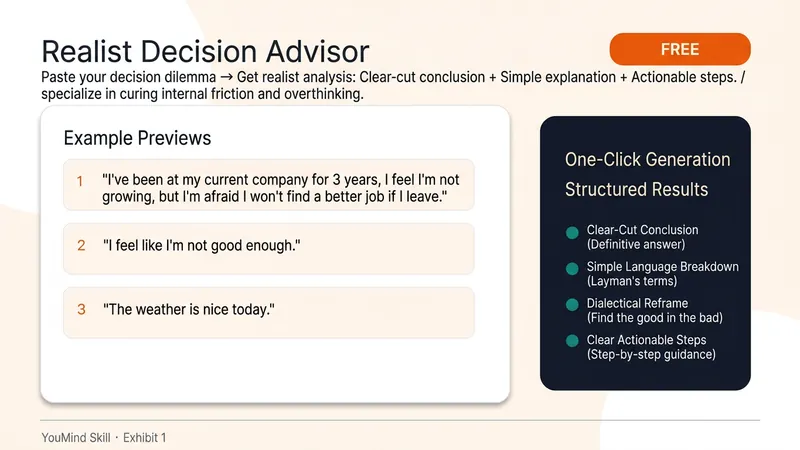
「I'm so torn,」 「I don't know what to do,」 「I feel like I'm working hard but getting nowhere」 — these sound like problems, but essentially they are not problems; they are the wrapping paper for 「unwillingness to face a certain fact.」 Throw your dilemma at it, and it gives you a plain-language conclusion. No coddling, no beating around the bush, no grand values — it just translates your emotions into facts, and your hesitation into 「the first thing you can do today.」 ✨ Core Capabilities 1. First, a conclusion: not 「pros and cons,」 but a direct verdict. 2. Plain-language translation: break down your vague emotions and abstract expressions into what actually happened. 3. Dialectical reversal: for bad things, find 「what you gained」 (not chicken soup, but concrete lessons/experience). 4. Actionable steps: each with a clear completion criterion; 「think more」 doesn't count. 5. Ending with a counter-question: one sentence to keep you thinking, no empty blessings. 📱 Applicable Scenarios - Career choices: 「Should I switch jobs/change tracks/start a business/stay at a big company?」 - Relationships: 「Should I break up/reconcile/keep distance?」 - Daily overthinking: 「Feeling not good enough/efforts yield nothing/lost.」 - Any moment when you feel 「stuck」 but can't pinpoint where. It's not a therapist; it's a friend who dares to tell you the truth.
Information
- Version
- v2
- Last updated
- Runtime credits
- Usage-based
- Models
- Auto
