
Anti-AI Tone Skill
Remove AI tone backed by 5.2M words of testing
Showcase
Description
A de-AI-tone skill based on two rounds of empirical corpus testing (totaling 1,169 articles, ~5.2 million Chinese characters, 100+ metrics, and ~500,000 model semantic evaluations), known as lieflat-less-ai-tone with 7.3K+ stars on GitHub. This Skill quantifies what makes writing sound like AI through two rounds of data experiments: the first round covered 629 articles (2.83 million words), and the second round ran 540 new paired articles (2.56 million words), totaling 1,169 articles and 5.2 million Chinese characters. The Skill breaks down every conceivable AI tone into over 100 metrics, validated through script detection, large model semantic detection, and manual blind reviews. It ran 507,000 sentence-by-sentence and paragraph-by-paragraph machine semantic judgments, followed by extensive manual blind-reading assessments. Ultimately, it was packaged as a Skill for easy use, bringing you the lieflat-less-ai-tone project. The Skill first delivers a detection report complete with metrics, research references, original example sentences, and revision methods, then proceeds to rewrite and retest after you reply.
Recommended by
Dancang
Why we love this skill
Built on large-scale parallel corpora and multi-round semantic testing, it first detects and explains evidence, then applies minimal rewrites upon confirmation while preserving facts and style.
Best for
Writers who want to reduce AI writing traces in text while preserving the original meaning, facts, and structure.
How to use this Skill
Provide your input
Provide the article or text to check, and optionally specify any focus areas.
Run the Skill
First analyzes suspected AI writing patterns in the text, providing an inspection report with examples and suggested fixes. After receiving confirmation, performs minimal rewriting based on selected suggestions and retests.
Review your result
Receive a pre-revision inspection report, the rewritten text, and a comparison of the text before and after revision.
Related Skills
View all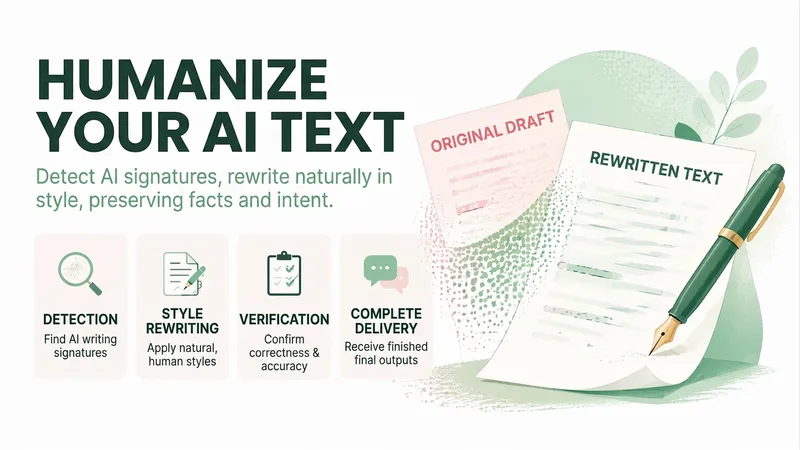 Write
De-AI Chinese Rewriter
Make your Chinese drafts sound more like they were written by a real person in a specific scenario, while preserving the original facts, stance, and tone strength. Whether it is WeChat messages, emails, Xiaohongshu posts, work reports, or academic papers, it first identifies the style and expression issues, then targets clichés, empty phrasing, mechanical structures, nominalizations, and inappropriate tones. This makes the text more specific, natural, and smooth without becoming overly colloquial. It strictly guards factual boundaries during rewriting: it does not arbitrarily add numbers, dates, names, organizations, cases, promises, or effects, nor does it change "might" to "will," or delete key qualifiers and conclusions. Where necessary information is missing, it clearly marks content to be added to avoid fabricating details for completeness. Formal expressions in academic papers and work reports are not misjudged as "AI-sounding" and overly altered. You will receive a fact-checked and doubly verified Chinese rewrite, ready for direct communication, publishing, reporting, or academic writing. When needed, you can also view specific trace judgments, modification rationales, and pending information to clearly understand what was adjusted and how information consistency was maintained.
AI Textbook Quality Inspector
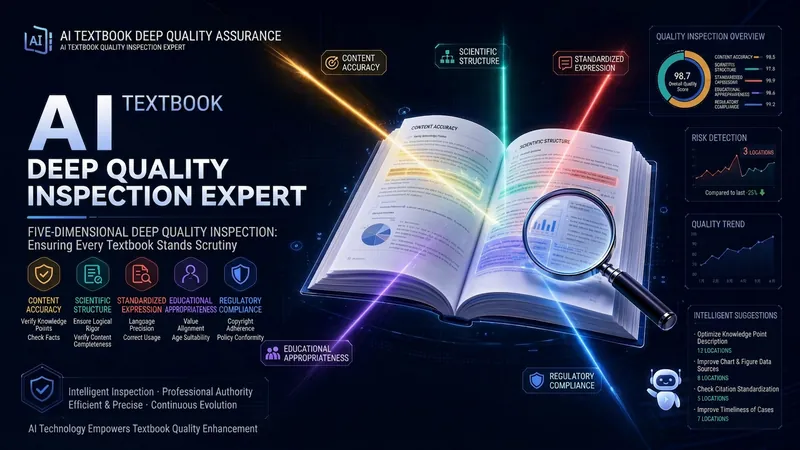
📚 AI Textbook Quality Inspector — Five-dimensional scan to make AI-written textbooks withstand review Textbooks written with AI assistance suffer from five common problems: hard-to-detect knowledge errors, instructional design lacking classroom feel, excessive 'correct but empty' statements, templated writing that feels robotic, and obscure language that makes students give up reading. This system performs a five-dimensional in-depth quality check chapter by chapter, examining each chapter from the perspectives of four roles: subject matter expert, instructional designer, fact-checker, and style reviewer. It outputs quantitative scores and directly replaceable modification suggestions. Five Dimensions: 📐 Knowledge Accuracy — Trace and correct concepts, models, and data one by one, with each error annotated with a source 🎯 Instructional Design — Review difficulty curve, prerequisite preparation, and chapter connections like a seasoned teacher 💎 Content Substantiveness — Expose 'correct but empty' statements, calculate real information gain per section 🤖 AI-Flavor Detection — Textbook-specific standards to distinguish normal writing from AI template patterns 📖 Readability — Paragraph rhythm, term density, assess whether students can read smoothly Highlight Features: 🔗 Cross-Chapter Consistency — Automatically generate knowledge profile, detect conceptual contradictions, inconsistent terminology, and duplicate definitions 🔄 Closed-Loop Iteration — After revision, resubmit and automatically track improvements, remaining issues, and new problems 📊 Layered Report — First see overview score + top 3 issues, then expand section-by-section analysis as needed 🎤 Sharp Commentary — No sugarcoating; if a definition is wrong, it says so bluntly, with each criticism accompanied by a revision reference Applicable to: AI-assisted undergraduate and graduate textbooks, academic monographs, and course handouts. Current version is optimized for undergraduate textbooks, but also works for graduate textbooks. Paste chapter → Get score → Make targeted revisions → Re-test until quality passes.
AI Prompt Architect MAX
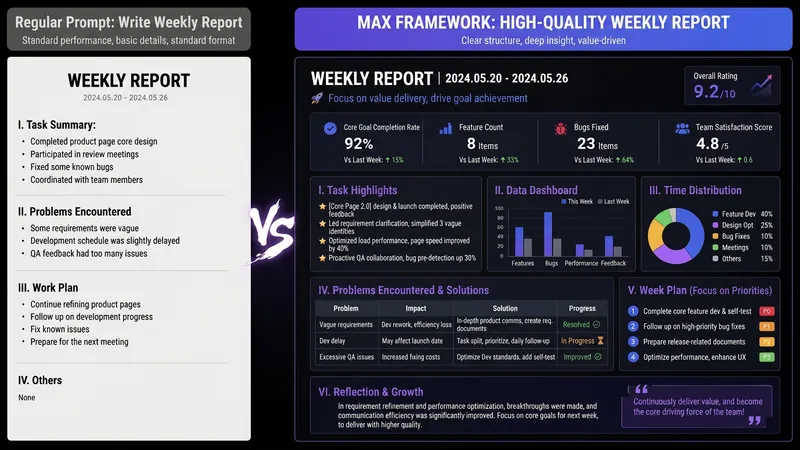
Have you ever had moments like these— You ask AI to write a weekly report, and it gives you a childish play-by-play; you ask it to revise a résumé, and it serves up “teamwork, diligence, and a strong sense of responsibility”; you ask it to analyze data, and it starts with, “As an AI, I’m happy to help you…” It’s not that AI is incapable—the problem is that your instructions are too amateurish. There are already plenty of Prompt templates teaching you how to write Prompts. But even after using them, you still can’t write your own—because what you’re missing isn’t a template. It’s the ability to compile requirements. This SKILL is my Prompt compiler: a condensed version of the Prompt architecture methodology I use every day as an AI OPC—someone working on the front lines of AI implementation—to write Prompts for teams. You explain what you need in plain language, and it gives you a top-tier architecture. Input: “Help me write a monthly report” Output: a complete eight-module Prompt architecture—role, task, audience, process, constraints, format, self-check, and examples, all locked in. Copy and paste it into ChatGPT / Claude / DeepSeek / Kimi, and the first output will be ready to use. Even better, it will tell you: ✓ Which model is best for this Prompt ✓ Which variables you can change directly next time (learn once, reuse repeatedly) ✓ Which one missing piece of information could take the output to the next level How is it different from an ordinary Prompt template SKILL? Other SKILLs give you a fish—one finished Prompt. This SKILL gives you a compiler—the ability to compile any requirement into a Prompt. Install it once, and every AI use case you have will improve—writing, reporting, analysis, translation, customer service, content creation, and more. Who should install it: People who use AI every day but are never satisfied with the output People who want to learn Prompt engineering without spending thousands on a course Team leaders who want to standardize AI use but don’t know where to start Content creators, researchers, students, job seekers, and side-hustle builders How well you use AI doesn’t depend on which model you choose. It depends on whether you can compile your requirements. Install it today, and the quality of your conversations with AI will take a dramatic leap forward.
Information
- Version
- v4
- Last updated
- Runtime credits
- Usage-based
- Models
- Auto
- Use cases
- Writing & content
- What you get
- ReportDocument
