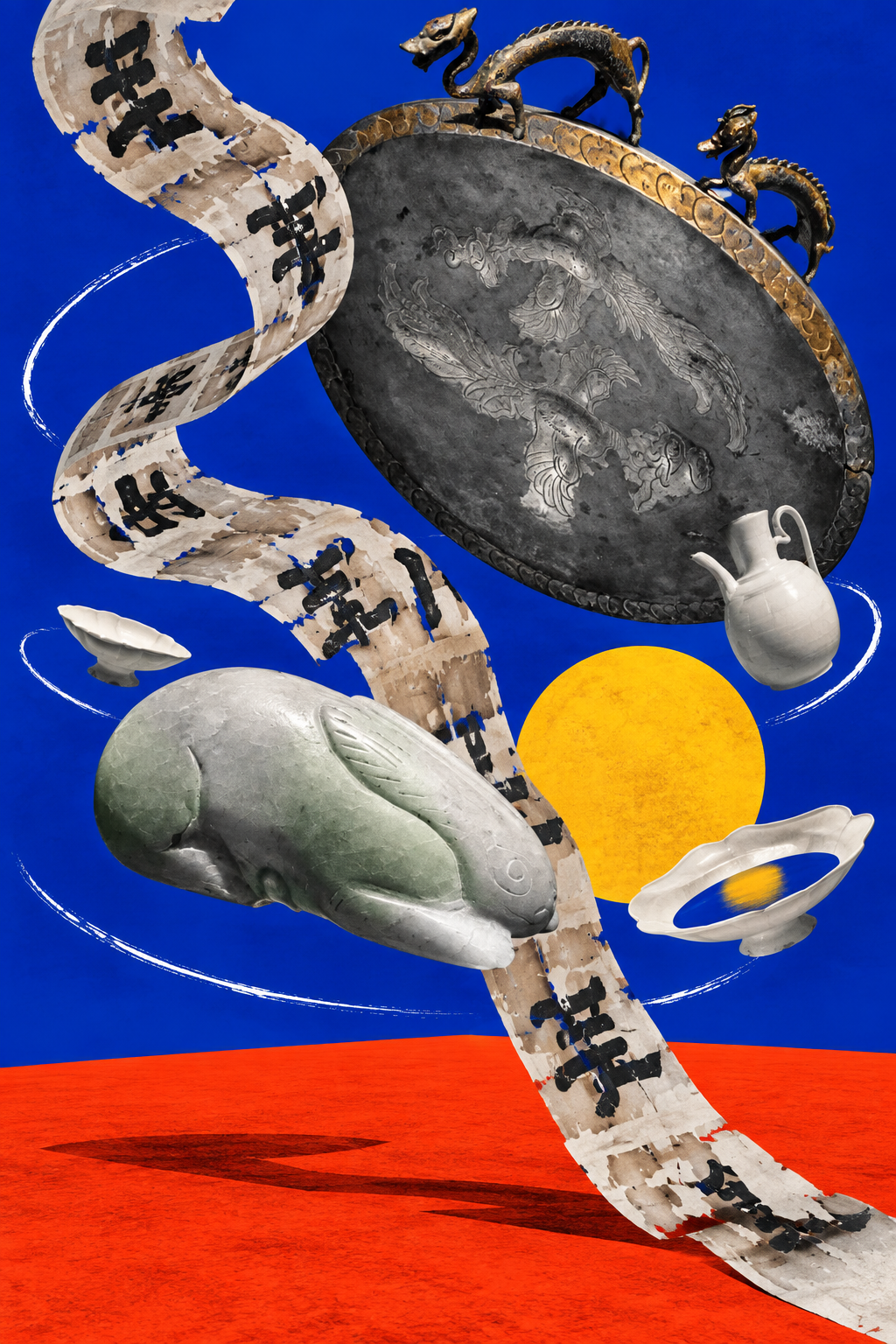
S.013 Radiant Artifact Collage
Turn five artifact photos into one artwork
S.013 Radiant Artifact Collage
Turn five artifact photos into one artwork
Showcase
Description
Transform the features of artifacts in exactly five photos into a completely new piece of art photography. The skill considers each artifact’s contours, proportions, materials, patterns, colors, and visible marks, organizing them into one complete scene with a visual focal point and spatial relationships. Recognizable formal characteristics are retained, while the background, lighting, shot type, placement, and overall color palette can be freely changed. The finished image may take the form of realistic photography, a surreal scene, or a visual effect with an artistic collage quality. Here, “collage” refers to the creative construction within the image—it does not mean arranging the five original photos into a grid, split layout, or composite. The result is a single, complete standalone image without source-photo layouts, alternate versions, borders, titles, logos, or watermarks, making it suitable for artifact-focused visual creation, cultural posters, and artistic image-making.
Recommended by
Dancang
Why we love this skill
Transforms five artifacts’ forms, patterns, and materials into one cohesive art photograph—not a simple photo grid—while preserving recognizability through freely reimagined color, light, and space.
Best for
Ideal for artifact-focused visual creation, cultural posters, and artistic image-making.
How to use this Skill
Provide your input
Provide exactly five artifact photos as references.
Run the Skill
Blend the five artifacts’ contours, materials, patterns, and colors into one scene to create a complete piece of art photography.
Review your result
Receive one complete, standalone art photography image without grids, borders, titles, logos, or watermarks from the original photos.
Related Skills
View all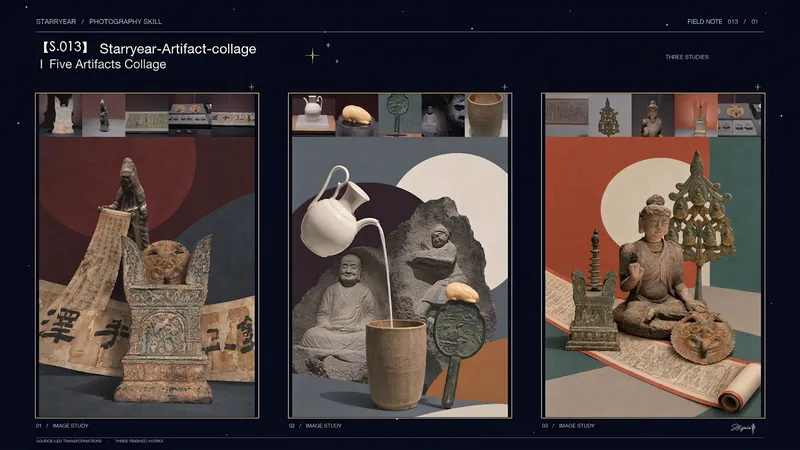 Image
S.013 Five Relics · Starryear
Arrange five artifact photos into a vertical surreal color-block collage, creating clear and imaginative visual relationships among different objects in one composition. The finished piece keeps five tightly aligned horizontal colored squares at the top, each corresponding to one source photo. Below, the main artwork occupies most of the canvas and is rebuilt from the artifacts’ recognizable forms, patterns, materials, and damage, with display cases, platforms, and other surroundings removed. The main artwork may use black and white, grayscale, or selective color. Based on the contours, colors, and relationships within the group of objects, design curved surfaces, geometric blocks, bands, and other color fields. The artifacts interact through support, passage, nesting, occlusion, or tipping and catching, rather than sitting in isolation. A small number of lines, short arcs, or color fragments are used only to reinforce movement and connection. Keep the overall composition clean, with a flat background, clear depth layering, and moderate negative space, while emphasizing the artifacts’ authentic details and photographic texture. Suitable for visually reinterpreting photos of multiple artifacts, exhibition concept images, culture-themed posters, and artistic image creation. Not intended for artifact identification, restoration, historical reconstruction, or archaeological fact inference. The output is a complete vertical composition without titles, logos, or watermarks.
 Image
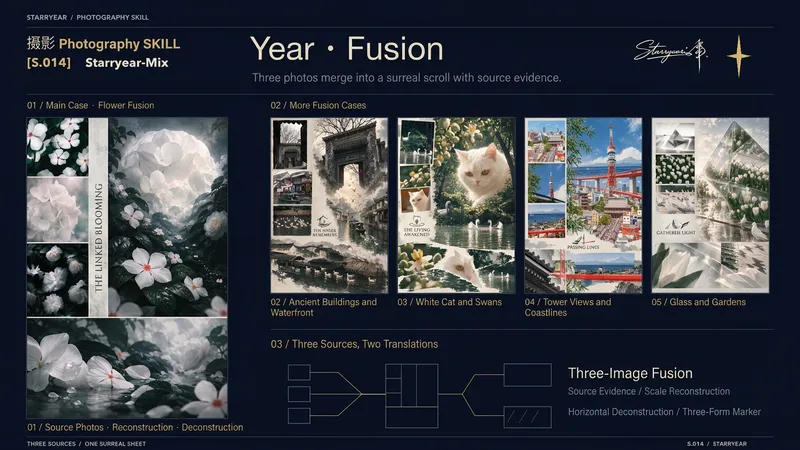
【S.014】Year · Fusion丨Photography Skill · Starryear
Combine three Buddhist-themed photographs into a complete vertical art collage, creating a coherent narrative where the original images, surreal imagination, and abstract deconstruction share the same frame. The work preserves all three photographs as recognizable visual evidence while distilling their colors, contours, lighting, and spatial relationships into a central composition with absurd scale and clear spatial tension—for example, placing a monumental Buddha image alongside a tiny human environment without changing facial features, poses, or religious identifiers. The lower section uses a horizontal composition distinct from the main visual, releasing fragments, silhouettes, and color blocks from the photographs while avoiding ordinary grids or repeated crops. The central negative space becomes an embedded editorial signature: a simple mark made from abstract elements extracted from each of the three photographs, paired with a short, natural, artistic French phrase. The final deliverable is a unified, flat-layout composition suited to Buddha’s Birthday themes, experimental religious imagery, art posters, and editorial-style photography collages.
 Image
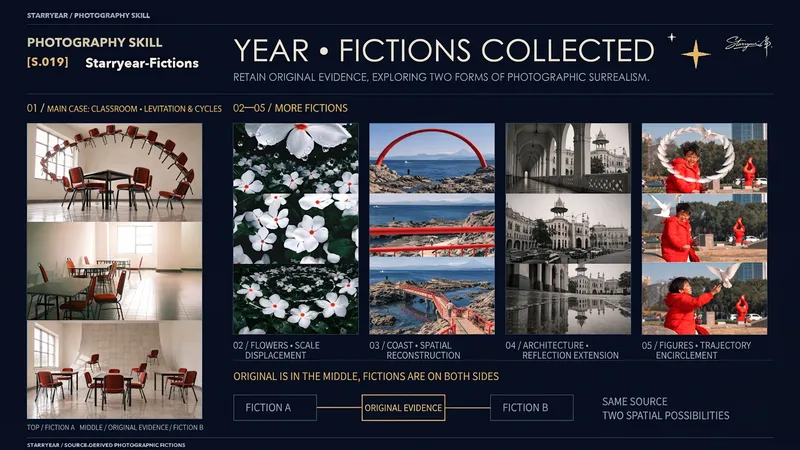
S.019 Starryear Photo Skill
Turn a supplied photograph into a photographic triptych that combines a sense of evidence with surreal imagination. The work retains an original photo—only cropped and proportionally resized—as the middle panel, allowing viewers to compare it directly with the source. The upper and lower panels preserve the identity, colors, lighting, textures, and photographic qualities of the original subject while presenting two distinct scenes that appear realistically photographed yet break the laws of space or physics. The finished work emphasizes the visual credibility of real photography: materials, exposure, depth of field, lighting direction, and subtle optical qualities all remain consistent with the source photo, rather than becoming an illustration, painting, or generic cinematic image. The three images are neatly arranged in a borderless vertical composition, suitable for photographic experiments, surreal image-making, visual storytelling, and artistic presentations that retain the original image as evidence. The final output is one complete photographic surreal triptych, with no title, logo, watermark, or decorative text.
Information
- Version
- v9
- Last updated
- Runtime credits
- Usage-based
- Models
- Auto
- Use cases
- Images & design
- What you get
- Image
- Visual styles
- CollagePhotorealisticSurrealist
