
Post-Meeting Decision Video
Turn meeting notes into 45–75s decision clips
Post-Meeting Decision Video
Turn meeting notes into 45–75s decision clips
Description
In complex B2B sales, you've won over the attendees, but they struggle to explain your value to executives and finance teams who missed the meeting. Send me your meeting notes, proposal, or product screenshots, and specify who should see it. I won't fabricate an AI ad; instead, I'll create a **Fact Ledger** and, once you confirm it, strictly follow the 3-10-15 narrative framework to produce a **45–75 second client-specific decision video** (with motion graphics, professional voiceover, and clear next steps). Designed for independent consultants, agencies, and B2B sellers, it lets your proposal be safely and accurately forwarded within your client's organization.
Showcase
1 / 2
Related Skills
View all
B2B Collaboration Feasibility
Input a client name, output a deal feasibility report ready for decision meetings. Process: Company profiling research → Value chain breakdown (including in-house/outsourcing assessment) → Scenario matching matrix → Hard constraint veto → Six-dimension weighted scoring (1-10) → Decision chain and 30/60/90-day action plan → Verification checklist. Produces both YouMind document and web report. Three key differences from ordinary client analysis: ① Will say 'no'. Things your solution cannot do are recorded in the 'Solution Profile', and boundary-crossing scenarios are directly vetoed, without masking through rhetoric. ② First determine whether the process is in-house or outsourced. No matter how painful the client's problem is, if that process has already been outsourced, the buyer is their supplier; the client entity has changed, and it must be assessed separately. ③ Check if value metrics can align. You talk about defect rate, the client talks about government assessment scores; proposals without a 'conversion rate' between the two languages will be rejected during financial review. Our capabilities are injected once via the 'Solution Profile' and reused long-term, applicable to any industry and any B2B solution (hardware/software/service/integration). Built-in value chain decomposition for seven types of industries: discrete manufacturing, retail chain, software/internet, B2B services & finance, energy & infrastructure, healthcare/education/government, and project-based integration, along with a mixed-ownership decision chain template. Every key piece of information is required to be labeled as fact/inference/unknown to avoid using inference as fact. Trigger words: client assessment, cooperation feasibility, client analysis, deal assessment, worth pursuing, can we take it, client screening.
High-Ticket Sales Diagnostic
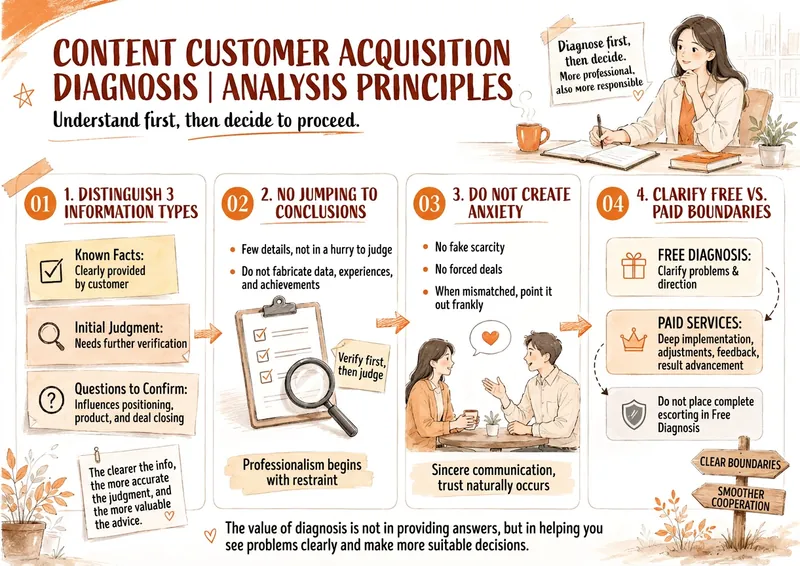
Have you encountered these situations? You've posted a lot of content, but clients don't take action after reading; You've spent half an hour on a free diagnostic, only to get a "I'll think about it"; You can clearly see the client's problem, but don't know how to ask questions, give solutions, or naturally move toward payment; You've talked a lot about your high-ticket product, but the other person still doesn't see the value. Tongtong's 30-Minute High-Ticket Content Lead Generation Diagnostic is designed specifically for those who want to generate leads through self-media, especially those selling high-ticket products. It turns an ordinary conversation into a professional diagnostic that is valuable, well-defined, and moves the sale forward. You only need to input the potential client's introduction, product, account, articles, and current issues. It will follow: Vision → Positioning → Product → Content → Platform Traffic → Private Domain Sales → Delivery Evidence to complete a systematic analysis and directly generate: ✦ The client's top 3 current sales blockers ✦ A minute-by-minute 30-minute diagnostic process with full scripts ✦ Coaching-style questions, follow-up questions, and mirroring ✦ Client differentiated advantages and high-ticket value extraction ✦ Content planning for lead generation, trust building, and closing ✦ Account types: WeChat Official Account, Xiaohongshu, Short Video, Private Domain division ✦ Methods to naturally transition from free diagnostic to paid coaching ✦ Common objection responses and post-meeting follow-up copy ✦ Judgment on whether the client is really suitable to purchase coaching Don't turn your free diagnostic into a useless Q&A session. Let the client see their problem clearly within 30 minutes, feel your expertise, and understand why they need a more complete paid solution.
 Video
VideoSpark | Video Diagram Maker
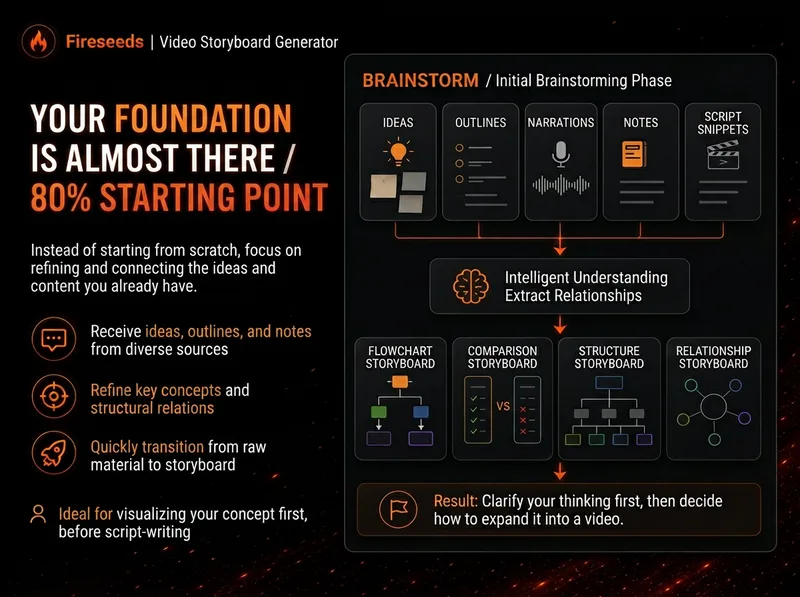
Many videos don’t lack content—the content is simply too abstract or dense. Viewers understand one sentence, then forget it by the next. “Spark | Video Diagram Maker” takes your ideas, brainstorms, outlines, scripts, transcripts, or articles and first breaks them down into concepts that are genuinely worth visualizing. It then determines whether they are best expressed as a process, comparison, architecture, hierarchy, cycle, branch, decision tree, or another diagram structure. It won’t draw just to hit a quota, or cram complex content into one cluttered infographic. Multiple diagrams maintain the same visual language, naming, and semantic color system, making them easy to insert into videos as an explanatory framework. Especially useful for: Explaining complex concepts Breaking down workflows Comparing two methods Showing system structures Clarifying cause-and-effect relationships Turning a long brainstorm into a set of visual nodes for a video The default output is a 16:9 static diagram. If the runtime environment cannot provide an editable Excalidraw source file, this will be stated clearly; static images will never be presented as .excalidraw files. Use cases Use case 1 | Turn a brainstorm into diagrams You only have a long stream of spoken ideas, without a complete script. The Skill identifies the points most worth drawing and organizes them into a set of diagrams with a clear presentation order. Use case 2 | Turn a script into visual nodes for a video You already have a complete script but don’t know where to add visuals. The Skill determines which sections are worth visualizing and selects suitable diagram types. Use case 3 | Explain complex concepts For example: how an AI Agent works, why a workflow matters more than a one-off demonstration, how a business model operates, or which layers make up a product architecture. Use case 4 | Break down a workflow or process For example: topic pool → research → Hook → script → production → review. Use case 5 | Make comparisons For example: no workflow vs. a workflow; traditional methods vs. AI methods; one-time success vs. stable, repeatable results.
Information
- Last updated
- Runtime credits
- Usage-based
- Models
- Auto