
Slow Teacher: Find Your Path
Clarify what matters and find your direction
Slow Teacher: Find Your Path
Clarify what matters and find your direction
Showcase
Description
Based on Jinpei Yagi’s *How to Find What You Want to Do*, this Skill accompanies users through a phased conversation in Chinese to explore life or work directions: first clarify what matters most (values), then distill work purpose, strengths, and interests, combine them into 2–4 directional hypotheses, and design practical small experiments with follow-up reflection. It is suited to people who don’t know what they want to do, have too many interests, are exploring themselves before a career change, or want to continue an existing exploration record. The Skill responds one round at a time, asking one question per round, writing its tentative understanding as a hypothesis that can be corrected, and recording supporting evidence and counterexamples along the way. It does not treat the three-element formula as an assessment, and it does not promise one lifelong career or guaranteed income.
Best for
For people unsure what they want to do, with many interests, preparing for a career change, or wanting to keep clarifying their direction.
How to use this Skill
Provide your input
Share your questions about life or work direction, interests, experiences, strengths, or an existing exploration record.
Run the Skill
Through a phased conversation in Chinese, gradually clarify what matters to you, what you do well, and what interests you, while inviting you to correct tentative interpretations.
Review your result
Get several testable direction hypotheses, small exploration experiments, reflection suggestions, and an exploration summary you can continue using.
Related Skills
View allSelf-Awareness & Career Coach
If you're at a career crossroads, feeling confused or lacking motivation, this skill will act as your deep conversation coach, guiding you through multiple systematic sessions to help you find what you truly want to do. It combines career planning and psychological counseling perspectives, using a scientific 'self-awareness method' to lead you through the three core dimensions of values, talents, and passions, sorting out the career intersection where you genuinely feel recognized, skilled, and loved. During the exploration, the coach will communicate with you like a professional friend, gently diagnosing and dispelling common cognitive misconceptions. You'll deeply explore the 'innate talents' hidden in your behavioral habits, and learn how to break down interests from superficial domains into transferable core elements. This multi-dimensional analysis helps you identify your true life motivations and avoid the frustration of blind attempts. After the deep conversation, the skill will generate a professional presentation report with minimal visual style and clear logic. This report includes detailed three-dimensional analysis, career direction permutations, suggestions for primary and secondary careers, and specific action guides. It's not only a summary of self-awareness but also a practical manual to help you set up 'information antennas' to capture career opportunities that were previously overlooked in the real world.
5 Unasked Qs: Talent & Career
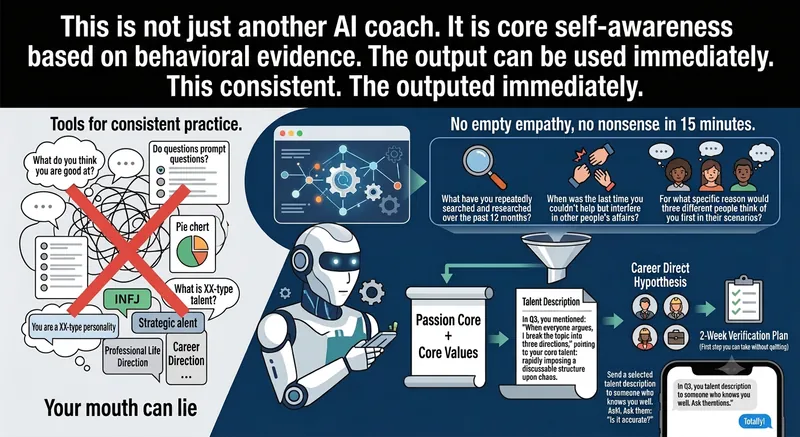
This isn't another AI coach. Most self-awareness tools on the market make you answer dozens of questions, give you a "You are an XX-type personality" label, and recommend a few job titles. You think "that kind of makes sense," but you don't know how to use it. This skill is different. Only 5 questions. All behavior-based—not "What do you think you're good at?" but "What did you repeatedly search and research in the past 12 months?" "When was the last time you couldn't help but meddle in someone else's business?" "What specific scenarios would three different people think of you first?" Your mouth may lie, but your behavior won't. No empathy, no fluff, no templates. No "Your words made my eyes light up," no "Now let's move to Question X." Ask, distill, next question. Done in 15 minutes. The results are yours alone. Every talent verb is tied to a real scenario you described. It won't tell you "You're a strategic talent"—it will say "You mentioned in Q3 that when everyone was arguing, you couldn't help splitting the topic into three discussable directions. This points to your core talent: quickly building a discussable structure amid chaos." The output is directly usable. A passion core + core values + talent description + career direction hypothesis + a 2-week validation plan (the first step you can do without quitting your job). Plus one action: send your one-line talent description to someone who knows you and ask—"Is that accurate?"
Uncover Your Hidden Strengths
Through conversational guidance—not a questionnaire—help users with low self-esteem, who feel they are good at nothing, or who are going through a low point in life uncover overlooked strengths, areas they excel in, or directions that may suit them. It then offers one small action they can take right away to test the possibilities. Use proactively when users say they don’t know what they’re good at, can’t find direction, feel useless, want to change careers or switch paths but don’t know what might suit them—even if they don’t explicitly ask for a test or talent analysis.
Information
- Version
- v2
- Last updated
- Runtime credits
- Usage-based
- Models
- Auto
- Use cases
- Career developmentPersonal growth
- What you get
- ReportDocumentPlan
