
Zizhi Tongjian: Power & Rule
1,362 years of dynasties and decisions
Zizhi Tongjian: Power & Rule
1,362 years of dynasties and decisions
Showcase
Description
SKILL FEATURES Millennium River Timeline: Divides the period from the 23rd year of King Weilie of Zhou (403 BCE) to the sixth year of Xiande of Later Zhou (959 CE) into several “river sections,” each labeled with its central conflict and main line of power transfer. Imperial Decision Sandbox: Breaks each major decision into eight steps: “background—options—decision-maker psychology—execution—immediate result—long-term impact—Sima Guang’s commentary—modern insights.” Causal Chain Tracing: Looks back at root causes (at least one level) and forward through consequences (at least two levels), addressing the common problem of viewing events in isolation. Rise-and-Fall Profiles: Tracks the trajectories of key figures, such as Shang Yang, Zhang Yi, Han Xin, Zhuge Liang, Wang Meng, and Wei Zheng, noting “why they gained power / why they lost power / their final outcome.” Institutional Change Line: Separately traces the evolution from feudalism to commanderies and counties, provinces and commanderies, military governorships, and provincial administration, enabling cross-dynasty comparison. War and Coup Quick-Reference Cards: Covers each major battle or coup with six elements: “time—place—sides—troop strength—key to victory or defeat—later impact.” History and Commentary in Two Columns: The left column presents excerpts from Zizhi Tongjian, including “Sima Guang says,” while the right provides plain-language translation and interpretations from modern management and political science perspectives. Multiple Detail Levels: General edition (focused on stories and insights) / close-reading edition (with selected original passages and key points from Hu Sansheng’s annotations) / management insights edition (for entrepreneurs and managers, focused on decision-making methodology). SUGGESTED QUESTIONS Break down the decision sandbox for the “Xuanwu Gate Incident,” including Sima Guang’s commentary and modern insights Turn “foreign policy during the reign of Emperor Wu of Han” into a causal chain, general edition Create a decision map for the “Reforms of Shang Yang,” with an institutional change line Summarize the “Battle of Fei River” in a war quick-reference card, clearly marking the key to victory or defeat Create a rise-and-fall profile of “Zhuge Liang’s Northern Expeditions,” close-reading edition, including key points from Hu Sansheng’s annotations Analyze “the relationship between Emperor Taizong of Tang and Wei Zheng” from the management insights perspective, with transferable principles
Best for
For history learners, researchers, and managers seeking insights from ancient Chinese decisions and institutional change.
How to use this Skill
Provide your input
Enter a dynasty, historical event, or person. You can also choose the general, close-reading, or management insights edition and specify a focus.
Run the Skill
Organizes history into timelines, decision sandboxes, causal chains, character trajectories, and institutional changes, interpreted through the historical perspective of Zizhi Tongjian.
Review your result
Receive a vintage scroll-style historical map and structured study notes covering decision analysis, causal tracing, historical commentary, and transferable insights.
Related Skills
View all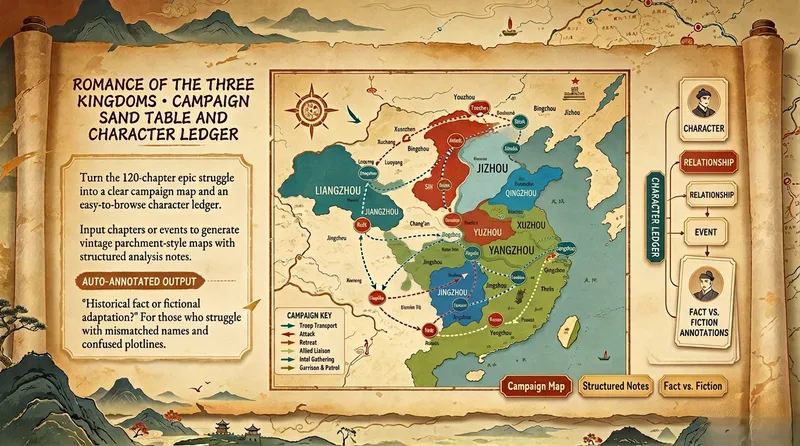
Three Kingdoms Campaign Guide
SKILL Features Chapter-by-chapter routes: Connect the chapter titles into a “campaign route,” with each chapter represented as a city or skirmish. Mark the starting and ending chapters, causes, and consequences to prevent losing track of earlier events. Character lineage trees: Organize the main characters by faction (Wei / Shu / Wu / other warlords / Han imperial house), showing lord–strategist–general relationships and identifying those who switched allegiance, such as Zhang Liao, Jia Xu, and Fa Zheng—the easiest relationships to confuse. Four elements for every campaign sandbox: Every major battle includes “time—location (ancient name + modern location)—troop strength and commanders on both sides—key to victory or defeat,” plus terrain and tactical notes such as fire attacks, water attacks, cutting off supplies, and feigned surrender. Strategy breakdown cards: Break down Thirty-Six Stratagems-style episodes into “plotter—bait—opponent’s psychology—flaw—result—what if the opponent had seen through it?” Build strategic thinking and create material that can also be adapted for writing. History and novel side by side: Mark each point as “recorded in Records of the Three Kingdoms / added in Pei’s annotations / fictionalized or adapted in the novel,” including examples such as borrowing arrows with straw boats, the Empty Fort Strategy, the oath of the Peach Garden, and borrowing the east wind. Avoid treating the novel as historical fact. Ancient and modern place-name and route correction: Jingzhou, Hanzhong, Jieting, Chibi, and other ancient place names always include their modern locations and strategic significance, with both names shown on the map. Classical and plain-language reading: For classic passages such as the Longzhong Plan, Memorial on Dispatching the Army, and proclamation against the rebels, provide excerpts of the original text, plain-language translations, and key-term notes while preserving the feel of the original. Thematic throughlines: Pull out themes such as loyalty and righteousness, power and strategy, talent movement, female characters, and fate versus human action to support reading the entire book and building material for argumentative essays. Multiple reading depths: Children’s story version (plot-focused, lighter on strategy) / Full original-text version / Deep study version (including narrative perspective, foreshadowing and callbacks, and key points from Mao Zonggang’s commentary). Recommended prompts Turn the Battle of Guandu into a campaign sandbox with the four battle elements and a historical comparison Map the chapter route around the Battle of Red Cliffs (Chapters 43–50), including ancient and modern place names Create a Shu-Han character lineage chart showing those who switched allegiance and their family relationships Turn Zhuge Liang’s “Longzhong Plan” into a thematic journal with original excerpts and plain-language translations Break down the “Chain Stratagem / Self-Injury Stratagem” into strategy cards and mark which parts are fictionalized in the novel Create a thematic chart of female characters in the Three Kingdoms, using the deep study version
 Image
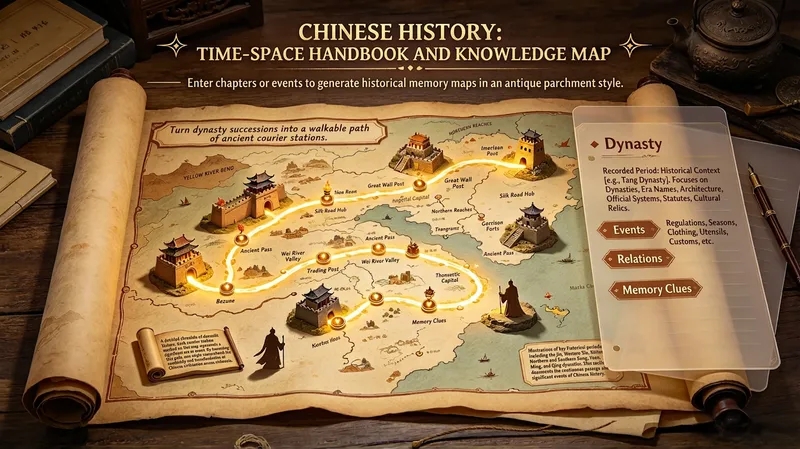
China History · Time & Map
Post-road format: Turn the timeline into a route of “post road—stations—passes,” with each dynasty as a city and each major transformation as a pass. Ancient and modern place names: Automatically label historical and present-day names (such as Chang'an → Xi'an, Lin'an → Hangzhou, and Jianye → Nanjing), showing both names on the map. Automatic fact-checking: Detect reign-title errors, mixed imperial temple and posthumous titles, reversed dynastic order, and misidentified figures. Correct errors before drawing the map. Longitudinal threads for institutional change: Trace systems such as civil service selection, taxation, and central government offices as standalone lines for cross-dynasty comparison without mixing their contexts. Character relationship map: Turn key figures into “travel companions,” with their factions, positions, and rivalries, helping solve the problem of forgetting names. Layered exam-point output: Separate recall-level content (dates, people, and places) from comprehension-level content (causes, effects, and comparisons), with mnemonics or comparison tables. Image-text cross-checking: The image handles routes and landmarks, while the text handles dates and conclusions. Neither repeats nor depends on the other. Multiple versions: Choose among three information-density levels: middle school general history, high school curriculum outline, or advanced preparation for graduate entrance and civil service exams. Recommended prompts Draw “the establishment and consolidation of unified Qin and Han rule” as a parchment map in an itinerary-on-the-post-road style. Turn “the evolution of ancient Chinese civil service selection systems” into a longitudinal institutional-change chart with a comparison table. Draw an ink-wash handscroll of “the Silk Road and Tang foreign relations,” with ancient and modern place names. Help me organize “the strengthening of autocratic monarchy in the Ming and Qing dynasties” at the high school curriculum-outline level, with a mnemonic.
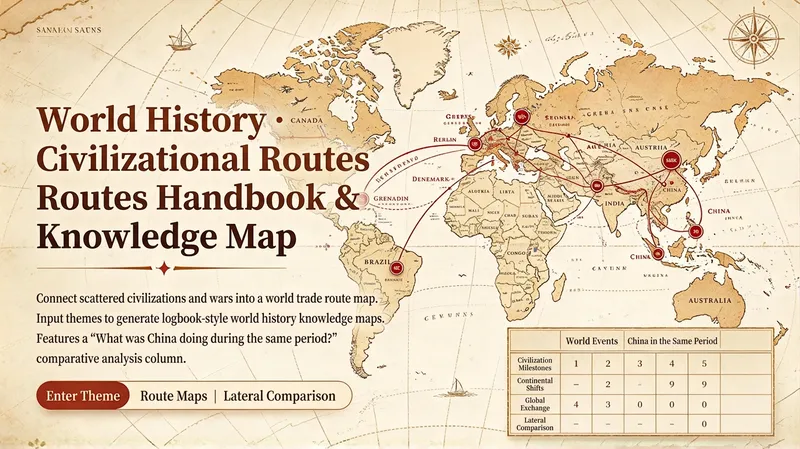
World History Route Atlas
SKILL features Civilizations as routes: river civilizations become harbors, imperial expansion becomes sea lanes, the spread of ideas becomes monsoons, and revolutionary waves become ocean currents. Cross-period and spatial comparisons: It always includes “China at the same time,” addressing the challenge of remembering world history in isolation (for example, the 1689 English Bill of Rights ↔ the 28th year of the Kangxi era). Calendar conversion: Converts between BCE/CE, centuries, reign titles, and the Gregorian calendar, with automatic labeling and error correction. Name standardization: Combines different translations of the same person under one entry (Charlemagne/Charles the Great, Catherine II), avoiding different names in different books. Concept distinctions: Provides comparison tables for Renaissance/Enlightenment, bourgeois revolution/Industrial Revolution, and colonialism/globalization. Make causal chains explicit: Breaks “background—trigger—process—result—impact” into five stages of a voyage to prevent memorizing conclusions alone. Map-reading practice: Includes three steps for “how to identify test points from the map,” supporting both understanding and exam-oriented map reading. Multiple levels of detail: The middle school version emphasizes narrative, the high school version emphasizes concepts, and the college/graduate exam version emphasizes historical perspectives and sources. Recommended prompts Turn the “Age of Exploration” into a great-voyage-log-style map and include a comparison with China during the same period. Create a route map comparing the “two Industrial Revolutions,” with concept distinction cards. Turn “Politics and culture in ancient Greece and Rome” into a civilization-harbor-style journal. Organize the “Versailles–Washington system” in a war-map style, clearly marking the layers of cause and effect.
Information
- Version
- v2
- Last updated
- Runtime credits
- Usage-based
- Models
- Auto
- Use cases
- Research & analysisLearning & educationBusiness & strategy
- What you get
- ReportImageDiagram
- Visual styles
- Ink washTraditional ChinesePaper art
