Course Model Construction
Course Model Construction
Showcase
Description
Based on the "One-Decision" modeling methodology, distills course core content into a structured, visual teaching model.
Related Skills
View all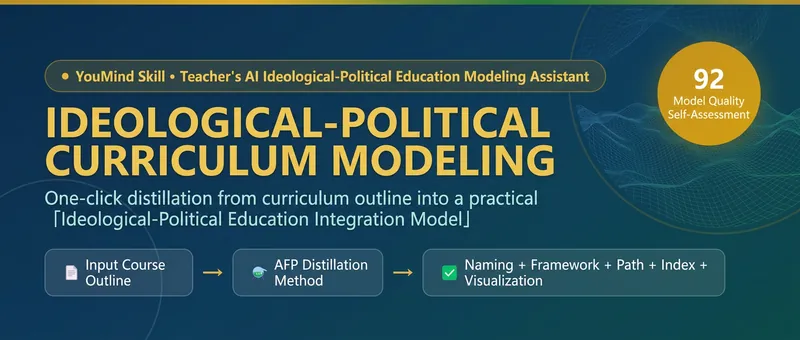
IP Integration Course Builder
Transform a course syllabus into a practical IP integration model. The assistant refines the integration logic based on course content and professional training goals, then names the model with a meaningful, discipline-specific title. It provides a core framework, dynamic implementation path, and three-dimensional verification indicators to ensure IP integration is aligned with the professional core and vocational skills. Three optional variants: abbreviation naming (using discipline-specific acronyms), a three-element version (professional root, ability vein, IP soul), and model visualization (embedded SVG diagram). Includes a five-stage implementation framework (cognitive integration → knowledge immersion → ability refinement → practice deepening → accomplishment sublimation) and three-dimensional indicators (value shaping, knowledge/ability, behavioral transformation).
Smart Course Dev II Workbench
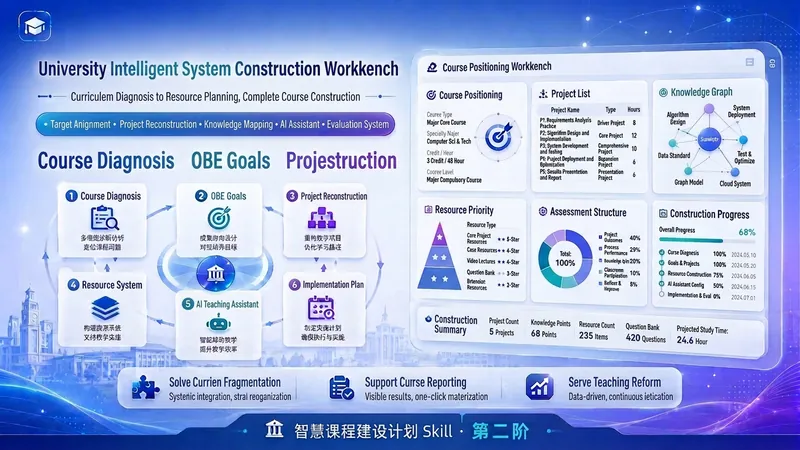
Systematically transform a traditional course into a smart course. This Skill is designed for college instructors who have already completed some lesson plans, syllabi, or unit designs and wish to further develop the entire course into a smart course. Teachers only need to provide the course name, target students, credit hours, course content, and existing materials, and a complete smart course construction plan will be generated, including: 1. Course positioning and construction problem diagnosis; 2. Knowledge, ability, and quality objective system; 3. OBE course objective mapping; 4. Project-based course content restructuring; 5. Course knowledge graph structure; 6. Smart teaching model for pre-class, in-class, and post-class; 7. Digital teaching resource development checklist; 8. Course AI assistant design plan; 9. Formative assessment and course evaluation system; 10. Construction tasks, implementation steps, and deliverable list. Applicable to courses in liberal arts, sciences, engineering, medicine, economics, management, arts, ideological and political education, etc. for undergraduate and vocational colleges. This Skill focuses on solving the problem of 'how to systematically build an entire course' and does not handle actual teaching data analysis, student early warning, or course operation diagnosis. Related tasks are completed by the third-level Skill.
Industry-Ready Course Builder
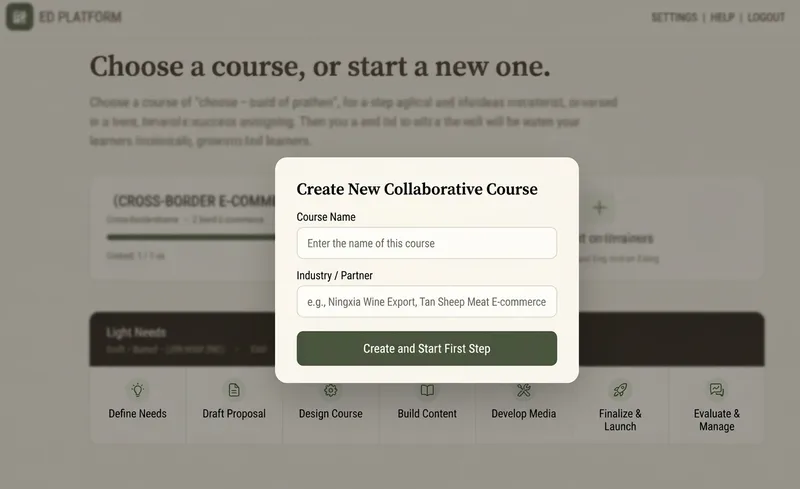
Industry-education integration course development coach: uses a “seven-step method” (identify needs → uncover real-world scenarios → set goals → structure content → plan teaching → design assessment → build resources) to guide teachers step by step in developing a course that integrates industry and education. Each step is reviewed by six experts in academic standards, formatting, data auditing, ethics and compliance, industry, and teaching, with Socratic pauses and linked change alerts. The final output includes a development record and a course showcase platform. Use this Skill whenever the user mentions industry-education integration course development, school-enterprise partnership course design, course proposals or applications, alignment with talent development plans, bringing real company scenarios into the classroom, dual-qualified teaching design, or developing course objectives, competency matrices, assessment rubrics, case libraries, or question banks; asks to “turn this course into an industry-education integration course”; wants to continue with step N of a specific course; or opens a folder containing a course-development CLAUDE.md file—even if they do not mention the “seven-step method” or “skill.” It applies to vocational education, vocational bachelor’s programs, applied bachelor’s programs, and general bachelor’s programs.
Information
- Version
- v1
- Last updated
- Runtime credits
- Usage-based
- Models
- Claude Opus 4.6
