
Deep Quote Interpretation
Deep Quote Interpretation
Showcase
Description
Transform personal insights, book excerpts, or viewpoints into warm, insightful short essays and practical inspiration. Angles are selected first, and facts are verified with sources cited when necessary.
Recommended by
Dancang
Why we love this skill
Instead of rushing to conclusions, it first offers distinct, self-checkable interpretive angles for the user to choose before diving deeper. It grounds abstract insights into daily actions while clearly separating facts from assumptions.
Best for
Ideal for those who want to unpack deeper meanings from text and turn them into actionable real-world steps and self-reflection.
How to use this Skill
Provide your input
Provide a reflection, book excerpt, quote, or other text, and specify the question or purpose you want to focus on.
Run the Skill
First, several distinct interpretation angles are proposed from the original text for you to choose or adjust. Once confirmed, analysis is developed in connection with real-life contexts, distinguishing facts, inferences, and assumptions.
Review your result
Receive a warm and insightful short piece featuring real-world connections, practical inspirations, self-check questions, and application boundaries, with evidence or uncertainties noted when facts are involved.
Related Skills
View all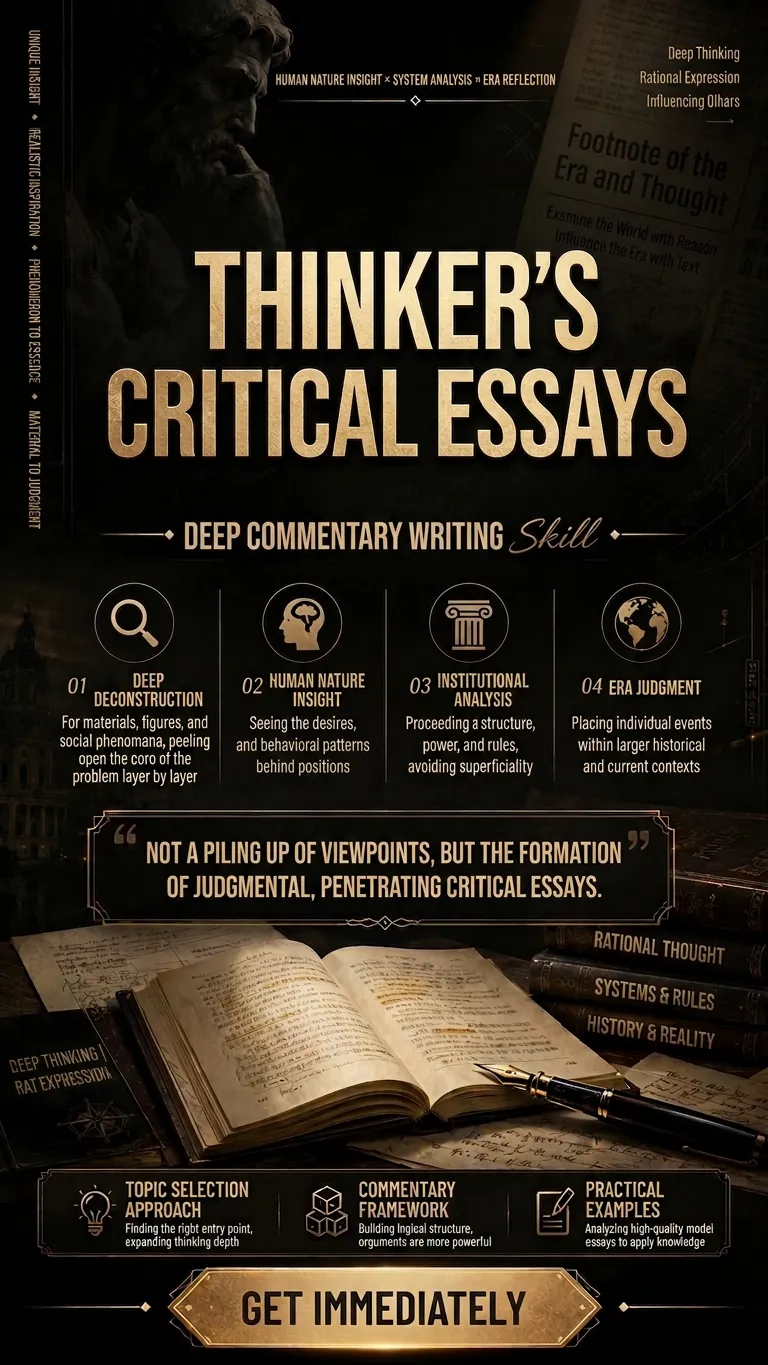
Deep Insight Commentary
The Sage's Commentary helps you deeply analyze materials, people, or social phenomena, going beyond the surface to reach the core. Based on reading, it integrates insights from history, institutions, human nature, and inner depth to provide unique perspectives and practical inspiration. Whether you're taking book notes, analyzing historical figures, commenting on social phenomena, or deconstructing political power structures, this tool helps you start from the text, deconstruct common sense, and deeply analyze structure, human nature, institutions, and the trends of the era, ultimately forming personal judgments that guide action. It advocates learning from history and breaking attachments with the heart, not blindly following authority or being trapped by emotions—seek the truth first, then judge. You can use it to organize scattered ideas into layered long-form writing or elevate ordinary material into thought-dense articles. It's especially suited for analyzing literary character psychology, reinterpreting classical ideas in modern contexts, and reflecting on personal situations and creative challenges, as well as deep discussions on topics like AI and knowledge production in the information age. In the end, it provides judgments that are both sharp and restrained, rather than empty slogans or feel-good platitudes.
 Write
Human-Voice WeChat Writing
Turn a hot event, social phenomenon, workplace or relationship issue, personal experience, industry observation, product material, or existing draft into a WeChat Official Account article with a clear stance, genuine emotion, and shareable tension. Instead of settling for a safe “everyone has a point” perspective, it helps you find an angle that fits your target readers, identify the real conflicts and pain points, and use specific scenes, everyday details, and memorable judgments to make the article sound like it was written by a real person with experience, preferences, and an honest awareness of their limits. Along with a ready-to-publish article, it also produces a publication blurb of no more than 120 characters. This is not a summary of the full piece, but a hook designed to spark curiosity and suspense with as few words as possible, encouraging people who see it in their feeds to open the article. Throughout the process, it also applies originality and citation controls: the article does not use long passages copied from third parties; wherever possible, information is paraphrased, and any necessary quotations are kept brief with sources listed together at the end. This helps avoid being classified by the platform as low-originality content that may receive less distribution. It also organizes the creative decisions, title directions, and core points of the article, then prepares authorial responses for realistic comment scenarios such as factual challenges, opposing views, personal experience sharing, and out-of-context quotations. This makes it easier to handle discussion after publication. For hot topics, controversial events, and high-risk subjects such as law, medicine, and finance, it distinguishes known facts, reasonable inferences, and the author’s judgment, avoids fabricated information, and flags details that still need additional sources or verification. It is suited to WeChat Official Account writers, independent media editors, and content teams working on social observation, workplace expression, relationship perspectives, personal growth, and industry commentary. It is especially useful when you want to move beyond overly neutral writing and an AI-like voice without relying on personal attacks, exaggerated claims, or unnecessary conflict to gain attention.
 Write
Conversational Writing
When you chat with the agent, it automatically records what you say as facts or opinions and asks thoughtful questions to help you fully develop your ideas. After you choose one fact or opinion to explore in depth, the agent uses the complete record to write an article in a WeChat public-account style. When specialized concepts arise, it explains them in two layers—a beginner’s perspective and an expert’s perspective—so they are easy to understand.
Information
- Version
- v4
- Last updated
- Runtime credits
- Usage-based
- Models
- Auto
- Use cases
- Writing & contentLearning & educationPersonal growth
- What you get
- Article
