Peter Yuan
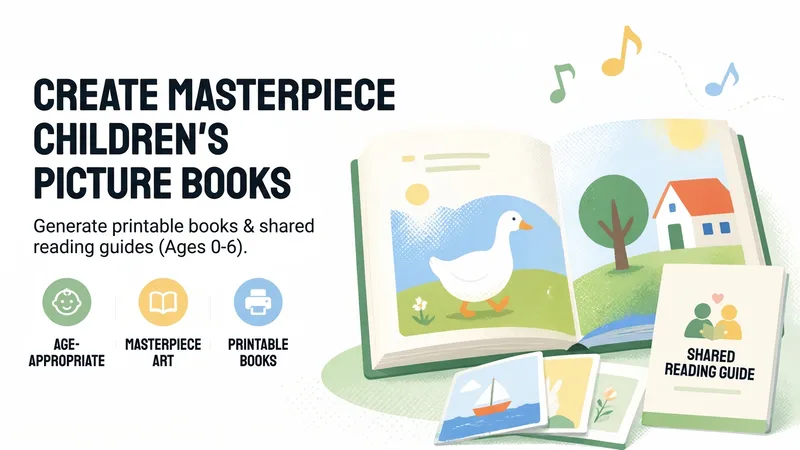
Master-Style Baby Book
Create printable picture book Slides tailored for infants and toddlers aged 0–6 based on monthly age, story themes, classical poetry, and specified master art styles (defaulting to Dick Bruna's minimalist style). It automatically plans age-appropriate storyboards, maintains visual consistency for characters, and generates ready-to-print picture books in one go.
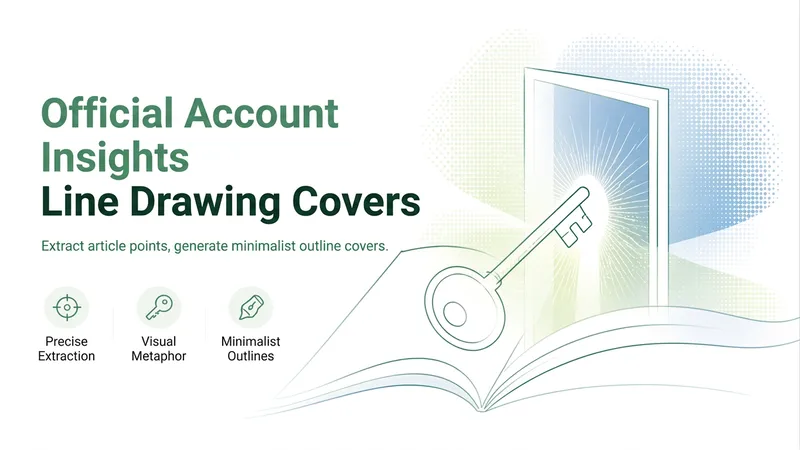
WeChat Line Art Cover
Transforms your article title, theme, core perspective, or text into an accurate and compelling visual metaphor, generating a minimalist line-art concept cover suitable for publication. Rather than simply drawing nouns from the title, it captures the real judgment, conflict, or paradox of the article, presenting a thought-provoking idea through a single core imagery. By default, it outputs an editorial-style illustration with a dark background, fine white lines, and a landscape wide format. The composition is restrained, clear, and retains ample negative space, making it ideal for article covers and mobile browsing. You can directly provide the title or text without describing the visual style; the skill selects object metaphors, character actions, or spatial relationships based on the content, avoiding complex scenes, clichés, and irrelevant decoration. It directly generates one cover by default, and also supports outputting complete prompts for image generation when needed. If you want to change the concept, adjust the aspect ratio, add color, or modify the visual style, you can also specify your requirements directly.
 Research
Selected Works of Mao
When facing business decisions, startup strategies, workplace competition, organizational management, project bottlenecks, major personal choices, or industry issues, this turns complex dilemmas into manageable, actionable problems. It uses principles from the Selected Works of Mao such as seeking truth from facts, interest analysis, principal contradictions, unity of opposites, protracted war, mass line, and practice to strip away emotions, slogans, and surface conflicts, pointing directly to the interest structures and critical contradictions that determine success or failure. Whether you provide a brief description or full background, you will receive a distinct and in-depth analysis: clarifying known facts and information blind spots, identifying allies, opponents, and forces that can be won over, determining whether to defend, build strength, or concentrate for a breakthrough under current conditions, and deducing feasible paths for different scenarios. The analysis does not dodge problems or replace judgment with ambiguous balance. The final output is a complete breakthrough analysis and action plan covering emergency damage control, near-term breakthroughs, and long-term mechanism building, complete with low-cost validation actions and feedback standards to help you quickly correct your judgment in real-world practice. Ideal for managers, entrepreneurs, and individual users who need strategic clarity, complex decision analysis, and executable solutions.
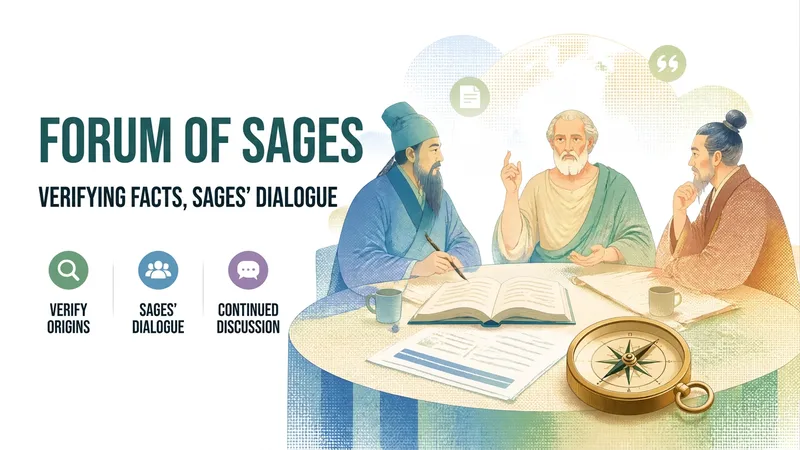
Fact-Checking & Philosopher Dialogue
Transform a piece of news, event description, or contemporary issue into a fact-based 'philosopher forum.' It begins by verifying key facts, timelines, and points of contention—distinguishing between verified information, unilateral claims, media reports, inferences, and unknowns—and organizes them into a public dossier with genuine sources, ensuring subsequent discussions are built on clear, traceable factual boundaries. Building on this, the forum can invite historical thinkers such as Confucius, Zhuangzi, Marx, and Nietzsche based on your specifications, or match thinker combinations to the topic. Each thinker analyzes the issue independently through a fictional thought experiment inspired by their philosophy, presenting their core concerns, reasoning paths, value conflicts, realistic costs, and potential counterarguments, all while integrating contemporary knowledge and life situations rather than simply quoting famous lines or using archaic tones. You can also call out and question a specific thinker, have them respond to points already raised by others, and conduct cross-examinations, position revisions, and continuous dialogue. When encountering the latest reports, you can update the facts before discussing their impact; subsequent exchanges default to appearing in the dialogue, and are only organized into a traceable discussion record when explicitly requested.
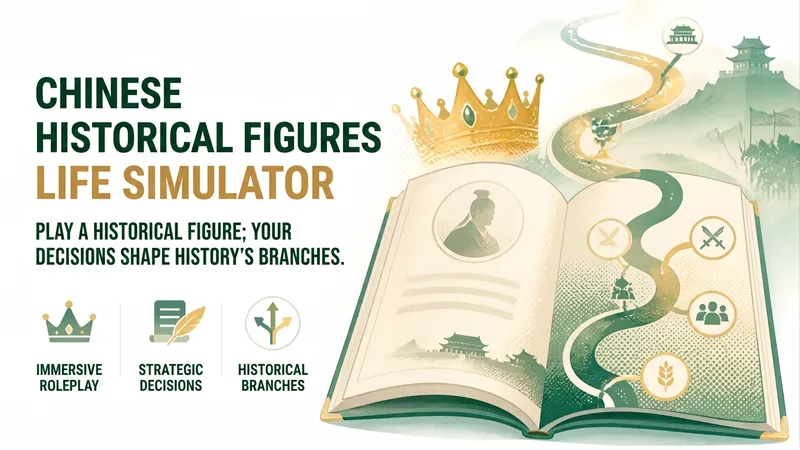
Chinese History Life Simulator
Step into the shoes of a real Chinese historical figure. Face political choices, military conflicts, financial pressures, diplomatic games, social unrest, and life turning points within a specific era and identity, experiencing historical branches driven by your own decisions. You can choose to be an emperor, general, powerful minister, or other key figures, starting from critical stages of their lives and making judgments based on available information and realistic conditions at the time. The simulation focuses on power relations, national governance, finance and economy, military and diplomacy, livelihood stability, talent and factions, and the succession order. During major events, you will see the short-term benefits and long-term risks of different strategies, or you can propose your own solutions. The system simulates the gradual impact of policies based on bureaucratic execution, resource limits, interest group reactions, and information lags. Reforms may face obstruction, wars may fail, alliances may break, and wrong decisions can trigger coups, rebellions, or succession crises. The experience distinguishes between real history and alternate branches created by your choices, without revealing all endings in advance or granting unreasonable omniscience. After character death, abdication, overthrow, or voluntary completion, you will receive a historical review focusing on key decisions, the plight of the people, institutional continuation, succession arrangements, and ruling ability, helping you understand the differences between this unique rule and real history.
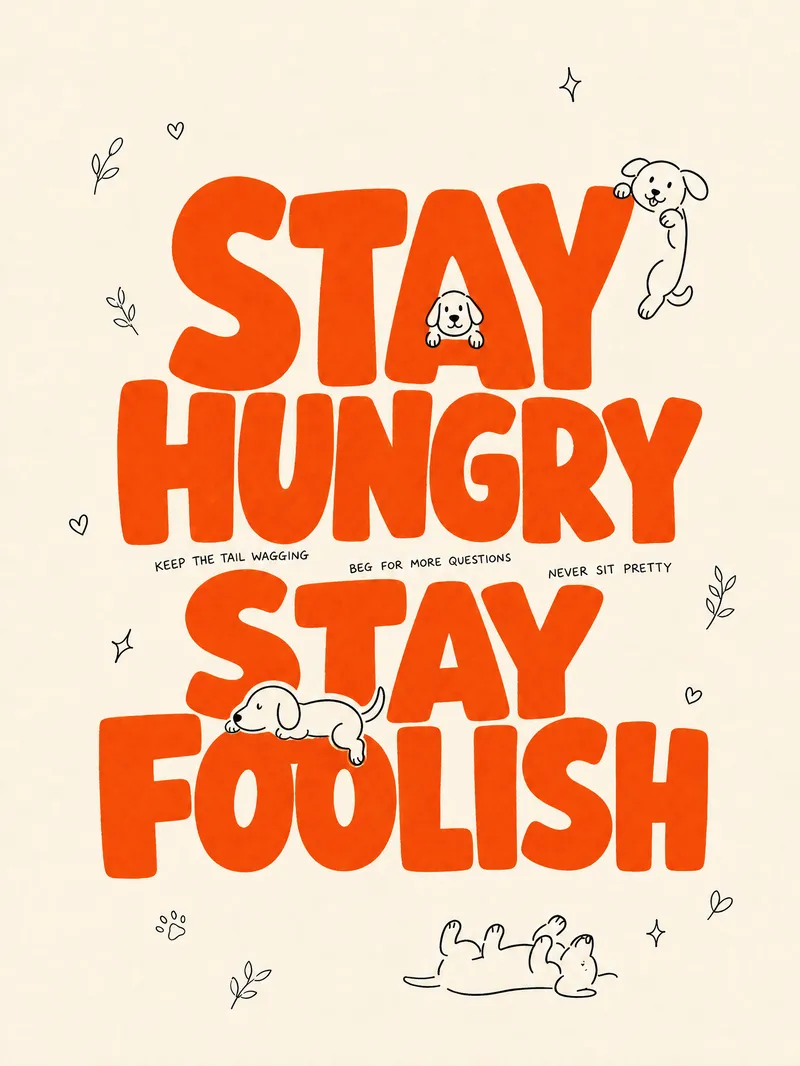
Hand-Drawn Slogan Poster
Enter an English slogan (2-3 words per line, up to 4 words total) and your desired animal to generate a vertical hand-drawn motivational poster. Huge, colorful, rounded bold words stack vertically like a letter wall, while minimal black single-line animals step on, hug, or peek through the letters. Smaller black marker handwritten phrases fill the gaps against a clean white background with generous negative space. You can specify aspect ratios (2:3 / 3:4 / 9:16), accent colors, and animal types (such as dogs, cats, rabbits, or bears). Ideal for slogan posters, phone wallpapers, and sticker collections.
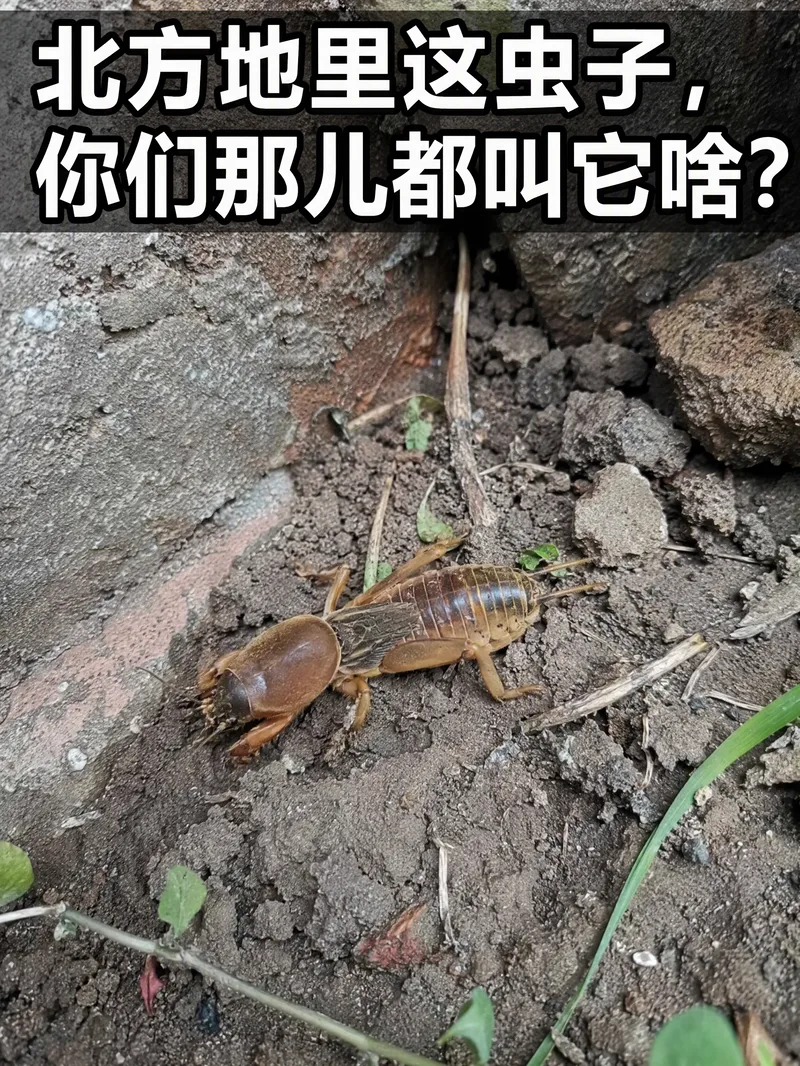
Everyday Moment Stickers
Turn a life moment, vague scene, or simple topic into a candid-style image ready to publish on a WeChat Official Account. The key is to “identify the content type first, then choose the tone of the copy.” For things most people recognize that naturally feel cute or comforting—hedgehogs, kittens, sunsets, and fallen leaves—use a pure sharing approach: describe the scene and genuine emotion like a social post, without forcing a question. Use an interactive question only when there is a real knowledge gap, such as an object people cannot name, one with different regional names, or one that is easily mistaken for something else. This encourages comments like “I know what it is,” “I want to correct that,” or “I want to add something.” Use a curiosity-driven approach only for objects that are genuinely uncommon or look counterintuitive. Never use “What do you call this where you live?” as a one-size-fits-all template for an animal like a hedgehog that everyone recognizes. Before creating the image, verify the species name, common names, habits, how common it is, and regional names online. This helps avoid exaggerating ordinary things into unusual discoveries and avoids details such as “conservation status” that are easy to get wrong and likely to be corrected in the comments. Then generate a 3:4 vertical, candid phone-photo-style image with large, eye-catching copy: a realistically messy setting and imperfect composition that feels like a real-life record rather than a polished production. Delivery includes a WeChat Official Account title and short body copy, so the image, title, and body can be published immediately.
生成时间:2026-10-14 08:31 原始需求:一个30岁男性在窗边的手机自拍,iPhone 17 Pro Max。有一点点的胡须。 场景模板:A 通用半哑光 目标模型:未指定(默认 GPT-Image 系) 状态:新生成
30岁男性窗边手机自拍 · 真实皮肤质感
原始需求
一个30岁男性在窗边的手机自拍,iPhone 17 Pro Max。有一点点的胡须。
场景判断
属于「日常写真 / 生活人像」类型,且为窗边自然光 + 手机手持自拍,非直闪、非棚拍 → 选 模板 A(通用半哑光)。 不使用直闪模板 B,因为窗边自然光有明确的受光面与暗部,属于柔和侧光,不需要处理机顶闪光造成的高光连片问题。
图片比例
-
比例:9:16(用户未指定,按默认手机竖屏)
-
用途:手机竖屏 / 小红书 / 抖音
-
模型写法:
-
Midjourney →
--ar 9:16 -
SDXL / WebUI → 分辨率
768x1344(9:16) -
GPT-Image / 即梦 / 豆包 → 提示词内写“竖幅构图,9:16”,或在生成界面直接选择
-
5 控制点配置
| 控制点 | 本次设定 |
|---|---|
| 整体基调 | 半哑光、克制的缎光基调 |
| 高光落点 | 仅 T 区(额头、鼻梁、鼻尖)轻微皮脂高光,不铺满全脸 |
Realistic Skin Texture Prompts
Generate text-to-image prompts for selfies, close-ups, half-body portraits, and portrait photography, with a focus on reducing plastic-looking skin, an oily film, and AI-looking faces. Skin is guided toward more natural glow, texture, and subtle variation. Whether you need everyday portraits, magazine-style portraits, direct-flash snapshots, or realistic portraits with less of an AI look, prompts can be customized based on the subject, camera position, lighting, style, and preferred imperfections. Prompts are organized around the overall skin texture, highlight placement, differences across facial areas, textures such as pores and peach fuzz, and natural skin-tone variation, rather than simply stacking vague terms like “realistic skin” or “ultra-realistic.” You can specify image ratios such as 9:16, 3:4, and 1:1, and get composition and parameter suggestions for the image-generation model you use. When needed, you can also generate Chinese, English, or bilingual versions for GPT-Image, 即梦, 豆包, Midjourney, SDXL, or Flux. In addition to copy-ready positive prompts, the Skill explains how key descriptions affect skin texture and provides targeted troubleshooting and adjustment suggestions for over-smoothed skin, an overly oily face, a waxy appearance, or distorted texture. Generated prompts can also be saved by topic for easier lookup, fine-tuning, and consistent texture across a portrait series.
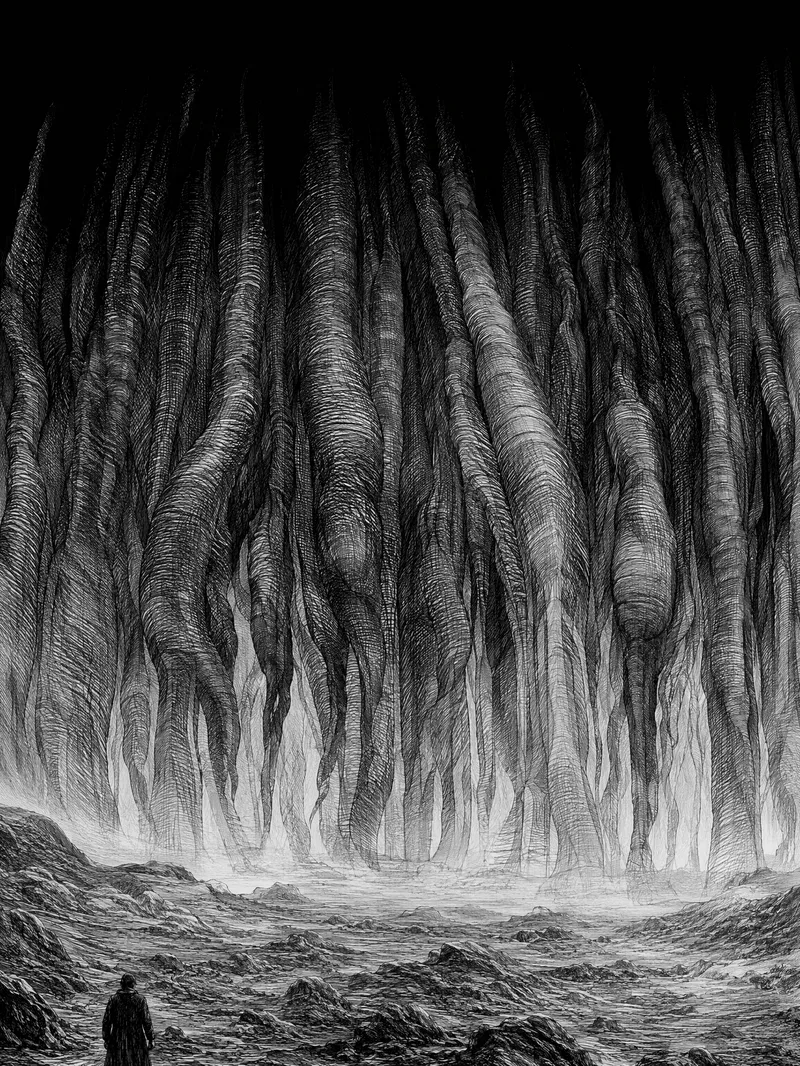
Cthulhu Black-and-White Prints
Turn written imagery or reference images into eerie Cthulhu-style black-and-white print illustrations. The goal is to create the unease of “a world malfunctioning,” rather than plainly depicting a recognizable monster. Whether the setting is a ruin, coastline, interior, or unfamiliar landscape, it is reorganized into an anomalous scene that is difficult to name, with an uncertain scale and purpose—ideal for atmospheric illustrations, horror concept art, and supernatural visual concepts. The core style draws on woodcuts, scraperboard art, and pure black-and-white line engraving. Dense hatching, stark contrast, misty depth, and irregular solid-black areas create a sense of oppression. The subject often supports two contradictory interpretations of its material or form at once. Spatial dislocation, distorted scale, and illogical lines remain embedded in the details, making it difficult for viewers to determine what they are seeing at a glance. You can specify the aspect ratio, whether monsters or text appear, the number of images to generate, and which elements of the composition and atmosphere to preserve. You can also upload one or more reference images to guide the style, subject, composition, or mood. Unless otherwise specified, the default is a vertical black-and-white print, one image, no clearly recognizable monster or text, and an effort to preserve an indescribable Cthulhu-horror effect.
 Image
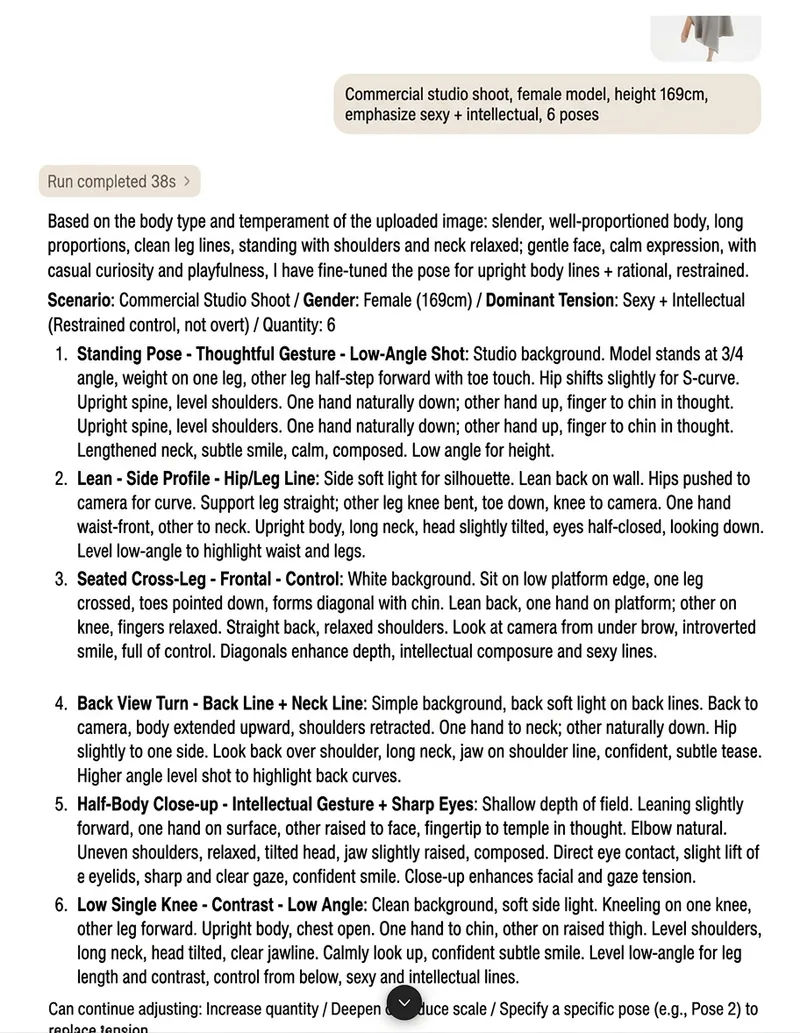
Portrait Tension Poses
Provide the scene, model's gender, desired tension, and number of poses to receive a set of professional Chinese pose prompts ready for portrait photography. Whether the setting is a studio, outdoor location, street, home, pool, or stage, each pose is shaped around the requested qualities—such as sensuality, cool restraint, elegance, wildness, grace, edgy confidence, or languid ease—with specific guidance on camera position, composition, body axis, center of gravity, shoulder-to-hip relationship, arm and leg lines, and neck and head angles. Each pose also comes with a tailored expression derived from it. Following the chain of “pose → emotion → expression,” the prompts specify gaze direction, eyelid opening, eyebrows, lips, and subtle facial expressions. These details bring out the pose’s emotion and tension while giving each option its own distinct mood and avoiding repetitive expressions. After you upload a model image, the skill can also adjust pose lines and expressions based on body shape, proportions, facial contours, and overall presence. The clothing, makeup, hairstyle, accessories, and setting in the image do not limit the style direction you specify. The generated options aim to vary body positions—standing, sitting, kneeling, lying down, and leaning—as well as camera views such as eye-level, high-angle, low-angle, side, back, and close-up shots. This helps avoid repetitive, stiff, or lifeless posing and makes the prompts suitable for portrait photography, model direction, and AI image prompt preparation.
 Image
Annotated Outfit Breakdown
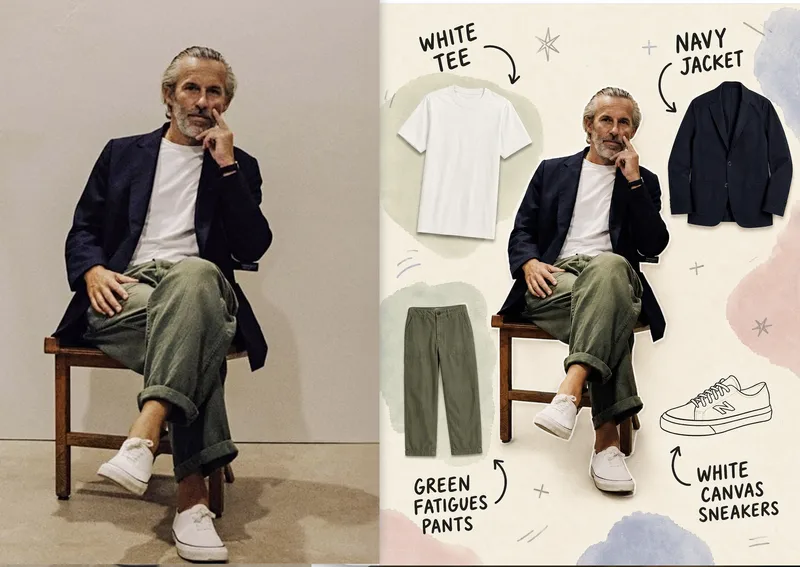
Turn a single outfit photo into a clear, easy-to-read outfit breakdown image—ideal for outfit sharing, fashion editing, styling records, and social media posts. The image preserves the person’s facial features, pose, and original outfit, while separating the jacket, top, bottoms, shoes, and visible accessories into individual product-style item images arranged naturally around the centered subject, making the full look easy to understand at a glance. Each item is labeled with handwritten doodle-style text and curved arrows that accurately identify its color, category, and material. Brand information is included only when you provide it and is never guessed. The overall design combines a warm off-white paper background, soft watercolor blocks, and a few hand-drawn symbols with a realistic person and clean item images, creating a relaxed, editorial collage effect while avoiding obstruction of the subject or inventing clothing that does not appear in the original photo. You can also adjust the label language, item-image style, color palette, number of items, and aspect ratio to better match your personal taste and publishing context.
Infinite Loop Selfie
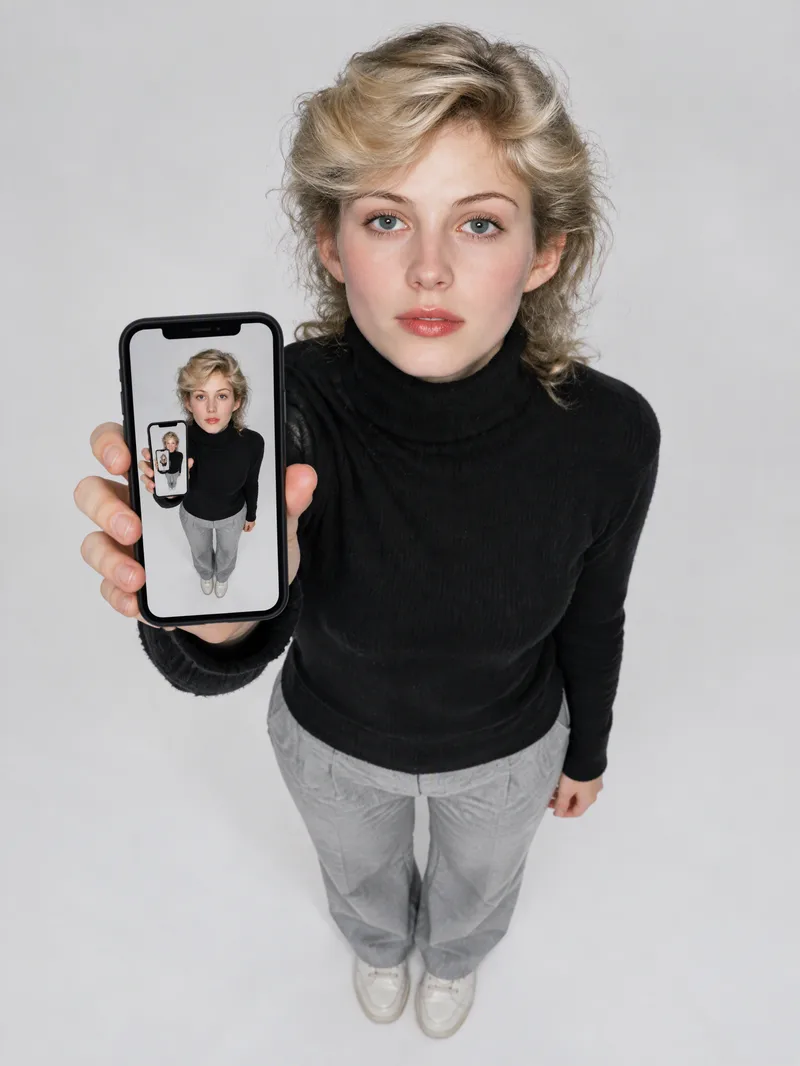
Turn your written concept or character reference image into a selfie photo with a Droste effect: the person in the image holds a phone with its screen facing the camera, clearly showing the complete scene—including the person, phone, and white studio background—nested and shrinking layer by layer to form a visible visual loop with at least three levels. Customize the person’s gender, age, hairstyle, clothing, pose, and expression. You can also specify a portrait 3:4, square 1:1, or vertical 9:16 aspect ratio. When you upload a reference image, the person’s facial features, hairstyle, skin tone, body type, accessories, and visible clothing will be faithfully recreated. If the reference is only a half-body shot or even a close-up, unseen bottoms, shoes, and accessories will be carefully inferred from visible cues such as the collar, top fabric, and color palette to complete a coordinated outfit in the same style. These details will only be changed when you explicitly describe the changes in text. Without a reference image or character specifications, an original character will be generated, with a consistent appearance, pose, and outfit at every layer. The final image uses a pure white or light gray seamless studio background, soft high-key lighting, and a realistic photographic look, highlighting natural skin tones, fabric details, and a clearly visible phone screen. The composition remains a clean, front-facing shot of one person against an uncluttered background. It avoids incorrect screen content, mirrored text, watermarks, and distorted phones or fingers, keeping the infinite nesting effect natural and easy to recognize.
Shadow Subject Film Style
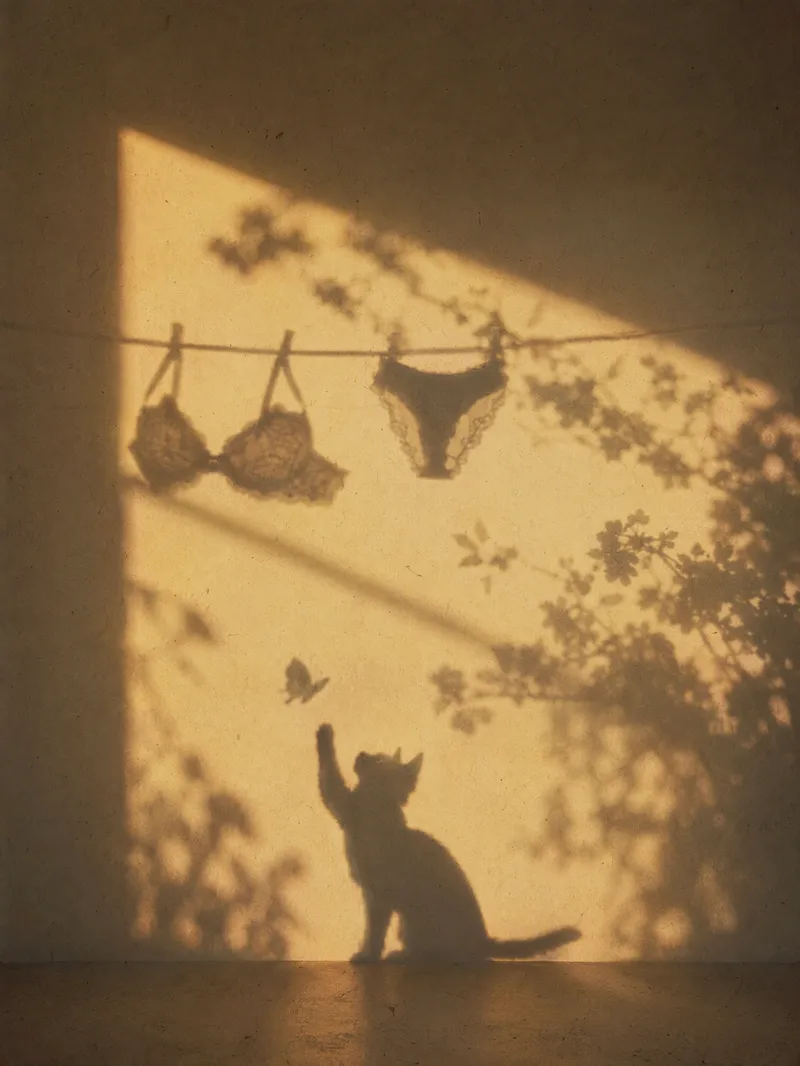
Transform people, animals, still lifes, or scenes into quiet, poetic images where “the shadow is the subject”: the content appears as shadows, silhouettes, and projections on walls, floors, or other surfaces, rather than as solid subjects accompanied by ordinary shadows. Whether generating a new image from a text description or redrawing an uploaded photo in this style, the relationships and poses between subjects are preserved while soft, evocative window light, natural light, or dappled tree shadows are introduced. The images use a low-saturation film atmosphere, with blue-gray, brown-yellow, warm gold, or restrained black-and-white tones matched to the scene and mood. Visible film grain, paper texture, soft focus, and a lightly faded quality are added, avoiding vivid commercial colors and overly smooth digital textures. Minimal compositions and generous negative space give the shadows room to breathe, making the style suitable for understated emotions such as solitude, nostalgia, warmth, healing, or silence. Suitable for visual needs such as a shadow-focused literary aesthetic, artistic silhouettes, or film-like light and shadow. It also works well for creating story-rich single images or image series with consistent color palettes and compositional logic. It is not suitable for ID photos that require clearly recognizable facial features, realistic portraits showing a solid subject with an ordinary cast shadow, or highly saturated commercial advertising imagery.
Free · Museum of Everything
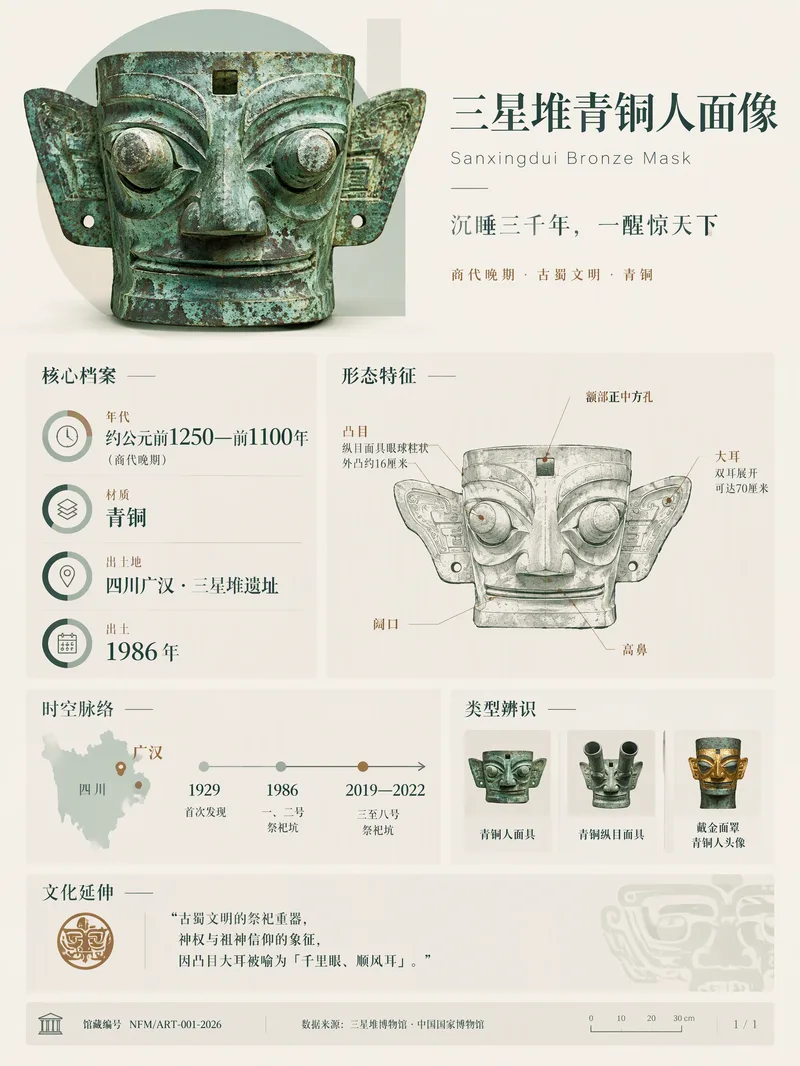
Turn a city, plant, animal, ingredient, mineral, object, building, or cultural concept into a museum-style knowledge infographic with both educational value and a collectible feel. The 3:4 portrait layout uses a high-quality hero visual to anchor the composition, paired with elegant Chinese titles, English or Latin scientific names, classification labels, and concise definitions so the subject’s traits and character are immediately clear. The information is organized flexibly according to the subject, covering modules such as a core profile, structural cross-section, geographic and historical context, experiences and applications, comparisons with similar subjects, identification and care, or cultural extensions. Key figures, icons, maps, timelines, and concise charts are interwoven to avoid crowded tables and rigid nine-grid layouts, balancing rich information with easy reading. When presenting key names and user-provided data, the design prioritizes textual accuracy and avoids inventing precise conclusions. The overall visual style combines natural specimen photography, refined museum wayfinding panels, and the character of a high-end magazine yearbook. It uses low-saturation natural colors such as off-white, gray-green, and warm gray, along with restrained accent colors, serif headings, and generous whitespace. It is suitable for knowledge cards, educational posters, exhibition guides, and social media content. It also supports creating a series of collectible images with consistent layouts, colors, and numbering across multiple subjects.
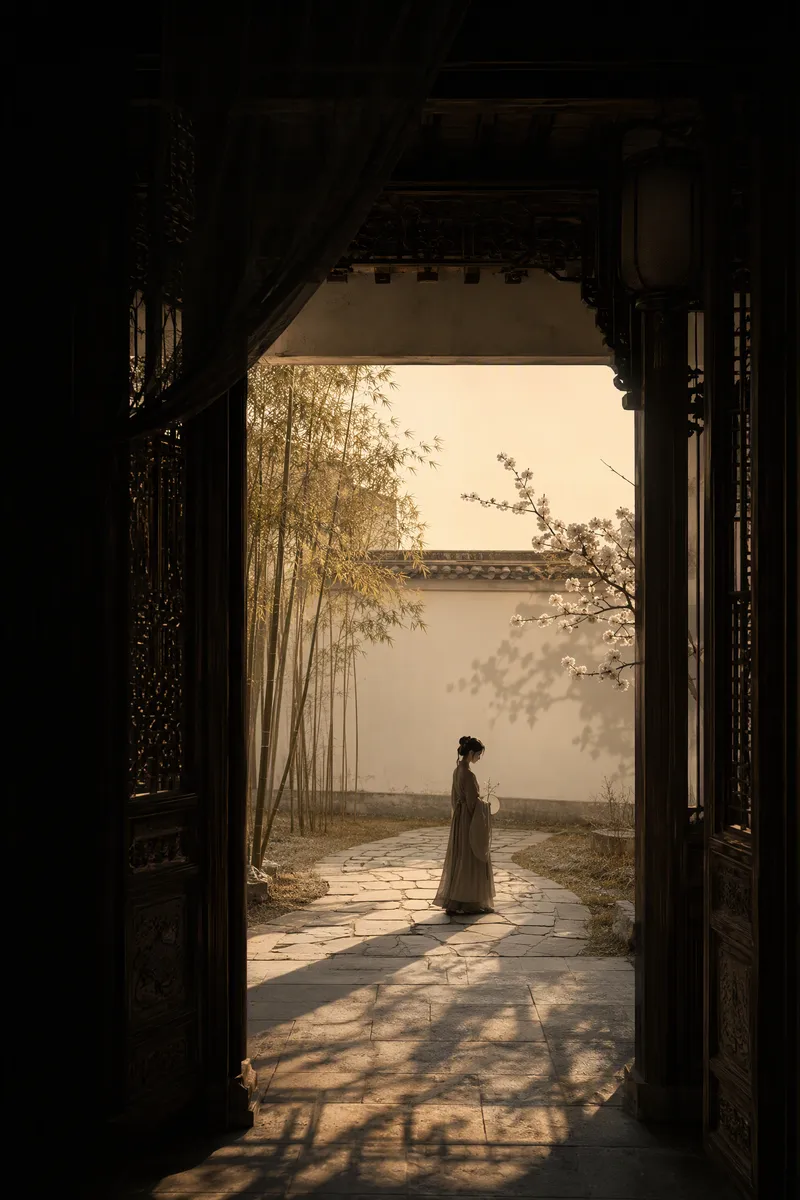
Light-and-Dark Zen Framing
Turn your written concept or reference image into a “light-and-dark framed Zen” scene: dark architecture or structures form a natural frame in the foreground, leaving an open, bright space within. A person or subject stands in the light at a small scale, as a silhouette or in muted colors, while crisp, elongated geometric shadows reinforce a sense of order and solitude. The overall style emphasizes high-contrast lighting, near-black shadows, restrained colors, ample negative space, and a tranquil, minimalist visual experience. It is suited to creating a meditative, ceremonial, and East Asian Zen atmosphere, while also extending to modern urban or Western classical settings. During generation, the architectural context is naturally matched to the subject’s identity, era, and cultural character—for example, a monk in a Zen temple corridor, a scholar in an academy, a samurai in a Japanese garden, a historical figure in a classical courtyard, or an urban professional in a glass-curtain-wall space—while preserving any scene you explicitly specify. For uploaded images, the composition can be reconstructed around a dark frame, bright area, subject in light, and long shadows while preserving the subject’s identity and approximate pose as much as possible. If the original image lacks spatial structure suitable for reconstruction, the style will not be forced onto it. Suitable for text-to-image, image-to-image, and style transfer; not suitable for highly saturated color images, standard black-and-white filters, or photo-realistic commercial portraits.
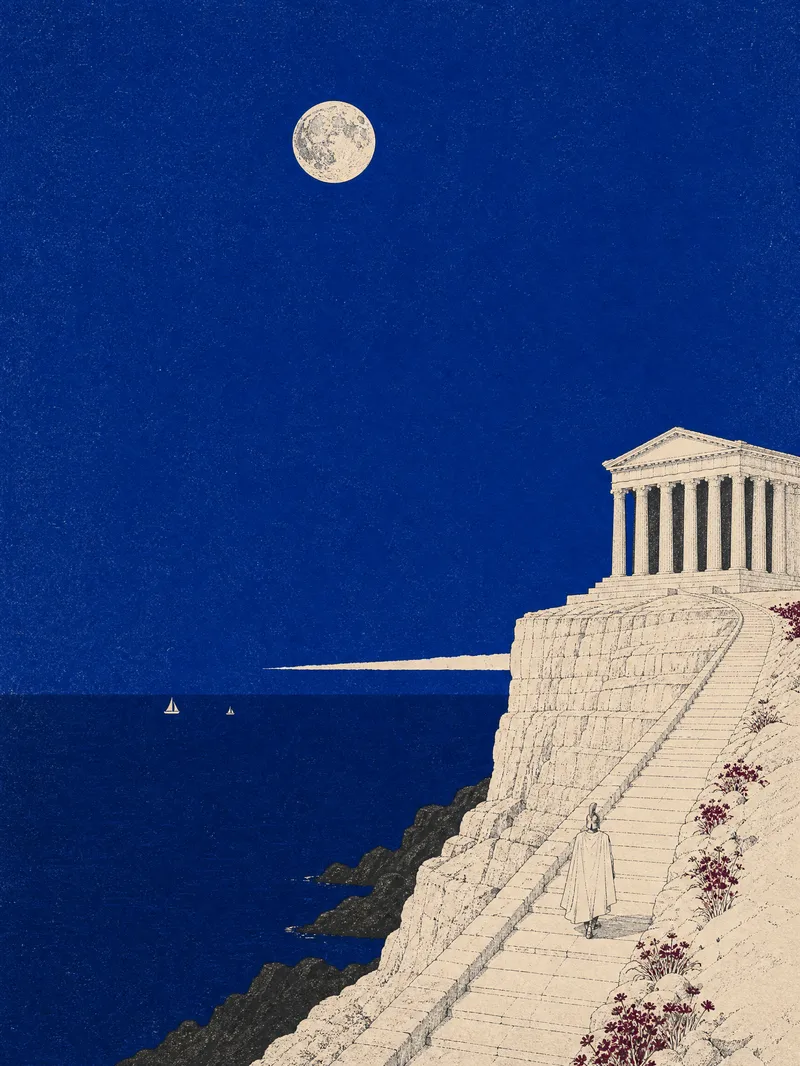 Image
Deep Blue Solitude Landscapes
Turn a theme into a deep-blue landscape illustration suited to wallpapers, cover art, and atmospheric posters. Let deep blue set the visual tone, while grand landscapes—mountains, coastlines, snowy plains, and classical ruins—carry the emotion. A tiny figure who does not face the viewer provides a sense of scale, conveying calm solitude and a feeling of timelessness. The work emphasizes a simple yet distinctive visual language, including strong diagonal compositions, generous negative space, solid-color skies, a limited palette, and a grainy matte texture reminiscent of lithographs, woodcuts, or felt. Avoid photo-realism, glossy CG rendering, heavy warm colors, and busy, crowded scenes. The style is suited to sublime images such as a tranquil night sea, a moonlit mountain valley, a lakeside beneath snowy peaks, or a seaside temple. You can provide a location, mood, or scene concept directly to receive a cohesive illustration, along with the complete prompt used for the generation so you can copy, adjust, and continue creating.