
STEM PhD Topic Designer
Use literature to shape a defensible PhD topic
STEM PhD Topic Designer
Use literature to shape a defensible PhD topic
Showcase
Description
Designed for PhD students in food science, chemistry, materials science, biology, environmental science, agriculture, and engineering. Through a six-step process—locking down the research object, identifying core variables, scanning titles, calibrating with abstracts, extracting gaps, and building a research-question chain—it turns a vague direction, an advisor-assigned topic, or scattered experiments into a defensible, actionable final PhD topic report. Rather than simply generating batches of topics, it identifies risks such as mixed variables, overcrowded research dimensions, expanding experimental scope, and overstated mechanistic claims. At each key stage, it waits for you to confirm, revise, or reject its suggestions, preserving the judgment that truly belongs to the researcher.
Related Skills
View all
STEM PhD Topic Diagnostician
Already have a PhD dissertation topic but unsure whether it is rigorous, innovative, and feasible? This Skill is designed to diagnose existing topics—not randomly generate topics from scratch or merely polish the wording. It breaks down the research subject, core variables, mechanisms, outcome measures, and research boundaries in your topic. Based on the Chinese and English literature, experimental foundation, samples, methods, equipment, timeline, and budget you provide, it assesses the topic’s rigor, novelty, and feasibility, while identifying risks such as “innovation” based only on changing materials, confounded variables, insufficient evidence for the proposed mechanism, an uncontrolled sample matrix, and chapters that cannot build progressively. The final output is a STEM PhD Topic Health Check Report, which clearly recommends whether to: retain the topic with minor adjustments; retain the research subject while strengthening its dimensions; retain the research problem and reconstruct the subject; or stop patching and redesign the topic. It is intended for STEM PhD students in food science, chemistry, materials science, biology, basic medical sciences, environmental science, agriculture, energy, and engineering. It is especially useful for those preparing a proposal defense, revising a topic at an advisor’s request, who have already defended their proposal but lack a clear central thread, or who have existing experiments but are unsure whether they can support an entire PhD dissertation.

Social Science Topic Master
Whether you are a novice researcher or an experienced scholar, whether you want to start from scratch to conceive a research direction or hope to optimize an existing topic, the 'Social Science Topic Master' can provide you with professional, systematic guidance. This tool is based on best practice methodologies for topic proposal writing, aiming to solve core challenges researchers face during topic selection: unclear direction, difficulty in refining research questions, ambiguous value judgment, and non-standard academic expression. Through step-by-step interactive guidance, this tool intelligently identifies your research needs and disciplinary background, providing customized theoretical perspective recommendations and policy clues. You will receive high-quality academic topic titles and undergo scientific diagnosis using the 'Five Criteria for a Good Question' to ensure the rigor and innovation of your topic. Ultimately, this tool outputs a structured complete topic proposal, including the academic title, topic element breakdown, results of the five-criteria test, key points for value argumentation, and policy and literature support. In addition, we provide two sets of detailed optimization suggestions: a 'Quick Fix' version and a 'Deep Optimization' version, helping you to improve key issues in a short time or to make systematic long-term enhancements, thereby significantly increasing the success rate of your topic proposal.
 Research
Thesis Topic & Intro v3.2
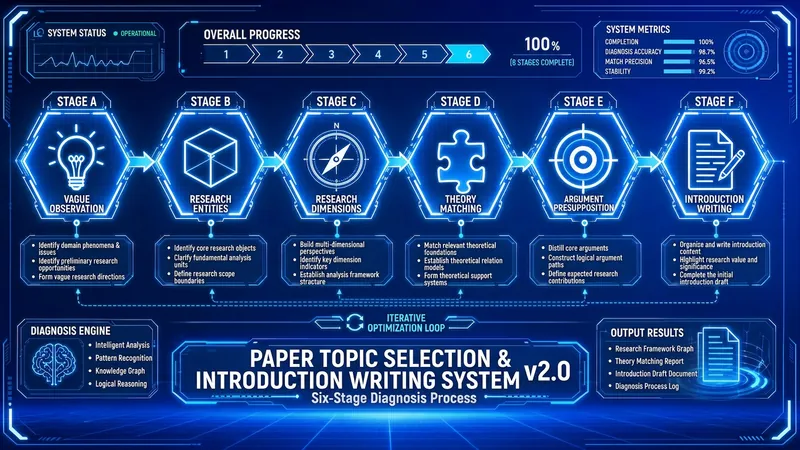
Read in 10 seconds: turn a vague observation into a defensible topic, then into an introduction that can pass review. Throughout, it uses only the real materials you provide — no fabricated references. Trigger words: thesis topic, topic selection, introduction, research gap, academic writing, thesis proposal, topic selection before literature review. Applies to: journal papers / dissertations / conference papers / course papers, across all disciplines — humanities and social sciences, STEM, agriculture, medicine, and life sciences. Up and running in 3 minutes: lock in your discipline and starting point → shape the topic layer by layer → strict evidence-chain gate → module-by-module introduction → ratchet finalization. [Division of labor with other skills] The health check comes first, writing comes after, and polishing comes last. This skill handles the middle stretch: topic shaping + introduction draft. It does not write the full paper (that's the Academic Paper Full-Process Writing System v4.x), and it does not polish language sentence by sentence (that's the Academic Paper Three-Track Polishing System v8.x). [Six gates] 1. Discipline placement: classify into one of four categories — 1A humanities/arts, 1B social sciences, 2A STEM, 2B agriculture/medicine/life sciences — and load the corresponding red-line norms; for category 2B, ethics review status is always checked. 2. Stage positioning: are you at a vague observation, have a unit but no angle, have an object but no theory, lack a method, lack a viewpoint, or only lack an introduction? Start from the corresponding gate instead of starting over from scratch. 3. Topic shaping: research unit → dimension compass → theoretical perspective → research method → research viewpoint, locked layer by layer; before locking each layer, first judge whether the previous layer holds. 4. Strict evidence-chain gate: before the introduction, your references are registered into an M1/M2… material library, each entry verified on four elements — author/year/title/locator; if fewer than 3 references are registered in the conversation, the system refuses to generate the research-gap statement — not a downgrade, a refusal. 5. Module-by-module generation: the introduction is produced in five inverted-pyramid modules, and each module must be annotated with citation numbers [Mn]; no source, no sentence. 6. Ratchet finalization: only versions that have passed receive credit; qualifying modules are locked and no longer changed; scores only go up, never down. [Deliverables] A '[Topic Keyword] · Topic & Introduction' document + a sentence-level traceable citation mapping table + a ⚠️ to-verify checklist + an AFP archive code. The archive code works across four systems — the proposal health-checker, the v4.x full-process system, and the three-track polishing system — so switching skills doesn't require re-stating your discipline, topic, journal, or material library. [Explicitly not done] It does not fabricate authors, years, volumes, issues, page numbers, or DOIs; any bibliographic records retrieved online are marked ⚠️ to-verify and can only be written into the reference list after you verify them; it makes no promises of acceptance or passing review. Authorship and responsibility are yours — please verify every citation and data point.
Information
- Version
- v2
- Last updated
- Runtime credits
- Usage-based
- Models
- Auto
