内容拆解 · 从对标到蓝图
Description
有仿写对象时使用。输入一篇你想学习的优质内容 + 你的内容人格档案,AI 帮你拆解它的选题角度、内容结构、钩子设计和表达风格,再结合你的定位做迁移适配,最终输出一份可以直接动笔的"内容蓝图"。
Related Skills
View all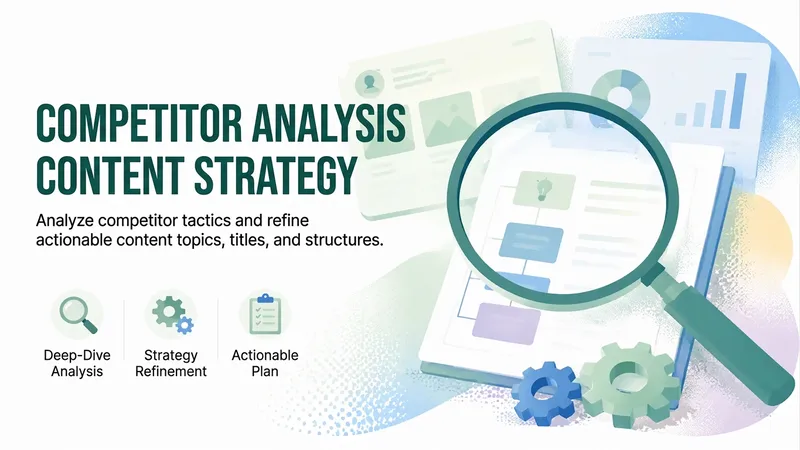 Research
Competitor Content Strategy
Turn content from competitor or benchmark accounts into an evidence-based, appropriately scoped content strategy report that you can put into action. Whether you provide local materials, article links, pasted text, or only an account name, the analysis can first build a source inventory, check sample coverage, time span, column and format distribution, and flag failed retrievals, missing information, or insufficient samples to avoid drawing overly certain conclusions from limited evidence. From there, it breaks down the benchmark account's topic angles, headline construction, opening promise, body pacing, and closing actions. It extracts reusable topic patterns, headline formulas, and structural frameworks while distinguishing consistently recurring tactics from isolated examples. The analysis goes beyond general judgments such as “worth learning from.” It considers your account positioning, platform format, stage, production capacity, category, and compliance boundaries to determine what can be adopted directly, what needs to be adapted, and what risks may come from copying it. It also provides practical adaptation directions and an action checklist for this week. If you provide content from your own account, the analysis can further compare it with your existing style, capability gaps, and audience expectations, then arrange a more suitable order for transferring applicable approaches. In the end, you can receive a conversation overview and a complete content strategy report. When needed, it can also generate a single-file HTML report that is easy to save, print, and share. Suitable for content creators, social media operators, and brand teams conducting competitor content analysis, planning topics, and building an account system.
 Research
Viral Video Breakdown
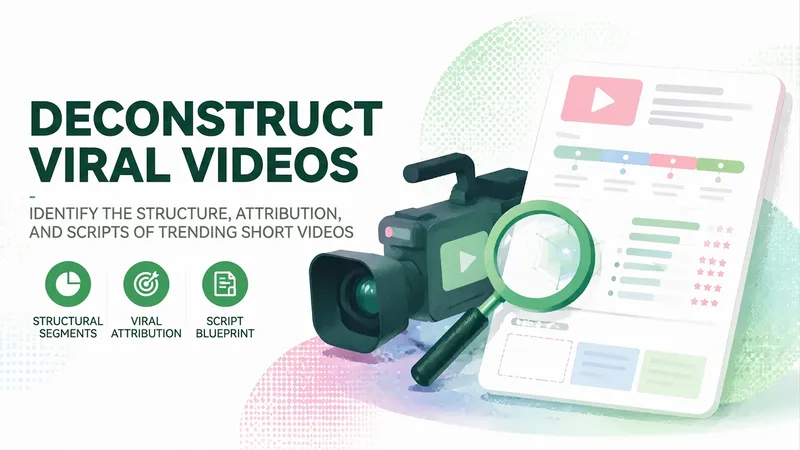
Turn a popular short video into clear, learnable, and practical content methods. Whether you provide a link from Douyin, WeChat Channels, YouTube, Xiaohongshu, or another platform, a local video, screenshots, or existing dialogue and descriptions, the analysis reconstructs the material needed to examine the video itself. It also marks information that is complete or missing, so guesses are not mistaken for facts. The report includes a video profile, a time-coded transcript, structural sections, and audiovisual techniques. It further explains why the video holds viewers' attention and where it loses momentum in the middle or focus at the end. Content attribution distinguishes replicable topic and presentation methods from external factors such as account history, posting time, and platform environment. Six-dimensional scoring uses timecodes, public data, or comment evidence to evaluate hook strength, structural strength, information value, emotional tension, communication, and reach—while clearly identifying weaknesses. You will receive a Markdown breakdown report for content planning and short-video creation. It includes transferable strategies, risks that make direct imitation unsuitable, and a fill-in-the-blank script framework that can be used with replacement topics, helping you move from understanding a viral video to deciding how to shoot your next one.
Short-Form Content Extractor
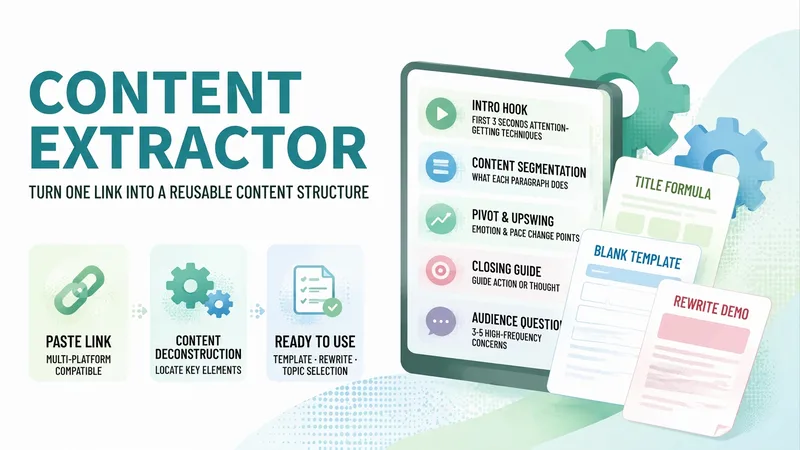
You come across a particularly well-made piece of content and want to learn its structure, but don’t know where to start. **Content Extraction Sheet** breaks down a link from Douyin, Xiaohongshu, WeChat Official Accounts, Bilibili, Weibo, or Zhihu into a practical structure you can use right away: what technique the first three-second hook uses, how many sections the content has and what each one does, where the transitions and emotional build-ups appear, and what the ending calls viewers to do. It then gives you three highly practical resources: an abstracted headline formula, with three examples adapted to your field; a blank structure template with fill-in fields; and a rewritten example based on a topic you choose. It also finds 3–5 questions viewers genuinely care about in public comments, which can become topics for your next piece of content. The honest boundary comes first: when the link content is accessible, it will clearly say “based on the original.” When it isn’t, it will say so plainly and give you a three-step method for obtaining the material—never inventing content from a link alone. Strict rules: no downloading videos, removing watermarks, bypassing login or paywalls, reposting original content, rewriting to disguise plagiarism, or extracting other people’s personal information.
内容拆解 · 从对标到蓝图
Description
有仿写对象时使用。输入一篇你想学习的优质内容 + 你的内容人格档案,AI 帮你拆解它的选题角度、内容结构、钩子设计和表达风格,再结合你的定位做迁移适配,最终输出一份可以直接动笔的"内容蓝图"。
Related Skills
View allResearchCompetitor Content Strategy
Turn content from competitor or benchmark accounts into an evidence-based, appropriately scoped content strategy report that you can put into action. Whether you provide local materials, article links, pasted text, or only an account name, the analysis can first build a source inventory, check sample coverage, time span, column and format distribution, and flag failed retrievals, missing information, or insufficient samples to avoid drawing overly certain conclusions from limited evidence. From there, it breaks down the benchmark account's topic angles, headline construction, opening promise, body pacing, and closing actions. It extracts reusable topic patterns, headline formulas, and structural frameworks while distinguishing consistently recurring tactics from isolated examples. The analysis goes beyond general judgments such as “worth learning from.” It considers your account positioning, platform format, stage, production capacity, category, and compliance boundaries to determine what can be adopted directly, what needs to be adapted, and what risks may come from copying it. It also provides practical adaptation directions and an action checklist for this week. If you provide content from your own account, the analysis can further compare it with your existing style, capability gaps, and audience expectations, then arrange a more suitable order for transferring applicable approaches. In the end, you can receive a conversation overview and a complete content strategy report. When needed, it can also generate a single-file HTML report that is easy to save, print, and share. Suitable for content creators, social media operators, and brand teams conducting competitor content analysis, planning topics, and building an account system.
ResearchViral Video Breakdown
Turn a popular short video into clear, learnable, and practical content methods. Whether you provide a link from Douyin, WeChat Channels, YouTube, Xiaohongshu, or another platform, a local video, screenshots, or existing dialogue and descriptions, the analysis reconstructs the material needed to examine the video itself. It also marks information that is complete or missing, so guesses are not mistaken for facts. The report includes a video profile, a time-coded transcript, structural sections, and audiovisual techniques. It further explains why the video holds viewers' attention and where it loses momentum in the middle or focus at the end. Content attribution distinguishes replicable topic and presentation methods from external factors such as account history, posting time, and platform environment. Six-dimensional scoring uses timecodes, public data, or comment evidence to evaluate hook strength, structural strength, information value, emotional tension, communication, and reach—while clearly identifying weaknesses. You will receive a Markdown breakdown report for content planning and short-video creation. It includes transferable strategies, risks that make direct imitation unsuitable, and a fill-in-the-blank script framework that can be used with replacement topics, helping you move from understanding a viral video to deciding how to shoot your next one.
Short-Form Content Extractor
You come across a particularly well-made piece of content and want to learn its structure, but don’t know where to start. **Content Extraction Sheet** breaks down a link from Douyin, Xiaohongshu, WeChat Official Accounts, Bilibili, Weibo, or Zhihu into a practical structure you can use right away: what technique the first three-second hook uses, how many sections the content has and what each one does, where the transitions and emotional build-ups appear, and what the ending calls viewers to do. It then gives you three highly practical resources: an abstracted headline formula, with three examples adapted to your field; a blank structure template with fill-in fields; and a rewritten example based on a topic you choose. It also finds 3–5 questions viewers genuinely care about in public comments, which can become topics for your next piece of content. The honest boundary comes first: when the link content is accessible, it will clearly say “based on the original.” When it isn’t, it will say so plainly and give you a three-step method for obtaining the material—never inventing content from a link alone. Strict rules: no downloading videos, removing watermarks, bypassing login or paywalls, reposting original content, rewriting to disguise plagiarism, or extracting other people’s personal information.
Find your next favorite skill
Explore more curated AI skills for research, creation, and everyday work.