
Education Proposal Four-Pillar Framework
Build a defensible thesis proposal framework
Education Proposal Four-Pillar Framework
Build a defensible thesis proposal framework
Showcase
Description
An emergency proposal assistance skill for education graduate students and young researchers, using the vertical Four-Pillar Proposal Method. Triggers when users ask how to write an education thesis proposal, how to design education research, what to do if a proposal is rejected, how to structure a literature review, how to formulate research questions, or how to handle advisor misalignment. Uses the Four-Pillar Method (Problem Pillar / Literature Pillar / Methodology Pillar / Innovation Pillar) to generate a proposal skeleton, a literature search strategy table, and a rejection risk checklist. Version 1.0.0. * **One-Sentence Positioning** Your personal proposal skeleton generator: turns loose directions, piled-up literature, mismatched methods, and empty innovation points into four solid pillars—problem, literature, methodology, and innovation—plus advisor alignment checks, making your proposal robust rather than a word count exercise. **How to Use - The Four-Pillar Method** 1. Problem Pillar: Three cuts to narrow the direction (lock the target / set the perspective / draw boundaries), with main and sub-questions ready to use. 2. Literature Pillar: Avoid piling up; build a map by context, school of thought, debate, or gap to pinpoint your research gap. 3. Methodology Pillar: Match quantitative, qualitative, or mixed methods by disciplinary paradigm, including red flags like IRB prerequisites. 4. Innovation Pillar: Choose one from theory, perspective, method, or target, grounding it in how it differs from existing work. 5. Closing: Advisor alignment check to connect your lens back to your advisor's framework, preventing rejections due to drifting off course. **What You Receive** A proposal skeleton (four pillars filled out cell by cell), a literature search strategy table (databases + keywords + tracing), and a rejection risk checklist (top 8 reasons + avoidance tips), ready to be expanded into a full proposal. **Compliance Disclaimer** This skill does not ghostwrite complete proposals or papers; it only generates frameworks and checklists. It does not fabricate literature or data, clearly labels AI generation, requires original literature verification, does not guarantee approval, prioritizes offline confirmation for ethics reviews and advisor conflicts, and defers to institutional formats and advisor opinions.
Related Skills
View all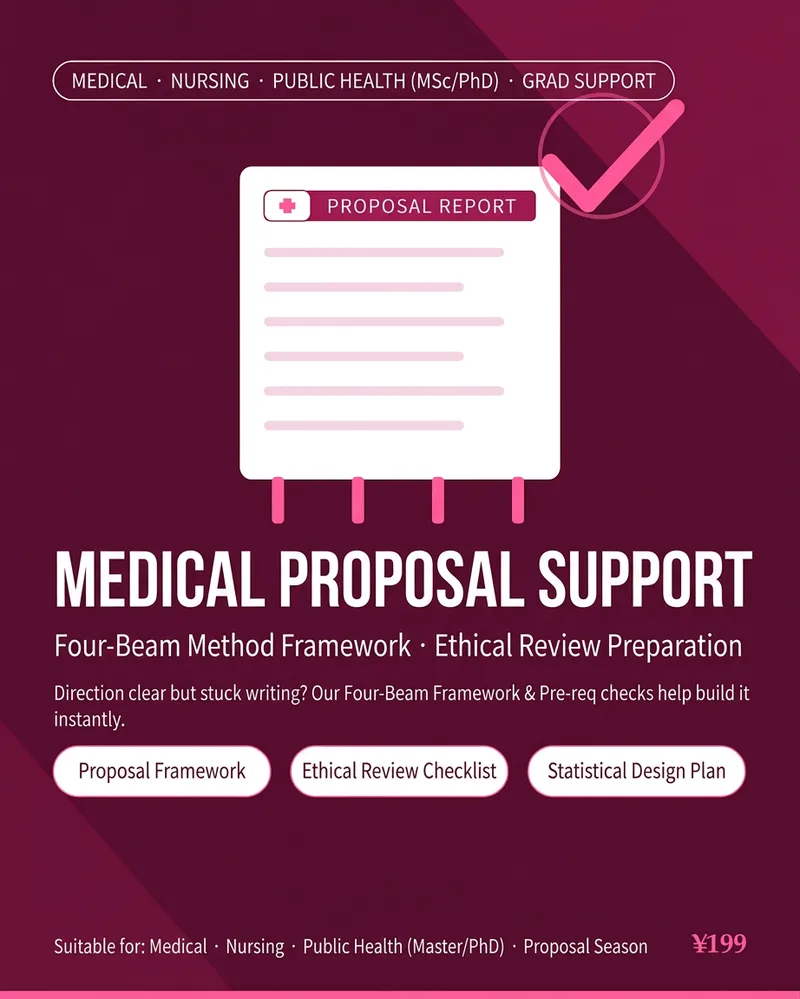 Write
Medical Proposal Rescue
Designed for master's, doctoral, and resident physicians in medicine, nursing, and public health facing urgent proposal deadlines. Triggered when users ask how to write a medical proposal, recover from a rejected clinical topic, structure a literature review, calculate sample sizes, pass ethics reviews, handle clinical registration, or resolve mentor alignment issues. It uses the Four-Pillars Method (Problem, Literature, Methodology, Innovation) along with medical-specific additions (IRB ethics, clinical registration, accessibility, and statistical design) to generate a proposal skeleton, ethics and registration checklist, and statistical design table. Version 1.0.0. - **Pain Points**: Struggling to write a proposal despite having a direction, or facing rejection over ethics, registration, or sample size. - **Method**: The Four-Pillars Method combined with dual prerequisites (IRB ethics and ChiCTR clinical registration) to build a solid proposal skeleton. - **Deliverables**: A three-part package including a proposal skeleton, an ethics and registration checklist, and a statistical design key points table.
 Write
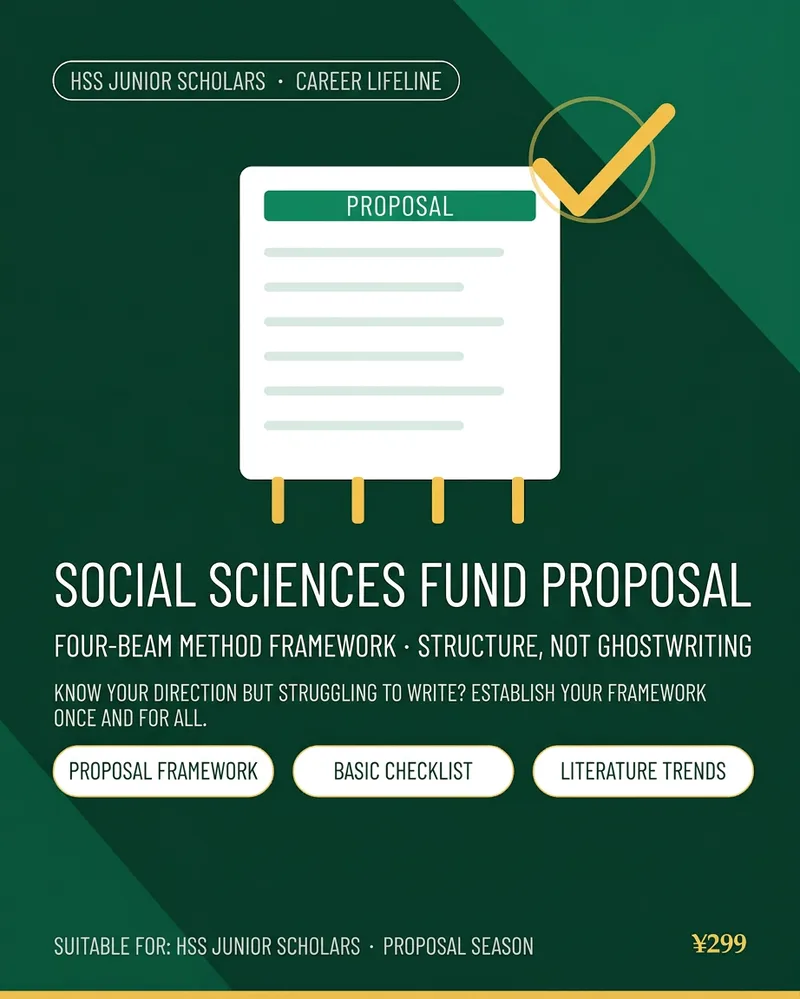
Social Science Grant Application Framework
Designed for young faculty in humanities and social sciences, this Skill uses the Four Pillars method to help build grant application frameworks and material checklists. It triggers when you need help with application strategies, literature reviews, research gaps, weak foundation handling, innovation points, blind review preparation, or restriction checks. By organizing your application into four solid pillars—foundation, content, background, and feasibility—plus restriction and anonymization checks, it turns a scattered draft into a robust proposal. Version 1.0.0. Your personal grant application framework generator: transforms weak literature reviews, unorganized content, thin preliminary records, vague innovation claims, and compliance risks into four sturdy pillars, ensuring your application stands strong. How to Use the Four Pillars Method: 1. Foundation Pillar: Ground your opening in top-level policies and build a four-part literature review to locate your research gap; 2. Content Pillar: Establish a clear objective-framework-difficulty logic chain where each section addresses your gap; 3. Background Pillar: Expand limited preliminary achievements honestly across four methods without falsification; 4. Feasibility Pillar: Select from four innovation angles and apply quantitative expected outcome templates; 5. Review Check: Self-check for grant restrictions and anonymization compliance. What You Receive: An application skeleton filled across the four pillars, a preliminary research checklist for limited backgrounds, and a literature dynamics table with gap identification and reference outlines, forming a three-piece toolkit for your proposal. Compliance Notice: This Skill does not write full proposals but generates frameworks and checklists. Falsification of preliminary results, unauthorized names, or fabricated data is strictly prohibited. AI usage should be noted, and all literature and preliminary results must be verified individually. Approval is not guaranteed. Prioritize compliance with your research office and mentor guidelines, and follow your institution's template.
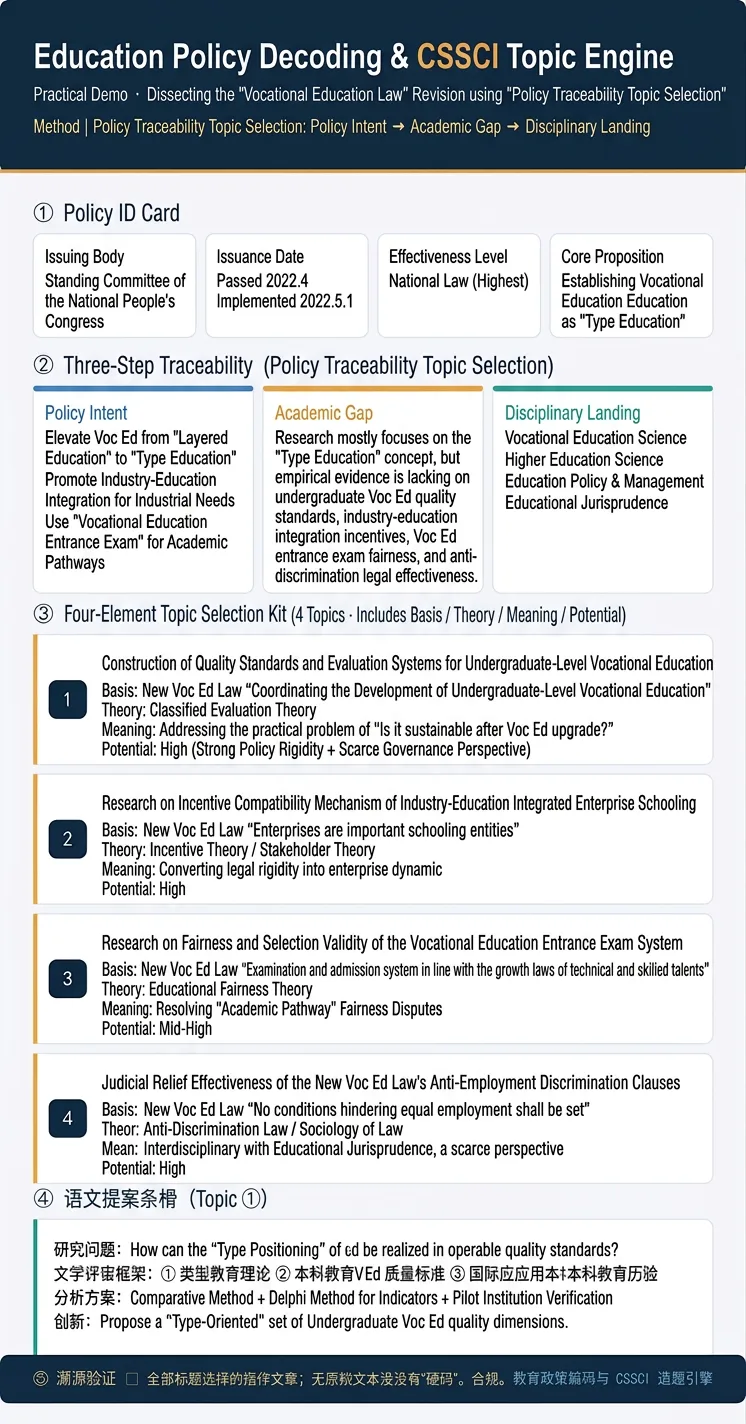
CSSCI Research Topics & Proposals
A policy decoding and CSSCI research topic generation skill designed for education master's and PhD students and university faculty. Triggered when users say things like 'help me turn education policies into research topics', 'how to write CSSCI papers from education policies', 'interpret the Double Reduction policy for journal publication', 'give me research topics based on the Education Powerful Country guidelines', or 'education policies + proposal framework'. It uses the Policy-Traceable Topic Method (policy intent -> academic gap -> disciplinary focus) to produce traceable interpretations, 3 to 5 high-potential topics, and proposal skeletons. Version 1.0.0. > This skill is not just a file collection; it acts as an academic topic advisor right inside your chat box. > > It goes through five steps: **Policy Anchoring** (a one-line "policy ID") -> **Three-Step Traceable Breakdown** (policy intent / academic gap / disciplinary focus) -> **Topic Generation** (3 to 5 topics, each with policy basis + theoretical foundation + theoretical/practical significance + publication potential rating) -> **Proposal Skeleton** (the highest-potential topic directly provides research questions / review framework / analytical approach / innovations) -> **Traceability Verification** (each topic is marked with the original policy source, and anything not mentioned in the original text is marked as "to be verified", ensuring no fabrication). > > What you get: a traceable policy interpretation, 3 to 5 CSSCI/PKU-core-rated topics, and 1 ready-to-fill research proposal skeleton. Built-in real breakdown examples for Double Reduction, the New Curriculum Standards, and the Education Powerful Country guidelines; suitable for higher education, basic education, vocational education, educational technology, and other fields.
Information
- Version
- v3
- Last updated
- Runtime credits
- Usage-based
- Models
- Auto
- Use cases
- Writing & contentResearch & analysisLearning & education
- What you get
- ReportDocumentPlan
