CSSCI Research Topics & Proposals
Decode education policies into research topics
CSSCI Research Topics & Proposals
Decode education policies into research topics
Showcase
Description
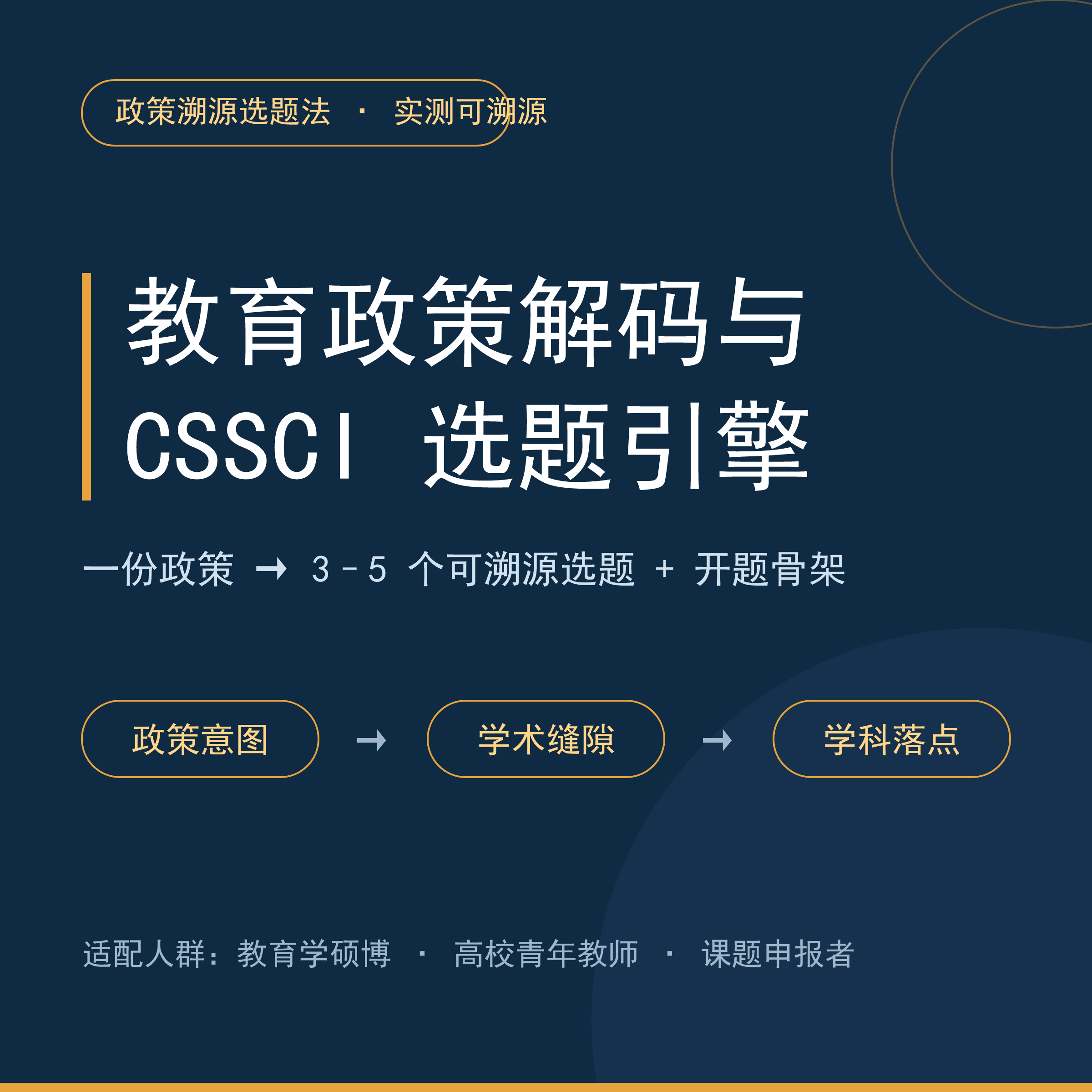
A policy decoding and CSSCI research topic generation skill designed for education master's and PhD students and university faculty. Triggered when users say things like 'help me turn education policies into research topics', 'how to write CSSCI papers from education policies', 'interpret the Double Reduction policy for journal publication', 'give me research topics based on the Education Powerful Country guidelines', or 'education policies + proposal framework'. It uses the Policy-Traceable Topic Method (policy intent -> academic gap -> disciplinary focus) to produce traceable interpretations, 3 to 5 high-potential topics, and proposal skeletons. Version 1.0.0. > This skill is not just a file collection; it acts as an academic topic advisor right inside your chat box. > > It goes through five steps: **Policy Anchoring** (a one-line "policy ID") -> **Three-Step Traceable Breakdown** (policy intent / academic gap / disciplinary focus) -> **Topic Generation** (3 to 5 topics, each with policy basis + theoretical foundation + theoretical/practical significance + publication potential rating) -> **Proposal Skeleton** (the highest-potential topic directly provides research questions / review framework / analytical approach / innovations) -> **Traceability Verification** (each topic is marked with the original policy source, and anything not mentioned in the original text is marked as "to be verified", ensuring no fabrication). > > What you get: a traceable policy interpretation, 3 to 5 CSSCI/PKU-core-rated topics, and 1 ready-to-fill research proposal skeleton. Built-in real breakdown examples for Double Reduction, the New Curriculum Standards, and the Education Powerful Country guidelines; suitable for higher education, basic education, vocational education, educational technology, and other fields.
Best for
Ideal for education master's and PhD students, university faculty, and researchers looking to turn education policies into research topics.
How to use this Skill
Provide your input
Provide the education policy name or original text, along with your research direction and target journal level if desired.
Run the Skill
The system locates the policy background, breaks down its intent, academic gaps, and disciplinary landing points, and generates traceable topics.
Review your result
Receive a policy interpretation, research topics with rationale and potential ratings, and a proposal skeleton including research questions, literature review framework, analytical approach, and innovations.
Related Skills
View all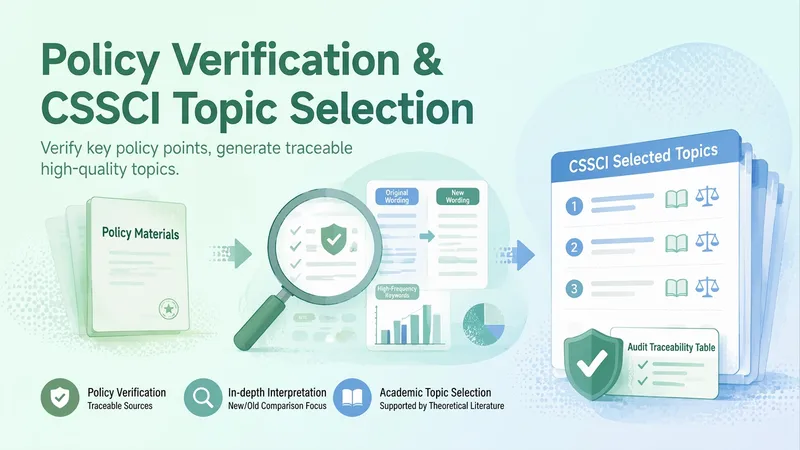
Policy Tracing & CSSCI Topics
Turn national policy materials into verifiable, traceable CSSCI research topics. Suitable inputs include full policy texts, older and newer versions of documents, policy keywords, policy lists, or document numbers. Whether the materials are complete or not, build a source record covering the policy origin, issuing body, document number, date, level, and validity status. Check each item against authoritative source texts, noting the citation location, source link, and verification status—“consistent,” “uncertain,” or “needs verification”—to avoid mistaking summaries for original policy language. Building on this verification, identify additions, strengthened measures, and phased-out content in newer and older policies. Extract high-frequency terms, policy context, and timing windows, then connect policy trends to real-world problems supported by evidence. Next, develop research questions at the levels of phenomena, mechanisms, and theory; match them with perspectives such as institutional theory, principal–agent theory, and policy diffusion; and identify research gaps through recent, traceable literature. The result is a pool of candidate topics with theoretical support, literature evidence, and proposed data and methods. Finally, select 3–5 CSSCI topics and assess each one’s policy timeliness, theoretical and practical value, and publication feasibility. Provide the policy basis, real-world problem, theoretical perspective, literature gap, data sources, and methodological approach. Confirmed results can be compiled into a structured research report that preserves complete source details, verification status, and audit-trail information—suitable for topic development in policy research, public administration, economics and management, and related social sciences.
Education Proposal Four-Pillar Framework
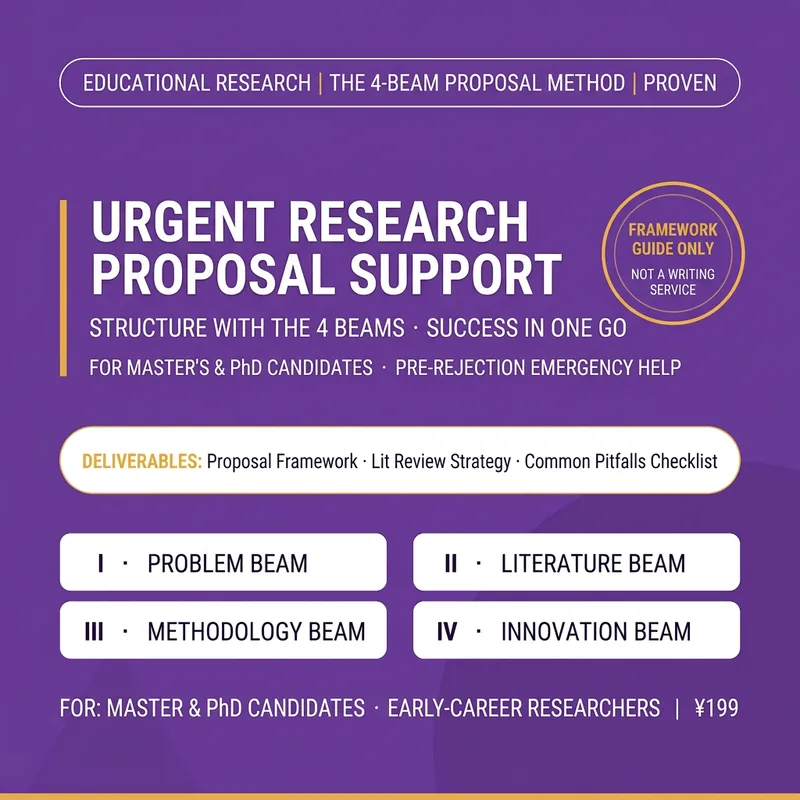
An emergency proposal assistance skill for education graduate students and young researchers, using the vertical Four-Pillar Proposal Method. Triggers when users ask how to write an education thesis proposal, how to design education research, what to do if a proposal is rejected, how to structure a literature review, how to formulate research questions, or how to handle advisor misalignment. Uses the Four-Pillar Method (Problem Pillar / Literature Pillar / Methodology Pillar / Innovation Pillar) to generate a proposal skeleton, a literature search strategy table, and a rejection risk checklist. Version 1.0.0. * **One-Sentence Positioning** Your personal proposal skeleton generator: turns loose directions, piled-up literature, mismatched methods, and empty innovation points into four solid pillars—problem, literature, methodology, and innovation—plus advisor alignment checks, making your proposal robust rather than a word count exercise. **How to Use - The Four-Pillar Method** 1. Problem Pillar: Three cuts to narrow the direction (lock the target / set the perspective / draw boundaries), with main and sub-questions ready to use. 2. Literature Pillar: Avoid piling up; build a map by context, school of thought, debate, or gap to pinpoint your research gap. 3. Methodology Pillar: Match quantitative, qualitative, or mixed methods by disciplinary paradigm, including red flags like IRB prerequisites. 4. Innovation Pillar: Choose one from theory, perspective, method, or target, grounding it in how it differs from existing work. 5. Closing: Advisor alignment check to connect your lens back to your advisor's framework, preventing rejections due to drifting off course. **What You Receive** A proposal skeleton (four pillars filled out cell by cell), a literature search strategy table (databases + keywords + tracing), and a rejection risk checklist (top 8 reasons + avoidance tips), ready to be expanded into a full proposal. **Compliance Disclaimer** This skill does not ghostwrite complete proposals or papers; it only generates frameworks and checklists. It does not fabricate literature or data, clearly labels AI generation, requires original literature verification, does not guarantee approval, prioritizes offline confirmation for ethics reviews and advisor conflicts, and defers to institutional formats and advisor opinions.
 Research
AFP Policy & CSSCI Topics
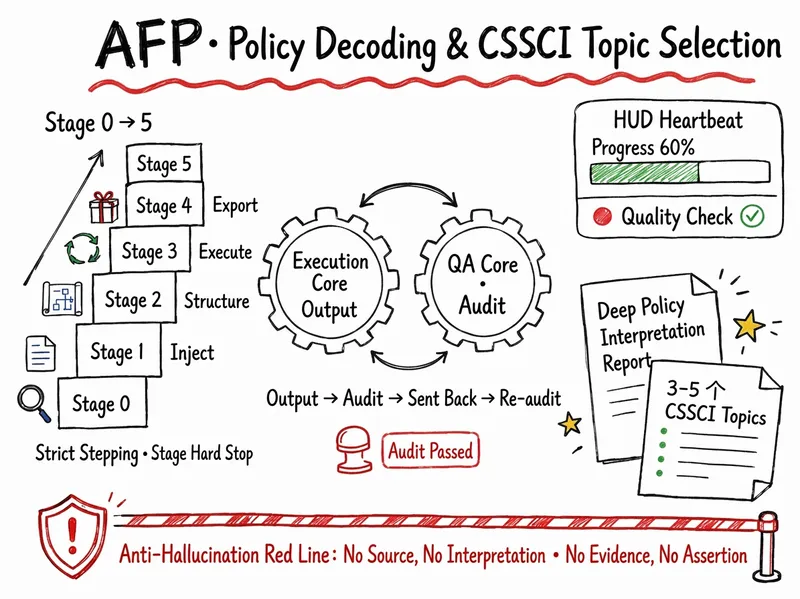
AFP prompt system for in-depth policy analysis—three-level source attribution, interpretation of hot topics, and academic mapping—and CSSCI topic generation (3–5 topics, each with policy basis, theoretical foundation, theoretical and practical significance, and publication potential assessment). Supports two entry points: A1 panoramic analysis and A2 targeted analysis, plus B reverse matching from ideas. Runs with Auto-Flow: strict step-by-step progression, silent background self-checks, a heartbeat HUD, and hard stops at each stage.
Information
- Version
- v3
- Last updated
- Runtime credits
- Usage-based
- Models
- Auto
- Use cases
- Writing & contentResearch & analysis
- What you get
- ReportDocumentPlan
