Dual-Anchor Brainstorming
Dual-Anchor Brainstorming
Showcase
Description
Strictly grounded in Dario Amodei’s core decision-making philosophy, this Skill can reproduce the full workflow of expert-level trend forecasting, opportunity breakdowns, dialectical analysis, and decision judgment on a 1:1 basis. Its dual closed loop—“experience anchors + first principles”—precisely breaks down opportunities, analyzes risks dialectically, and delivers actionable decision plans.
Recommended by
nene@YouMind
Why we love this skill
Anchors reality in a few verifiable facts, then uses first-principles reasoning to derive contrarian conclusions and challenge both “impossible” thinking and blind optimism.
Related Skills
View all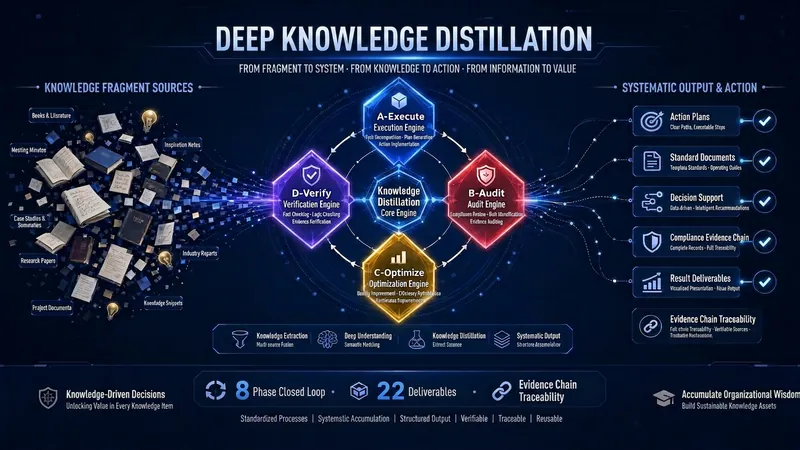
Flagship Knowledge Distiller
Distill scattered book notes and inspirational fragments into actionable plans. Uses a four-core collaborative architecture (A Execution/B Audit/C Optimization/D Verification) plus a dual-core verification mechanism (authenticity and accuracy) to ensure every theory, data point, and method has a complete evidence chain with traceability. The 8-stage closed-loop workflow, from intelligent diagnosis to methodology consolidation, is fully visualized and trackable, ultimately delivering N visual products (including evidence chain traceability documentation). Suitable for knowledge workers, deep growth seekers, and those facing decision dilemmas.
 Research
Bohai Xiaoli Thinking Analyzer
Deeply analyze problems using Bohai Xiaoli's 5 major mental models and 10 decision heuristics. Reject surface narratives, dig into underlying logic; calculate using cost-benefit frameworks; identify information gaps; verify authenticity; acknowledge structural constraints. Output includes three-level logical deconstruction, cost-benefit analysis, actionable recommendations, and is expressed in Bohai Xiaoli's colloquial, critical style. Applicable to business decisions, workplace dilemmas, strategic choices, historical analysis, and more.
First Principles Forecaster
A predictive analysis system based on first principles. Users enter any question they want to predict, and the AI will act as a strict first principles analyst, performing a bottom-up decomposition through a four-component causal reasoning framework (fact anchor → causal mechanism → inhibiting factors → falsifiable conditions), outputting a structurally rigorous, testable, and calibratable prediction report. Maintains a critical perspective throughout, no platitudes, no ambiguity, no empty words, only outputting hard reasoning that can be used for decision-making.
Information
- Version
- v2
- Last updated
- Runtime credits
- Usage-based
