
Headline Diagnosis
Pinpoints the exact words causing issues, not just vague advice
Headline Diagnosis
Pinpoints the exact words causing issues, not just vague advice
Showcase
Description
Explains clearly why your headline gets no clicks instead of just rewriting ten new ones. Using five failure causes (no target audience, no benefit, no conflict, too long, too vague), it pinpoints the exact problematic words and offers three revision methods: change one word, change the structure, or change the perspective.
Recommended by
Dancang
Why we love this skill
Instead of offering vague advice to "optimize further," it first determines if a title is worth revising, identifies specific issues like lack of audience or benefit, highlights the problematic words, and provides three distinct revision paths.
Best for
Content creators and editors looking to improve headline clarity, appeal, and click-through rates.
How to use this Skill
Provide your input
Provide a headline that needs to be checked.
Run the Skill
The system diagnoses the headline based on target audience, value, conflict, length, and specificity, and identifies the exact problematic words.
Review your result
Receive a headline diagnosis, three different revision approaches, and an explanation of the issues resolved by each change.
Related Skills
View all Write
Profile Makeover Plan
Your content may be solid, but strangers leave within three seconds of opening your profile. The problem is almost always the storefront: your name doesn’t show what you do, your bio says “Documenting life and sharing reflections,” your cover image has nothing to do with your content, and even you’ve forgotten which three posts are pinned. **Profile Makeover Plan** treats your profile as one cohesive whole and provides specific, replaceable copy for each of the five essentials: name (three versions—real-name, niche-based, and memorable), profile picture (three paths—person, object, or wordmark—with the tradeoffs of each), bio (the “who I am + who it’s for + what I offer + why trust me” formula, with the first three covered in the first 20 characters), cover image (a visual description that marks the area hidden by the profile picture), and three pinned posts (one signature piece, one methodology post, and one latest post). It also includes a five-second test: show the profile to someone who has never seen the account for five seconds and ask three questions. Hard rules: no image generation, only visual descriptions; no text should appear in the visuals (Chinese text may render incorrectly, and you can overlay the wording yourself); no imitation of any specific account; no help disguising anyone’s identity; no guidance on buying followers, reciprocal follows, or inflating metrics; and no promises of follower growth.
 Write
Academic Research Question
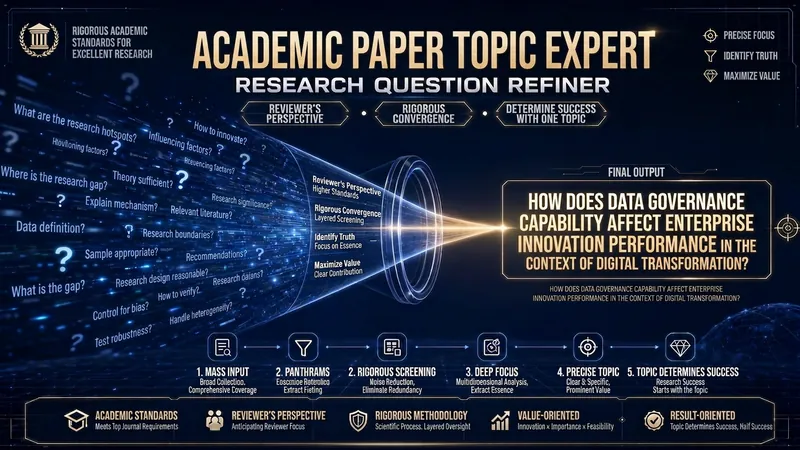
• Diagnose candidate topics: Identify overly broad topics, unclear subjects, uncontrolled boundaries, and false novelty before determining whether the topic is ready to be finalized. • Narrow the research scope: Remove nonessential subjects, variables, and objectives to reduce “trying to study everything” to one central question. • Derive the core question: Identify a single research direction based on subject clarity, question sharpness, scope control, and fit with available materials. • Generate a standardized title: Produce one Chinese title aligned with the research question, with an English title and a specific contribution statement when needed. After opening, say: “I have 3 candidate topics and want to submit to a CSSCI journal. Help me finalize the topic.” It will first check the research subject, core question, scope, and practical constraints, then provide a well-supported final research question. If information is insufficient, it will ask follow-up questions instead of forcing a polished title. Suitable for: Researchers with candidate topics who are struggling to choose one / scholars who need to focus quickly before submission / anyone who does not want to be rejected by a reviewer’s one-line criticism that the research question is unclear. ✅ This version has undergone two months of refinement, testing, and iteration.
Information
- Version
- v2
- Last updated
- Runtime credits
- Usage-based
- Models
- Auto
- Use cases
- Writing & contentMarketing & growth
- What you get
- Report
