
End-First Humanities Proposals
Work backward from reviewers to design
End-First Humanities Proposals
Work backward from reviewers to design
Showcase
Description
The biggest risk in a proposal isn’t writing slowly—it’s heading in the wrong direction. Most methods have you “write from start to finish, following the research process.” This Skill takes the opposite approach—backward first, then forward: it pushes you to clarify “what exactly is the innovation,” then work backward from the reviewers’ perspective to determine “what needs to be shown and why they should believe you.” Only after that does it have you write in a logical reading order. It sets three hard gates: you can’t lock in a topic until you’ve searched the literature thoroughly, you can’t start writing until the innovation is clear, and the final draft can’t be completed without your confirmation. It also uses XYZ multi-axis searches to verify that a “research gap” truly exists—never treating “I didn’t find it” as “no one has studied it.” Other AI helps you write faster. This Skill has you start later, so you get it right the first time.
Recommended by
淡苍
Why we love this skill
Works backward from reviewer judgment to shape the topic, innovation, research design, and proposal. Literature, innovation, and human-confirmation gates curb vague ideas and rework while evidence and cross-checks protect credibility.
Related Skills
View all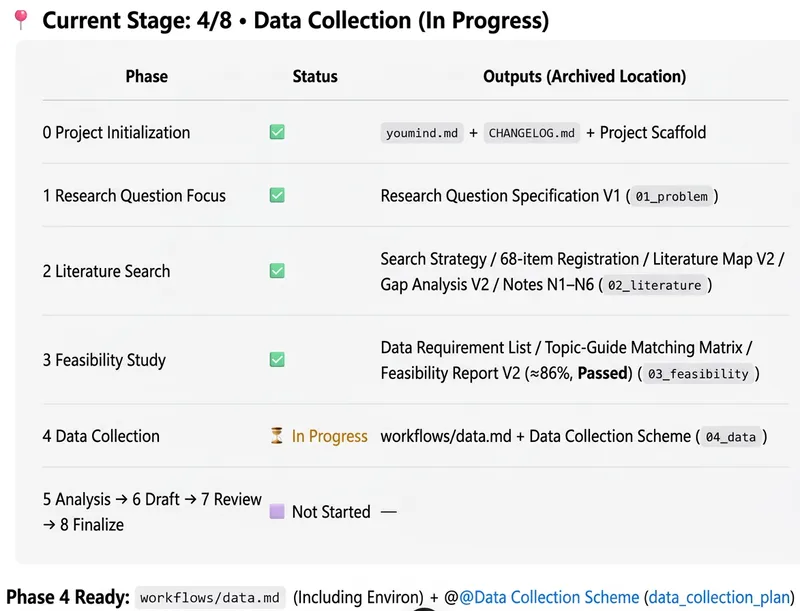
Research Proposal Assistant
Designed for university faculty and researchers, this assistant turns an initial research idea into an executable, fundable project plan. It covers national- and provincial-level humanities and social sciences projects, teaching reform projects, and other research project types. Provide the project type and application guidelines or template, research direction, existing成果, and personal and institutional information. The assistant helps clarify the topic, focus the research question, and build a complete foundation for the proposal around the research problem, application requirements, and review logic. As the project develops, the assistant can support academic searches, literature reviews, research gap analysis, feasibility assessments for data and methods, comparable project matching, and research design adjustments. It helps ensure that literature, data, and funding information are authentic and verifiable, while incorporating AI, contemporary relevance, and methodological innovation into the topic and innovation points. Once the research plan is mature, it can draft an initial proposal based on the application guidelines or blank template you provide, simulate different reviewer perspectives, and suggest revisions through to the final draft. The project retains stage outputs, version records, and the basis for changes. It can ultimately organize a proposal, technical roadmap, research framework diagram, innovation logic diagram, progress Gantt chart, and other research visuals. For tasks requiring an external environment, such as full-text PDF analysis, code execution, web scraping, or large-scale data processing, the assistant clearly identifies handoff tasks and supports filling in results and continuing the work, helping move the project from preparation through a properly formatted final proposal.
HE Document Write&Review v3.0
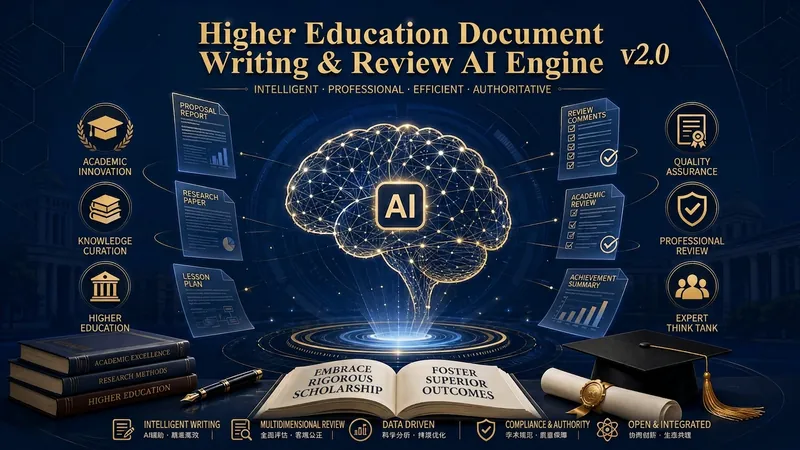
🎯 Got your application rejected? Can't find the highlight for your proposal? Don't know where to start with review comments? Three real scenarios: 🔸 Scenario 1: Application season anxiety—Reviewer feedback: "Insufficient theoretical support, vague policy basis." Unsure which documents to cite or which theoretical framework to use. 🔸 Scenario 2: Proposal writing dilemma—In charge of course construction plan: objectives, tasks, pathways, evaluation… each part needs writing, but you feel the logic is not rigorous enough and worry about being questioned on "feasibility" during review. 🔸 Scenario 3: Review dilemma—Need to write peer review comments: must point out issues while maintaining professionalism, be well-founded but not too harsh. How to strike the balance? 💡 What can this system do for you? Not just give advice—it writes, revises, and reviews for you directly. 📝 Writing Mode: From topic to final document Enter your topic and existing materials. The system automatically identifies the document type (application/proposal/report/review). Automatically matches authoritative policy documents and theoretical support. Generates content chapter by chapter, each with evidence, logic, and facts. Key promise: Never fabricates data; clearly tells you what's missing. 🔍 Review Mode: Expert-level diagnosis Upload your text. Professional scoring across 7 dimensions (value, alignment, completeness, innovation, feasibility, support, expression quality). Precisely identifies problem areas. Provides specific revision suggestions + example rewrites. Not general advice, but paragraph-level specific guidance. ✏️ Revision Optimization Mode: Precision enhancement Strengthens arguments based on existing text. Optimizes expression, eliminates empty talk and clichés. Standardizes terminology and logic. Improves overall competitiveness. ⚡ Three Core Mechanisms (Unique) 🛡️ Firewall Mechanism Built-in "fact boundary": User-provided real data is never fabricated; policy basis must have sources; theoretical support cannot be misapplied. Every sentence you see can be traced back to its source. 🔄 Multi-core Adversarial Engine One core writes, another specifically checks for errors. Like having a strict auditor watching, ensuring no "unsubstantiated facts," "logic gaps," or "policy mismatches" occur. 📊 Stepwise Guidance Doesn't ask you 20 questions at once—identifies the most critical gaps and asks only the 3–5 most necessary questions. After each stage, clearly tells you "what's done," "what's missing," and "what to do next." 🎯 Scope of Application (All Higher Education Scenarios) ✅ Teaching achievement award applications (institutional/provincial/national) ✅ Quality engineering project applications (top courses/teaching teams/textbooks, etc.) ✅ Course construction plans, major construction plans ✅ Major self-assessment reports, course acceptance reports ✅ Expert review comments, peer reviews ✅ Education reform project applications, closing reports 🚀 User Experience Writing an application from scratch: Provide the topic and basic materials → System identifies document type, takes inventory, matches policies and theories → Generates outline → Writes chapter by chapter → Consolidates → Get a draft in 1 hour. Reviewing existing text: Upload document → System automatically scores → Lists main issues → Provides revision suggestions and example rewrites → Get review report in 20 minutes. Optimizing existing plan: Provide existing text and optimization direction → System diagnoses weaknesses → Strengthens arguments, optimizes expression → Get optimized version in 30 minutes. 👉 Try it now—make higher education document writing no longer a burden. This is not just a writing assistant; it's an intelligent engine that understands higher education rules, review standards, and professional expression.

Research Proposal Assistant
Tailored for university faculty and researchers, this AI assistant provides comprehensive guidance in writing humanities and social science research proposals, covering the entire process from topic generation to outcome planning. Whether you need to brainstorm a topic from scratch or optimize a specific section of your proposal, this tool offers expert-level guidance and support. This assistant combines expert experience with a strategy of 'example guidance + writing theory integration' to help you efficiently produce high-quality proposals. You receive targeted analysis of research hotspots in your discipline, topic refinement suggestions, and—based on your research direction and project type—generate a rigorous background, in-depth literature review, and insightful research value statement. In the research content design phase, the assistant helps you define the research subject, build a logically clear research framework, and recommend innovative research ideas and methods. It also helps you distill key points and difficulties, set clear research objectives, and plan a detailed research schedule and feasibility analysis, ensuring your proposal is rigorous and well-structured. Additionally, you can use this tool to deeply explore the innovative aspects of your topic in terms of academic ideas, viewpoints, and research methods, and systematically plan multiple forms of expected outcomes, their applications, and social benefits. Finally, all content is integrated with one click to generate a complete, logically rigorous proposal that meets submission standards, helping you increase your success rate.
Information
- Version
- v5
- Last updated
- Runtime credits
- Usage-based
- Models
- Auto