
Creator Outreach Pro
Shortlists, rates, outreach, and compliance checks
Creator Outreach Pro
Shortlists, rates, outreach, and compliance checks
Showcase
Description
SKILL FEATURES Reverse-engineer your creator profile: Start with goals such as promoting a mini program or driving product sales, then determine the creator category, follower range, content format (short video, image-and-text, or livestream), and price range—so you do not start by aimlessly searching for big-name creators. Candidate shortlist: Organize 10–30 candidates using public information, including platform, follower range, category, content style, estimated rate range, recommendation, and official outreach channels (Xingtu homepage, Pugongying creator marketplace, or a publicly listed MCN business email). Rate and budget model: Estimate costs using flat fees, CPM, CPE, and commission (CPS), then show “total budget → creator tier allocation (top-tier 10% / mid-tier 60% / long-tail 30%) → expected impression range,” with platform service fees noted (about 5% for Xingtu and 10% for Pugongying). Tiered outreach script package: Generate four versions—a Xingtu task Brief, a Pugongying brand invitation, an MCN business email, and a first-contact direct message to the creator—each checked for platform-restricted terms. Brief generator: Automatically create a complete Brief covering product benefits, required and prohibited talking points, number of verbal mentions, publishing window, retention period, component linking (shopping cart / LINK / anchor), and data tracking requirements. Three-part compliance check: Check ad identifiability (clearly labeling content as “Advertisement”), platform disclosure rules (mandatory disclosure on Pugongying; disclosure required for product exchanges valued at ¥500 or more), and prohibited absolute claims or efficacy promises. When a risk is found, provide rewrite suggestions. Follow-up CRM sheet: Output fields that can be pasted into a spreadsheet (creator / platform / follower count / rate / outreach date / channel / reply status / script pending confirmation / publish date / acceptance / review data), with support for updating statuses through follow-up questions. Post-campaign review template: Compare views, engagement, conversions, CPM, and CPE with expectations, then build reusable creator whitelists and blacklists. Suggested prompts I want to promote a bookkeeping mini program with a ¥30,000 budget, mainly on Douyin and Xiaohongshu. Create a shortlist and estimate rates. Write a Pugongying brand invitation and post Brief for a low-sugar snack category, and run the three-part compliance check. I have a list of 20 creator accounts. Assess which are worth investing in and how to allocate the budget. For product sales, should I use a flat fee or commission? Compare CPM/CPE estimates for both options. Rewrite this outreach direct message so it does not trigger restricted terms or get treated as spam. How should I review creator content after publishing? Give me a post-campaign data review template and whitelist criteria.
Recommended by
淡苍
Why we love this skill
Combines creator selection, pricing, outreach, and compliance into an actionable plan grounded in official channels and verifiable budget models.
Best for
For brands, merchants, and marketing teams planning creator campaigns, outreach, and compliance management.
How to use this Skill
Provide your input
Provide your product or service, promotion goal, budget, target platforms, content format, and collaboration preferences. You may also add a creator list, outreach copy, or post-campaign data.
Run the Skill
Based on your goals, organize a creator partnership plan and generate budget estimates, outreach content, collaboration requirements, and compliance check results.
Review your result
Get actionable creator candidates and partnership recommendations, including rate estimates, tiered outreach scripts, a Brief, follow-up plan, and review framework.
Related Skills
View all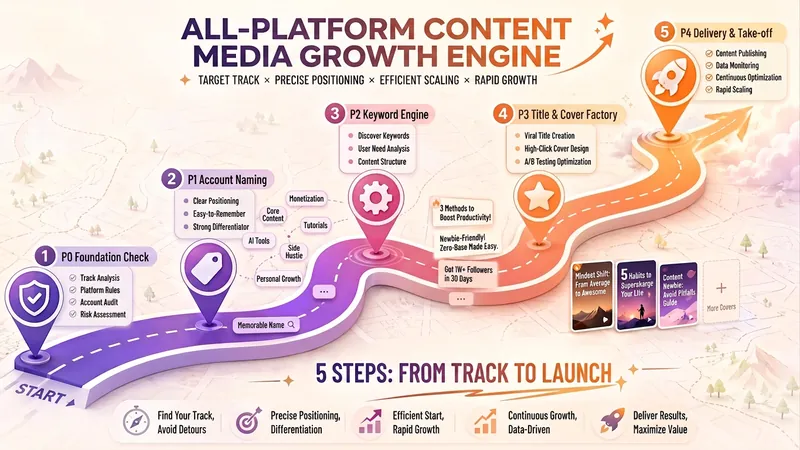
Account Launch Assistant v2.3
📝 Skill Overview In one sentence: input your niche and platform, get a complete account launch plan in 5 steps—account name, keywords, viral titles, covers, and posting calendar—no thinking required. 🎯 Core Capabilities · Niche Panorama Matching — covers 70+ niches across 7 major categories (money-making, wellness, fashion, workplace, etc.), with custom options · Keyword × Trend Engine — combines underlying desire words, current trends, and collective memory keywords to generate high-click title prototypes · Title Combination Factory — 6-element formula (identity/audience/time/method/endorsement/result) + platform word-count adaptation + good/bad comparison samples, producing 10+ titles at once · Cover Strategy + AI Mockups — 6 cover types with image prompt templates, plus an A/B testing schedule (stable values on weekdays, test new types on weekends) · Platform Knowledge Base — automatically adapts title length and cover specs for Douyin, Xiaohongshu, Bilibili, WeChat Official Account, WeChat Channels, and Kuaishou · Full Plan Delivery — cross-phase consistency check + 7-day posting calendar + launch checklist + review template 🛡️ Structural Upgrade (v2.3) · Global state register + quality control core + rollback — zero variable loss, no release without passing, rollback anytime · Three-core roles — main engine × platform adaptation expert × quality control officer · Compliance filtering — auto-rewrites medical efficacy/absolute claims/financial promises, reducing throttling risk · Global anti-hallucination — no fabricated search results, no invented trends, uncertain items flagged as 'pending verification' How to use? Just say 'niche + platform', e.g., 'wellness, Douyin' → the engine walks you through naming → keywords → titles → covers → plan delivery. For quick titles, say 'quick mode' and finish within 3 rounds; say 'try another batch', 'back to P2', or 'review' to adjust anytime. Trigger words: launch account / quick mode / title factory / try another batch / back to P{N} / review
Xiaohongshu Lazy Starter Tool
1. wb-xhs-monetization-backsolve Integration: Reverse engineering the monetization path, account positioning, and content direction for Xiaohongshu accounts. yanliudreamer's timing judgment, personal IP route, long-term expression ability, and 10-20 validation ideas. Visual Director's judgment that 'different trust paths require different visual trust cues'. Core change: Instead of just asking 'how to monetize', it also answers 'why now, why you, can you keep talking long-term, and what visual trust needs to be built'. 2. wb-xhs-low-follower-pattern Integration: Analysis of low-follower high-engagement samples on Xiaohongshu. yanliudreamer's click rate × dwell time × interaction rate, and five types of user underlying needs. dbskill's benchmark filtering, propagation reasons, and resonance mechanism judgment. Visual Director's cover composition, main visual, page rhythm, and mobile readability checks. Core change: Instead of just imitating sample forms, it judges which data link is effective and which content and visual mechanisms can be transferred. 3. wb-xhs-account-profile Integration: Xiaohongshu account profile and long-term memory. yanliudreamer's trust assets, personal IP story, persona consistency, and feedback from comments/DMs written back. dbskill's personal language samples, credible evidence, and AI style calibration. Visual Director's frame, color, font, components, and anti-patterns forming visual identity. Core change: Account profile evolves from a static style guide to a continuously updated 'trust business card + content and visual memory'. 4. wb-xhs-topic-bank Integration: Xiaohongshu topic matrix and title formulas. yanliudreamer's five user needs and three pre-posting questions. dbskill's title triggers, strict title checks, and traceable trigger reasons. Visual Director's cover hook, main visual direction, information density, and page count suggestions. Core change: Topics not only generate titles but also provide user needs, content promises, and a brief ready for visual production. 5. wb-xhs-humanize-compliance Integration: Xiaohongshu draft calibration and pre-publish checks. dbskill's hooks, single core mechanism, diagnose before rewrite, and 5-second opening. Visual Director's 6-8 page image-text structure, information hierarchy, and mobile readability. Core change: Removing AI feel isn't just about conversational tone; it makes content more human, easier to finish, and clearly divisible into image-text pages. 6. wb-xhs-schedule-review Integration: WorkBuddy's first 10 posts, 7-day, and 30-day scheduling and review cycle. yanliudreamer's system profile, 10-20 validation, and deepening after a hit. dbskill's status recording and conclusion writing back. Visual Director's master template, visual approval images, final images, and visual review nodes. Core change: Scheduling not only arranges posting times but also content and visual production; it saves visual constraints but does not replace visual routing or image delivery. 7. wb-xhs-visual-router Integration: Existing project outputs from topic selection, revision, and scheduling: titles, pages, and visual constraints. New additions: shared Visual Brief, fact boundaries, real runtime status, and QA recording conventions. Core change: Visual requests have a single entry point; it first fills in cover titles, evidence, and fact boundaries, then routes to the appropriate expert, without writing 'image tool not yet called' as delivered images. 8. wb-xhs-cover-anchor Integration: ponyodong2026/ponyo-cover-anchor-system's information density × visual anchor, conflict/number/screenshot/emotion four template types, old cover diagnosis, and completed cover prompts. Lifestyle cover variations: doodle outline fresh, sunlight film collage white outline, and 3:4 thumbnail readability rules. Xiaohongshu fact boundaries: numbers, screenshots, cases, and subjects only used when confirmed or authorized. Core change: Cover is not just a title skeleton but a publishable finished cover with quantifiable diagnosis; when evidence is missing, it still retains a credible title and composition, never drawing unverified data, cases, or results as facts. 9. wb-xhs-xiaohei-illustration Integration: helloianneo/ian-xiaohei-illustrations' Xiaohei character, 16:9 body illustrations, shot list, white background hand-drawn style, and grotesque cognitive metaphors. Pure white background, black thin lines, limited red-orange-blue annotations, and QA that 'Xiaohei must perform the core action'. Core change: Convert judgments, processes, states, and metaphors in articles into instantly readable cognitive illustrations; retain MIT source attribution, recreate each illustration's metaphor, and do not copy existing images or compositions. 10. wb-xhs-material-illustration Integration: op7418/guizang-material-illustration's materialized central explanatory images, chart semantic redrawing, reference-only facts, and outer card division of labor. Mechanisms, processes, cycles, hierarchies, comparisons, charts, and components extracted from central images: objects, arrows, badges, and explanatory parts. Core change: First let a wide central image explain relationships or data, then extract reusable components; when both 'material' and 'cover' are needed, first confirm the precise cover title, then complete both deliverables separately.
Private-Domain Content Engine
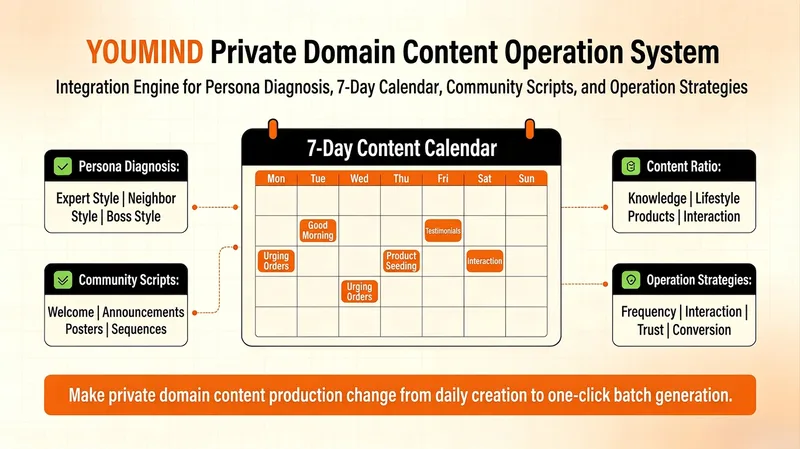
Built for private-domain operators, social commerce teams, brick-and-mortar owners, and insurance and real estate agents, this all-scenario private-domain content engine helps you produce content at scale. This Skill is not simply about "writing a few social posts." It is a complete private-domain content operations system with the following core capabilities: 🎯 Personal brand diagnosis: After receiving your industry and product information, it first analyzes your target customer profile and content strategy—what do your customers want to see in your social posts? Professional insights that build trust, authentic daily life that creates connection, or proof of capability that supports decisions? It then matches the ideal content mix to your personal brand type (expert, relatable neighbor, or business owner): experts focus on useful insights (60% insights + 20% lifestyle + 20% product), relatable voices focus on authentic sharing (40% lifestyle + 30% product discovery + 20% interaction + 10% product), and business owners focus on demonstrating results (40% results and testimonials + 30% team updates + 20% industry perspectives + 10% lifestyle). 📅 7-day content calendar: This is the Skill's core output—a complete plan with 3–5 social posts per day for 7 days, covering five major content types: Good morning/good night: Positive quotes and industry insights that build the feeling that customers see you every day Product discovery: Introduce a relatable situation or pain point, present the product solution, and highlight customer benefits for a natural, non-intrusive product mention Customer testimonials: Captions for customer review screenshots, before-and-after comparisons, and third-party endorsements that build social proof Conversion messages: Limited-time offers, scarcity, and calls to action that encourage hesitant customers to place an order Interactive topics: Questions, polls, and requests for submissions that encourage likes and comments and increase social visibility Each post includes the recommended publishing time (for example: good morning 7:30–8:30 / product discovery 12:00–13:00 / conversion 20:00–21:00) and suggested visual direction (original photo / screenshot / poster / text only), so you can publish it right away. 👥 Community operations scripts: Get a complete set of scripts covering the journey from creating a group to keeping it active—welcome messages that make newcomers feel valued and guide them to introduce themselves, group announcements with rules, value statements, and benefit previews, referral poster copy with a headline, subheadline, and call to action ready for a designer to format, and event sign-ups for group purchases, check-ins, and polls that energize the community. This helps turn a group from "created and immediately abandoned" into one with daily interaction. 📊 Operations strategy: You get more than copy—you also learn how to use it. This includes recommended social posting frequency to avoid irritating your audience, principles for balancing promotional and lifestyle content, engagement techniques for creating a second wave of sharing in the comments, and three elements of personal brand building—practical ways to put expertise, authenticity, and warmth into action. The goal is to help you move from being a "social seller who posts ads" to a "trusted personal brand." Whether you are new to social commerce, a team manager who needs standardized content output, or an experienced operator looking to improve social post conversions, this Skill can resolve the anxiety of not knowing what to post each week. It turns private-domain content production from "coming up with ideas every day" into "one-click batch generation."
Information
- Version
- v2
- Last updated
- Runtime credits
- Usage-based
- Models
- Auto
- Use cases
- Marketing & growthE-commerce & salesBusiness & strategy
- What you get
- ReportBriefPlan